
Restrictive outside activities clauses commonly appear in physician assistant (PA) employment and independent contractor agreements. These provisions govern whether and under what circumstances a PA may engage in work outside the primary employer relationship, including moonlighting, telehealth work, locum tenens, teaching, research, or ownership interests in ancillary businesses. Because such clauses intersect with compensation, licensure and supervision requirements, malpractice exposure, and long-term mobility, we treat them as material contract terms that warrant attorney-led review. In this text we explain how these clauses function, the typical variations you will encounter, and the concrete risks they can create for your income and professional freedom.
What Restrictive Outside Activities Clauses Are

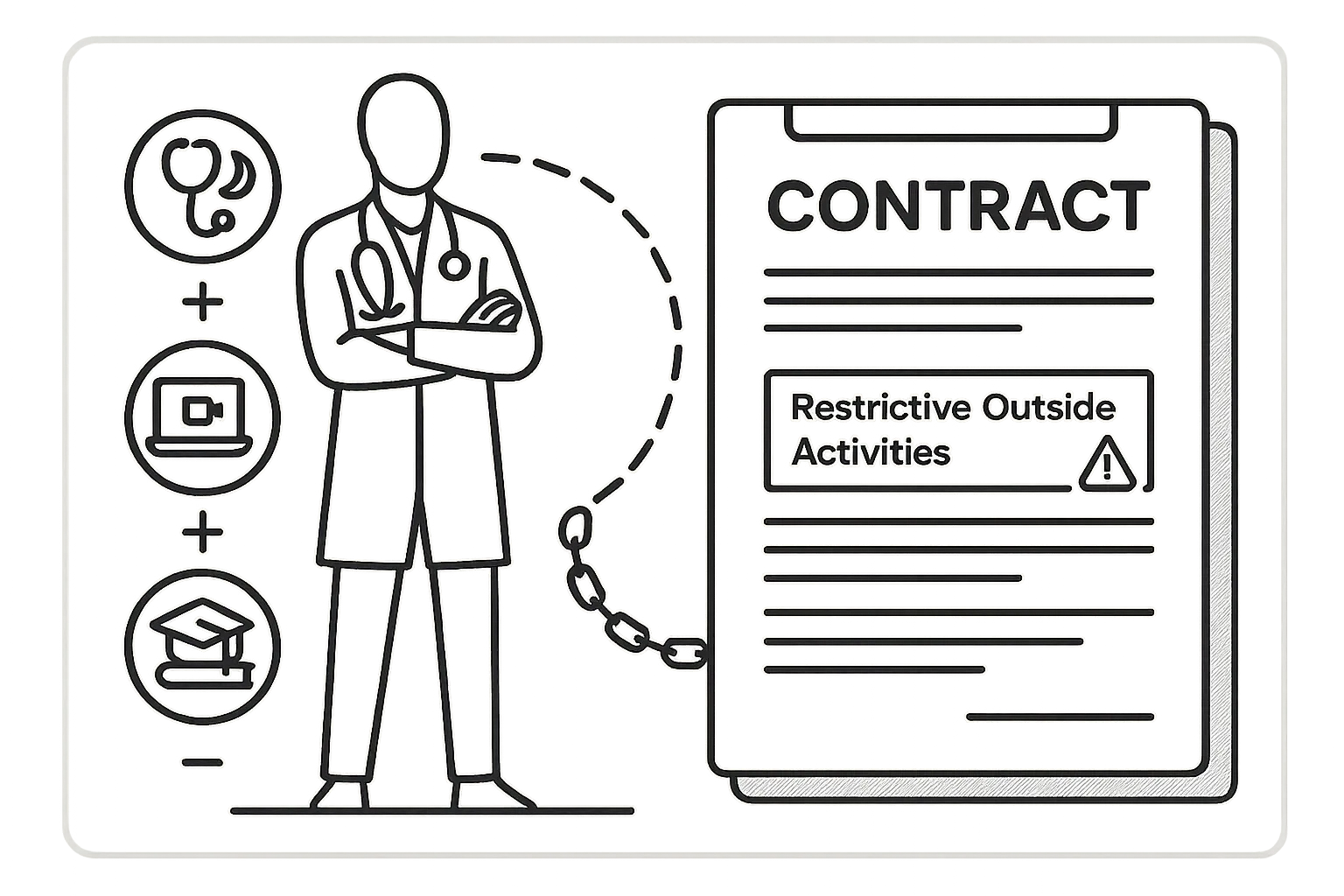
Restrictive outside activities clauses are contract terms that place limits, conditions, or reporting requirements on a PA’s engagement in work or business activities outside of the employing organization. The language can range from narrowly focused (for example, prohibiting clinical work within a defined geographic radius for competing groups) to broad and vague (for example, prohibiting any outside activity that “interferes with duties” or that is “in the employer’s discretion” undesirable).
Functionally, these clauses serve three employer objectives: protect clinical productivity and patient referrals, prevent conflicts of interest, and avoid regulatory or malpractice exposure. For the PA, the same provisions can affect take-home pay, opportunities for additional clinical hours (moonlighting or locums), academic work, entrepreneurial activity, telehealth engagements, and even volunteer or pro bono services if the clause lacks appropriate carve-outs.
We emphasize that these are not merely administrative. They are compensation and mobility terms that can trigger repayment obligations, termination events, or restrictive covenants that survive employment. As such, they should be reviewed as part of a comprehensive contract check focused on income protection, regulatory compliance, and long-term career flexibility.
Why These Clauses Matter To Physician Assistants


Outside activities provisions matter because they intersect directly with financial and professional risk.
- Income: For many PAs, moonlighting, locum work, telehealth shifts, or academic stipends supplement base pay or cover loan obligations. A clause that restricts or conditions outside work can materially reduce expected income streams.
- Malpractice and liability: Employers often frame restrictions in the name of insurance and supervision. But, ambiguous language can leave a PA exposed to gaps in malpractice coverage (for example, if the employer claims an outside activity created an uninsured exposure).
- Regulatory compliance and scope of practice: State supervision and delegation rules may require disclosure or approval of certain outside clinical activities. Contract terms that ignore regulatory realities can create conflicts with licensing boards.
- Career mobility: Broad prohibitions or post-termination application of outside activity rules can limit where and how a PA practices after leaving an employer.
Because employers frequently draft contracts to protect institutional interests, we approach restrictive outside activities clauses as foreseeable sources of one-sided risk. A line-by-line attorney review identifies where the clause affects compensation, creates repayment exposure, or conflicts with state law or professional obligations.
Common Elements And Variations In Outside Activities Clauses
Contracts group outside activities language into several recurring categories. Understanding the typical structure helps identify overbroad or vague drafting.
Scope And Definitions
Clauses may define “outside activities,” “moonlighting,” or “competing services” narrowly or expansively. Narrow definitions list clinical work types (locum tenens, telehealth) and business ownership. Broad definitions can encompass any employment, consulting, teaching, or volunteer activity. We watch for undefined key terms, those invite broad employer interpretation and later enforcement.
Permitted Versus Prohibited Activities
Some agreements list permitted activities (e.g., board service, academic appointments) subject to prior written approval. Others simply prohibit activities that compete with the employer or interfere with obligations. The presence or absence of express carve-outs for education, scholarly activity, or emergency work materially affects a PA’s options.
Notice, Approval, And Reporting Requirements
Typical clauses require written notice to the employer and sometimes prior approval. Approval standards vary from objective (no material conflict of interest) to subjective (employer’s sole discretion). Reporting requirements may be periodic or event-driven. We assess whether the approval process is reasonably fast and based on objective criteria, because prolonged or discretionary delays effectively function as a ban.
Conflict Of Interest, Moonlighting, And Competing Work
Employers commonly raise conflicts of interest as the basis for restrictions. Contracts often prohibit work for direct competitors, referral sources, or entities that create billing or compliance conflicts. We analyze whether the conflict definitions are tethered to real risks (billing, patient safety, supervision) or cast with broad brushes that capture unrelated activities.
Practical Risks And Career Impact For PAs
Outside activities clauses can produce measurable career and financial consequences. Below are common risk areas and how they manifest in practice.
Effects On Income And Moonlighting Opportunities
When an agreement restricts moonlighting or requires employer approval in discretionary terms, a PA may lose predictable supplemental income. Under RVU or productivity-based compensation models, lost outside shifts can also affect incentive thresholds tied to clinical volume. Collections-based or bonus formulas may be indirectly impacted when the employer interprets outside work as diminishing productivity or availability.
Licensure, Credentialing, And Scope-Of-Practice Risks
Failure to disclose or obtain required approvals can trigger credentialing issues with hospitals or health systems. If an outside activity involves practice across state lines or under a different supervising physician, it can create scope-of-practice conflicts and expose the PA to regulatory scrutiny. Some clauses mistakenly attempt to disclaim the employer’s responsibility for supervision: we identify these as regulatory red flags.
Reputational And Contractual Penalties
Penalties in these provisions range from corrective action to termination, repayment of sign-on bonuses, or clawback of incentives. Even where immediate termination is not at issue, allegations of unauthorized outside work can result in professional investigations, delayed credentialing, or damage to referral relationships that affect long-term earning potential.
How To Review, Negotiate, And Protect Yourself
Our approach to these clauses focuses on identifying vagueness, quantifying potential income effects, and ensuring objective processes govern approvals.
Read For Vagueness And Overbreadth
We scrutinize undefined terms (“competing,” “interfere,” “materially affect”) and clauses that grant approval rights on the employer’s “sole discretion.” Vague provisions are enforcement magnets: they should be clarified so obligations and prohibited activities are predictable.
Ask For Specific Carve-Outs And Clear Approval Processes
Practical carve-outs include explicit permission for academic appointments, board service, pro bono work, and moonlighting that does not create billing conflicts. Approval processes should require written responses within defined time frames and be governed by objective standards tied to supervision, patient safety, and credentialing concerns rather than business convenience.
Drafting Alternatives: Reasonable Limits And Objective Standards
Reasonable drafting uses narrow geographic or service-based limitations, ties prohibitions to demonstrable conflicts (e.g., billing or referral diversion), and limits post-termination application. Objective standards, for example, whether outside work will impair clinical availability or violate supervision rules, reduce the potential for arbitrary enforcement.
When To Seek Legal Review And What To Provide Your Attorney
Engage counsel before signing. Provide the full agreement, any prior employer policies referenced in the contract, information on intended outside activities (type, hours, locations), and relevant compensation structures (RVU targets, bonuses). We use these facts to model income impacts and to flag repayment triggers, supervision mismatches, and regulatory conflicts.
Red Flags And Contract Language To Avoid
Certain clause formulations consistently produce disputes or unintended consequences. We flag the following as problematic.
Broad Unrestricted Prohibitions On Any Outside Work
Language that prohibits “any other employment or business activity” without exception can capture innocuous activities, like part-time teaching or telehealth shifts, and should be narrowed or clarified.
Undefined Or Discretionary Approval Rights
Provisions granting approval “in the employer’s sole discretion” or requiring notice without timelines help arbitrary denials and practical de facto bans. Approval standards lacking objective metrics increase enforcement risk.
Punitive Remedies, Repayment, Or Immediate Termination Triggers
Clauses that authorize forfeiture of previously earned bonuses, immediate repayment of sign-on or relocation funds, or termination for undisclosed outside activities create disproportionate financial exposure. We treat these provisions as high priority because they directly threaten income and may be enforceable absent regulatory protections.
Enforcement, Remedies, And State Law Considerations
Enforcement of outside activities restrictions typically follows from internal reporting, credentialing flags, billing audits, or complaints from referral sources. Employers apply disciplinary processes, seek repayment, or invoke termination rights depending on contract terms.
How Employers Typically Enforce Outside Activities Restrictions
Common enforcement mechanisms include: internal investigations triggered by patient complaints or billing discrepancies: credentialing committee reviews: and formal notices of breach that may lead to corrective action. Hospitals and large systems may couple contractual remedies with administrative privileges suspension, which has immediate clinical and income consequences.
Potential Remedies And Consequences For PAs
Consequences can include written reprimands, repayment or clawback of bonuses, suspension of clinical privileges, termination for cause, and, in extreme cases, referral to licensing authorities if the outside work implicates malpractice or regulatory violations. Financial remedies are particularly consequential when tied to relocation, sign-on bonuses, or guaranteed salary recoupment clauses.
State Law Limits And Variations (Including Preemption And Public Policy)
State law affects enforceability: some jurisdictions limit the permissible scope of employment restrictions or interpret ambiguous provisions against the drafter. Supervision and delegation rules differ across states and can alter what contractual restrictions are reasonable or lawful. We avoid making universal legal conclusions in this text: instead, we recommend attorney review that integrates the applicable state law with the contract’s language and your factual circumstances.
Conclusion
Restrictive outside activities clauses are more than administrative provisions: they are contract terms that influence compensation, liability exposure, credentialing, and career mobility. Employer-drafted language frequently favors institutional interests and may be vague, overly broad, or tied to punitive financial remedies. For PAs at any career stage, from new graduates to experienced clinicians evaluating specialty moves or system transitions, an attorney-led review identifies income risk, regulatory conflicts, and mobility constraints before you sign.
At Chelle Law we focus on translating contractual language into practical career consequences. If you intend to engage in moonlighting, telehealth, academic work, locum tenens, or ancillary business activity, provide your agreement and the facts about the outside work during a review. Our objective is to protect your income, license, and long-term professional flexibility by clarifying risk and recommending specific, enforceable contract language modifications where appropriate.