
Moonlighting can give a nurse practitioner additional income, broader clinical experience, and greater scheduling flexibility. Outside work may include per-diem hospital shifts, urgent care coverage, telehealth services, locum tenens assignments, teaching, consulting, or a separate independent contractor role. Yet accepting a second position is not simply a scheduling decision. The arrangement must fit the NP’s primary employment agreement, professional obligations, and the requirements governing the outside practice.
Restrictions are not always labeled as moonlighting provisions. Exclusivity language, non-compete and non-solicitation clauses, call requirements, productivity standards, conflict-of-interest policies, and approval procedures can each limit outside work. Separate concerns include state licensure, prescribing authority, telehealth rules, facility privileges, payer enrollment, malpractice insurance, and responsibility for tail coverage. Written employer approval resolves only the contractual permission issue; it does not replace the regulatory, credentialing, billing, or insurance requirements applicable to the second role.
A careful review compares the primary agreement with the proposed moonlighting contract and identifies obligations that may conflict. Chelle Law evaluates how the documents allocate scheduling priority, compensation risk, restrictive-covenant exposure, professional liability, and termination consequences. Resolving those issues before the first outside shift can reduce the risk of a coverage gap, regulatory problem, compensation dispute, or allegation that the NP breached the primary contract.
Key Takeaways
- Outside-work restrictions may appear in exclusivity, non-compete, scheduling, conflict-of-interest, confidentiality, or approval provisions.
- Written employer approval does not replace state licensure, telehealth, prescribing, credentialing, payer enrollment, or malpractice requirements.
- Professional liability coverage must be confirmed for the specific entity, services, location, and period involved in the moonlighting role.
- Telehealth work requires particular attention to the patient’s location and the requirements of the jurisdiction where the patient receives care.
- Clear exceptions, objective approval standards, and consistent scheduling terms can make permission to moonlight more useful and predictable.
Begin With Both Contracts, Not Just the Outside Job

Moonlighting generally means compensated professional work performed outside an NP’s primary employment relationship. The second role may classify the NP as a W-2 employee, per-diem employee, or independent contractor. That classification affects tax withholding, benefits, expense responsibility, insurance, control over scheduling, and the terms governing termination. An NP evaluating a contractor opportunity can compare these consequences through Chelle Law’s discussion of W-2 and 1099 arrangements for nurse practitioners.
The primary contract and the outside agreement must be read together. One document may promise schedule flexibility while the other requires open availability, rotating call, or work at multiple locations. The moonlighting organization may also assign duties, billing responsibilities, or insurance obligations that the primary employer’s approval does not address. Reviewing only the clause labeled “outside activities” can therefore miss the provisions most likely to create a conflict.
Employee and Independent Contractor Roles Create Different Risks
A separate employment agreement may include its own benefits, handbook obligations, restrictive covenants, and disciplinary rules. An independent contractor agreement may instead place greater responsibility on the NP for taxes, licenses, business expenses, insurance, billing compliance, and replacement coverage. The title assigned to the relationship does not answer every classification question, and the agreement’s practical allocation of control and responsibility remains important.
Compensation also warrants close review. A per-shift rate can appear straightforward but may exclude chart completion, administrative work, meetings, call, or canceled sessions. Productivity-based compensation requires definitions for crediting services, collections, quality measures, payment timing, and reconciliation. These outside obligations may also affect whether the NP can satisfy productivity thresholds or availability requirements in the primary position.
How Employment Clauses Can Limit Moonlighting
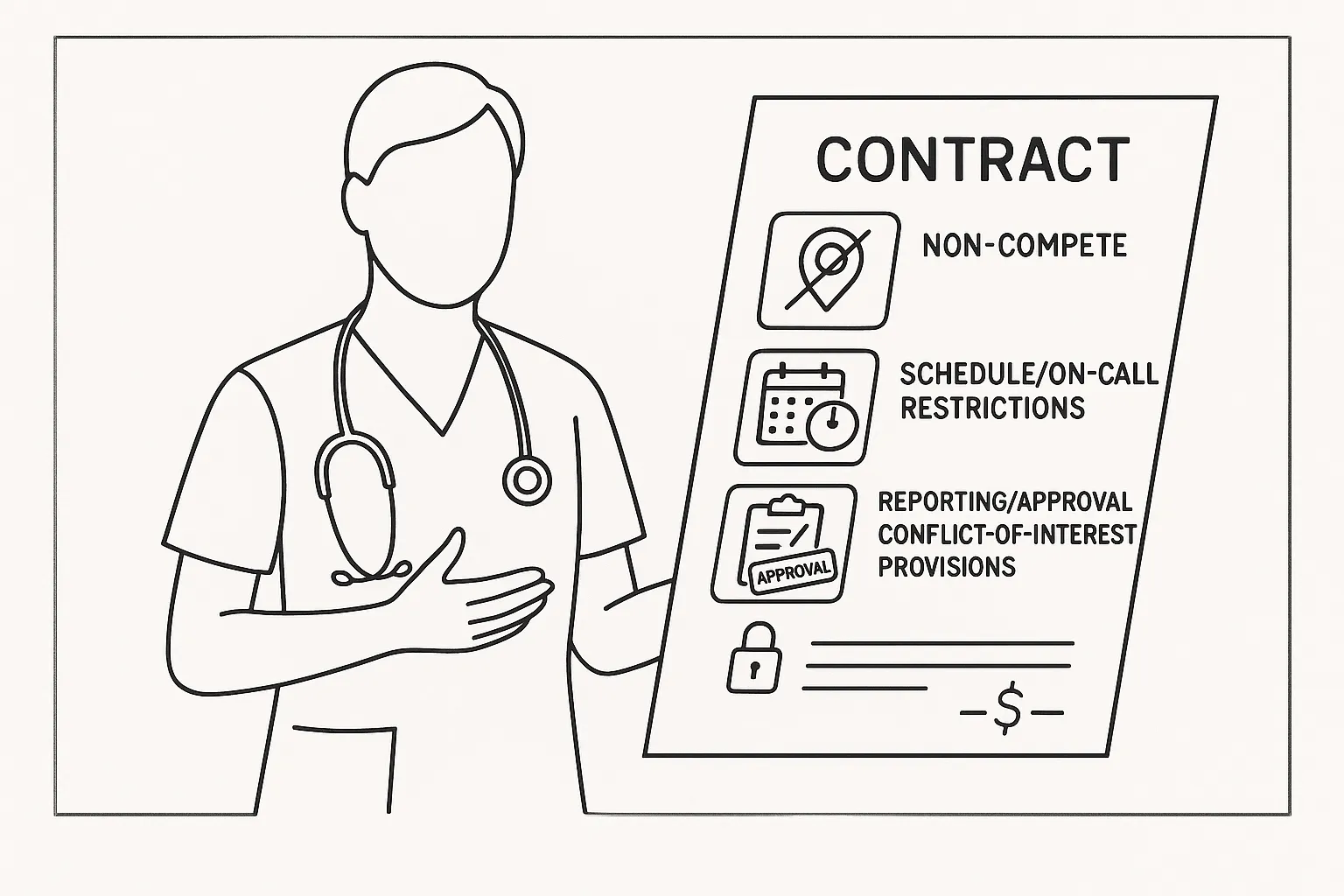
An agreement may prohibit outside clinical work directly or make it impractical through several overlapping provisions. The analysis requires more than locating a single clause. Definitions of competing activity, covered services, employer business, confidential information, patients, and geographic territory can determine whether a per-diem, telehealth, consulting, or locum tenens position falls within a restriction.
Exclusivity, Non-Competes, and Non-Solicitation Terms
An exclusivity provision may bar all professional work outside the primary job or permit only activities approved in advance. A non-compete may produce a similar result by restricting services for competing organizations, specified patient populations, or facilities within a defined area. Non-solicitation provisions can separately address patients, referral sources, employees, or contractors. A focused review of an NP non-compete can identify whether an exception is needed for a particular organization, service line, location, or virtual practice.
Non-compete enforceability remains jurisdiction-specific. The Federal Trade Commission’s 2024 Noncompete Rule is not currently in effect or enforceable following federal-court litigation, as reflected in the FTC’s current Noncompete Rule materials. Its status does not eliminate independently applicable state statutes, common-law standards, contractual defenses, or case-specific restrictions. An NP should not assume that federal action automatically invalidates a moonlighting restriction nationwide.
Scheduling Priority, Call, and Employer Approval
Schedule language can restrict outside work even when the contract contains no express prohibition. Obligations involving rotating call, weekend coverage, multiple sites, minimum shifts, schedule changes, or open availability may conflict with commitments to another organization. The risk increases when productivity bonuses, guaranteed compensation, or continued employment depend on satisfying those obligations. Chelle Law’s resource on NP call coverage requirements explains additional terms that may affect outside scheduling.
Disclosure and approval provisions deserve equal attention. Useful language identifies what must be disclosed, who decides, the permitted reasons for denial, and whether the employer must respond within a defined period. Approval should be documented for the specific organization, work type, location, and schedule. A general verbal assurance may not resolve a contract requiring written consent, while approval that can be withdrawn at any time may offer little practical security.
Licensure, Telehealth, Credentialing, and Billing
Employer consent is only one part of the analysis. Scope of practice, prescribing authority, supervision or collaboration, controlled-substance requirements, and permitted practice structures differ by state and setting. Some jurisdictions authorize broader independent NP practice, while others impose additional relationships or documentation requirements. The outside role must fit the NP’s authority in every jurisdiction where professional services are provided.
Patient Location Matters in Telehealth Practice
Telehealth moonlighting can create obligations beyond those associated with a single physical clinic. The state where the patient is located is generally a critical jurisdiction for licensure and practice requirements, including virtual and telephonic care. The National Council of State Boards of Nursing advises APRNs practicing across state borders to satisfy the requirements of the state where the patient is located. Its APRN practice guidance provides a useful regulatory starting point, although the specific state’s statutes, board rules, and prescribing requirements still control.
A telehealth contract may also address permitted patient locations, platform use, prescribing protocols, emergency procedures, medical-record access, privacy, documentation, and professional liability. A primary employer’s approval does not establish that the NP is licensed or authorized to treat patients in every state served by the telehealth company. Broader scope-of-practice provisions in an NP contract therefore remain relevant even when the work is performed remotely.
Facility Privileges and Payer Enrollment Are Separate Requirements
Hospitals and other facilities may require separate credentialing, delineation of privileges, background checks, administrative approval, and proof of insurance. Privileges are generally tied to the facility and services approved. Authorization from the primary employer does not replace the moonlighting organization’s credentialing process, and an existing set of privileges does not necessarily transfer to another site.
Payer enrollment must be evaluated separately from facility credentialing. For arrangements involving Medicare patients, questions may include the NP’s enrollment, National Provider Identifier, PECOS records, reassignment of benefits, billing entity, and reported practice locations. CMS guidance on telehealth and remote patient monitoring addresses enrollment and practice-location considerations for distant-site providers. The parties should clarify who completes enrollment, who submits claims, and whether the arrangement permits billing before services begin.
Malpractice Coverage and the Cost of a Contract Conflict
An NP should not assume that a primary employer’s professional liability policy extends to work for another entity. Coverage depends on the policy’s definition of an insured, covered professional services, named entities, locations, exclusions, endorsements, and reporting requirements. Written confirmation should identify the role and services covered, applicable limits, policy period, and any circumstances that could leave the NP personally responsible for defense or indemnity costs.
Policy type remains important but is not the only coverage issue. Occurrence coverage generally responds to a covered event occurring during the policy period, even if the claim is filed later. Claims-made coverage generally requires that the claim be made and reported while the policy or an applicable extended reporting endorsement is active. A malpractice and tail insurance review can clarify retroactive dates, prior-acts coverage, exclusions, and who must purchase tail coverage when the outside relationship ends.
A moonlighting dispute may also affect the primary job. Unapproved work, missed call, schedule conflicts, disclosure failures, or an alleged misuse of confidential information could trigger discipline or for-cause termination. The resulting exposure may extend beyond lost wages if the agreement contains signing-bonus repayment, relocation reimbursement, negative accrual, training-cost repayment, unpaid incentive compensation, or tail obligations. Reviewing termination and post-employment terms helps identify those consequences before a conflict develops.
Creating Workable Permission for Outside Practice
Permission to moonlight is more useful when the agreement defines its boundaries. A provision can identify permitted activities, exempt approved services or locations from restrictive covenants, and distinguish outside practice from prohibited competition. Depending on the NP’s plans, the language may address telehealth, urgent care, teaching, consulting, locum tenens work, volunteer care, or occasional per-diem shifts.
The approval process can specify the required information, decision-maker, response period, and objective grounds for denial. The documents can also clarify scheduling priority, use of employer resources, confidentiality, outside income, patient communications, and when renewed approval is required. Any written permission should remain consistent with the second agreement rather than authorizing work that the NP cannot perform without violating another contractual obligation.
Before beginning outside clinical work, an NP can assemble and verify the following records:
- The primary employment agreement, incorporated policies, and any written outside-work approval.
- The complete moonlighting employment or independent contractor agreement.
- Licensure, prescribing, supervision, collaboration, and practice-location documentation applicable to the services.
- Telehealth authorization for each jurisdiction where patients will be located.
- Facility credentialing, privileges, payer enrollment, NPI, PECOS, and reassignment records when applicable.
- Written malpractice confirmation addressing the insured entity, covered services, locations, limits, policy type, exclusions, retroactive date, and tail responsibility.
- Schedules and communications showing compliance with primary call, availability, and productivity obligations.
Potential warning signs include unrestricted employer discretion, vague conflict-of-interest standards, broad exclusivity language, inconsistent schedules, non-competes without a usable exception, uncovered services, unclear billing responsibility, and repayment provisions tied to termination or productivity. Contract review can identify which terms require clarification or revision before the NP commits to the outside role.
Frequently Asked Questions
Can an employer prohibit a nurse practitioner from moonlighting?
An employment agreement may prohibit or condition outside work through exclusivity, non-compete, scheduling, conflict-of-interest, or approval provisions. Whether a particular restriction applies or is enforceable depends on its wording, the surrounding agreement, and applicable state law.
Is written employer approval enough to begin an outside NP job?
No. Written approval can satisfy a contractual consent requirement, but it does not replace state licensure, prescribing, telehealth, supervision or collaboration, credentialing, payer enrollment, privacy, or malpractice requirements. Each obligation must be evaluated separately.
Does a primary employer’s malpractice policy cover moonlighting?
Not necessarily. Coverage depends on the policy’s insured parties, covered services, entities, locations, exclusions, endorsements, and reporting requirements. The NP should obtain written confirmation for the specific outside role and determine who is responsible for any required tail coverage.
Can a non-compete restrict per-diem or telehealth work?
It may. A broadly drafted restriction can define competition by geography, patient population, employer type, or clinical function. Telehealth, urgent care, locum tenens, and per-diem services may fall within that language unless the agreement contains a clear exception.
Which state’s rules apply when an NP moonlights through telehealth?
The patient’s location is generally a critical jurisdiction for licensure and practice requirements. The NP may need authorization in each state where patients receive care, along with compliance concerning scope, prescribing, supervision or collaboration, records, and telehealth practice.
Can moonlighting jeopardize compensation or continued employment?
Yes. Outside work may create risk if it conflicts with approval, scheduling, call, productivity, confidentiality, or restrictive-covenant obligations. Termination can also trigger repayment, negative accrual, unpaid bonus, relocation reimbursement, or tail insurance consequences.
Review Your NP Moonlighting Terms Before Accepting Outside Work
Chelle Law can analyze your primary agreement and proposed outside-work contract for approval requirements, schedule conflicts, restrictive covenants, malpractice obligations, compensation exposure, and termination risks.
Contact Chelle Law