

Renewing an associate veterinarian contract can feel routine, but subtle changes at renewal can materially affect your income, mobility, and professional liability exposure. We’ve reviewed hundreds of veterinary agreements and, more often than not, the renewal draft contains hidden shifts: tweaks to ProSal formulas, broadened restrictive covenants, surprise requirements for tail insurance, or automatic amendments that lock you into worse terms. In this guide we walk through the recurring renewal pitfalls we see, explain how they play out in practice, and provide practical steps you can use to protect your compensation, autonomy, and future career options. Where state law matters, we flag common variations so you know when a local rule could help or hurt your position.
Key Takeaways
- Veterinary contract renewal pitfalls often hide in compensation, restrictive covenants, malpractice, and termination clauses, so read renewal drafts line-by-line before signing.
- Require explicit pay mechanics—define ProSal/production formulas, billed vs. collected revenue, guarantee reconciliation timing, and cap negative accruals or chargebacks.
- Limit restrictive covenants at renewal by narrowing scope, geography, and duration (6–12 months preferred) and replace broad noncompetes with narrowly worded non-solicitation carve-outs.
- Demand clear malpractice coverage: insist on employer-paid tail or an occurrence policy, written confirmation of uninterrupted coverage during carrier changes, and coverage for prior acts.
- Remove or renegotiate automatic renewals and unilateral amendment language by requiring mutual written consent, shorter renewal windows, and advance notice of proposed changes.
- If renewal changes compensation, covenants, malpractice, ownership, or termination terms, engage counsel to spot hidden risks and negotiate objective KPIs, cure periods, and fair buy-in/valuation methods.
Compensation And Payment Risks On Renewal
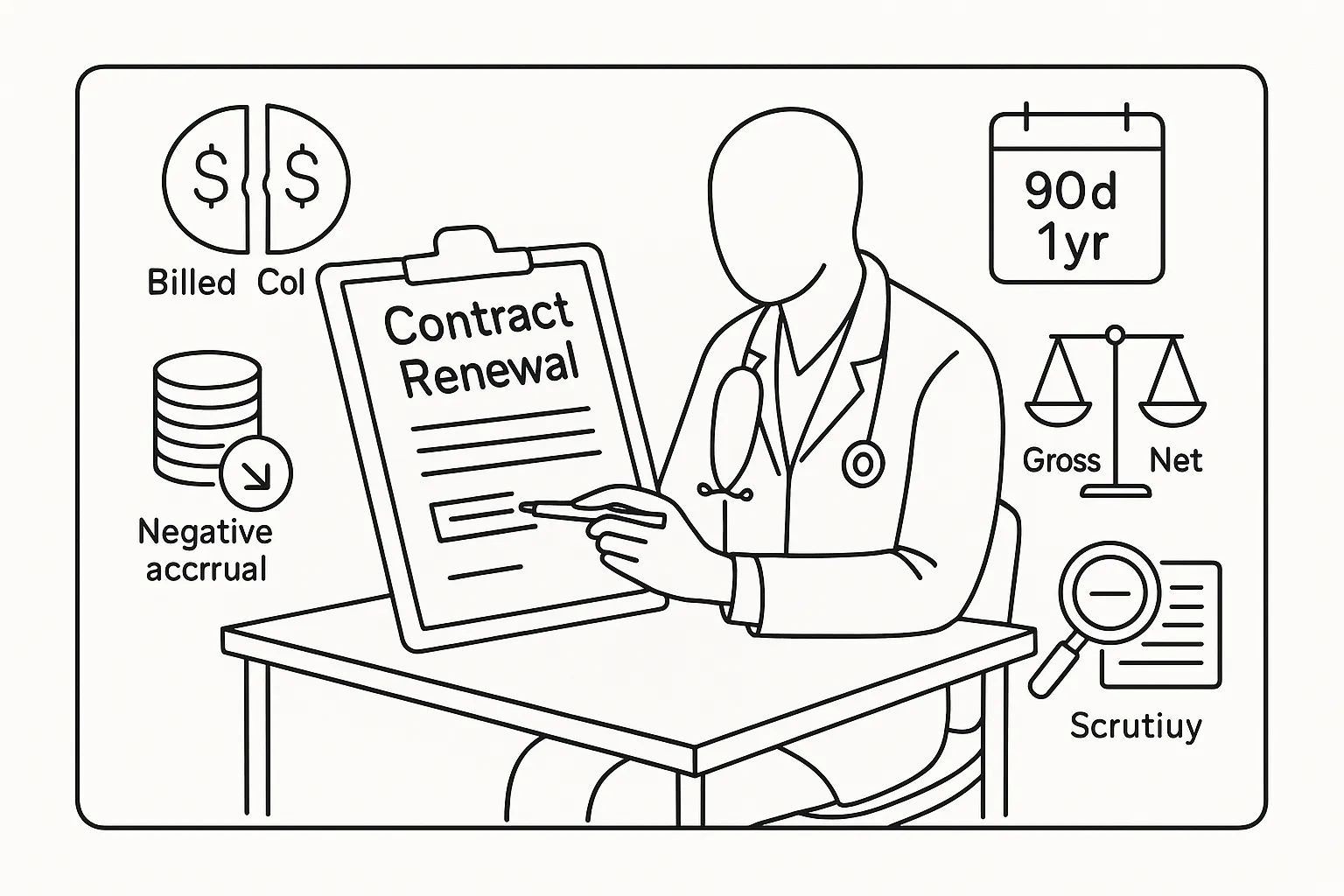
Compensation is the area where veterinarians lose real dollars at renewal. Employers may adjust base pay, change how production is calculated, or introduce clawback mechanics that aren’t obvious on a quick read.
Understanding Production, ProSal, And Collections Formulas
ProSal, production percentage, and collections-based pay are common in associate agreements. ProSal usually combines a guaranteed base salary plus a production percentage after a threshold. Production percentage means you receive a fixed share of billed or collected revenue: collections-based pay ties your compensation to actual payments received by the clinic. Key distinctions matter:
- Billed vs. collected: If the contract uses billed revenue but the clinic has slow collections, you may appear productive on paper without receiving cash. Collections-based pay is usually fairer but can delay payments.
- Gross revenue vs. net revenue: Net typically subtracts discounts, refunds, or third-party fees: verify what deductions are allowed.
- Thresholds and guarantees: Guaranteed draws that convert to production after a set period should specify reconciliation timing, true-up mechanics, and whether negative accrual applies.
State context: Some states with strong wage-and-hour enforcement (e.g., California) require clear disclosure of how pay is calculated and limit unilateral pay changes. In other states, employers have more freedom to redefine production metrics at renewal unless the contract expressly prohibits unilateral changes.
Negative Accrual, Chargebacks, And Timing Of Payments
Negative accrual (or chargebacks) lets an employer offset future production against prior shortfalls, for example, reducing your pay for patient refunds, returns, or unpaid balances attributed to your docket. These provisions can compound over time and create persistent underpayment. Watch for:
- Lookback periods: How far back can the clinic recover overpayments or apply chargebacks? Ninety days vs. one year makes a big difference.
- Materiality thresholds: Is every small refund charged back, or only amounts above a floor?
- Timing of payments: Monthly vs. biweekly reconciliations, and late-payment interest. Contracts should state when production is calculated and when you’ll receive commissions.
Practical note: At renewal, insist on explicit language limiting negative accrual to specific events, capping recovery amounts, and requiring notice and documentation before any deduction.
Changes To Base Salary, Bonuses, And Guaranteed Pay
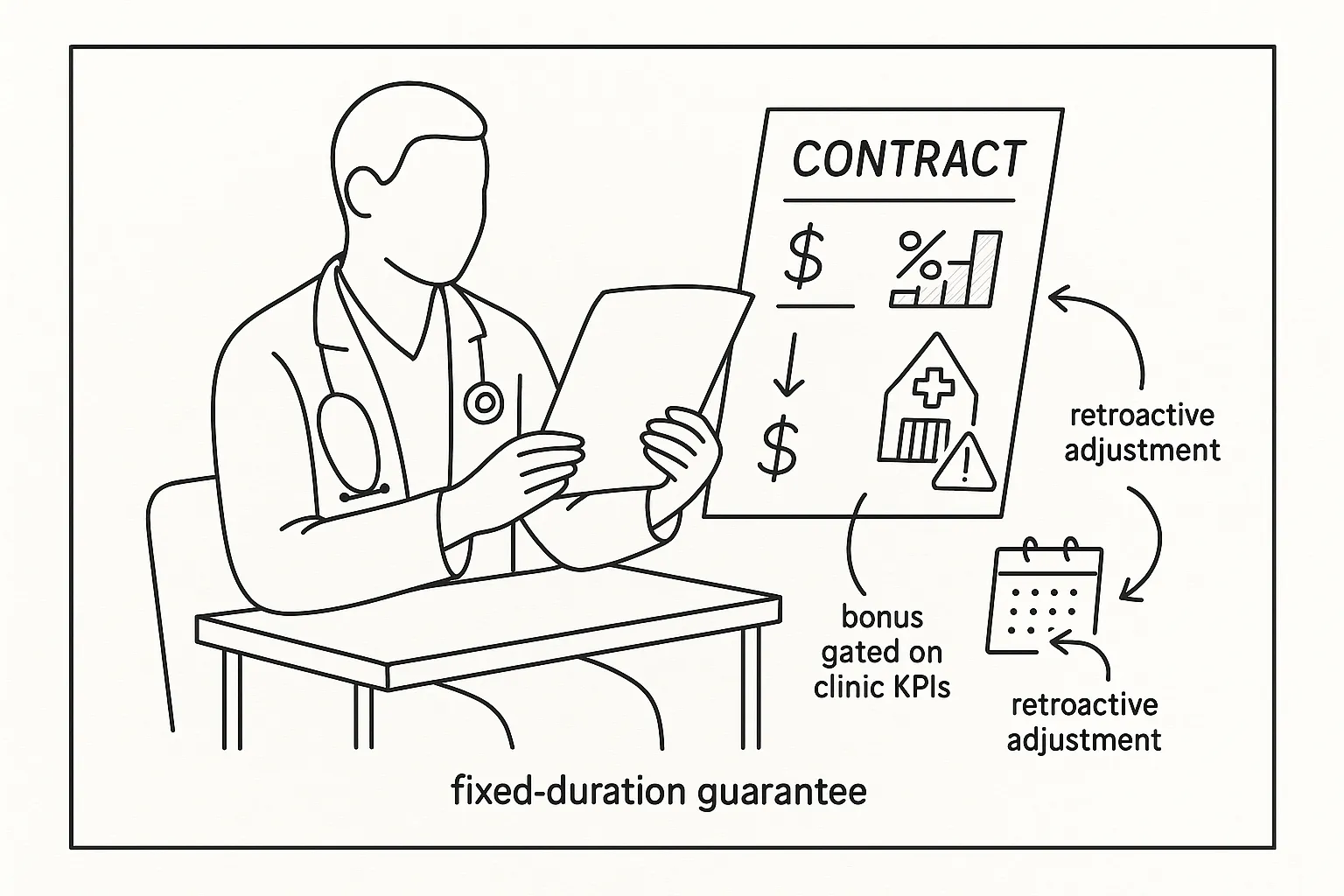
Employers often recast guaranteed pay at renewal, reducing guarantees, changing bonus formulas, or conditioning bonuses on metrics outside your control (e.g., clinic net income). Key risks:
- Reduced guarantees: A common tactic is replacing part of your base salary with a lower guaranteed draw plus a larger production split. That shifts risk to you.
- New bonus gating: Bonus eligibility tied to clinic-wide KPIs or subjective manager assessments can be unpredictable.
- Retroactive adjustments: Some renewal drafts include language allowing the employer to retroactively recalculate bonuses or base pay if they ‘‘discover” errors.
State context: Where labor law requires advance notice of pay changes, you may have statutory protections against mid-period reductions, but renewal terms generally govern going forward. Negotiation tactics we use include fixed-duration guarantees, clearly defined bonus KPIs, and caps on retroactive recalculation.
Restrictive Covenants And Post‑Employment Limits
Noncompete and restrictive covenant clauses are a top renewal danger: employers sometimes broaden geographic scope, extend duration, or add new prohibited services at renewal.
Scope, Geography, Duration, And Enforceability Considerations
Key variables in noncompete language are the prohibited activities, geographic radius, and duration. Enforceability differs widely by state. Examples:
- California: Noncompetes are generally unenforceable against employees, so renewal attempts to add a noncompete are usually ineffective, though other states may enforce them.
- Florida & Texas: States that can enforce noncompetes with reasonable scope and duration: employers frequently use multi-mile radii and 1–2 year durations.
- Massachusetts & North Dakota: Have heightened scrutiny and statutory limits on noncompetes for certain professionals.
At renewal, insist that any restrictive covenant be subject to a reasonableness test: narrow scope, short duration (6–12 months preferred), and clear geographic limits tied to actual client base.
Non‑Solicitation Versus Noncompete: Practical Impacts On Your Practice
Non-solicitation clauses (clients, employees) are generally easier to defend than noncompetes but can still restrict your ability to build a new practice. A non-solicit of staff for several years can prevent you from starting a clinic with people you trained. We recommend:
- Narrowly worded non-solicitation periods (6–12 months)
- Carve-outs for passive recruitment (e.g., responding to general ads)
- Clear definitions of ‘‘solicit” and ‘‘client”
State nuance: Some states treat overly broad non-solicits as de facto noncompetes and refuse to enforce them: others will blue-pencil reasonable portions. At renewal, remove or limit any expansion of solicitation prohibitions.
Malpractice Coverage, Tail Insurance, And Liability Gaps
Malpractice coverage is a renewal item we always scrutinize. Renewals can switch insurers, change policy types, or shift tail-payment responsibility to you.
Occurrence Vs. Claims‑Made Policies And Who Pays For Tail
Occurrence policies cover acts that occur during policy periods even if claims arise after termination: claims-made policies only cover claims reported while the policy is active. If your employer provides claims-made coverage, termination or non-renewal creates a potential gap unless tail coverage is purchased.
Common arrangements:
- Employer-provided occurrence policy (best for associates): employer typically shoulders long-term risk.
- Employer-provided claims-made policy with employer-paid tail: acceptable if the employer contractually commits to pay for tail upon termination without cause.
- Claims-made with associative responsibility for tail: risky. Tail insurance can cost 100–300% of an annual premium, depending on state claim exposure and specialty.
State nuance: Some states (or carrier practices) make tail underwriting expensive for emergency or specialty veterinarians. At renewal, demand explicit commitments about who pays for tail if the policy type changes.
Coverage During Notice Periods, After Termination, And For Renewals
Ensure the renewal specifies malpractice coverage during any notice period and for claims related to services you provided while employed. If the employer changes carriers on renewal, ask for written confirmation that coverage will be uninterrupted and that prior acts are covered under the new program or that employer will buy tail for prior claims.
Termination, Notice, And Severance Traps On Renewal
Renewals are a favorite time to tighten termination language: shorter notice periods, broader for‑cause definitions, and reduced severance. Watch for traps that convert at-will employment into effectively at-will with fewer protections.
Constructive Termination, For‑Cause Clauses, And Cure Periods
For-cause termination provisions often list vague conduct (‘‘professionalism,” ‘‘performance”) that can be used to avoid severance and deny unpaid compensation. Constructive termination, where working conditions are made intolerable, can be hard to prove. We push for:
- Clear definitions of for-cause grounds
- Reasonable cure periods for performance issues (30–90 days) with objective metrics
- Notice requirements tied to payment obligations
State context: Some states require certain notice for mass layoffs or have laws protecting earned but unpaid wages on termination. At renewal, avoid shortening notice or removing severance previously provided without clear compensation.
Automatic Renewals, Unilateral Amendments, And Renewal Deadlines
Automatic renewal clauses and unilateral amendment rights are common renewal red flags. They let the employer roll terms forward or change them at will.
What Automatic Renewal Language Means And How To Negotiate It
Automatic renewals usually specify an additional term (e.g., one year) unless you or the employer gives notice before a deadline. Risks include:
- Missed deadlines that lock you into another year under unfavorable terms
- Unilateral amendment clauses allowing the employer to change pay formulas or policies by notice alone
Negotiation strategies:
- Require mutual written agreement for material changes
- Shorten automatic renewal periods or remove auto-renewal entirely
- Add explicit advance notice windows (30–90 days) and require employer to provide any proposed amendments well before the deadline so you can seek counsel
Practical tip: Calendar your renewal deadline immediately upon signing and demand written confirmation of any proposed changes at least 60 days before the renewal.
Ownership, Buy‑In Pathways, And Exit Terms When Renewing
Renewal is often when ownership discussions arise, or when employers change buy-in economics. Pitfalls include new valuation methods, forced buy-ins, and earnout structures that transfer risk to the associate.
Valuation, Earnouts, Noncompete Buyouts, And Forced Buy‑Ins
Watch for:
- Valuation methods that favor employer (e.g., book value without market multiple)
- Earnouts that pay for goodwill over long, performance-based periods
- Forced buy-ins requiring immediate capital contributions on renewal
- Noncompete buyouts that are nominal or contingent on future performance
State differences: Some states require specific disclosures and fair process for forced buy-ins or partnership admissions. At renewal, insist on clear, objective valuation methods, written timelines for buy-in, and transparent accounting for earnouts and profit distributions.
Duties, Schedule Changes, Moonlighting, And Professional Autonomy
Renewal drafts often expand duties, require coverage at additional locations, or restrict moonlighting. These changes affect quality of life and earning potential.
Duty Scope, Required Continuing Education, And Employment Policies
Red flags to watch for:
- Multi-location assignment language without travel reimbursement or schedule guarantees
- Expanded on-call, emergency, or weekend requirements without adjusted compensation
- Tight moonlighting prohibitions that prevent relief work or locum shifts
- New mandatory CE or administrative tasks without time or reimbursement
Compensation tie-ins: If the employer increases clinical expectations, ensure proportional pay adjustments (higher base, greater production %, or on-call stipends). Regional cost-of-living affects typical pay: urban clinics may offer higher base salaries but stricter schedules, while rural practices often pay locum or shift differentials.
When To Seek Legal Review And Practical Negotiation Steps
Renewal is the moment to involve counsel. We recommend an attorney-led review for any renewal that changes compensation, restrictive covenants, malpractice terms, ownership pathways, or termination provisions.
Checklist For A Safe Renewal And Sample Negotiation Requests
Checklist before signing:
- Compare new compensation language line-by-line with prior agreement
- Confirm who pays for tail if malpractice coverage changes
- Verify scope/duration/geography of any restrictive covenant and ask for narrowing
- Require written, mutual consent for material amendments
- Demand objective metrics, cure periods, and caps on negative accruals
- Confirm on-call, multi-location assignments, and reimbursement provisions
Sample negotiation requests we use:
- “All material changes in compensation require mutual written consent: no unilateral adjustment permitted.”
- “Negative accrual limited to documented refunds related to our patient care and capped at X% per quarter.”
- “Employer will provide employer-paid tail coverage for claims arising from services performed during employment upon termination without cause.”
- “Noncompete removed: non-solicitation limited to 12 months and excludes passive recruitment.”
When state law is favorable (for example, in California where noncompetes are generally unenforceable), request explicit language reflecting that statutory protection: where law is less protective, negotiate contractual limits and buyout options.
Conclusion
Renewals often feel like administrative housekeeping, but small contractual edits can reshape your professional life. We approach renewals as negotiation opportunities: to clarify pay mechanics, preserve mobility, secure malpractice protection, and protect ownership pathways. If your renewal contains any change to compensation, restrictive covenants, malpractice terms, termination language, or ownership rights, have it reviewed by counsel experienced in veterinary contracts. At Chelle Law, Robert Chelle personally reviews veterinary renewals to identify hidden risks and propose concrete, practice-attuned revisions so you’re not trading short-term convenience for long-term harm.
Frequently Asked Questions — Veterinary Contract Renewal Pitfalls
What are the most common veterinary contract renewal pitfalls I should watch for?
Common renewal pitfalls include changes to ProSal or production formulas, expanded restrictive covenants (noncompetes/non-solicits), surprise tail‑insurance obligations, new negative accrual/chargeback rules, and unilateral amendment or automatic renewal clauses that lock you into worse terms.
How can changes to ProSal, production %, or collections-based pay affect my income at renewal?
At renewal employers may switch billed vs. collected revenue, alter thresholds or guarantees, or reduce base pay while raising production splits. These tweaks can delay cash, increase your earnings risk, and enable retroactive adjustments that reduce take‑home pay unless contract language limits unilateral changes.
What should I do about tail coverage and malpractice changes during a renewal?
Insist the renewal specifies policy type (occurrence vs. claims‑made), who pays for tail upon termination, and that coverage continues during notice periods. Demand employer-paid tail or explicit written commitment if coverage shifts to claims‑made to avoid costly gaps and unexpected tail expenses.
Are expanded noncompete or non‑solicitation clauses common at renewal, and how can I protect my mobility?
Yes—employers frequently broaden scope, geography, or duration. Protect mobility by narrowing scope, limiting duration to 6–12 months, defining ‘‘client’’/‘‘solicit,’’ adding carve‑outs for passive recruitment, and tying restrictions to actual client bases rather than broad radii.
Can an automatic renewal clause lock me into worse terms, and how do I negotiate it?
Automatic renewal clauses can renew unfavorable terms if you miss a notice deadline. Negotiate for mutual written consent for material changes, shorter renewal terms or removal of auto‑renewal, and require the employer to provide proposed amendments 60+ days before the deadline so you can seek counsel.
When should I get an attorney review for a veterinary contract renewal?
Seek attorney review for any renewal that changes compensation, restrictive covenants, malpractice/tail obligations, ownership or termination terms. An attorney experienced in veterinary contracts—like Chelle Law—performs a line‑by‑line, practice‑attuned review to protect income, mobility, and liability.