

Production-based compensation can reward a veterinarian for strong performance, but the formula must be clear enough to verify. ProSal, straight production, percentage-of-collections, and salary-plus-bonus models may produce very different results depending on how the agreement defines revenue, assigns services, handles discounts, and reconciles payments. A promising percentage can therefore deliver less income than expected when the underlying terms are vague.
Veterinarians should pay particular attention to negative accrual, retroactive chargebacks, delayed reconciliation, hidden thresholds, final-pay deductions, and the employer’s ability to change a compensation formula. Restrictive covenants, malpractice coverage, termination provisions, and ownership promises can also affect the overall financial value of an offer. These issues matter whether the veterinarian is joining a private practice, corporate group, mobile service, emergency hospital, or relief practice.
Chelle Law reviews veterinary associate agreements to identify compensation terms that could reduce or delay earnings. That review includes the production formula, reporting rights, sample calculations, post-termination payments, restrictive covenants, malpractice obligations, and related provisions affecting career mobility. This guide explains the most common production-pay pitfalls and the practical protections veterinarians can request before signing.
Key Takeaways
- Vague percentage-of-collections language is a major production-pay risk. The agreement should define collections and include worked examples before the veterinarian signs.
- Negative accrual and chargeback provisions should address applicable lookback periods, repayment limits, and whether deductions can affect base compensation or only future production payments.
- Monthly production reports, access to relevant billing data, and meaningful audit rights help veterinarians verify calculations and resolve discrepancies.
- The agreement should explain final-pay timing, post-termination collections, malpractice coverage, and responsibility for any required tail insurance.
- Compensation terms should be reviewed together with termination provisions, restrictive covenants, benefits, and ownership language rather than evaluated as an isolated percentage.
How Production Pay Works in Veterinary Employment Agreements
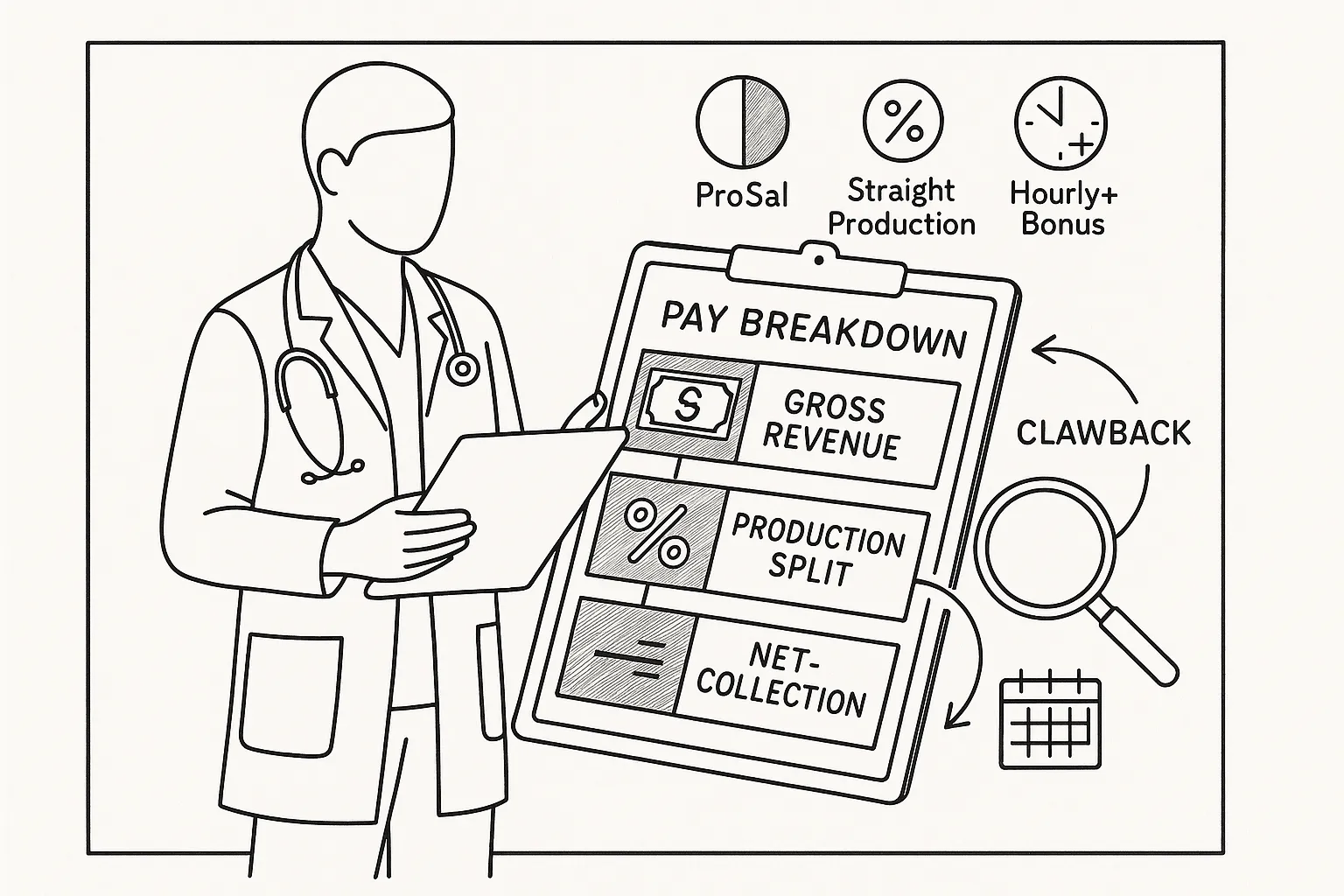
Production Models and Essential Compensation Terms
Veterinary employers use several common production models. ProSal generally combines a guaranteed salary with a percentage of production above a stated target. Straight production bases compensation entirely on a percentage of revenue or collections, while salary or hourly models may add periodic bonuses tied to individual or practice performance. Some employers also use flat daily or shift rates with incentives for after-hours work, overtime, or production above a threshold.
The best model depends on practice stability, appointment volume, fee schedules, staffing, case mix, and the veterinarian’s tolerance for variable income. Veterinarians evaluating a hybrid formula can review a more detailed explanation of how ProSal compensation works. Whatever model is offered, the written agreement should identify the applicable percentage, base or draw, production target, measurement period, payment date, and reconciliation method.
- ProSal: A hybrid model combining guaranteed compensation with a percentage of production above a target.
- Production or collections-based pay: Compensation calculated from what the veterinarian bills, produces, or the practice actually collects.
- Negative accrual: A negative balance that may carry forward when production does not meet a target or prior calculations are adjusted.
- Chargeback: A deduction associated with a refund, discount, write-off, returned payment, or other adjustment.
- Reconciliation: The process through which the employer compares guaranteed compensation with earned production pay and calculates an additional payment or balance.
Employers sometimes rename these concepts or use them inconsistently. A personal glossary that maps the agreement’s terminology to the actual calculation can make the compensation provisions easier to evaluate and compare with another offer.
Collections, Adjustments, and Chargeback Calculations
Many production disputes begin with an undefined use of the word “collections.” A formula may be based on gross charges, adjusted production, net collections, or cash received after discounts and write-offs. The agreement should also identify which veterinarian receives credit when several doctors participate in a case and whether laboratory charges, medications, technician services, boarding, or other revenue categories are excluded.
- Gross revenue versus net collections: Determine whether the percentage applies to billed charges or only money the practice receives after write-offs, discounts, refunds, and payment processing adjustments.
- Timing: Confirm whether the employer counts revenue in the month of service, the month of client payment, or the month in which cash posts to the practice management system.
- Attribution: Identify how revenue is assigned when another veterinarian performs a follow-up, a technician provides part of the service, or a patient is treated at multiple locations.
- Adjustments: Establish how client refunds, discounts, uncollected invoices, returned products, and later write-offs affect previously reported production.
Worked examples should show the formula at several realistic production levels and explain the effect of refunds, discounts, shared cases, and delayed payments. If the employer cannot provide a calculation that can be reproduced from its own billing records, the veterinarian may have difficulty verifying future compensation.
Common Veterinarian Production Pay Pitfalls
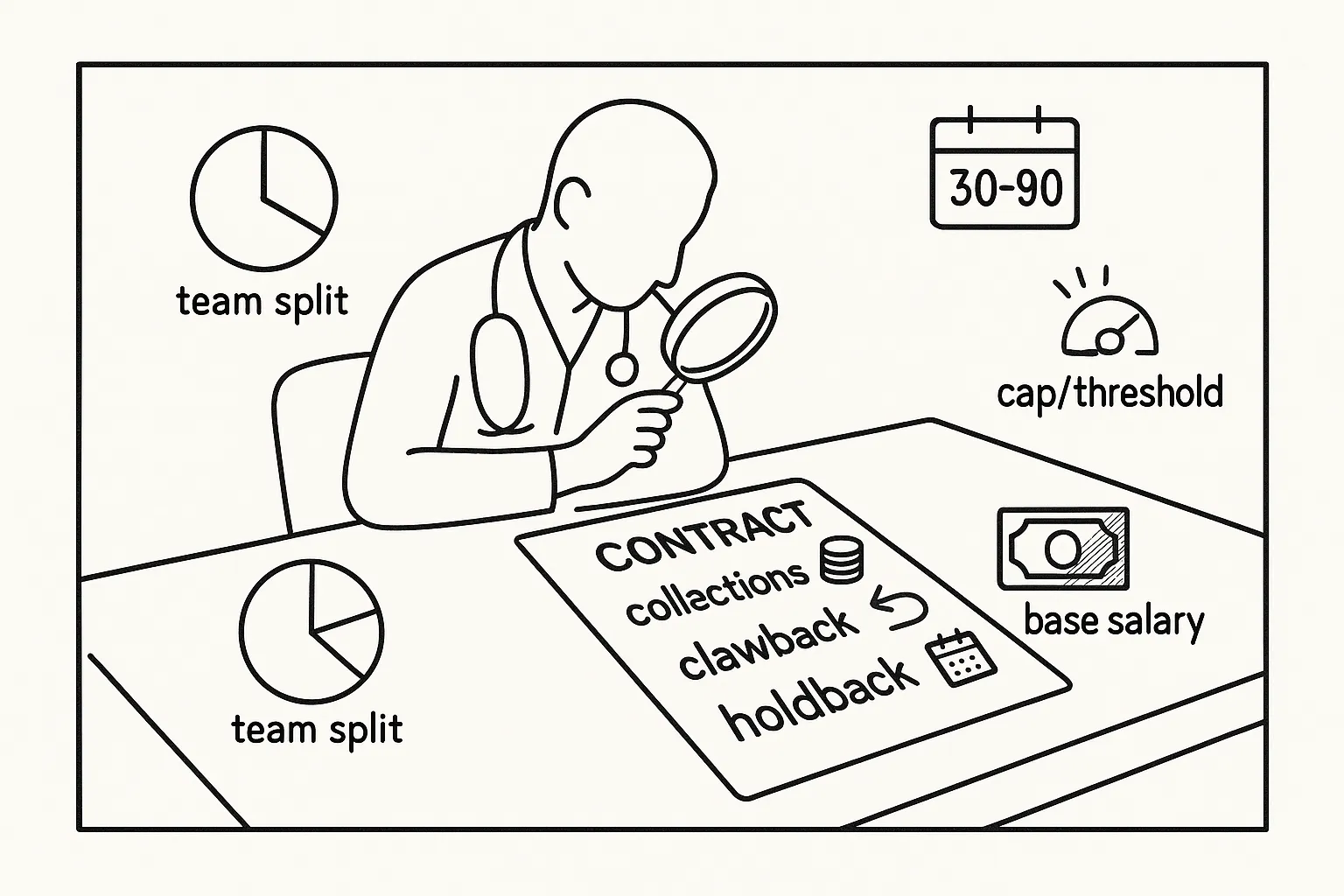
Negative Accrual, Delayed Reconciliation, and Retroactive Deductions
Negative accrual provisions can allow an unfavorable balance to carry into a later month or quarter, reducing future bonuses even after production improves. The contract should explain whether a deficit carries forward, when it resets, and whether the veterinarian could owe money back. Veterinarians should carefully examine the mechanics of negative accrual in production compensation rather than assuming a guaranteed salary is insulated from later reconciliation.
Chargebacks create a related risk when the employer revises prior calculations after a client refund, discount, write-off, or collection problem. An open-ended clause may permit adjustments long after the veterinarian received the original bonus. Negotiation points can include a defined lookback period, limits on the types of adjustments that qualify, a cap on deductions, and language addressing whether a chargeback may reduce base wages or only future production compensation.
Long reconciliation cycles and discretionary holdbacks also make earnings less predictable. Quarterly or annual calculations may delay compensation and make errors harder to identify. Monthly statements and a specific payment deadline generally provide better visibility into how the formula is operating.
Hidden Thresholds, Caps, and Revenue Allocation Rules
A seemingly competitive production percentage may be offset by a high threshold, an undisclosed cap, or exclusions from credited revenue. Some agreements allocate a portion of production to a team pool, divide revenue among multiple doctors, or exclude services performed with technician support. Others permit the employer to modify fee schedules, discounts, staffing, or appointment availability without adjusting the veterinarian’s target.
A base salary can also make an offer appear stronger than it is when the production target is difficult to reach. Veterinarians should model total compensation using realistic appointment volumes, average transaction values, time off, seasonal fluctuations, staffing limitations, and the practice’s actual collection experience. The analysis should show expected compensation in an average period, not only an ideal high-volume month.
Team-based arrangements require additional questions. The agreement should identify how multi-doctor cases, referrals within the practice, emergency transfers, hospitalized patients, support-staff services, and work at multiple locations are credited. Without objective allocation rules, the employer may control both the inputs and the final compensation calculation.
Contract Clauses That Can Reduce Production Compensation
Production pay cannot be evaluated separately from the rest of the veterinary employment agreement. Termination language determines whether the veterinarian receives compensation from services performed before departure but collected afterward. It should address the final reconciliation date, payment deadline, access to supporting reports, and any post-termination deductions. A focused review of veterinary termination terms can identify notice requirements and payment provisions that otherwise undermine an attractive compensation formula.
Restrictive covenants can affect future earnings after employment ends. A broad noncompete may restrict where the veterinarian can work, while a nonsolicitation clause may limit communications with clients or staff. The geographic scope, duration, covered activities, and applicable state law should be assessed through a veterinary noncompete review rather than treated as standard language.
Malpractice provisions also carry financial consequences. The agreement should identify whether the employer provides occurrence or claims-made coverage, the policy limits, and the parties’ responsibilities when employment ends. If tail coverage may be required, the contract should explain who purchases it and whether the reason for termination changes that obligation. Chelle Law’s malpractice and tail insurance review focuses on these cost-allocation terms.
Benefits, paid time off, continuing education, licensing costs, dues, relocation assistance, and signing bonuses should be included when comparing total compensation. A high production percentage may not offset weak benefits or substantial repayment obligations. The agreement should also explain whether paid leave lowers the production target or merely reduces the veterinarian’s opportunity to earn a bonus.
Verbal promises of partnership or ownership should not substitute for objective written terms. A meaningful pathway should address timing, eligibility, valuation, payment structure, governance rights, and exit obligations. Vague references to a future buy-in provide little protection if the parties later disagree about price or availability.
State Law and Worker Classification Considerations
State law can affect restrictive covenants, wage deductions, commission agreements, recordkeeping, and final-pay timing. Noncompete rules vary significantly: some jurisdictions broadly restrict their use, while others evaluate duration, geography, protected interests, and the employee’s circumstances. Because these rules change, veterinarians should not assume that language used by a multistate employer is enforceable or appropriate in every location.
Wage and commission laws may also determine when production compensation is considered earned, what deductions are permitted, and what records the employer must maintain. A contract that allows post-termination chargebacks or discretionary adjustments should be evaluated against the law governing the employment relationship. The analysis may differ depending on whether the formula is treated as wages, a commission, a discretionary bonus, or another form of incentive compensation.
Worker classification introduces another layer of risk. Some practices engage relief or associate veterinarians as independent contractors even when the practice controls schedules, locations, fees, clinical operations, and working methods. Classification depends on the governing legal test and the actual relationship, not only the agreement’s label. Veterinarians comparing these arrangements can review the practical distinctions between W-2 and 1099 veterinary work.
Negotiating Clearer Production Pay Protections
A stronger production provision begins with a formula that an independent reader can reproduce. The contract should define production or collections, identify included and excluded revenue, establish the applicable percentage and threshold, and explain attribution for shared cases. Worked examples should cover ordinary production, discounts, client refunds, delayed payments, and adjustments.
- Request monthly production statements showing credited revenue, exclusions, discounts, refunds, chargebacks, thresholds, and the resulting compensation.
- Seek access to the relevant practice-management or billing reports and a process for disputing discrepancies.
- Define the reconciliation period and require payment within a stated time after the period closes.
- Address whether negative balances carry forward and whether the employer can recover an alleged overpayment from base wages.
- Limit unilateral amendments to the compensation formula, fee schedule, production target, and revenue-allocation method.
- Specify how paid leave, continuing education, staffing shortages, location assignments, and schedule changes affect production expectations.
Audit rights are especially important when the employer controls all underlying data. The agreement can require the practice to retain supporting records, provide read-only reports, and investigate discrepancies within a defined period. If an audit reveals a material error, the contract should provide a practical correction and payment process.
Red flags include undefined terms, inconsistent formulas, unilateral amendment rights, lengthy reconciliation cycles, broad discretion over revenue attribution, silence on final collections, and unclear tail obligations. Mandatory arbitration, repayment clauses, and ownership promises also deserve careful review because they can affect the veterinarian’s ability to challenge compensation or leave the practice.
When an Attorney Should Review the Agreement
Legal review is most useful before the veterinarian signs the offer or employment agreement. An attorney can compare the offer letter with the final contract, test the compensation formula, identify terms that permit later changes, and evaluate the interaction among production pay, termination, restrictive covenants, malpractice insurance, repayment obligations, and ownership language.
- The exact compensation formula, production target, timing, and sample calculations.
- Definitions of collections, production, adjustments, chargebacks, and negative accrual.
- Noncompete and nonsolicitation provisions under the applicable state law.
- Termination notice, final-pay timing, post-termination collections, and deductions.
- Occurrence or claims-made malpractice coverage and any tail obligation.
- Signing bonuses, relocation assistance, repayment clauses, and benefit costs.
- Buy-in or partnership language, valuation procedures, and exit terms.
An attorney-led review can produce a practical explanation of problematic provisions, proposed revisions, and negotiation points. If the employer responds with a revised agreement, the new language should be checked against the original concerns. Targeted edits often improve compensation predictability without requiring the parties to renegotiate every provision.
Frequently Asked Questions
What are the most common veterinarian production pay pitfalls?
Common pitfalls include vague collections definitions, negative accrual, retroactive chargebacks, delayed reconciliation, hidden thresholds, revenue exclusions, and unclear final-pay terms. Restrictive covenants, malpractice obligations, and repayment clauses can further reduce the overall value of the compensation package.
How should collections be defined in a veterinary employment contract?
The agreement should state whether collections means gross charges, adjusted production, or cash actually received. It should also explain timing, excluded revenue, discounts, refunds, write-offs, shared cases, and how services are attributed to the veterinarian.
Can a veterinary employer carry negative accrual into a later pay period?
The answer depends on the contract and applicable law. The agreement should clearly state whether a negative balance carries forward, when it resets, how adjustments are calculated, and whether the employer may deduct an alleged overpayment from base compensation or final pay.
What happens to production collected after a veterinarian leaves the practice?
The contract should specify whether the veterinarian receives credit for services performed before departure but collected afterward. It should also establish a final reconciliation date, payment deadline, reporting obligation, and any permitted post-termination adjustments.
How do state laws affect veterinarian production pay provisions?
State laws may govern when compensation is earned, final-pay timing, payroll deductions, written commission terms, recordkeeping, worker classification, and restrictive covenants. The contract should be evaluated under the law applicable to the veterinarian’s actual work location and relationship.
What records should a veterinarian receive to verify production compensation?
A veterinarian should request regular statements showing credited revenue, excluded items, discounts, refunds, chargebacks, thresholds, and the final calculation. Access to relevant billing reports, record-retention requirements, and a defined process for disputing discrepancies provide additional protection.
Review Your Veterinary Production Pay Terms Before Signing
Chelle Law reviews ProSal, collections-based compensation, negative accrual, final-pay provisions, and the related contract terms that can affect your earnings and career mobility.
Contact Chelle LawExplore Veterinary Contract Guidance
Review legal services, practical resources, and state-specific information for veterinary employment agreements.