
An employer may ask a nurse practitioner to sign a contract amendment after compensation, scheduling, clinical duties, supervision, or work locations change. A written amendment can accurately document a legitimate change, but it can also shift financial, regulatory, and professional risk without replacing the entire employment agreement. The practical effect depends on the amendment’s wording, its effective date, and the provisions of the original contract that remain in force.
The most consequential amendments often involve productivity formulas, telehealth services, additional facilities, call coverage, malpractice insurance, restrictive covenants, or repayment obligations. Even a document presented as a routine administrative update may change how compensation is earned, who pays certain expenses, what happens when employment ends, or where the NP may practice afterward. Retroactive language can create additional concerns if it affects compensation or obligations arising before the amendment is signed.
A careful review compares the proposed amendment with the complete existing agreement rather than analyzing the new document in isolation. Chelle Law evaluates the revised language, unchanged provisions, definitions, cross-references, and incorporated policies to identify financial consequences, compliance concerns, and terms that may warrant clarification or revision before the NP signs.
Key Takeaways
- Put material changes to compensation, duties, scheduling, location, telehealth, or supervision in a complete written amendment rather than relying on verbal assurances.
- Compare the amendment with the entire existing contract because unchanged provisions may produce unexpected consequences when read with the new terms.
- Require precise compensation definitions, payment timing, reconciliation rules, and sample calculations for productivity-based arrangements.
- Clarify licensing, billing, credentialing, supervision, malpractice coverage, and expense responsibility when duties or locations expand.
- Review the effective date, repayment terms, restrictive covenants, and termination provisions before accepting the amendment.
Why an Amendment Requires a Whole-Contract Review
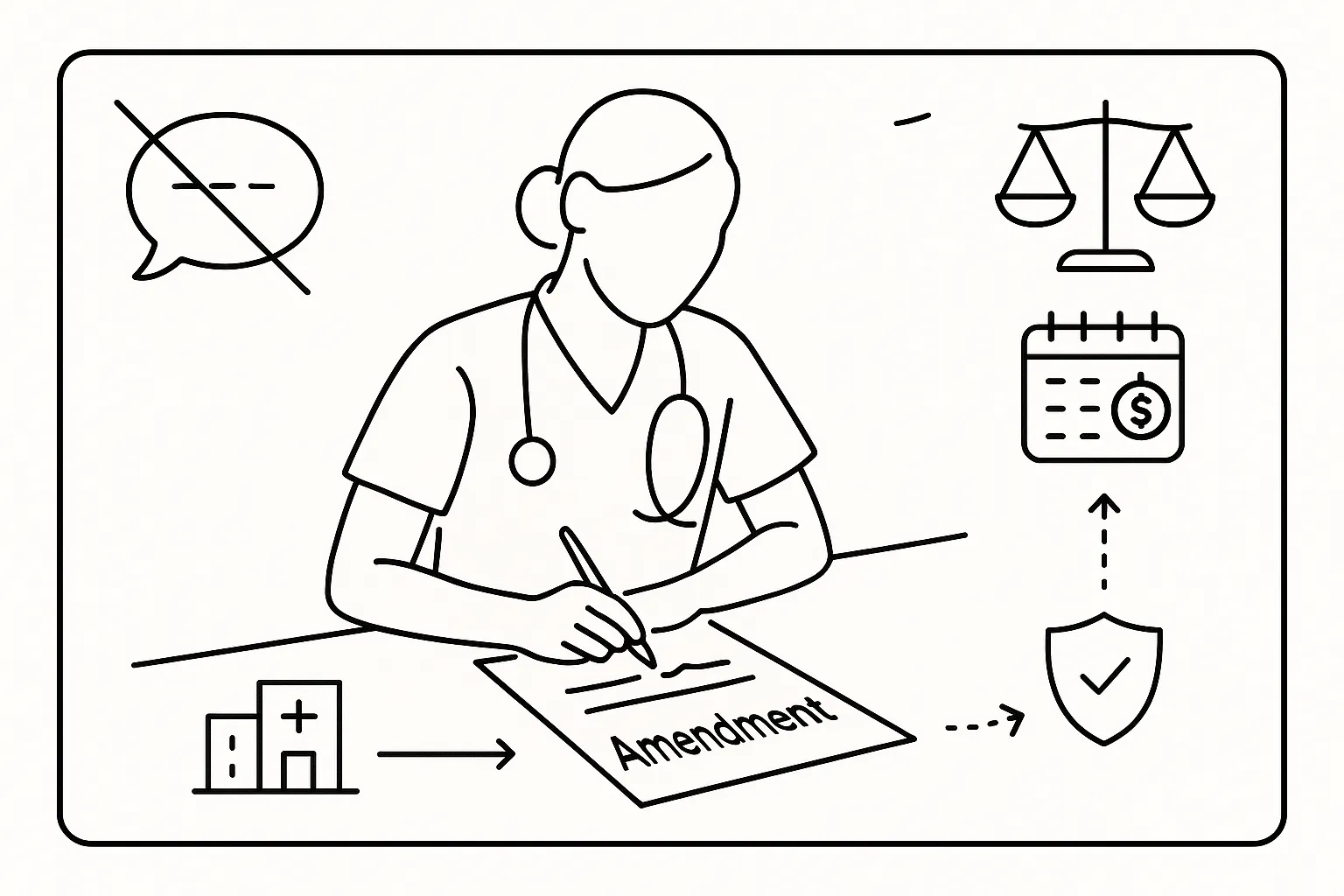
A written amendment is generally appropriate when the parties intend to make a material, continuing change to their rights or obligations. Common triggers include a promotion, a revised compensation model, expanded clinical responsibilities, new call requirements, added telehealth services, assignments at additional facilities, or a different supervision or collaboration structure. The document can establish what changes, when the revision takes effect, and which provisions remain unchanged.
The amendment’s scope matters as much as its headline term. Language modifying “compensation,” for example, may implicate definitions of collections, earned bonuses, repayment, termination, and post-employment payment. A new location may affect travel, credentialing, malpractice coverage, productivity credit, and a geographic noncompete. An amendment may also contain a new integration clause stating that the written document supersedes prior discussions, making an earlier verbal promise difficult to reconcile with the signed text.
Effective-date language deserves separate attention. A prospective amendment applies from an identified future date, while a retroactive provision may attempt to alter earlier productivity calculations, expenses, or other obligations. The review should determine whether the amendment affects compensation already earned, creates a prior-period balance, or changes responsibilities for conduct that occurred before execution.
Materiality can be evaluated by asking whether the change affects take-home pay, professional liability, licensure exposure, benefits, future employment opportunities, or the cost of leaving. If it does, the amendment is more than an administrative form and warrants comparison with the full contract.
Compensation Amendments and Hidden Financial Exposure

Productivity Formulas, Bonuses, and Payment Timing
A compensation amendment may replace a guaranteed salary with a base-plus-productivity model or revise an existing collections, charges, or RVU formula. A focused NP compensation review examines more than the stated percentage or conversion factor. It also considers the threshold, measurement period, payment schedule, reconciliation process, excluded services, attribution rules, and the employer’s ability to modify the methodology.
- Base salary plus productivity: The amendment may reduce guaranteed pay, raise the productivity threshold, change the conversion factor, or alter how excess production is divided.
- Collections-based compensation: The wording should define which receipts count, when collections are credited, how refunds and payer adjustments are treated, and whether collections received after departure are paid.
- RVU compensation: Important terms include the type of RVU used, the source of the data, the conversion rate, services excluded from credit, and the frequency of reconciliation.
- Bonuses and quality incentives: The document may establish objective payment criteria or reserve discretion to change, reduce, or withhold an award. Eligibility dates and payment deadlines also matter.
Sample calculations can reveal consequences that are not obvious from the formula alone. Suppose an amendment replaces a $95,000 guaranteed salary with a $70,000 base plus 25% of collections above $200,000. The NP cannot assess the change without reliable information about historical collections, excluded revenue, payer delays, overhead deductions, and whether shortfalls carry forward. The same percentage can produce materially different income depending on those definitions.
Negative Accrual, Chargebacks, and Repayment Terms
Negative accrual permits a productivity deficit from one period to reduce compensation in a later period. Chargeback provisions may permit the employer to recover advances, bonuses, overpayments, or compensation tied to later refunds and denials. The amendment should identify the triggering event, calculation method, look-back period, cap, repayment schedule, and whether the balance survives termination. Chelle Law’s resource on negative accrual in NP contracts explains how a seemingly favorable productivity model can create a continuing deficit.
Repayment language may extend beyond productivity compensation. An amendment could renew a service commitment associated with a signing bonus, relocation allowance, training expense, or student loan benefit. It may also accelerate repayment when the NP gives notice or permit deductions from final wages to the extent allowed by applicable law. The review should distinguish between amounts already earned, advances subject to reconciliation, and separate repayment obligations.
Expanded Duties, Telehealth, and Billing Responsibilities
A change in work location or clinical responsibilities can affect more than the schedule. Additional sites may require credentialing, privileging, travel, new equipment, different productivity attribution, and expanded insurance coverage. Call amendments should define frequency, response expectations, geographic availability, compensation, and whether call duties are included within ordinary clinical hours or added to them.
Cross-State Telehealth and the 2026 Medicare Rules
Telehealth amendments require operational detail because remote care is not merely a scheduling change. Current HHS cross-state licensing guidance explains that authorization may depend on full licensure, temporary-practice laws, reciprocity, an interstate compact, or a telehealth registration pathway. Requirements vary by state, and patient location can determine which rules apply. The amendment should therefore address responsibility for verifying patient location and consent, maintaining licenses, completing credentialing, supplying technology, protecting privacy, and paying related costs.
Malpractice coverage also must correspond to the actual telehealth practice. The NP should be able to determine whether the existing policy covers remote services, every state in which patients are treated, and any expanded scope of duties. The document should also explain how virtual encounters count toward collections, RVUs, quality metrics, panel size, or other productivity measures.
Medicare rules add another layer when an amendment changes telehealth, billing, or supervision obligations. Under the CY 2026 Medicare Physician Fee Schedule final rule, CMS permanently removed frequency limits for specified subsequent inpatient visits, subsequent nursing-facility visits, and critical-care consultations furnished through telehealth. CMS also permanently permits real-time audio-video direct supervision for specified services requiring direct supervision, subject to exclusions and service-specific requirements. An amendment should not assume that every service qualifies or that a federal billing rule replaces applicable state scope-of-practice, collaboration, delegation, or licensure requirements.
Supervision, Collaboration, Documentation, and Billing
Supervision and collaboration provisions should reflect both the state-law practice framework and the arrangement’s actual operations. The parties may need to identify the collaborating or supervising professional, required documentation, availability expectations, chart review, prescribing responsibilities, and responsibility for associated fees. A dedicated supervision and collaboration agreement review can help identify inconsistencies between the employment amendment and separate practice documents.
Billing obligations require equally precise treatment. Depending on the services and applicable requirements, an NP may bill under the NP’s own NPI, while some services may be billed incident-to when all conditions are satisfied. An amendment that changes sites, supervising personnel, or productivity attribution should clarify who enrolls the NP, submits claims, selects billing identifiers, maintains supporting documentation, and bears responsibility for compliance. Productivity credit should not depend on an unexplained billing convention that the NP cannot verify.
Malpractice, Noncompete, Termination, and Classification Risks
Expanded duties, procedures, locations, or patient populations may affect professional liability exposure. The amendment review should identify whether the policy is occurrence-based or claims-made, who pays the premium, whether additional locations or services are covered, and who is responsible for tail insurance when claims-made coverage ends. A focused malpractice and tail insurance review can clarify how new responsibilities interact with existing coverage and post-employment costs.
An amendment may also expand a noncompete, nonsolicitation clause, confidentiality obligation, or definition of restricted activity. A location amendment is particularly important when the noncompete radius runs from every facility at which the NP provides services. The current federal landscape does not create a generally enforceable nationwide ban: the FTC states that its 2024 Noncompete Rule is not in effect or enforceable, and the agency recorded removal of the rule in 2026 to conform to federal court decisions. State law, contract wording, and case-specific facts therefore remain central. An NP restrictive covenant review can evaluate the stated duration, geography, restricted activities, triggering events, and governing law.
Termination provisions can magnify the effect of other changes. The amendment may revise without-cause notice, immediate termination events, severance, final productivity reconciliation, tail responsibility, or bonus repayment. It may also make a repayment obligation due as soon as notice is given rather than on the final employment date. Comparing the revised document with the original departure provisions is a central part of an NP termination review.
Classification deserves attention when an amendment purports to convert an employee into an independent contractor or materially changes control, benefits, payment methods, permanency, or independence. A contractual label alone does not resolve worker status; tax authorities evaluate the substance of the relationship, including behavioral control, financial control, and the parties’ relationship. A proposed conversion therefore may affect taxes, benefits, insurance, expenses, scheduling authority, and legal protections beyond the compensation section.
A Practical Process for Reviewing the Proposed Change
The review process should test whether the written terms match the proposed business arrangement and allocate its costs and risks clearly. The following sequence helps identify omissions before the amendment takes effect:
- Identify the business reason and effective date. Confirm why the revision is being proposed, when it begins, and whether any provision is intended to apply retroactively.
- Obtain a complete written amendment. The document should identify the sections being replaced, supplemented, or left unchanged. Informal summaries should not substitute for the operative language.
- Read the amendment with the original agreement. Review definitions, cross-references, exhibits, policies, integration clauses, and provisions governing conflicts between documents.
- Test the financial terms. Request sample calculations using realistic collections, RVUs, adjustments, denials, thresholds, and reconciliation periods. Identify negative accrual, caps, chargebacks, and post-termination payment rules.
- Map the operational responsibilities. Determine who handles licensing, credentialing, billing enrollment, supervision documents, travel, technology, malpractice coverage, and related expenses.
- Evaluate the departure consequences. Examine notice, final compensation, repayment, tail insurance, restrictive covenants, and obligations that survive termination.
- Allow time for a line-by-line review. A document characterized as routine may contain new definitions, broad waivers, or employer-favorable terms unrelated to the stated purpose of the amendment.
The objective is not merely to confirm the visible change. It is to understand how the revised agreement reallocates compensation, expenses, compliance responsibility, liability, and post-employment risk. Questions or requested revisions are most useful when tied to specific language and practical consequences.
Frequently Asked Questions
Should an NP rely on a verbal promise about a compensation or duty change?
A material change is best documented in a written amendment identifying the affected contract provisions, effective date, calculation methods, and each party’s responsibilities. Verbal promises and informal summaries may leave essential terms unresolved and can conflict with an integration clause in the signed agreement.
Can an NP contract amendment apply retroactively?
An amendment may state a retroactive effective date. Before signing, the NP should determine whether it affects compensation already earned, earlier productivity calculations, expenses, repayment balances, or obligations arising before the document was executed.
What compensation details belong in a productivity amendment?
The document should define the compensation measure, threshold, conversion factor or percentage, payment schedule, reconciliation period, exclusions, and treatment of refunds, denials, and adjustments. It should also disclose negative accrual, chargebacks, caps, repayment obligations, and any balance that survives termination. Sample calculations can make the practical result easier to evaluate.
What must be clarified when an amendment adds telehealth or new locations?
Important issues include licensure, patient-location verification, consent, credentialing, technology, privacy, documentation, scheduling, travel, billing, supervision, malpractice coverage, and responsibility for related expenses. The amendment should also explain how remote or multi-site services count toward productivity and compensation.
Can an amendment change an NP’s noncompete or termination obligations?
Yes. An amendment may broaden restricted activities or locations, change the notice period, add termination grounds, modify severance, or accelerate repayment obligations. Those provisions should be compared with the original agreement and evaluated under the governing state law.
Why should the original employment agreement be reviewed with the amendment?
An amendment ordinarily changes selected provisions while leaving the remainder of the contract in effect. Reading both documents together helps identify conflicting language, cross-references, unchanged definitions, integration terms, and indirect effects on compensation, insurance, restrictions, and termination rights.
Review an NP Contract Amendment Before Signing
Chelle Law can compare a proposed amendment with your existing agreement, identify financial and professional risks, and explain which provisions may warrant clarification or revision.
Contact Chelle LawExplore Nurse Practitioner Contract Guidance
Review legal services, educational resources, and state-focused information for nurse practitioner agreements.