
A dental associate bonus can appear straightforward during recruitment: exceed a production target and receive a stated percentage. The actual payment often depends on a much longer formula. The agreement may measure total production, adjusted production, collections, or net profit, then apply thresholds, write-offs, laboratory costs, refunds, management fees, draw offsets, and other adjustments before calculating the associate’s share.
That gap between the headline percentage and the amount deposited is not necessarily evidence that the practice calculated the bonus incorrectly. It may reflect delayed insurance payments, an unfavorable payer mix, limited patient volume, inadequate clinical support, or contract definitions the associate did not fully evaluate before signing. Even so, a disappointing payment warrants careful review because ambiguous terms, undocumented deductions, broad employer discretion, and post-employment reconciliation provisions can shift substantial financial risk to the dentist.
Chelle Law reviews dental associate agreements to identify the compensation base, thresholds, permitted deductions, payment schedule, reporting rights, draw or guarantee terms, and repayment obligations. The analysis also considers how compensation interacts with scheduling, termination, restrictive covenants, and final pay. Understanding those connections makes it easier to test an offer before accepting it and to investigate a bonus that does not match the associate’s expectations.
Key Takeaways
- A percentage has little meaning until the agreement defines the compensation base to which it applies.
- Total production, adjusted production, collections, and net profit can produce substantially different payments from the same clinical work.
- Draws, thresholds, laboratory expenses, refunds, write-offs, and delayed collections can reduce or postpone incentive compensation.
- Scheduling, staffing, payer mix, patient allocation, and location assignments may affect whether a dentist can reach the stated target.
- Predetermined production bonuses may have federal overtime implications for nonexempt employees even when a contract labels the payment discretionary.
- A worked example and access to supporting reports can expose problems before a compensation dispute develops.
The Percentage Is Only One Part of the Bonus Formula
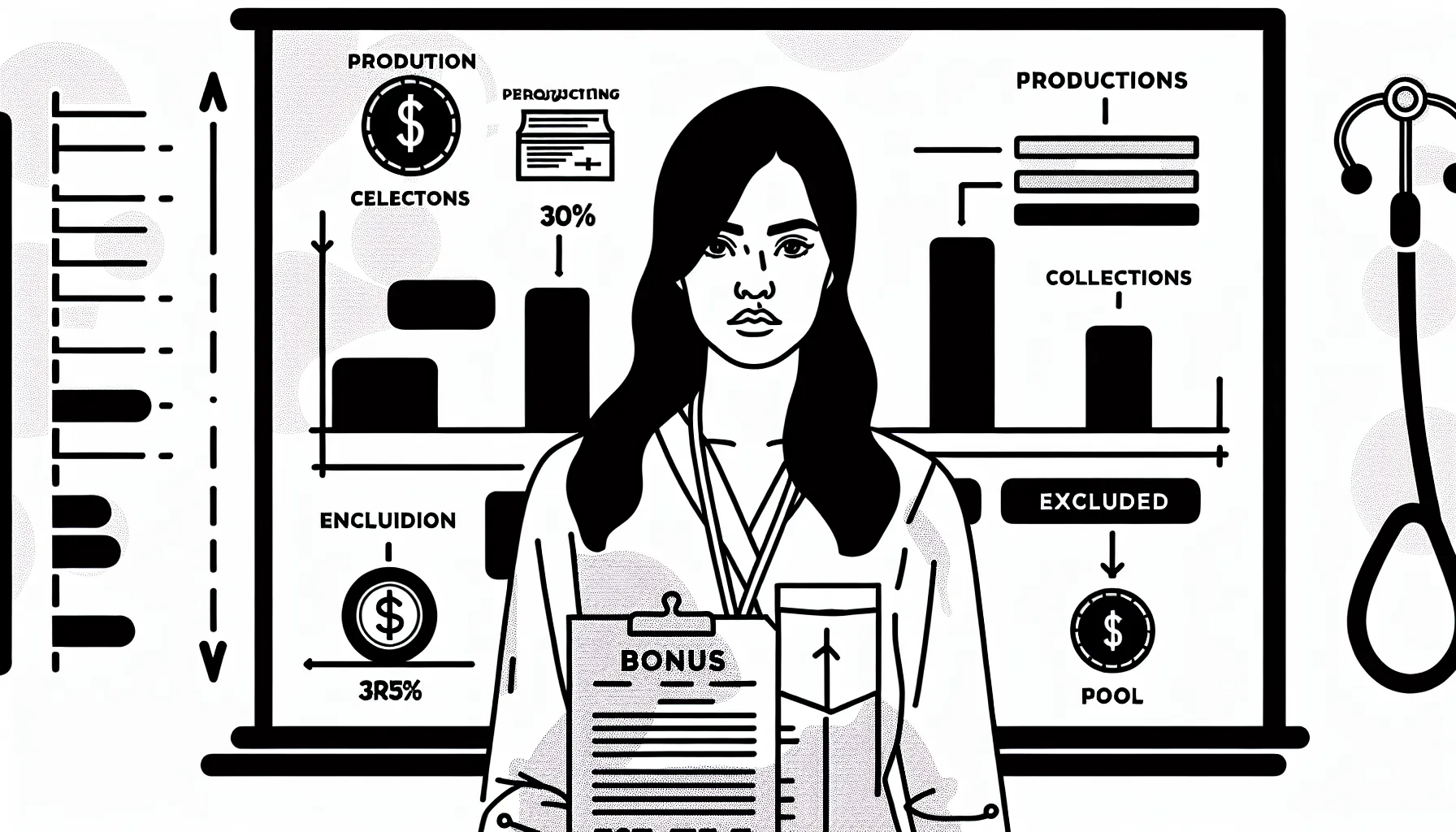
An offer stating that an associate will receive 30% of production does not establish the likely payment unless “production” is defined. The practice might use its full fee schedule, the amount billed to the patient, the amount allowed under a payer contract, or a figure reduced by discounts and write-offs. A collections-based plan introduces another variable because compensation depends on when and whether the practice receives payment.
The associate must therefore evaluate the percentage and the underlying accounting method together. A comparatively high percentage of net profit may generate less compensation than a lower percentage of clearly defined adjusted production. The practice’s historical numbers, the dentist’s expected procedure mix, and the treatment of expenses are usually more informative than the percentage standing alone.
Production, Adjusted Production, Collections, and Net Profit
Total production generally refers to the value assigned to services performed, but that value may come from the practice’s fee schedule rather than the amount a payer allows. Adjusted or billable production commonly accounts for contractual discounts, insurance adjustments, or other write-offs. Collections measure money actually received, while a net-profit formula may subtract designated operating expenses before applying the associate’s percentage.
These are economically different compensation bases. The American Dental Association’s compensation guidance illustrates how the same procedure can produce different associate pay after discounts, payer adjustments, write-offs, and laboratory fees. Dentists comparing offers can use the same framework when reviewing broader dental compensation models.
The agreement also needs to identify which services are credited to the associate. Questions may arise concerning hygiene examinations, diagnostic work, treatment completed by another provider, remakes, products, referrals, or procedures started by one dentist and completed by another. Without attribution rules, two reasonable readers may reach different conclusions about the production included in the calculation.
Thresholds, Tiers, Guarantees, and Team Pools
Many plans pay nothing until the associate exceeds a monthly, quarterly, or annual threshold. A tiered plan may apply one percentage to the first level of eligible revenue and a higher percentage above another level. The contract needs to clarify whether the higher percentage applies only to revenue within that tier or retroactively to the entire measurement period.
A minimum payment may be a true guarantee, but it may instead operate as an advance against future productivity earnings. Under the second structure, the practice can carry a deficit forward and offset later bonuses until the advance has been recovered. The label does not control the economics; the reconciliation and repayment provisions do. Associates offered this arrangement may benefit from examining whether the dental draw or guarantee is genuinely guaranteed.
Team and officewide pools create a different form of uncertainty. The associate’s payment may depend on the performance of other providers, the location’s total expenses, or a group target that the individual dentist cannot control. A slow month for another clinician, a costly remake, or a shift in the office’s payer mix can reduce the pool even when the associate’s own productivity remains consistent.
Clinical Productivity Does Not Always Translate Into Bonus Credit

A threshold can look achievable in a spreadsheet while remaining unrealistic at the assigned practice. The target may assume a full schedule, established patient demand, favorable recall rates, extended clinical hours, or a procedure mix the location has not historically supported. If the practice will not provide historical production ranges or an anonymized example, the associate may have no reliable way to test the assumptions behind the offer.
Payer and procedure mix also matter. A day devoted to complex, time-intensive treatment may be valued differently from a high-volume schedule, depending on the formula. Medicaid participation, preferred-provider discounts, membership plans, charity care, and insurance write-offs can reduce adjusted production or collections even though the dentist performed the same clinical work.
Practice operations may have an equally significant effect. Limited assistant coverage, inadequate operatory access, equipment downtime, cancellations, weak front-office collection practices, and added administrative assignments can lower measurable productivity. If the employer can alter workdays, locations, call duties, or nonclinical responsibilities, the compensation target needs to be considered alongside the agreement’s schedule and duty provisions.
Location transfers can change the economics without changing the written percentage. A dentist moved from an established office to a developing location may receive fewer patients, less favorable procedure opportunities, or weaker support while remaining responsible for the same threshold. Attribution may also become difficult when revenue is tracked by provider number, office, or date of collection rather than the date and dentist associated with treatment.
Where Expected Bonus Value Disappears
Deductions, Chargebacks, Holdbacks, and Reconciliation
Bonus calculations may permit deductions for patient refunds, insurance recoupments, bad debt, remakes, discounts, laboratory charges, credit-card fees, management expenses, or other allocated costs. A dentist expecting a straight share of collections may instead receive a percentage of a substantially reduced figure. Contract analysis can determine which deductions are expressly authorized, how they are allocated, and whether the associate can inspect the records supporting them.
Laboratory expenses deserve particular attention because agreements handle them in several ways. The practice may subtract the full cost before applying the compensation percentage, require the associate to bear a stated share, or deduct only expenses associated with specified procedures. The effect can be material for dentists performing crown, bridge, implant, aligner, or prosthodontic work, making lab fee treatment in associate pay an important part of the analysis.
Timing can make an otherwise accurate bonus appear smaller. A monthly estimate may be followed by quarterly reconciliation, and collections for work performed near the end of a period may not arrive until the next cycle. Minimum payout thresholds and holdbacks can delay smaller surpluses. The written terms need to identify the measurement period, payment deadline, reconciliation method, and treatment of amounts that remain pending when employment ends.
Retroactive chargebacks present another risk. A practice may seek to reverse prior bonus credit after an insurance denial, refund, failed payment plan, or remake occurring months later. The agreement may or may not limit how far back those adjustments can reach. Without a defined period and transaction-level reporting, the associate can face deductions that are difficult to verify.
Contract Language and Wage Rules Address Different Questions
The compensation clause determines how the parties describe the bonus, but it may not answer every legal question. Whether a promised amount has been earned, when it must be paid, and which deductions are permitted can depend on the agreement and applicable state wage-payment law. Federal law does not independently require employers to offer commissions or production bonuses, so entitlement and payment-timing disputes often require a state-specific analysis.
Discretionary Labels, Overtime, and Employee Classification
A clause may describe a payment as discretionary while also establishing a predetermined production target and formula. Those concepts can conflict. Under current U.S. Department of Labor guidance on bonuses, an individual or group production bonus announced in advance is generally nondiscretionary for Fair Labor Standards Act purposes, regardless of the label used. For a nonexempt employee, a nondiscretionary bonus generally enters the regular-rate calculation and may require an overtime recalculation after the bonus is determined.
That federal overtime analysis is distinct from whether the associate can enforce the compensation promise under the contract or state law. It also depends on the worker’s classification. Following the federal court vacatur of the 2024 overtime rule, the Department of Labor states that it is enforcing the 2019 salary thresholds, including the $684 weekly standard salary level and the $107,432 highly compensated employee threshold. Its current exempt-employee bonus guidance also explains the limited circumstances in which nondiscretionary incentives may count toward the standard salary level.
Dental associates should not assume that a W-2 title, salary, commission structure, or contract label resolves classification. Duties, compensation structure, and the governing legal tests all matter. An associate engaged as a contractor faces separate classification and tax questions that extend beyond the bonus formula.
Broad employer discretion creates a separate contractual risk. If management can change the formula, suspend the program, reinterpret definitions, or revise an incorporated policy without the associate’s consent, the expected incentive may not be as dependable as the recruiting discussion suggests. The agreement needs to distinguish a binding compensation obligation from a policy-based benefit that remains subject to unilateral revision.
Departure Can Trigger a Second Bonus Calculation
The end of employment often produces a final reconciliation. The practice may account for uncollected treatment, later insurance payments, refunds, remakes, patient credits, draw balances, or previously paid advances. The agreement may provide for delayed payment, forfeiture, continuing adjustments, or repayment. Those outcomes can differ significantly depending on the contract language and applicable state law.
Signing and retention bonuses may carry separate repayment terms. Some clauses require full repayment if the dentist leaves before a specified date, even when only a small portion of the commitment remains. Others prorate the obligation or trigger repayment only under defined forms of termination. Because these provisions may appear in an offer letter, promissory note, policy, or termination section, reading only the main compensation paragraph can miss a substantial liability.
Associates also need to understand whether collections received after departure remain bonus eligible and how long the practice may apply later deductions. The termination and final-compensation terms can be as important as the percentage earned during active employment. Notice requirements may affect when the associate stops treating patients, which work counts, and whether a repayment clause is triggered.
Restrictive covenants can compound the financial effect of leaving by limiting where the dentist may work next. The FTC’s nationwide Noncompete Clause Rule is not currently in effect or enforceable, so the effect of a dental noncompete remains dependent largely on applicable state law, the wording of the restriction, and the surrounding facts. Bonus, termination, repayment, and restrictive-covenant provisions are therefore best evaluated together rather than as unrelated clauses.
How to Test and Verify a Dental Bonus Plan
Before signing, ask for a worked example that begins with a hypothetical month of clinical activity and ends with the amount paid. The calculation can identify the fee schedule, discounts, insurance adjustments, write-offs, refunds, laboratory costs, management fees, threshold, applicable percentage, draw offset, and payment date. If the plan contains tiers, the example needs to show how revenue is allocated among them.
The example can then be compared with the proposed schedule, patient base, procedure mix, payer participation, staffing, and location. Useful follow-up questions include whether current associates regularly reach the threshold, how long collections usually take, who controls patient allocation, and whether the practice has changed the formula in the past. Historical information does not guarantee future earnings, but it can reveal whether the target reflects actual operating conditions.
Once employment begins, associates can maintain contemporaneous records of procedures, production, adjustments, scheduled days, and reported collections. Monthly statements can be compared with personal records, and discrepancies can be raised by identifying specific patients, transactions, or adjustment codes. A targeted request for the calculation and supporting entries is usually more productive than a general complaint that the bonus seems low.
Potential revisions may include clearer definitions, limits on retroactive deductions, an identified payment deadline, access to reports, rules for post-employment collections, a time-limited minimum guarantee, or a prorated repayment obligation. The appropriate request depends on the compensation model and the overall offer. The dental bonus structures overview provides additional context for comparing common arrangements.
A professional dental associate contract review can translate the formula into practical financial consequences and identify provisions that may warrant clarification or revision. The analysis is particularly valuable when the offer includes a draw, discretionary language, extensive deductions, a signing-bonus clawback, multiple locations, or broad authority to change compensation policies.
Frequently Asked Questions
Why is my dental associate bonus smaller than the percentage in my contract?
The percentage may apply only after the practice accounts for a threshold, write-offs, refunds, laboratory costs, management fees, payer adjustments, or draw offsets. It may also apply to adjusted production or collections rather than gross production. The full formula and its defined terms determine the payment.
How does a collections bonus differ from a production bonus?
A production formula generally measures the value assigned to services performed, while a collections formula depends on money the practice receives. Either figure may be adjusted under the agreement, so the written definition matters more than the label alone.
Can lab fees, refunds, or insurance adjustments reduce a bonus?
They may reduce the payment if the agreement authorizes those deductions and applicable law permits them. The dentist can review which expenses are included, how they are documented, whether they are allocated to the correct provider, and how long retroactive adjustments may continue.
Is a compensation guarantee the same as a recoverable draw?
No. A true guarantee may establish a minimum amount that is not repaid, while a draw is commonly an advance credited against later productivity compensation. The reconciliation, carryforward, and repayment language reveals how the payment actually operates.
What happens to bonus compensation after a dental associate leaves?
The agreement may require a final reconciliation involving pending collections, refunds, insurance adjustments, draw balances, or signing-bonus repayment. Whether compensation is earned, payable, forfeited, or subject to deduction can also depend on applicable state law.
Which records help a dentist verify a bonus calculation?
Useful records may include production and collections reports, adjustment ledgers, laboratory charges, patient credits, procedure data, payment dates, and the calculation for the relevant period. Comparing those materials with personal schedule and procedure records can help isolate discrepancies.
Understand the Dental Bonus Formula Before You Sign
Chelle Law can review production and collections definitions, deductions, draws, reporting rights, repayment obligations, and termination provisions in a dental associate agreement.
Contact Chelle Law