
A dental associate offer letter is often the first written account of a proposed position. It may identify the employer, start date, location, schedule, compensation, benefits, and anticipated path toward ownership. Although the letter is usually shorter than an employment agreement, its language can shape the parties’ expectations and may create obligations before a more detailed contract is signed.
The risk lies in what a concise offer does not explain. A production percentage may omit adjustments and deductions; a pay guarantee may operate as a recoverable draw; and a promise of malpractice coverage may say nothing about policy type or tail insurance. References to standard restrictions, office policies, or future partnership can also conceal terms that materially affect a dentist’s income, workload, departure options, and ability to practice elsewhere.
This guide explains how an offer letter fits into the complete dental associate agreement and which terms require supporting definitions or documents. Chelle Law reviews the offer alongside compensation exhibits, benefit summaries, insurance provisions, policies, and the final contract to identify inconsistencies, unresolved risks, and provisions that may warrant clarification before signing.
Key Takeaways
- A dental associate offer letter may create binding obligations when it includes definite compensation, restrictive covenant, repayment, or termination terms, even if a longer agreement is expected later.
- Compensation language often lacks definitions for production, collections, timing, deductions, and adjustments that can materially change actual earnings.
- Malpractice insurance references may omit the policy type and responsibility for tail coverage, creating potential post-employment expense.
- Restrictive covenant language introduced in an offer letter may carry forward into the associate agreement and affect future practice options under applicable state law.
- Vague references to ownership, notice requirements, reporting rights, or office policies usually indicate that important terms remain unresolved or subject to employer control.
How an Offer Letter Fits Into the Final Dental Contract
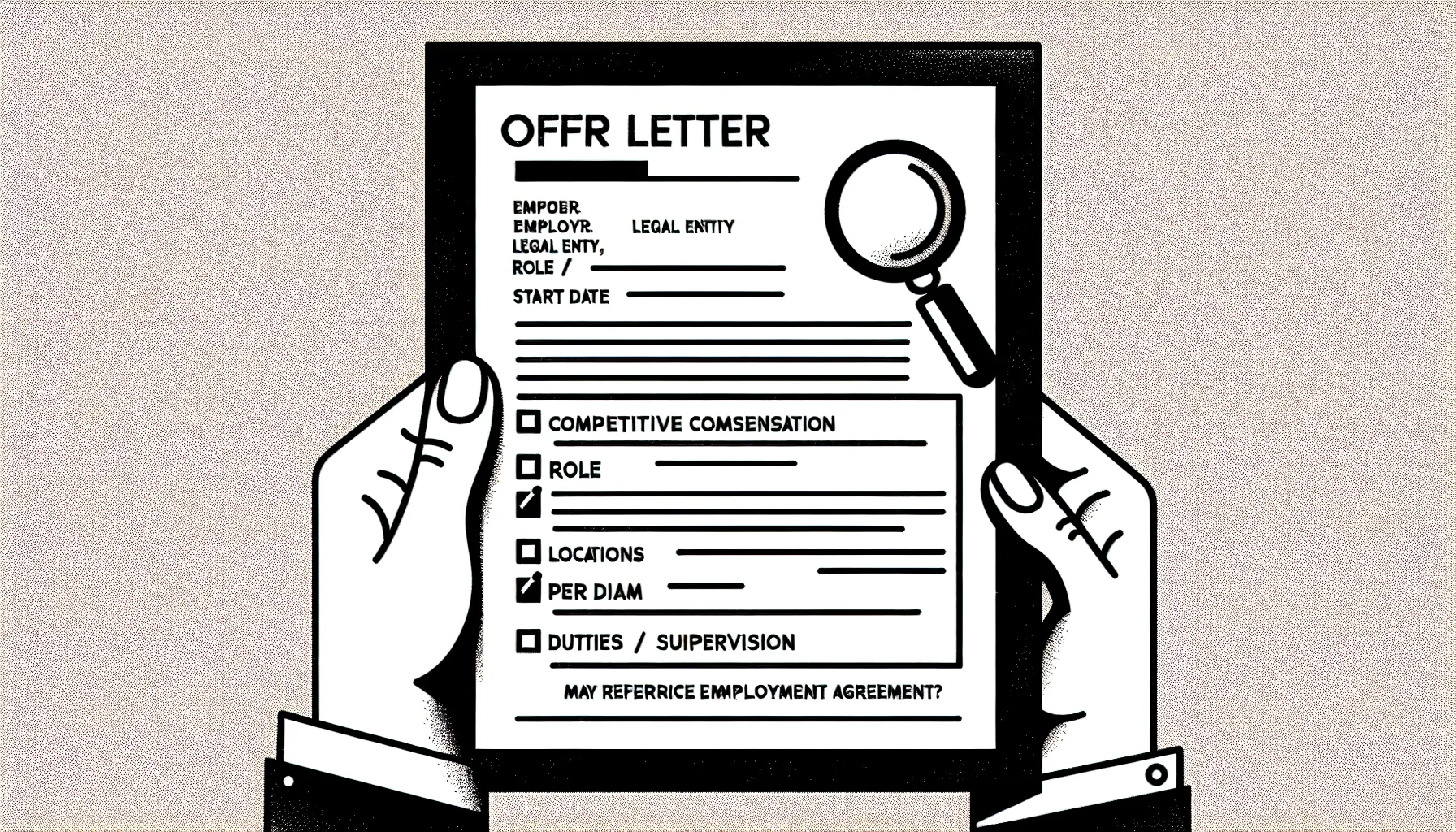
An offer letter commonly identifies the employing entity, the dentist receiving the offer, the expected start date, and whether the position is full-time, part-time, or per diem. It may also list a primary office, authorize assignments to additional locations, and summarize clinical or administrative responsibilities. These details deserve careful attention because location, schedule, and duty provisions can affect compensation, commuting demands, professional exposure, and the reach of a later restrictive covenant.
A short role description may encompass more than patient care. Documentation, meetings, training, marketing, supervision, community outreach, and administrative work can consume time without generating production credit. Reviewing the letter for both stated obligations and material omissions helps reveal where the final agreement or an incorporated policy may alter the position.
Referenced Documents and Conflicting Terms
Offer letters are often presented as summaries, but their legal significance depends on the wording, the definiteness of the terms, the parties’ conduct, and applicable law. A letter may state that the offer is contingent on execution of an employment agreement, incorporate an attached contract by reference, or provide that specified terms apply until a longer agreement is completed. Every attachment and referenced policy therefore belongs in the same review.
The final employment contract may narrow an earlier promise, add conditions, or contain an integration clause stating that the signed agreement supersedes prior discussions and writings. Dentists can use a broader dental contract red-flag review to identify provisions that change the economic or professional deal described in the offer. When documents conflict, the discrepancy is better resolved in the final written agreement than left to assumptions about which statement controls.
When Preliminary Language Creates Uncertainty
Terms such as “competitive compensation,” “standard benefits,” “reasonable notice,” and “partnership opportunity” do not establish measurable obligations without supporting definitions. Even a specific figure can be misleading if the letter does not identify the calculation base, eligibility requirements, payment timing, or employer discretion attached to it.
A dentist should not assume that the document is nonbinding simply because it is labeled an offer letter or contemplates a later contract. Provisions addressing repayment, confidentiality, restrictions, dispute resolution, or termination may have independent significance. The appropriate analysis considers the complete language and applicable state law rather than the document’s title alone.
Compensation Terms Need More Than a Percentage

An annual figure or production percentage does not, by itself, reveal likely earnings. Current professional guidance from the American Dental Association likewise emphasizes looking beyond the stated dollar amount to understand how compensation is calculated. A meaningful analysis considers the calculation base, exclusions, adjustments, measurement period, reconciliation process, and the associate’s access to supporting reports.
Production, Collections, Adjustments, and Reporting
Production compensation may be based on gross production, adjusted production, or net production after specified costs. Collections compensation depends on money the practice actually receives and may be affected by insurance adjustments, discounts, refunds, write-offs, payment plans, and the practice’s collection procedures. The dental compensation models guide explains how these structures allocate collection and operational risk between the practice and the associate.
The documents also need to explain which services receive credit, whether hygiene or radiology is included, how remakes and refunds are treated, and whether lab fees, supplies, management charges, or other costs reduce the calculation. Tiered formulas require a defined threshold and measurement period. If compensation relies on internal software, the dentist needs to know which reports are available, when calculations become final, and how errors can be questioned.
Post-termination collections can create another gap. A dentist paid on collections may leave before the practice receives payment for completed services. The agreement may provide a collection window, cut off compensation on the final day, or condition later payment on chart completion and other transition duties. An offer that states only the percentage leaves these issues unresolved.
Guarantees, Draws, Bonuses, and Repayment
A salary, daily minimum, or initial guarantee can provide stability while the dentist builds a patient base. Its value depends on whether the amount is guaranteed compensation or a draw that the practice can recover from future earnings. The offer and final agreement need consistent language about the guarantee period, reconciliation, negative balances, repayment, and what happens if employment ends before productivity reaches the stated level.
Signing, relocation, retention, and performance bonuses also require defined eligibility and repayment provisions. Important questions include when the bonus is earned, whether repayment is prorated, which termination events trigger repayment, and whether the employer can deduct an alleged balance from final compensation. A focused dental associate compensation review can compare these provisions with the production formula and termination language instead of evaluating each term in isolation.
Classification, Schedule, Duties, and Benefits
The offer letter may describe the associate as an employee or independent contractor, but the label does not conclusively determine legal or tax classification. It may also summarize working conditions without defining the practice’s authority to change them. These provisions affect taxes, benefits, control over clinical work, and the economic assumptions underlying the offer.
Employee and Independent-Contractor Labels
Federal tax classification depends on the complete relationship, including behavioral control, financial control, and the nature of the parties’ relationship. The IRS classification guidance makes clear that a contract label, payment method, or part-time schedule does not resolve the issue. State employment and tax standards may impose additional requirements.
Misclassification can affect withholding, payroll taxes, benefits, insurance, and compliance responsibilities. An offer for contractor work also warrants analysis of who provides staff and supplies, controls scheduling, sets fees, bills patients, bears business expenses, and determines how services are performed. Dentists comparing the two structures can review the practical distinctions in the guide to W-2 and 1099 dental associate arrangements.
Schedule language deserves the same level of scrutiny. A letter may list expected clinic days while reserving broad authority to add evenings, weekends, emergency coverage, or assignments at affiliated offices. These changes can increase commuting time, alter patient volume, affect production, and expand the locations connected to a restrictive covenant.
The documents can clarify clinical hours, administrative time, after-hours coverage, call rotation, meetings, marketing, documentation, referral protocols, and supervision duties. The dental associate schedule and duties guide addresses how these obligations interact with productivity expectations. Benefits such as paid time off, continuing education, licensing costs, professional dues, health coverage, and retirement contributions also require eligibility dates, limits, approval rules, and treatment upon termination.
Malpractice Coverage and Departure Costs
A statement that the practice provides malpractice insurance does not answer who is insured, what services are covered, the applicable limits and exclusions, or what happens after employment ends. The offer needs to be compared with the actual policy and the final contract, including reporting requirements and any conditions imposed by credentialing organizations, payers, facilities, or state law.
Occurrence coverage generally responds to a covered incident that happened during the policy period even when the claim is asserted later. Claims-made coverage generally requires coverage to be active when the claim is made or reported, subject to the policy terms. When claims-made coverage ends with employment, tail insurance or another form of extended protection may be necessary for later claims arising from earlier treatment.
The agreement may assign the cost of tail coverage based on who ends the relationship, whether the dentist completes an initial term, or whether termination is for cause. It may also permit continuing coverage through a new policy if specified conditions are met. The resource on tail insurance for dentists explains why policy type, reporting periods, cost allocation, and proof of coverage need more detail than a general insurance promise.
Departure costs can extend beyond insurance. Unvested bonuses, relocation payments, continuing education advances, or other benefits may become repayable. The compensation, repayment, termination, and insurance provisions need to be read together so the dentist can estimate the financial consequences of leaving under different circumstances.
Restrictions, Termination, and Dispute Terms
An offer letter may refer generally to a noncompete, nonsolicitation requirement, confidentiality obligation, arbitration clause, or governing-law provision without supplying the operative language. A reference to “standard restrictions” is not enough to measure their practical effect. The final wording may regulate future practice locations, communications with patients and staff, use of confidential information, and the forum in which a dispute must be resolved.
Noncompete enforceability remains highly dependent on applicable state law, the contract language, and the circumstances of the relationship. The Federal Trade Commission’s nationwide Noncompete Clause Rule is not currently in effect or enforceable, so it should not be treated as a generally operative federal ban on dental associate noncompetes. State statutes, professional rules, and controlling court decisions remain central to the analysis.
A restrictive-covenant review examines the prohibited activities, duration, geographic area, triggering events, and locations used to calculate the restriction. In a multi-office practice, language tied to every affiliated location can be much broader than a restriction based on offices where the dentist regularly worked. The guide to dentist noncompete rules and risks explains how drafting and jurisdiction can change the practical result.
Termination provisions determine how the dentist can leave and what follows the separation. An offer may mention at-will status, a fixed term, notice, or termination for cause without explaining cure periods, immediate-termination events, compensation cutoffs, repayment, patient-transition duties, or restrictions that activate after departure. Arbitration, attorney-fee clauses, liquidated damages, governing law, and venue may further affect the cost and process of resolving a disagreement.
Patient records, chart completion, unfinished treatment, access to information, and transition communications may be governed by the agreement, office policies, privacy requirements, and professional rules. Before signing, the dentist can evaluate whether the exit provisions provide a workable transition and whether incorporated policies leave material obligations subject to later unilateral change.
Ownership Promises and a Practical Review Checklist
A future buy-in or partnership opportunity may make an associate position more attractive, particularly when the dentist accepts lower initial compensation or broader restrictions in anticipation of ownership. A general statement about future partnership, however, does not establish a complete ownership right. The offer may leave eligibility, timing, price, financing, governance, and approval entirely unresolved.
A meaningful ownership pathway addresses the proposed interest, valuation method, decision-making rights, financing terms, conditions for eligibility, and what happens if the parties do not complete the transaction. It may also require separate entity, purchase, operating, shareholder, or partnership documents. The dental partnership and buy-in guide provides a framework for distinguishing a defined opportunity from an aspirational recruiting statement.
Before relying on an offer letter, the dentist can gather and compare the following materials:
- The complete employment or independent-contractor agreement and all exhibits
- Compensation examples, production or collection reports, and deduction schedules
- Benefit summaries, paid-time-off policies, and continuing education terms
- The malpractice policy details, including policy type, limits, exclusions, and tail obligations
- Policies incorporated into the agreement, including scheduling and repayment rules
- Restrictive covenant, dispute resolution, and termination provisions
- Written ownership, buy-in, or partnership criteria and proposed transaction documents
The signed offer, attachments, compensation illustrations, and relevant written communications should be preserved. A side-by-side review can identify promises that disappeared, terms that became conditional, and obligations introduced only in the final contract. Resolving those differences in writing provides a clearer record than relying on oral explanations or assumptions about future revisions.
Frequently Asked Questions
Can a dental associate offer letter be legally binding?
It can be, depending on the letter’s wording, the definiteness of its terms, incorporated documents, the parties’ actions, and applicable law. A letter containing specific compensation, repayment, confidentiality, restriction, or termination provisions should not be assumed to be nonbinding merely because the parties expect a longer agreement.
Is it risky to sign before receiving the full employment agreement?
Signing before reviewing the complete agreement can leave the dentist committed to an offer without knowing the detailed restrictions, repayment duties, insurance obligations, termination rights, or compensation definitions. When possible, the referenced contract, policies, exhibits, and benefit documents should be reviewed together.
Which compensation details need to appear in the documents?
The documents need to identify whether pay is based on salary, production, collections, a daily minimum, or a draw. They should also define the calculation base, adjustments, deductions, measurement period, reporting access, reconciliation, bonus conditions, and treatment of compensation after termination.
What malpractice insurance information should a dentist request?
Important information includes the policy type, insured parties, coverage limits, exclusions, reporting requirements, and who pays the premiums. For claims-made coverage, the agreement also needs to address responsibility for tail insurance or another acceptable form of post-employment coverage.
Does federal law currently ban dental associate noncompetes?
No generally operative nationwide FTC ban is currently in effect. The practical effect and enforceability of a dental noncompete depend primarily on applicable state law, the contract language, the restricted activities and locations, and the circumstances of the associate’s work.
Does an offer letter promising a future buy-in guarantee ownership?
Not necessarily. A general promise of future partnership may leave the transaction subject to later approval or negotiation. A meaningful ownership pathway ordinarily requires written terms addressing timing, eligibility, valuation, percentage ownership, financing, governance, and the documents required to complete the buy-in.
Have Your Dental Associate Offer Reviewed Before You Sign
Chelle Law can evaluate the offer letter, supporting documents, and final agreement to identify compensation, insurance, restriction, termination, repayment, and ownership terms that may warrant clarification.
Contact Chelle LawExplore More Dental Contract Guidance
Find related review services, practical contract resources, and state-focused information for dental professionals.