

Collections-based compensation links a veterinarian’s earnings to revenue the practice actually receives. Although the formula may appear to be a simple percentage, the stated rate does not reveal how much the associate will ultimately earn. Definitions, revenue-attribution rules, payment timing, refunds, discounts, processing fees, and reconciliation procedures can all change the amount credited to the veterinarian.
The risk extends beyond a disappointing bonus. Some agreements carry shortfalls into future periods, authorize retroactive deductions, or leave compensation earned near termination unresolved. A collections formula may also interact with a salary guarantee, signing-bonus repayment obligation, malpractice coverage, restrictive covenant, or ownership opportunity. An associate who evaluates only the percentage may overlook provisions that affect both current cash flow and the financial consequences of leaving the practice.
Chelle Law reviews collections-based, production, and ProSal provisions as part of the complete veterinary agreement. The analysis considers what revenue counts, when calculations become final, how shared cases are assigned, which deductions are permitted, and whether the veterinarian can verify the practice’s records. It also identifies ambiguous terms that may warrant clarification or revision before the associate relies on projected compensation.
Key Takeaways
- The compensation percentage has limited meaning until the agreement defines collections, permitted deductions, attribution rules, and the reconciliation schedule.
- A salary guarantee may be fixed compensation or a recoverable draw. The contract must be read closely enough to determine whether a shortfall creates a future deficit.
- Negative accrual, chargebacks, and open-ended adjustments can transfer ordinary business risk from the practice to the associate.
- Detailed statements, access to supporting records, and a defined dispute procedure are essential to verifying compensation.
- Final-pay, malpractice, bonus-repayment, and restrictive-covenant terms can magnify the consequences of an unfavorable collections formula.
How a Collections Formula Produces the Veterinarian’s Pay

Under a pure collections model, the veterinarian receives a percentage of eligible payments credited to the veterinarian’s work. If the rate is 30%, the associate might assume that generating $40,000 in charges produces $12,000 in compensation. That result occurs only if the practice collects all $40,000 and treats the entire amount as eligible revenue. If the practice collects $30,000 after payment delays, discounts, refunds, or uncollectible accounts, the same percentage produces $9,000.
Collections therefore differ from billed production. Production generally measures charges generated for services, while collections measure money the practice receives. A contract may use one measure to establish a target and another to calculate payment, creating a mismatch that is easy to miss. Associates comparing these structures can review how veterinary production pay differs from revenue collected by the practice.
What Counts as Collections and Who Receives Credit?
An administrable formula identifies when revenue becomes a collection. The triggering event might be card authorization, deposit, posting to the client ledger, or final clearance. The agreement may also need to address insurance or third-party payments, client payment plans, refunds, charge reversals, professional discounts, promotional pricing, and amounts received after the original service date. Vague references to “net collections” or “adjusted revenue” do not explain which amounts the practice may remove.
Revenue attribution presents a separate issue in multi-doctor hospitals. Follow-up examinations, hospitalized patients, prescription refills, diagnostic services, referrals, and procedures involving several professionals may not be credited to a single veterinarian automatically. An associate working at multiple clinics may also need to know whether collections are assigned by the treating veterinarian, the invoice owner, the location, or an internal policy that the employer may change.
The formula can specify how shared revenue is divided and whether the practice may revise an attribution after payroll closes. Without a consistent written method, an associate may generate substantial work while receiving limited credit for it. Historical reports can help illustrate how the practice applies its formula, but they do not replace binding contract language.
Salary Guarantees, Draws, and ProSal Reconciliation
A guaranteed payment may be a true salary, a recoverable draw, or the fixed component of a ProSal arrangement. Those structures are not interchangeable. A true salary generally does not fluctuate merely because monthly collections fall below a target. A recoverable draw may create a balance that offsets future production compensation or becomes payable under specified circumstances.
ProSal typically combines predictable salary payments with a periodic comparison between the associate’s compensation and a stated production or collections formula. The documents need to explain the applicable percentage, threshold, reconciliation frequency, treatment of deficits, and whether excess production is paid as a bonus. A veterinarian can learn more about the mechanics in Chelle Law’s ProSal compensation guide.
Monthly reconciliation provides faster feedback but can magnify short-term fluctuations. Quarterly or annual reconciliation may smooth seasonal revenue while leaving a larger potential adjustment unresolved. The agreement can also distinguish between a temporary onboarding guarantee and the formula that applies after the ramp-up period. If an employer calls a payment “guaranteed” while retaining an unrestricted right to recover it, the economic value of that guarantee may be substantially less than the label suggests.
Deductions and Adjustments That Can Reduce Expected Earnings
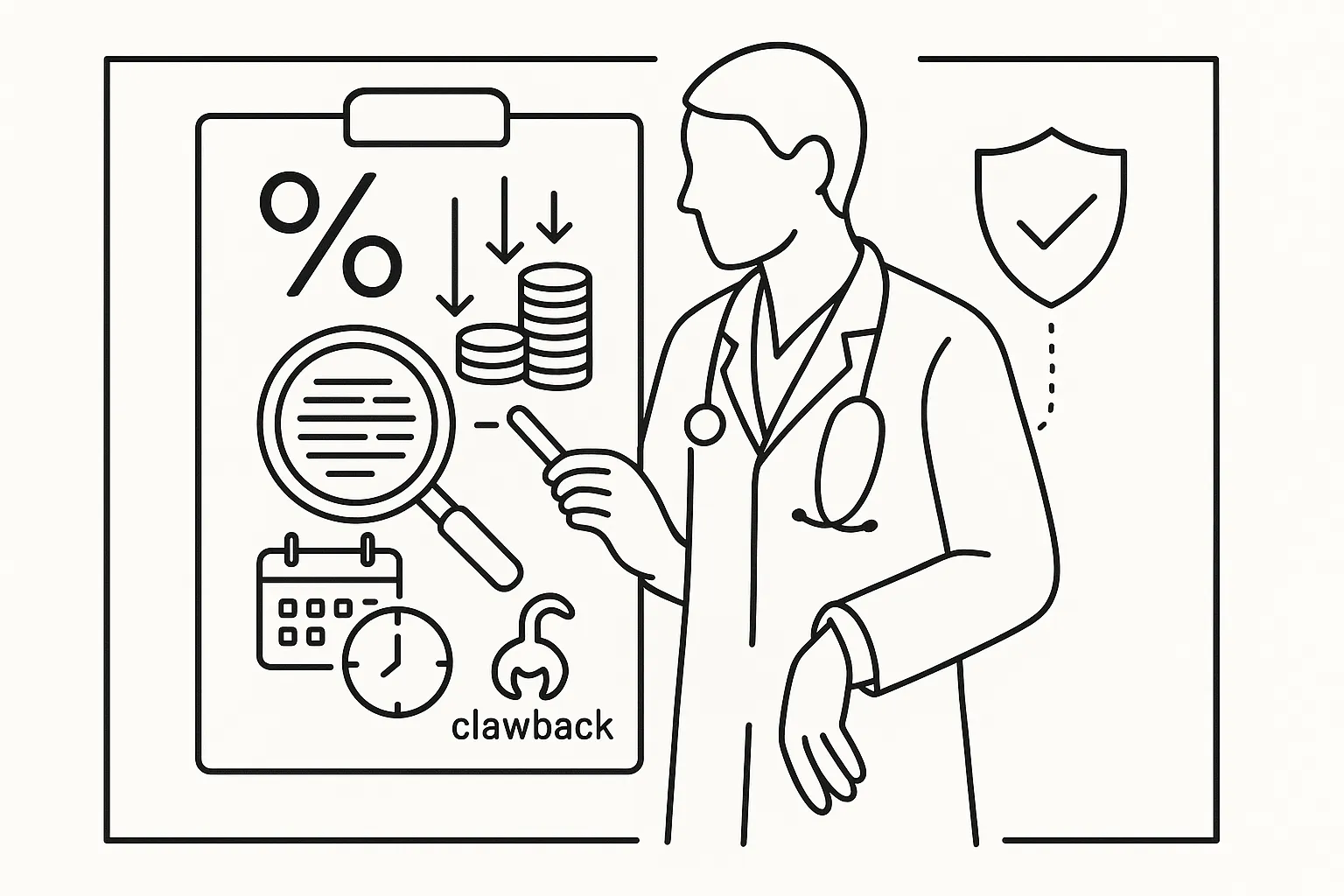
The practice incurs ordinary costs while collecting revenue, but the agreement determines whether any of those costs reduce the associate’s compensation. Potential deductions include credit-card fees, refunds, client discounts, laboratory expenses, inventory costs, collection expenses, chargebacks, disputed transactions, and corporate overhead. The calculation can produce materially different results depending on whether a deduction occurs before or after the veterinarian’s percentage is applied.
For example, assume the practice receives $30,000 and deducts $2,000 in expenses. Applying a 30% rate to the remaining $28,000 produces $8,400. Applying the percentage first and then charging the associate the full $2,000 produces only $7,000. The same listed percentage therefore produces different compensation because the order of operations changes.
- Undefined adjustments: Broad language permits the practice to remove amounts without an exclusive or reasonably specific list of deductions.
- Unilateral formula changes: An incorporated compensation policy may allow the employer to revise attribution, thresholds, or deductions without amending the agreement.
- Unexplained write-offs: The associate may bear the cost of discounts or account adjustments the associate did not authorize.
- Delayed posting: Revenue received after a reconciliation cutoff may be omitted or carried into a period when the associate is no longer eligible for payment.
- Client complaint triggers: Compensation may be reversed based on an allegation without an objective review or documentation process.
- Practice-wide expenses: General overhead may be allocated to one veterinarian without a transparent connection to that veterinarian’s services.
A contract may allocate certain business costs, but the written allocation does not answer every wage-law question. Federal law generally does not guarantee commissions above applicable minimum-wage and overtime requirements; many disputes over promised collections compensation instead depend on the contract and state law. At the same time, deductions and chargebacks involving a nonexempt employee must be evaluated under the minimum-wage, overtime, and recordkeeping principles summarized by the U.S. Department of Labor, together with any more protective state requirements. A deduction is not automatically lawful merely because the contract mentions it.
Negative Accrual, Chargebacks, and Recovery Periods
Negative accrual occurs when a compensation shortfall carries forward. If a recoverable draw exceeds earned collections compensation, the practice may subtract the difference from a later bonus. A deficit may also arise after a refund, disputed charge, coding correction, or reassignment of revenue. When the agreement imposes no cap or expiration date, an associate can begin each new period below zero and may have to generate additional revenue before receiving production pay.
Chargeback language may allow the practice to recover an alleged overpayment through future payroll deductions or a demand after termination. The provision needs to be evaluated for its triggering events, documentation requirements, dispute procedure, recovery method, and interaction with applicable wage law. A proposed 30-, 60-, or 90-day adjustment period is a negotiation position rather than a universal legal deadline. The appropriate period depends on the practice’s payment cycle, refund history, governing law, and other contract terms.
Possible contractual safeguards include a defined correction period, an itemized notice requirement, a cap on the amount carried forward, and a prohibition on deficits caused solely by employer-controlled write-offs. Whether those terms are appropriate depends on the actual arrangement. Chelle Law also provides a focused discussion of negative accrual in veterinarian production pay.
Statements, Audit Rights, and Final Reconciliation
A veterinarian cannot meaningfully verify the formula without usable records. A detailed statement may show billed production, posted collections, discounts, refunds, fees, write-offs, adjustments, and revenue attributed to the associate. Aggregate totals are less useful when the veterinarian cannot trace a disputed amount to the underlying client ledger or transaction.
The agreement can establish how often statements are delivered, how long the associate has to identify an error, and which records may be reviewed. An audit provision may permit inspection of relevant ledger entries, adjustment records, remittance information, and attribution reports while protecting client confidentiality. The documents can also explain who bears the cost of a neutral accounting review when a material error is found.
Final reconciliation deserves separate treatment. Revenue for work completed before departure may not arrive until weeks or months later. The contract can address whether the former associate receives credit for those collections, when the final statement will be issued, how refunds are handled, and whether a deficit survives termination. Silence on post-termination collections may leave both parties with competing interpretations after access to the practice’s records has ended.
Cash-Flow Examples That Reveal Formula Risk
Testing the contract with sample numbers is often more informative than reading the percentage by itself. A spreadsheet can show how collection rates, deductions, and reconciliation timing affect monthly earnings. It can also reveal whether the compensation discussed during recruitment matches the written formula.
- A low-collections month: The veterinarian generates $40,000 in charges, but only $30,000 is collected because of payment plans and delayed third-party payments. A 30% collections formula produces $9,000 rather than the $12,000 associated with billed production. If the remaining revenue is collected later, the contract determines whether and when the associate receives credit.
- A retroactive correction: The practice later reverses $4,000 in revenue because of refunds and attribution changes. At a 30% rate, the employer asserts that $1,200 was overpaid. The financial consequence depends on whether the contract permits the correction, requires supporting records, and allows recovery from future wages or the final paycheck.
- A recoverable guarantee: A new associate receives a $10,000 monthly guarantee while building a client base. The formula produces only $8,000 in the first month. If the $2,000 difference is a recoverable draw, the associate may start the next month with a deficit rather than a clean calculation.
- A buy-in mismatch: An ownership proposal values the veterinarian’s contribution using billed production while current compensation remains tied to collections. If the two measurements use different definitions, the associate may receive less current pay without receiving equivalent credit in the ownership valuation.
These illustrations are not predictions of a particular practice’s results. Their value lies in exposing ambiguity. The veterinarian can ask what happens if a payment arrives after the cutoff, a refund occurs after termination, a shared case is reassigned, or a guarantee exceeds earned compensation. If the contract does not answer those questions, projected annual earnings may rest on assumptions rather than enforceable terms.
How Collections Pay Interacts With Other Contract Provisions
Compensation provisions do not operate in isolation. A collections formula can become more consequential when combined with repayment obligations, termination language, malpractice insurance, a noncompete, or an ownership pathway. Reviewing those terms together helps identify the total risk assigned to the associate.
Signing and relocation bonuses: A veterinarian may owe repayment after an early departure while also waiting for a final collections reconciliation. The repayment schedule, forgiveness method, and definition of termination can determine whether the associate leaves with a substantial net obligation. A separate bonus and repayment clause review can address those provisions in detail.
Malpractice coverage: Compensation language does not establish the scope of professional liability protection. The veterinarian needs to examine the actual policy type, declarations, limits, exclusions, retroactive date, reporting requirements, and responsibility for any extended reporting endorsement. Occurrence coverage generally responds to covered events occurring during the policy period even if a claim is reported later. Claims-made coverage ordinarily requires the applicable policy to be in effect when the claim is made, making prior-acts protection or tail coverage important after the relationship ends. Chelle Law’s claims-made and occurrence coverage guide explains this distinction.
Clinical independence: Incentive compensation cannot be evaluated only as a payroll issue when it may affect professional judgment. California provides a useful example: veterinary regulatory materials authorize scrutiny of employment arrangements and compensation-related interference with a veterinarian’s or registered veterinary technician’s professional judgment. The current California Veterinary Medicine Practice Act materials underscore why a production incentive cannot properly be used to require care inconsistent with professional standards. Other jurisdictions may address professional independence differently, so the applicable licensing rules and agreement require context-specific review.
Restrictive covenants: A broad noncompete can reduce the practical value of compensation by limiting where the veterinarian may work after departure. The FTC’s 2024 nationwide noncompete rule is not currently enforceable, and the agency subsequently acceded to vacatur. As a result, veterinarians cannot assume that federal rule automatically invalidates a restriction; enforceability continues to depend primarily on applicable state law and other potentially relevant law. The FTC’s noncompete rule status page reflects the current federal posture.
State approaches differ substantially. California generally prohibits employment noncompetes, subject to statutory exceptions that include certain sale-of-business circumstances. Texas applies a statutory framework that examines whether a covenant is ancillary to an otherwise enforceable agreement and reasonably limited in time, geography, and activity. These differences make broad statements about nationwide enforceability unreliable. A veterinary noncompete review can evaluate the restriction in the context of the governing law and the rest of the agreement.
Questions to Resolve Before Accepting Collections-Based Pay
A productive review begins with the complete agreement and every document incorporated into it. Compensation exhibits, employee handbooks, bonus policies, attribution rules, and later-issued schedules may contain essential terms. If the employer can change an incorporated policy unilaterally, the associate needs to understand which parts of the promised compensation are actually fixed.
- Is the percentage applied to billed production, gross collections, net collections, or another defined amount?
- When does a payment become eligible, and are collections received after the service date still credited?
- How are shared cases, follow-up care, prescriptions, diagnostics, and multi-location services attributed?
- Which refunds, discounts, fees, expenses, or write-offs reduce the calculation?
- Is the stated salary guaranteed, or can a shortfall create negative accrual or a repayment obligation?
- How frequently does reconciliation occur, and when does a calculation become final?
- What statements and underlying records can the veterinarian examine?
- How are calculation disputes raised, investigated, and resolved?
- Does the associate receive credit for collections posted after termination?
- Can the practice recover an alleged deficit from wages, bonuses, or other amounts, subject to applicable law?
- How do signing-bonus repayment, malpractice coverage, and restrictive covenants affect the cost of leaving?
- Do the practice’s historical reports support the earnings represented during recruitment?
Historical collection rates and sample compensation statements can help test the economics of the offer. Useful information may include the average delay between treatment and payment, the percentage of revenue written off, how refunds are assigned, and how existing associates perform under the same formula. Those records are most helpful when reviewed against the actual contract rather than treated as a substitute for it.
An attorney review is particularly valuable when the agreement contains mixed production measures, substantial bonus repayment, negative accrual, broad employer discretion, unclear final-pay terms, a noncompete, or an ownership proposal. Chelle Law’s veterinary compensation and ProSal review evaluates how the written formula allocates financial risk and which provisions may warrant clarification before signing.
Frequently Asked Questions
What is collections-based compensation for a veterinarian?
Collections-based compensation pays the veterinarian a stated percentage of eligible revenue the practice actually receives and credits to the veterinarian. It differs from billed production, which generally measures charges generated before considering whether the client or another payer ultimately pays them.
How does collections pay differ from ProSal?
A pure collections plan may pay only a percentage of collected revenue. ProSal generally combines regular salary payments with a periodic comparison to a production or collections formula. The agreement determines whether a shortfall disappears, carries forward, or creates a repayment obligation.
What deductions can reduce a veterinarian’s collections compensation?
Potential deductions include refunds, discounts, card fees, chargebacks, write-offs, laboratory or inventory costs, collection expenses, and other adjustments identified by the agreement. Their effect depends on whether they are deducted before or after the compensation percentage is applied and whether applicable wage law permits the deduction.
What is negative accrual in a veterinary compensation plan?
Negative accrual is a deficit carried into a later compensation period. It may arise when a draw or guarantee exceeds earned compensation or when the practice reverses previously credited revenue. The contract may cap the deficit, limit how long it carries forward, or allow recovery after employment ends.
Will a veterinarian receive collections posted after leaving the practice?
The answer depends on the agreement and applicable law. Clear final-reconciliation language can identify whether post-termination receipts remain payable, the cutoff date, how later refunds are handled, and when the practice must provide the final compensation statement.
When is legal review useful for a collections-based offer?
Legal review is useful before signing when the formula contains unclear definitions, negative accrual, retroactive deductions, limited reporting rights, bonus repayment, malpractice uncertainty, restrictive covenants, or ownership terms. Reviewing the complete agreement can show how those provisions affect both expected earnings and departure risk.
Have a Veterinary Collections Formula Reviewed Before You Sign
Chelle Law can analyze the compensation formula, deductions, reconciliation provisions, negative accrual, and related contract risks so you can understand how the written terms may affect your pay.
Contact Chelle LawExplore Veterinary Contract Guidance
Review legal services, practical resources, and state-focused information for veterinary employment agreements.