
A dental associate can be offered an attractive percentage of production or collections and still earn substantially less than expected. The percentage is only one part of the compensation formula. Management charges, laboratory expenses, billing fees, refunds, insurance adjustments, and other deductions may reduce the amount to which that percentage applies. When those items are buried in definitions, external policies, or broadly worded deduction clauses, the associate may not understand the actual economics until a reconciliation statement or paycheck arrives.
The financial impact may extend well beyond one pay period. A reduced compensation base can affect productivity bonuses, guarantee reconciliations, repayment calculations, reported performance, and potential ownership opportunities. Refunds and chargebacks posted months after treatment may also create substantial income swings, including after the associate has left the practice. The risk is especially difficult to measure when the practice controls the accounting records and the agreement provides limited access to supporting reports.
This article explains how management fees and related deductions operate, where consequential language often appears, and how compensation provisions interact with accounting policies and final-pay terms. A dental associate contract review can evaluate the compensation base, authorized deductions, incorporated documents, reporting rights, amendment language, and post-employment reconciliation provisions. The objective is to determine whether the written formula is understandable, reproducible, and consistent with the associate’s financial expectations.
Key Takeaways
- A compensation percentage has limited meaning until the agreement defines the production, collections, or other amount to which it applies.
- Management fees may appear as administrative charges, billing expenses, overhead allocations, lab costs, supply deductions, refunds, or chargebacks.
- Compensation exhibits, fee schedules, accounting policies, and management documents referenced by the contract need to be reviewed with the main agreement.
- Useful contract controls include a defined deduction list, actual-cost or cap language, supporting records, adjustment deadlines, and regular reconciliation statements.
- Whether a deduction is legally permissible depends on the agreement, worker classification, applicable state law, and relevant federal wage protections.
The Compensation Base Determines the Real Value of the Percentage

A management fee is generally an administrative, corporate, billing, or service-related charge that affects the revenue credited to an associate. It may be deducted before the compensation percentage is applied, subtracted afterward, or incorporated into a broader definition of net collections. A fee is not necessarily secret or unlawful simply because it is unfavorable. The problem is that its economic effect cannot be evaluated when the agreement fails to disclose the amount, calculation method, timing, or supporting records.
Consider an associate offered 30% of collections. A calculation based on gross collections produces a different result from one based on collections remaining after refunds, insurance adjustments, credit card expenses, laboratory costs, and a corporate management charge. The nominal percentage remains 30%, but the effective percentage of the original collections may be much lower. A worked example using realistic figures can reveal more than the headline rate alone.
Current American Dental Association guidance on employment agreements distinguishes among production, gross billings, net collections, and net profit. It also identifies laboratory, supply, overhead, and staff-salary deductions as compensation terms requiring review. These distinctions reinforce why the agreement needs to identify the base amount, every permitted deduction, and the order in which the calculation occurs.
The same definitions may control productivity bonuses. A fee that reduces credited production or collections can make a threshold harder to reach, while a retroactive adjustment may reverse compensation previously paid. Chelle Law’s overview of dental compensation models provides additional context for comparing production, collections, guarantees, and percentage-based formulas.
Where Management Fees and Chargebacks May Be Hidden
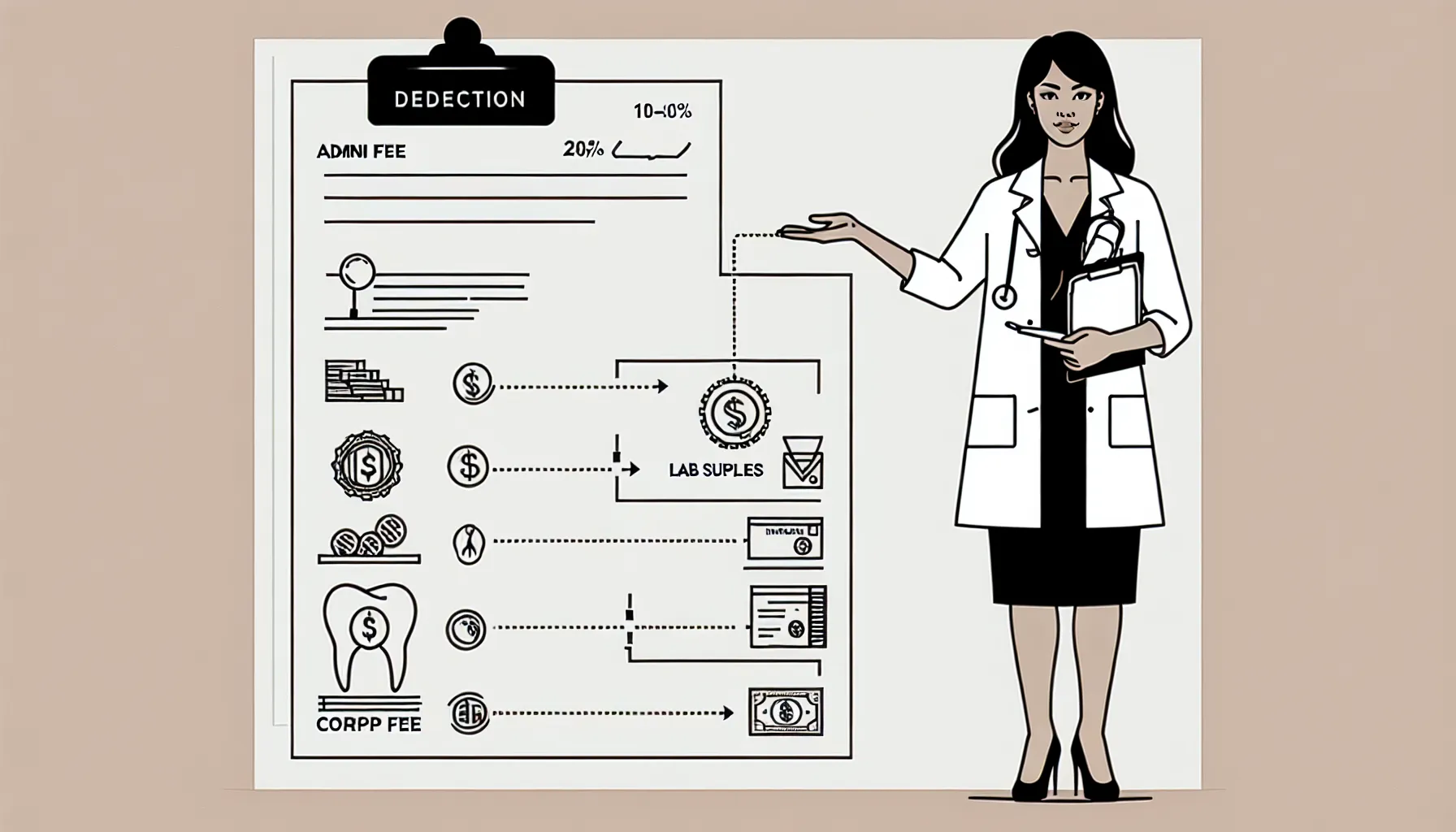
Recurring Administrative and Practice Expenses
The label assigned to a charge does not fully explain its economic effect. A practice may use several descriptions for costs that reduce the compensation base or are deducted from calculated compensation. Common categories include:
- Administrative or corporate charges: A percentage of production, collections, or adjusted revenue may be described as a management, corporate-services, or administrative fee.
- Billing and collection costs: The formula may allocate expenses associated with accounts receivable, payment processing, credit card charges, refunds, or collection activity.
- Laboratory and supply expenses: The practice may pass through laboratory invoices, implant costs, aligners, supplies, or other procedure-related expenses. The allocation method can materially affect pay, making dental lab fee deductions a distinct issue to evaluate.
- Refunds and account adjustments: Patient refunds, insurance denials, contractual write-offs, remakes, and later billing corrections may be charged against a future compensation period.
- Overhead and support-service allocations: Staffing, marketing, equipment, facilities, technology, or other practice costs may be allocated to the associate under broad overhead language.
These categories are not interchangeable. A documented laboratory invoice associated with a particular procedure differs from a recurring overhead percentage established solely by the practice. Patient refunds and insurance adjustments also change reported revenue differently from a separate management-services charge. The formula is easier to evaluate when it addresses each category independently instead of placing every expense under a catch-all term.
Definitions, Exhibits, and Incorporated Policies
Consequential fee language may appear outside the primary compensation paragraph. Relevant terms are often located in definitions, payroll provisions, bonus exhibits, employee handbooks, billing policies, fee schedules, or an “other deductions” clause. One section may promise a percentage of collections while another authorizes the practice to modify accounting procedures or subtract expenses it considers necessary.
Every document incorporated into the agreement can affect the calculation. If the contract refers to a compensation plan, management policy, accounting procedure, fee schedule, or service agreement, that document needs to be obtained and reviewed before signing. Verbal assurances and offer-letter summaries may not resolve inconsistent language in the final agreement, particularly when an integration clause states that the signed documents contain the complete agreement.
This concern is particularly significant in a DSO or multi-location setting. The associate’s employment agreement may operate alongside a separate business-services or management-services arrangement governing billing, staffing, technology, and administrative functions. The ADA describes DSO business-services agreements as complex arrangements involving compensation, responsibility, control, and regulatory issues. An associate may not be a party to every organizational agreement, but any fee schedule, policy, or procedure incorporated into the compensation formula needs to be available for review. Other provisions common to this employment model are discussed in Chelle Law’s DSO contract guide.
How Deductions Change Earnings During and After Employment
A deduction applied before the compensation percentage reduces the pool from which pay is calculated. A deduction applied afterward may appear directly on a statement or paycheck. Although the mathematical sequence differs, either method can reduce actual earnings. The agreement therefore needs to identify not only what may be deducted but also when each item enters the calculation.
- Lower effective compensation: The associate’s percentage of the original production or collections may be substantially lower than the stated rate after management and practice expenses are applied.
- Unpredictable payroll: Refunds, remakes, insurance denials, and delayed adjustments can move compensation between periods or create an alleged negative balance.
- Reduced bonus eligibility: Deductions that lower credited production or collections may prevent the associate from reaching a productivity threshold.
- Distorted performance records: Practice-controlled fees may make an associate appear less productive even when the underlying clinical work has not changed.
- Complicated final accounting: Delayed collections, patient refunds, and accumulated chargebacks may affect final compensation after the last day of work.
The consequences may also reach partnership or buy-in discussions. If ownership eligibility, valuation assumptions, or purchase terms depend on the associate’s historical performance, a compensation report reduced by practice-controlled fees may affect how that performance is presented. The agreement needs to clarify whether reports used for compensation, bonus eligibility, and ownership evaluation rely on the same definitions.
Timing is equally important. A practice may receive collections months after treatment, and an insurer may later recoup or adjust an earlier payment. The contract can establish whether the associate receives compensation on delayed collections, how long chargebacks remain possible, and whether an adjustment can be imposed after termination. Those terms need to be read with the agreement’s broader termination and final-pay provisions.
Contract Controls That Make the Formula Verifiable
Define the Formula and Limit the Deduction Categories
The starting point is an exact definition of the compensation base. The agreement can identify whether compensation depends on gross production, adjusted production, gross collections, net collections, or another measure. If multiple terms appear, it needs to explain how they relate to one another. A written example can then show the order in which contractual adjustments, expenses, fees, and the associate’s percentage are applied.
An exclusive list of permissible deductions is generally more predictable than language allowing any expense the practice deems necessary. For pass-through costs, the provision can identify whether the deduction equals the actual invoiced amount, a fixed percentage, or a capped allocation. It can also state whether a cost must relate directly to the associate’s procedure and whether the expense is shared with the practice.
Unilateral amendment language requires separate attention. A formula may be detailed at signing yet remain vulnerable if the practice can later change the compensation plan, fee schedule, payroll method, or incorporated policy without the associate’s written agreement. Important questions include how much notice is required, whether changes apply prospectively, and whether a modification requires mutual written consent.
Require Reports, Adjustment Deadlines, and Final Reconciliation Terms
A useful reconciliation statement shows gross production, collections, contractual adjustments, refunds, pass-through expenses, management charges, and the calculation used to determine compensation. The associate may also need access to laboratory invoices, collection reports, adjustment histories, patient refund records, and payroll calculations. Access to source records matters because a summary line labeled “management” does not establish how the amount was derived.
Retroactive deductions can be addressed through a defined look-back period, written notice, and a description of the underlying transaction. The contract can specify how quickly an associate must question an accounting entry and how the practice will respond. Audit or inspection rights are most useful when they are practical, do not impose prohibitive costs, and remain available long enough to evaluate delayed adjustments.
Final-pay language needs the same level of detail. The agreement can identify the final accounting period, whether collections received after departure remain compensable, the date of the final reconciliation, and the treatment of later refunds or insurance recoupments. Without a defined endpoint, a practice may claim that a negative balance or chargeback remains open long after the employment relationship ends.
Contract Deductions Are Not the Same as Legal Wage Deductions
Not every unfavorable compensation formula is automatically an unlawful wage deduction. One agreement may define compensation as a percentage of net collections after specified expenses, while another may calculate earned compensation first and then subtract an expense from wages. The legal analysis may differ depending on the language, applicable state wage-payment law, the associate’s classification, and the timing of the deduction.
Federal law supplies a limited floor rather than a nationwide approval or prohibition of dental management fees. The U.S. Department of Labor explains that, for covered nonexempt employees, certain deductions for employer-benefit costs, business losses, or similar expenses cannot reduce pay below required minimum wage or overtime compensation. Its wage-deduction guidance does not determine whether every collections-based formula is contractually valid or permissible under state law.
Worker classification also matters. A contract’s employee or independent-contractor label does not alone resolve legal status, and the federal enforcement landscape continues to require careful analysis. In May 2025, the Department of Labor announced that Wage and Hour Division investigators would use longstanding classification principles while the agency reviewed the 2024 rule and related litigation. Associates comparing W-2 and 1099 arrangements can review the practical distinctions in Chelle Law’s resource on dental associate classification, but state-specific advice may still be necessary before drawing conclusions about a particular deduction.
Pre-Signing Checklist for Fees and Accounting Terms
Before signing, compare the agreement, compensation exhibits, referenced policies, and any fee schedules against the following questions:
- Does the contract define the compensation base as gross production, adjusted production, gross collections, net collections, or another measure?
- Does it provide a complete list of permitted deductions and explain whether each deduction is applied before or after the associate’s percentage?
- Are laboratory, supply, billing, overhead, and management charges based on actual cost, a fixed formula, or an amount controlled by the practice?
- Does the agreement establish caps, allocation rules, or a connection between the expense and the associate’s work?
- Are refunds, remakes, insurance denials, and other chargebacks subject to notice and a defined look-back period?
- Will the associate receive production, collection, adjustment, and deduction reports detailed enough to reproduce the calculation?
- Can the practice change the compensation method, accounting policy, or fee schedule without mutual written agreement?
- Does the contract provide a practical process and deadline for questioning an accounting entry?
- How are delayed collections, final compensation, and post-termination chargebacks handled?
- Have all incorporated compensation plans, policies, exhibits, and management documents been provided?
If the documents do not answer these questions, the headline percentage may not accurately communicate the compensation opportunity. Precise definitions, enumerated deductions, adjustment deadlines, supporting records, and a reproducible calculation provide a clearer basis for evaluating the offer and identifying terms that may warrant clarification or revision.
Frequently Asked Questions
What is a management fee in a dental associate agreement?
A management fee is an administrative, corporate, billing, or service-related charge that reduces the revenue credited to an associate or is deducted from calculated compensation. Its effect depends on the defined compensation base, the amount of the fee, and where the deduction occurs in the formula.
Does a written contract automatically make every deduction permissible?
No. Written terms help establish the parties’ compensation arrangement, but legal permissibility may also depend on employee classification, applicable state wage-payment law, and federal minimum-wage or overtime requirements. A contract provision does not necessarily override governing law.
How can an associate determine whether fees are deducted before or after the compensation percentage?
Review the definitions of production, collections, net collections, adjustments, and compensation together with any exhibits or fee schedules. The agreement is clearer when it states the calculation sequence and provides an example that can be reproduced using production and collection reports.
Should laboratory fees and patient refunds be treated as the same deduction?
Not necessarily. Laboratory fees are treatment-related expenses, while patient refunds and insurance adjustments generally modify previously reported revenue. The agreement can address each category separately, including allocation, documentation, timing, and any limits on retroactive deductions.
Can management fees affect compensation after the associate leaves?
Yes, when the agreement permits post-employment reconciliation, delayed chargebacks, or deductions from collections received after termination. The final-pay provisions need to explain the accounting period, payment date, supporting reports, and treatment of later refunds or adjustments.
What records help verify dental compensation deductions?
Useful records may include production reports, collection reports, adjustment histories, patient refund records, laboratory invoices, billing statements, fee schedules, and payroll calculations. The agreement can provide a practical right to receive or inspect the records used to calculate compensation.
Understand Dental Pay Deductions Before You Sign
Chelle Law reviews dental associate compensation formulas, management fees, chargebacks, accounting rights, and final-pay provisions to help dentists understand how the written agreement may affect actual income.
Contact Chelle LawExplore Dental Contract Guidance
Review legal services, practical contract resources, and state-focused guidance for dentists.