
A multi-site nurse practitioner agreement may authorize work at several clinics, hospitals, urgent care centers, outreach facilities, or virtual-care locations under one employment or independent contractor relationship. Although this structure gives a healthcare organization staffing flexibility, it can leave the NP responsible for additional travel, changing schedules, unfamiliar workflows, and uneven patient volume. The practical consequences depend on how the contract defines work locations and limits the employer’s reassignment authority.
Location changes can also affect compensation, credentialing, billing, supervision or collaboration requirements, malpractice coverage, and post-employment restrictions. For example, an NP transferred to a lower-volume clinic may have difficulty reaching a productivity threshold, while temporary work at an additional site could expand the geographic reach of a broadly written noncompete. Cross-state and telehealth assignments add another layer because licensure, prescribing, scope-of-practice, and patient-location rules vary by jurisdiction.
Before accepting a multi-location position, the NP needs more than an informal description of the anticipated schedule. A written agreement can be evaluated for assignment limits, travel treatment, compensation attribution, enrollment obligations, insurance protection, and the consequences of credentialing delays or site closures. A focused nurse practitioner contract review helps identify terms that could shift operational, financial, or professional risk to the NP.
Key Takeaways
- Location language determines whether an employer can add, remove, or change work sites and what notice the NP receives.
- Ordinary commuting, travel between sites during the workday, mileage reimbursement, and productivity credit are separate contract and wage-hour issues.
- Collections, RVUs, bonuses, and negative accrual require transparent attribution rules when services are performed across multiple locations.
- Credentialing, payer enrollment, scope of practice, telehealth, supervision, and malpractice protection must account for every assigned site and jurisdiction.
- Temporary assignments can affect termination rights, repayment obligations, and the geographic reach of restrictive covenants.
How the Contract Allocates Multi-Site Risk
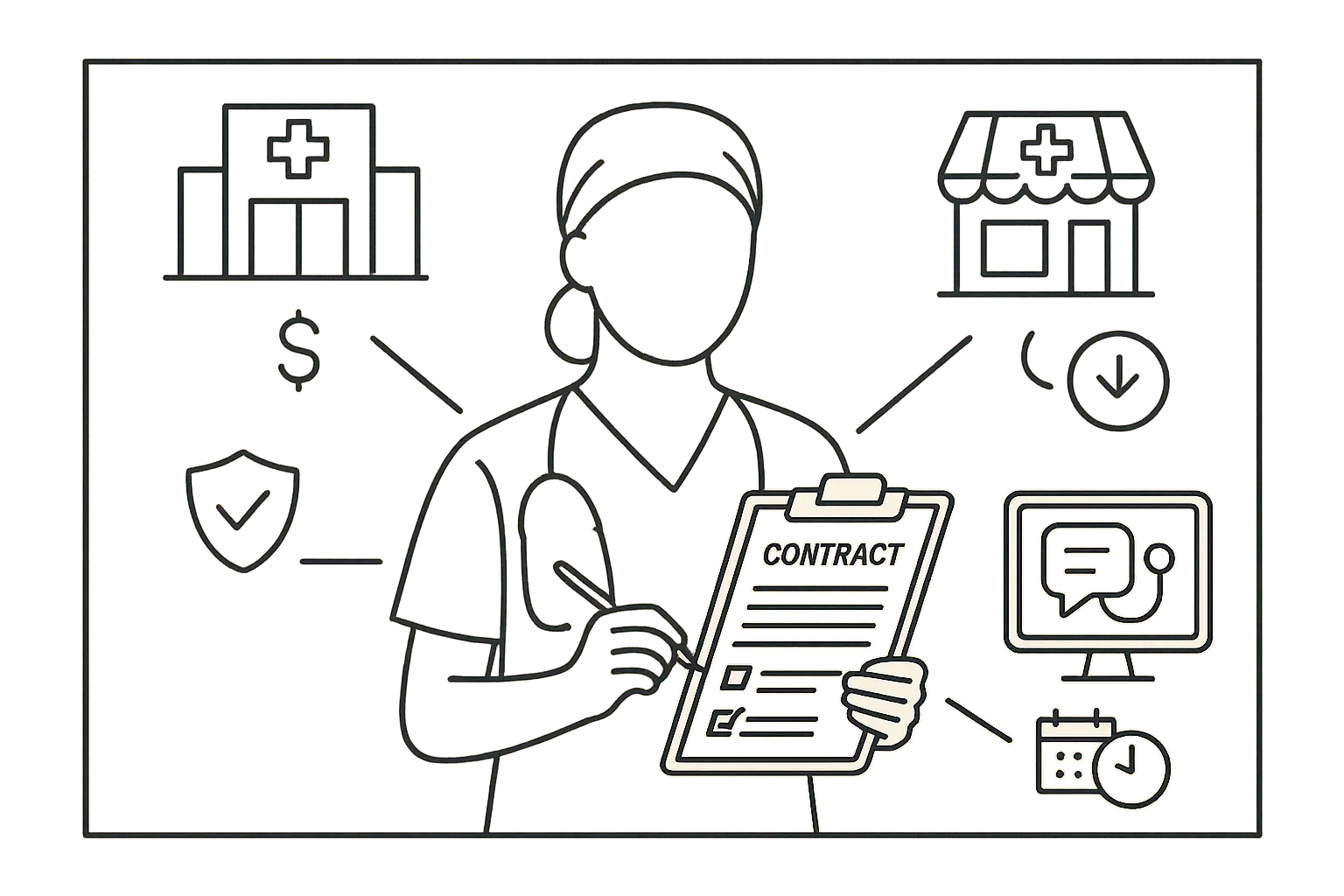
A multi-site arrangement can include permanent locations, temporary coverage sites, affiliated facilities, mobile services, and telehealth panels. Those locations may operate under different legal entities and use different EHR platforms, scheduling systems, payer contracts, clinical protocols, and administrative teams. Treating every site as interchangeable may obscure meaningful differences in workload, revenue potential, patient acuity, and regulatory responsibility.
The agreement is the principal source for determining how much flexibility the employer retains. Language allowing work at any current or future location can be much broader than a clause identifying two regular clinics and permitting temporary coverage within a defined area. The review should also examine incorporated policies, compensation exhibits, job descriptions, handbooks, and supervision or collaboration documents because important location obligations may appear outside the main contract.
Multi-site terms interact with the rest of the agreement. A reassignment clause may change the NP’s schedule, productivity opportunity, call responsibilities, commute, malpractice exposure, and ability to satisfy performance metrics. It can also affect whether the position remains economically practical even when base compensation does not formally change.
Location Assignments, Scheduling, and Travel
Regular Sites, Temporary Coverage, and Schedule Control
Clear assignment language identifies the NP’s regular work locations and explains how additional sites may be added. Important terms include advance notice, maximum travel distance, frequency of temporary coverage, minimum and maximum clinical hours, weekend or call duties, and whether the NP can be scheduled at more than one location on the same day. Vague phrases such as “other locations as needed” may leave those practical limits entirely unresolved.
The schedule provision also deserves attention when clinic hours differ by site. The contract may need to address early or late coverage, split shifts, administrative time, chart completion, meetings, and responsibility for patients or test results after reassignment. These questions overlap with broader nurse practitioner schedule control issues, particularly when the employer can change both the location and the hours without a defined notice period.
A site closure or reduction in patient demand can create a different problem. The agreement may permit reassignment, reduce available shifts, or condition compensation on work being available. The NP should understand whether guaranteed pay continues, whether another location can be substituted, and whether a substantial assignment change creates any contractual termination or repayment consequences.
Travel Time and Expense Reimbursement
Ordinary travel from home to a regular workplace generally differs from employer-directed travel between work locations during the workday. The U.S. Department of Labor’s travel-time guidance generally treats inter-site travel during the workday as hours worked for covered nonexempt employees, while ordinary commuting is generally not compensable. The result can depend on employee classification, applicable exemptions, the facts of the trip, and state wage law, so the rule is not identical for every NP.
Compensable work time and expense reimbursement are separate questions. Even when travel time counts as work under an applicable wage law, the agreement or employer policy may separately determine whether mileage, tolls, parking, rental vehicles, lodging, or other expenses are reimbursed. The contract can also clarify whether travel time counts toward scheduled hours, productivity expectations, overtime calculations, or minimum shift requirements.
Without written rules, an NP may lose clinical time while moving between sites but still be measured against the same visit or production target. A useful review compares the anticipated route and frequency of travel with the compensation formula, schedule, reimbursement policy, and employer’s right to add locations.
Compensation and Productivity Across Locations
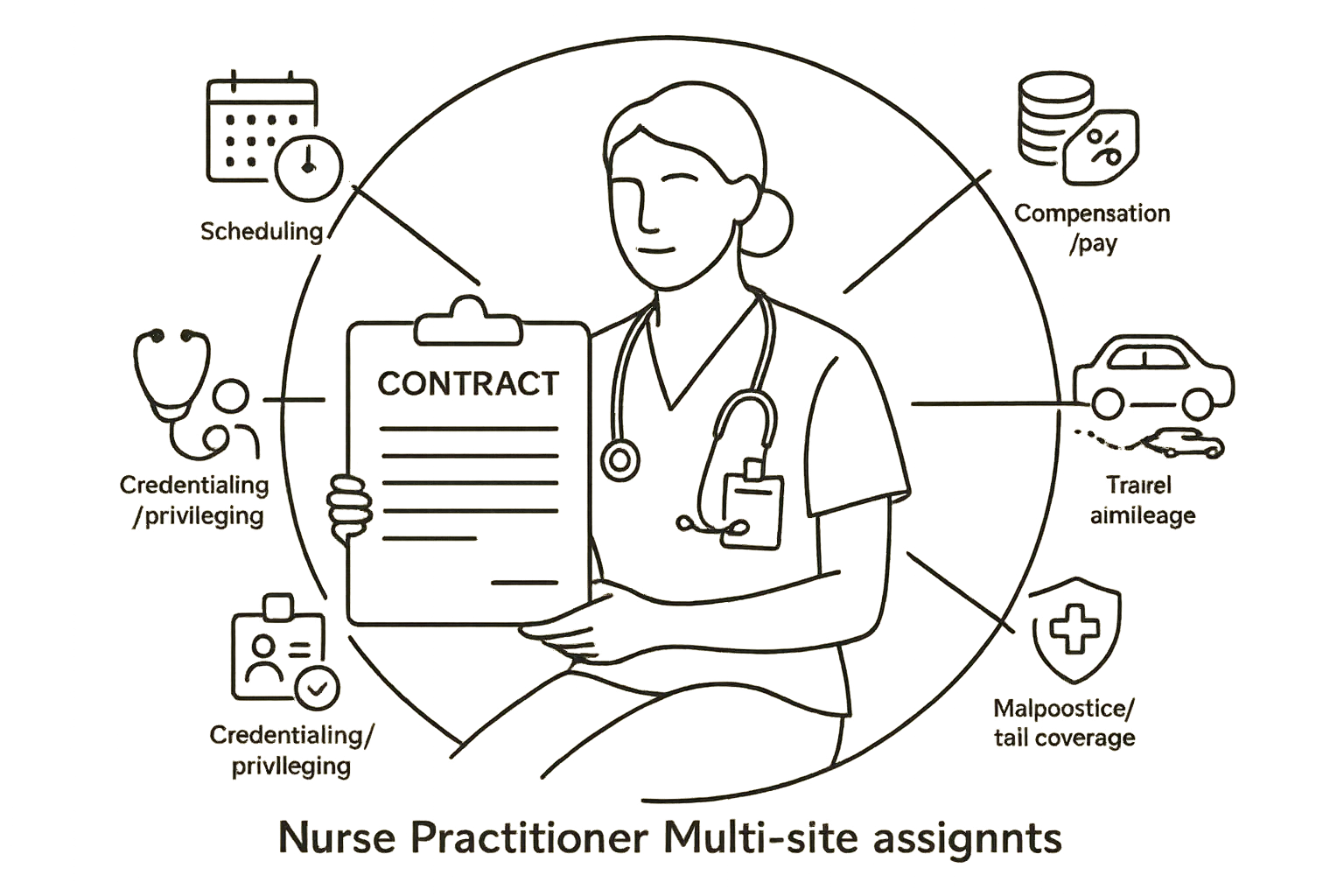
Multi-site compensation may use a fixed salary, hourly pay, collections, work RVUs, quality incentives, encounter counts, or a hybrid model. The central question is not merely which formula appears in the contract, but how the employer attributes services when care, documentation, billing, and collections occur across different locations. A detailed NP compensation and productivity review can test whether the formula accounts for the realities of the assignment.
- Does the employer combine production from all locations or maintain a separate pool for each site?
- Who receives credit for telehealth follow-ups, telephone triage, care coordination, and encounters spanning multiple locations?
- Are bonus thresholds prorated when the NP spends time traveling, training, or waiting for access at a new site?
- How do payer adjustments, denied claims, refunds, delayed collections, or facility billing affect credited revenue?
- Can a shortfall at one location create negative accrual that reduces compensation earned later or elsewhere?
Patient volume and payer mix can vary sharply among sites. An NP transferred from a busy clinic to a newer or lower-volume location may be unable to reach a threshold that was realistic at the original assignment. The same problem can arise when the employer controls scheduling, staffing, marketing, payer enrollment, or billing but the NP bears the economic effect of low collections or reduced RVU production.
Negative accrual deserves particular attention because a deficit may carry into a later month, quarter, or contract year. The agreement should be examined for reset periods, reconciliation methods, reporting rights, employer deductions, and treatment of deficits caused by reassignment or administrative problems. Chelle Law’s resource on negative accrual in NP contracts explains how an unfavorable formula can postpone or eliminate later incentive compensation.
Credentialing, Enrollment, and Clinical Operations
Practice Locations, Billing, and Administrative Delays
Each assigned facility may require payer enrollment, credentialing, privileging, background checks, EHR access, or site-specific training. The agreement can allocate responsibility for completing applications, supplying records, paying fees, monitoring renewals, and correcting administrative errors. It also needs to address what happens when the NP is ready to work but a facility, payer, group, or employer has not completed its part of the process.
Medicare participation can involve obligations beyond the employment contract. Current CMS enrollment materials address practice-location information and reassignment relationships, including additions, removals, and changes. Multi-site work may therefore require coordinated updates among the NP, group practice, billing entity, and Medicare contractor. A contractual promise to credit collections does not replace the enrollment steps needed for claims to be submitted correctly.
The compensation language should explain how credentialing or payer-enrollment delays affect salary, productivity thresholds, and start dates. It is also important to distinguish delays caused by the NP’s failure to provide required information from those caused by the employer, facility, billing company, or payer. Otherwise, the NP may lose income because an assigned site cannot bill for services even though the NP has satisfied the applicable obligations.
Operational differences can create patient-care and documentation risks as well. Sites may use separate EHR systems, order-entry processes, referral networks, or result-management protocols. Contract analysis can identify whether training time is paid, whether administrative work counts toward productivity, who handles outstanding results after a transfer, and how patient handoffs occur when the NP changes locations.
Scope of Practice, Telehealth, and Liability Protection
Jurisdiction-Specific Practice Requirements
Nurse practitioner authority is not uniform nationwide. Licensure, independent practice, supervision, collaboration, prescribing, delegation, and facility requirements depend on the relevant statutes, regulations, board guidance, practice setting, and patient location. The APRN Consensus Model provides a regulatory framework, but it has not eliminated state-by-state differences.
Cross-border and virtual assignments require particular care. The National Council of State Boards of Nursing’s APRN guidance emphasizes compliance with the requirements of the state where the patient is located when care is delivered, including care provided by telephone or virtual technology. A contract authorizing telehealth from one office may therefore create licensure, prescribing, collaboration, or professional-practice questions in every state where patients are located.
The agreement and related policies can identify who verifies licensure and prescribing authority, obtains required registrations, maintains collaboration or supervision documentation, and limits scheduling when authorization is incomplete. A review of supervision and collaboration terms can also reveal inconsistencies between the employment agreement, a separate clinical arrangement, and the NP’s actual location responsibilities.
Malpractice protection must extend to the work the NP is actually expected to perform. Relevant terms include occurrence versus claims-made coverage, policy limits, covered locations and entities, exclusions, consent-to-settle provisions, indemnification, personal insurance requirements, and responsibility for tail coverage after termination. If the employer sends the NP to an affiliated or external facility, the review should determine whether that work falls within the employer’s policy or requires separate protection.
Independent contractor and multi-employer arrangements present additional concerns because more than one entity may control the facility, schedule, billing, or clinical operations. A focused malpractice and tail insurance review can clarify how the contract allocates liability and whether post-termination coverage obligations match the underlying policy.
Restrictions, Reassignment, and the End of the Relationship
A restrictive covenant may define its prohibited territory by reference to every site where the NP worked, received an assignment, or provided services during a lookback period. That wording can make even brief or employer-directed coverage consequential. The review should identify which locations count, the applicable radius, restricted activities, duration, triggering events, and whether telehealth patients or affiliated entities expand the restriction.
Federal developments do not eliminate the need for contract-specific analysis. The Federal Trade Commission currently states that its 2024 nationwide Noncompete Rule is not in effect and is not enforceable following federal court proceedings. Whether a particular NP restriction may be enforced continues to depend on applicable state law, the contract language, the facts of the relationship, and any other governing authority. A dedicated nurse practitioner noncompete review can evaluate how multi-site language affects the practical reach of the restriction.
Location changes can also interact with termination and repayment provisions. An NP may want to know whether a material reassignment permits departure without repaying a signing bonus, relocation allowance, training expense, or other benefit. The answer depends on the contract’s termination triggers, repayment exceptions, notice requirements, and definition of employer breach or material change.
Patient transition obligations also require planning. The agreement may address chart completion, pending test results, follow-up communications, credentialing termination, return of records or equipment, and cooperation with billing after employment ends. These duties can continue even when the NP no longer works at the location where the care was provided.
Questions to Resolve Before Accepting Multi-Site Work
The written agreement should be compared with the employer’s description of the expected schedule, locations, compensation, and patient population. Useful review materials may include the offer letter, compensation exhibits, job description, reimbursement policy, productivity reports or examples, supervision or collaboration documents, malpractice certificate, and communications describing anticipated assignments.
- Which locations are regular, temporary, optional, or subject to future assignment?
- How much notice applies before a schedule or site change, and is there a maximum travel radius?
- How are travel time, mileage, tolls, parking, and overnight expenses treated?
- How are collections, RVUs, quality measures, telehealth services, and cross-site encounters attributed?
- Who bears the financial effect of low volume, denied claims, enrollment delays, or employer billing errors?
- Who handles licensure, payer enrollment, privileges, registrations, EHR access, and required training?
- Does malpractice coverage include every location, affiliated entity, and service line?
- Can a temporary assignment enlarge a noncompete or trigger a repayment obligation?
- What happens to compensation if a site closes, credentialing is delayed, or available work decreases?
No single provision answers all of these questions. The location clause must be read together with compensation, scheduling, billing, insurance, restrictive-covenant, and termination terms. That integrated review shows whether the employer’s operational flexibility is balanced by clear limits and financial protections for the NP.
Frequently Asked Questions
Can an employer require an NP to work at a newly added location?
It depends on the assignment language. A broad clause may authorize additional locations, while a narrower provision may identify regular sites, impose a travel limit, require advance notice, or call for the NP’s agreement before a material reassignment.
Is travel between clinics compensable for a nurse practitioner?
Employer-directed travel between work locations during the workday is generally treated as work time for covered nonexempt employees under federal guidance. Classification, exemptions, state law, and the trip’s circumstances can affect the result, and mileage reimbursement remains a separate issue.
How can a site transfer affect NP productivity compensation?
A transfer may change patient volume, payer mix, billing efficiency, travel time, and access to support staff. The contract should explain how production is attributed, whether thresholds are adjusted, and whether a deficit at one site can reduce compensation earned elsewhere.
What happens when credentialing at one assigned site is delayed?
The outcome depends on the agreement. It may provide continued salary, reassignment, a delayed start, or reduced compensation, so the contract should allocate application duties and distinguish NP-caused delays from administrative delays outside the NP’s control.
Does malpractice insurance automatically cover every work location?
Not necessarily. The policy and contract must be reviewed for covered entities, locations, services, exclusions, limits, indemnification terms, and any requirement for personal coverage or claims-made tail insurance.
Can temporary locations expand an NP noncompete?
They can if the covenant measures its restricted territory from every location where the NP worked or was assigned. The practical effect depends on the wording, applicable state law, assignment history, duration, geographic radius, and covered activities.
Have Your Multi-Site NP Contract Reviewed Before You Sign
Chelle Law can analyze location assignments, travel provisions, compensation formulas, credentialing terms, malpractice coverage, practice restrictions, and termination risks in your proposed agreement.
Contact Chelle Law