
Collections-based compensation ties some or all of a nurse practitioner’s pay to revenue collected for the services the NP provides. Although this model is common in employment agreements and independent contractor arrangements, its financial impact depends on definitions, deductions, reporting practices, and payment timing that may not be obvious from the offered percentage alone. An NP should understand how the employer calculates collections, handles denied claims, applies holdbacks or clawbacks, and completes reconciliation after termination. This guide explains the mechanics of collections-based pay, recurring contract pitfalls, financial and career consequences, protective terms, and practical documents to request before signing. It also identifies circumstances in which an attorney-led contract review can clarify significant income and liability risks.
Key Takeaways
- Collections-based pay ties income to receipts, so the agreement should clearly define whether “collections” means charges, gross receipts, or cash received after adjustments.
- Holdbacks, clawbacks, long look-back periods, and one-sided audit provisions can produce retroactive reductions and continuing repayment exposure.
- Historical collections reports, payer-mix information, and sample calculations help an NP estimate realistic compensation.
- Minimum guarantees, defined deductions, mutual audit rights, limited recoupment provisions, and clear final-payment deadlines can make the compensation model more predictable.
- Attorney review is particularly useful when collections definitions are vague, the arrangement lacks meaningful guaranteed pay, or repayment and post-termination obligations are broad.
How Collections-Based Pay Works for Nurse Practitioners
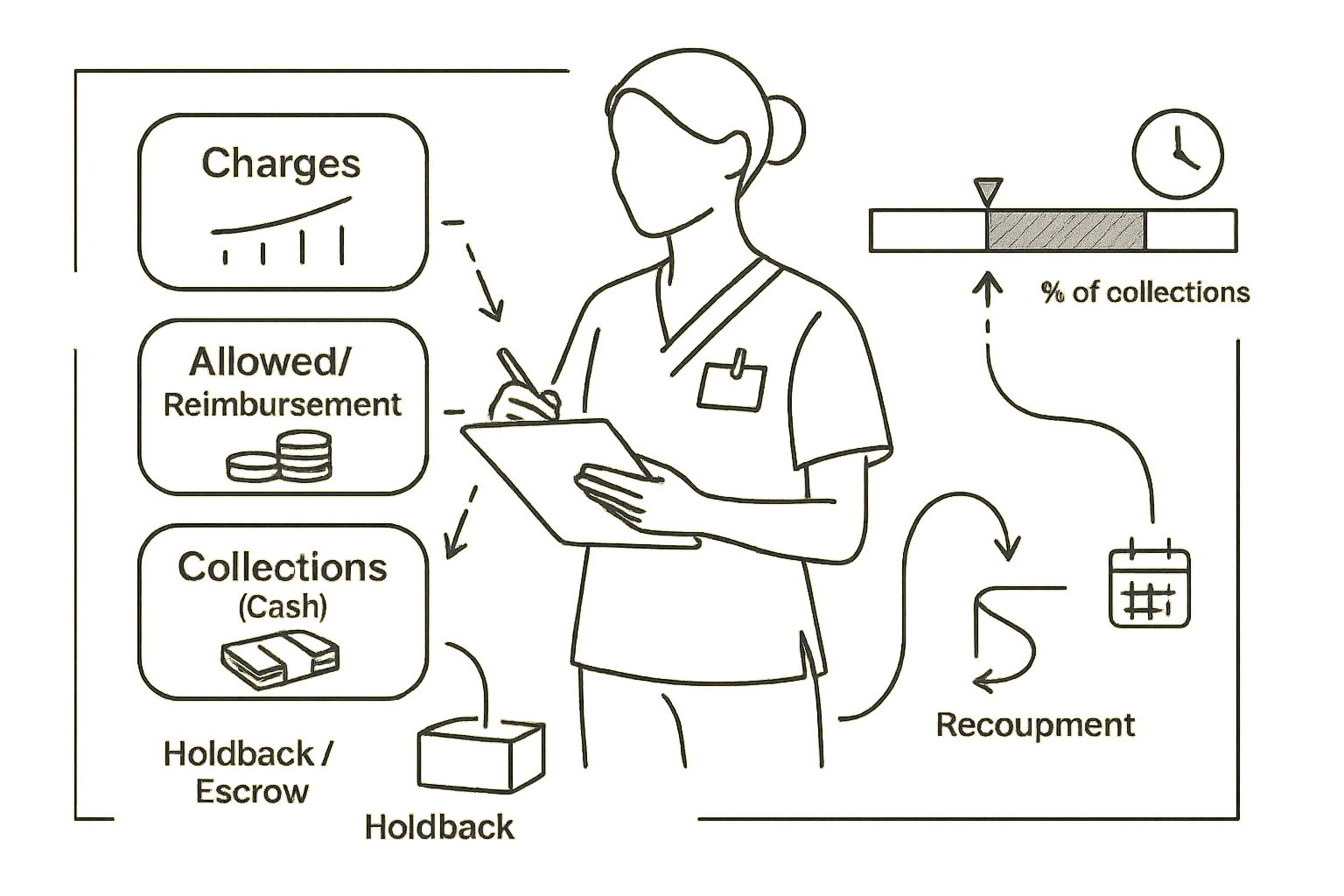
Collections-based compensation connects at least part of an NP’s pay to receipts the employer receives for the NP’s services. Common structures include a guaranteed base salary plus a percentage of collections, a collections-only model with no base, and a blended arrangement that combines fixed pay with collections or productivity measures. An NP comparing these arrangements may also benefit from reviewing how other nurse practitioner compensation models allocate financial risk.
Definitions, Deductions, and Payment Calculations
The agreement should distinguish billed charges from money actually received. “Net collections” may exclude contractual adjustments, payer write-offs, refunds, discounts, uncollectible balances, or other amounts. The specific deductions and the order in which they are applied directly affect the revenue pool used to calculate compensation.
For example, if an agreement pays 25% of cash received after payer adjustments, an $800 charge might result in only $150 reaching the practice. The NP’s share would then be $37.50 for that encounter, not 25% of the original charge. Worked examples are therefore more informative than a percentage standing alone.
Reporting, Holdbacks, and Negative Accrual
Monthly or quarterly reporting determines when the NP can review collections and reconcile compensation. Some employers retain a percentage as a holdback to account for denials, refunds, or chargebacks. Others advance compensation and later recover any shortfall from future earnings through negative accrual. These mechanics affect pay predictability, administrative burden, and potential repayment obligations.
Common Collections-Based Compensation Pitfalls

Ambiguous definitions can allow the employer to decide which receipts receive credit, which deductions apply, and when an amount becomes payable. The economic difference between billed charges and payer remittances can be substantial, particularly when the agreement does not include historical reimbursement information or sample calculations.
Denied claims create another area of risk. A contract may withhold compensation until an appeal is completed, assign responsibility for appeals to the NP, or make the NP financially responsible for denials caused by coding, documentation, or administrative issues. Broad employer control over billing and appeals is especially concerning when the NP bears the resulting income loss but cannot meaningfully review the underlying records or process.
Clawbacks, Audits, and Retroactive Changes
Clawback provisions may permit recoupment after payer denials, charting disputes, refunds, audits, or alleged overpayments. Long look-back periods can extend exposure well beyond the original payment date. One-sided audit language adds risk when the employer controls the relevant records, determines the amount owed, and can deduct that amount from compensation without independent review.
Production thresholds and sliding percentages also require objective measurement methods. An agreement that lets the employer change collection credits, split rates, or calculation policies retroactively undermines income predictability. These provisions are among the broader contract red flags NPs should evaluate before accepting an offer.
Financial, Tax, and Career Consequences
Collections-based compensation increases income variability because payment depends on patient volume, payer processing, reimbursement rates, denials, and the employer’s billing operations. Delayed reconciliation or negative accrual can reduce compensation months after the services were performed, making budgeting more difficult. This risk is greater when collections constitute most or all of the NP’s pay.
Employment status also changes the overall value of the arrangement. W-2 wages and 1099 contractor income can involve different tax withholding, benefit, and retirement considerations. NPs evaluating a collections-only contractor offer should review the broader differences between W-2 and 1099 arrangements, not just the offered collection percentage.
Collections provisions may also interact with restrictive covenants and repayment obligations. If an employer claims a continuing right to offset compensation after departure, the NP may face an unresolved balance while beginning a new position. A noncompete or non-solicitation clause can further increase the economic cost of leaving, making it important to assess compensation and mobility terms together.
Protective Terms for Collections-Based Agreements
A more transparent agreement defines collections objectively, identifies every permitted deduction, and explains when receipts are credited to the NP. Worked examples should show how a typical billed service becomes collected revenue and then compensation. A minimum guarantee or blended base-and-collections formula can provide an income floor while preserving a productivity component.
Holdbacks should have a defined percentage, purpose, and release date. Clawbacks should identify the specific events that permit recoupment, the supporting documentation required, and any applicable time limit. Mutual audit rights and access to relevant billing and collection records can help the NP verify calculations, while an independent accountant or coder may provide a process for resolving technical disputes.
The agreement should also explain final reconciliation after employment ends, including whether the NP receives credit for services collected after departure and when the final statement will be issued. If claims-made malpractice insurance applies, the contract should separately identify responsibility for tail coverage. A focused malpractice and tail insurance review can clarify how that expense interacts with termination and final compensation.
What to Review Before Signing
Request historical collections data, representative monthly revenue reports, payer-mix information, and sample pay calculations. These materials help show whether the offered formula is likely to produce the compensation described during recruitment. The NP should also ask who controls coding and appeals, how often reports are issued, whether records can be audited, and how denials or refunds affect previously paid compensation.
Attorney review is particularly important when the definition of collections is incomplete, clawback or audit rights are one-sided, the arrangement has no meaningful guaranteed pay, or post-termination obligations remain unclear. A line-by-line NP compensation and productivity review can assess the payment formula alongside termination, restrictive covenant, contractor-status, and malpractice provisions rather than treating the percentage in isolation.
Frequently Asked Questions
How is collections-based pay calculated for a nurse practitioner?
The employer applies the contract’s stated percentage or formula to the collections credited to the NP. The result depends on whether collections means gross receipts or cash received after adjustments, which deductions are allowed, and whether a threshold or base salary applies.
What deductions can reduce an NP’s collections compensation?
Depending on the agreement, deductions may include contractual payer adjustments, refunds, write-offs, denied claims, discounts, uncollectible balances, or chargebacks. The contract should identify permitted deductions instead of leaving them to broad employer discretion.
Can an employer claw back collections-based compensation?
An agreement may authorize recoupment after a denial, refund, audit, documentation issue, or alleged overpayment. The NP should review the triggering events, look-back period, documentation requirements, dispute process, and whether the employer can deduct money directly from future compensation.
What happens to collections received after the NP leaves?
The contract should state whether the NP receives compensation for services performed before termination but collected afterward. It should also establish a final reconciliation date, reporting process, and treatment of later denials, refunds, holdbacks, or outstanding advances.
Does W-2 or 1099 status change the value of collections-based pay?
Yes. Employment status may affect tax withholding, benefits, retirement contributions, business expenses, and overall financial risk. An NP should compare the complete compensation package and obligations rather than relying only on the collections percentage.
When should an NP obtain legal review of a collections-based offer?
Legal review is especially useful when key terms are undefined, compensation depends primarily on collections, the employer has broad audit or recoupment authority, or termination and malpractice obligations are unclear. Review before signing allows the NP to understand how the provisions operate together.
Review Your Collections-Based Compensation Terms
Chelle Law reviews nurse practitioner agreements to identify unclear collection formulas, deductions, clawbacks, audit rights, and post-termination payment risks before an NP signs.
Contact Chelle Law