
Nurse practitioner employment arrangements often evolve through new productivity targets, revised compensation formulas, added telehealth responsibilities, or changes in supervision and site assignments. A mid-employment contract amendment puts those changes in writing, but it can also reallocate significant legal and financial risk. NPs should understand not only what the amendment changes, but also how its effective date, calculation methods, repayment terms, malpractice obligations, restrictive covenants, and termination provisions interact with the original agreement. This guide explains when a written amendment is appropriate, the provisions commonly revised, how to approach the amendment process, and the issues that warrant careful review before signing.
Key Takeaways
- Request a written amendment whenever a material change affects compensation, duties, location, scheduling, or supervision rather than relying on verbal assurances.
- Compare the amendment with the entire existing agreement because revised language may affect repayment obligations, termination rights, or restrictive covenants outside the provision being discussed.
- Require precise compensation metrics and sample calculations defining collections, RVUs, payout timing, caps, reconciliation, negative accrual, and chargebacks.
- Clarify responsibility for malpractice insurance, tail coverage, licensing, credentialing, and supervision associated with new sites or telehealth duties.
- Confirm whether the amendment operates prospectively or retroactively and allow time for a line-by-line legal review before signing.
When a Written NP Contract Amendment Is Appropriate
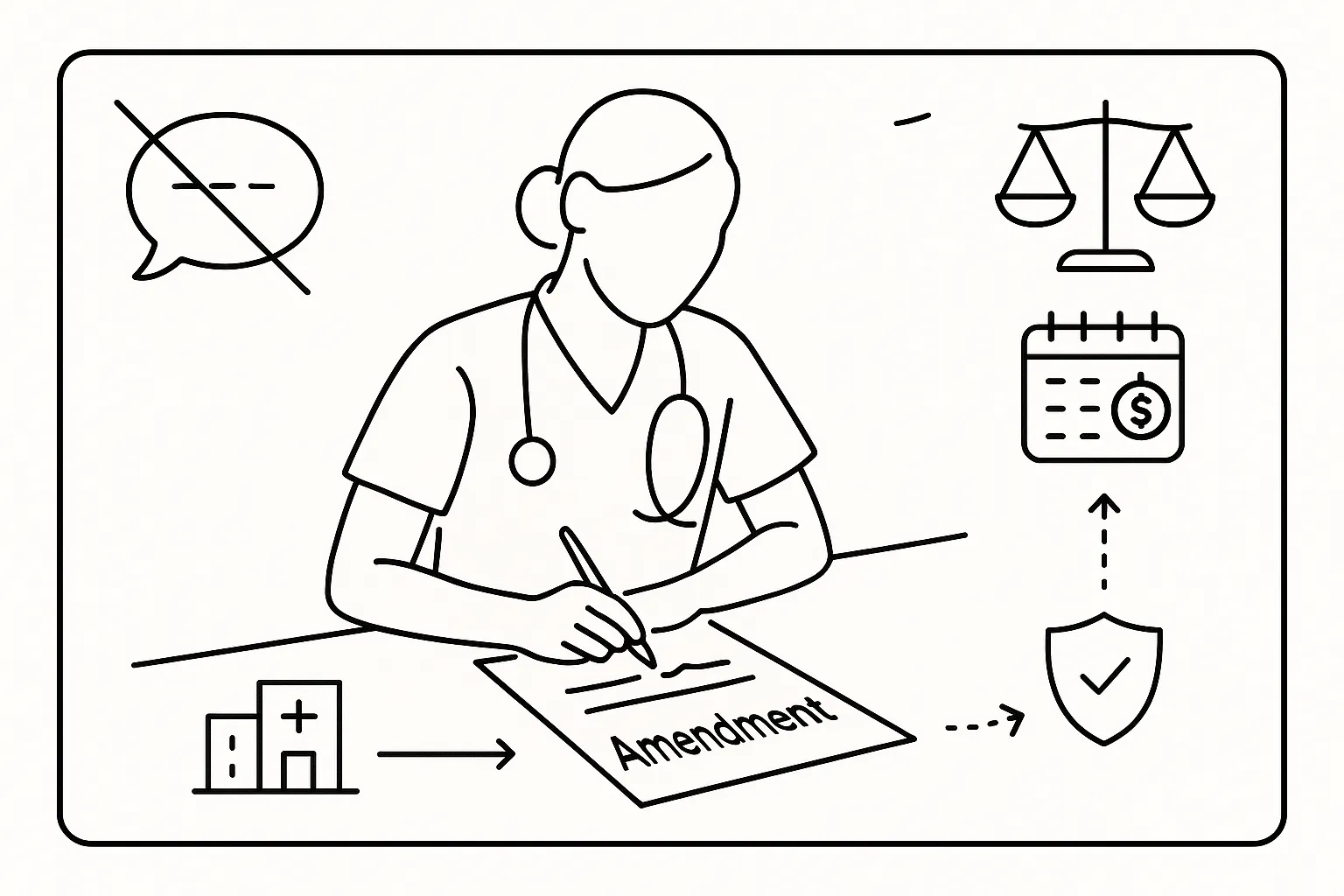
An amendment is appropriate when the parties want the written agreement to reflect a material, ongoing change in their rights or obligations. Typical triggers include a promotion, revised clinical duties, a move from straight salary to base-plus-productivity compensation, assignments at additional facilities, modified hours or call obligations, and changes in reporting lines or supervision.
A written amendment clarifies timing, performance metrics, repayment obligations, and responsibility for risks such as reduced collections or increased expenses. It also creates evidence of the parties’ agreement if a dispute later arises. Verbal assurances or informal emails may leave important terms unresolved, particularly when they do not identify the provisions of the original contract being changed.
Materiality is the central question: does the proposed change affect take-home pay, licensure exposure, future practice opportunities, liability, or post-termination restrictions? If so, it should be documented and reviewed carefully. An amendment that appears limited may still include a retroactive effective date, a broad integration clause, repayment language, or expanded restrictions with consequences extending well beyond the immediate change.
Common Mid-Employment Contract Changes

Amendments vary by employer and practice setting, but the most consequential changes frequently involve compensation, clinical responsibilities, scheduling, work locations, telehealth, and supervision. Each revised term should be evaluated alongside the provisions that remain in the original agreement.
Compensation, Bonuses, and Productivity Formulas
Compensation amendments may convert guaranteed salary into a hybrid model or change how earnings are measured and reconciled. A thorough NP compensation and productivity review should identify the financial effect of changes such as:
- Base salary plus productivity: A guaranteed base with an incentive tied to collections, net charges, or RVUs. An amendment may change the base, productivity threshold, conversion factor, or division of revenue above the threshold.
- Collections-based pay: Compensation tied to cash collections, with potential revisions to which receipts count, how payer adjustments are treated, and when compensation is paid.
- RVU compensation: Payment based on relative value units, with changes to targets, conversion factors, reconciliation periods, or services excluded from credit.
- Bonus structures: One-time or recurring incentives based on productivity, quality metrics, or panel growth. An amendment may make a bonus formulaic or give the employer greater discretion.
Negative accrual and chargebacks deserve particular attention. Negative accrual language can carry a productivity shortfall into a later period and deduct it from future earnings, while chargebacks may require repayment of compensation advances or bonuses after termination or a revenue shortfall. NPs should understand the triggers, calculations, timing, caps, and survival language; the guide to negative accrual in NP contracts explains why these mechanics can materially reduce realized compensation.
For example, an amendment might replace a $95,000 guaranteed salary with a $70,000 base plus 25% of collections above a $200,000 threshold. If it also adds negative accrual, a low-collection period could create a balance carried against later earnings rather than simply eliminating incentive pay. Sample calculations are essential because the formula’s practical effect may not be apparent from the compensation percentage alone.
Clinical Duties, Hours, Locations, and Telehealth
Amendments may broaden clinical duties, add site assignments, revise schedules, impose call coverage, or introduce telehealth responsibilities. A change in supervisory structure or collaborating physicians can affect day-to-day practice and compliance with the applicable state licensing or regulatory authority. Any related documentation should remain consistent with state law and the parties’ actual working arrangement; additional guidance is available on NP supervision and collaboration agreements.
- Additional sites: Specify locations, travel expectations, scheduling authority, credentialing, privileging, and reimbursement of related expenses.
- Expanded hours or call: Define frequency, availability standards, additional compensation, and how call responsibilities interact with ordinary clinical hours.
- Telehealth duties: Address technology, documentation, licensing across state lines, malpractice coverage, and how virtual encounters count toward collections or RVU targets.
- Supervision or collaboration: Identify responsible parties, required agreements, documentation, and responsibility for associated costs.
An amendment that expands clinical scope or work locations without corresponding changes to compensation, malpractice coverage, credentialing support, or supervision may shift both liability and uncompensated work to the NP. Those operational effects should be evaluated before the new responsibilities begin.
How to Request and Evaluate an Amendment
The amendment process should focus on accurate documentation, transparent calculations, and a clear allocation of risk. A structured review helps ensure that the written language reflects the parties’ actual agreement rather than an incomplete summary of the proposed change.
- Document the change and its business rationale. Ask the employer to confirm the reason for the revision and its proposed effective date, including whether any part is intended to operate retroactively.
- Request a complete written amendment. It should identify the exact provisions being replaced or supplemented. Review it together with the current agreement rather than treating it as a standalone document.
- Ask for precise metrics and examples. For compensation changes, request sample monthly or quarterly calculations showing how collections, adjustments, denials, RVUs, thresholds, and reconciliation are treated.
- Identify operational gaps. Determine who is responsible for malpractice coverage, licensing, DEA registration, credentialing, travel, technology, additional premiums, and supervision documentation.
- Compare the amendment with termination terms. Confirm whether the change creates new repayment obligations, modifies notice, affects severance, or changes what happens to earned compensation at departure.
- Allow time for legal review. A line-by-line comparison can reveal definitions, cross-references, and employer-favorable language that are easy to overlook when the amendment is presented as a routine administrative update.
The objective is not simply to confirm the headline change. It is to determine how the amendment modifies the complete allocation of compensation, expenses, regulatory responsibility, liability, and post-employment risk.
Legal and Financial Risks to Review Before Signing
A mid-employment amendment should be reviewed for its immediate financial impact and its longer-term effect on liability and career mobility. Important issues include:
- Compensation mechanics: Verify whether earnings depend on gross charges, net collections, RVUs, or another measure. Confirm payment timing, reconciliation periods, negative balances, chargebacks, look-back periods, caps, and whether repayment obligations survive termination.
- Bonus discretion: Determine whether measurable criteria require payment or whether the employer retains discretion to modify or withhold a bonus. Payout triggers and timelines should be clear.
- Malpractice insurance: Identify whether coverage is occurrence-based or claims-made and who pays for any required tail policy. A focused malpractice and tail insurance review can clarify whether new duties or locations shift coverage costs to the NP.
- Restrictive covenants: Check whether the amendment extends or broadens noncompete, nonsolicitation, or confidentiality provisions. Because enforceability varies by state, an NP non-compete review should consider the governing law, duration, geographic scope, and restricted activities.
- Supervision and regulatory compliance: Compare revised supervisory, collaborative, delegation, and documentation obligations with state-specific practice requirements and the actual clinical relationship.
- Termination and repayment: Determine whether the amendment changes notice periods, severance, immediate termination triggers, earned compensation, bonus repayment, or obligations activated at departure. These changes may warrant a broader contract termination review.
- Classification and benefits: If the amendment changes employment status, control, or hours materially, evaluate the effect on tax classification and benefits rather than assuming the original arrangement remains unchanged.
Consider an amendment that adds telehealth, shifts 20% of productivity measurement to RVUs, leaves base pay unchanged, adds negative accrual, and expands a noncompete. Although each revision may appear separate, the combined effect concentrates financial downside, adds potential liability, and limits future mobility. Reviewing the provisions together translates contract language into practical income, licensing, and career consequences.
Frequently Asked Questions
Should an NP rely on a verbal promise about a compensation or duty change?
A material change should be documented in a written amendment that identifies the affected contract provisions, effective date, calculation methods, and responsibilities of each party. Verbal promises and informal summaries can leave important terms ambiguous and make it harder to establish what was agreed if a dispute develops.
Can a mid-employment amendment apply retroactively?
An amendment may include a retroactive effective date, so the document should be checked carefully before signing. The NP should understand whether the change affects compensation already earned, prior productivity calculations, expenses, or obligations arising before execution.
What compensation details should an NP request before signing an amendment?
The amendment should clearly define the compensation measure, threshold, conversion factor or percentage, payment schedule, reconciliation period, excluded services, and treatment of adjustments or denials. It should also disclose any negative accrual, chargeback, repayment obligation, cap, or balance that survives termination, preferably with sample calculations.
What should an amendment address when telehealth or new locations are added?
The document should address licensing, credentialing, technology, documentation, scheduling, travel, malpractice coverage, supervision, and responsibility for related costs. It should also explain how services at new locations or through telehealth count toward productivity and compensation.
Can an amendment change an NP’s noncompete or termination obligations?
Yes. An amendment may broaden restrictive covenants, change notice requirements, add termination triggers, modify severance, or accelerate repayment obligations. These provisions should be compared with the original agreement and evaluated under the applicable state law.
Why should the entire employment agreement be reviewed with the amendment?
An amendment usually changes only selected provisions while leaving the rest of the agreement in effect. Reviewing both documents together helps identify cross-references, conflicting language, integration terms, and indirect effects on compensation, malpractice coverage, restrictive covenants, and termination rights.
Review an NP Contract Amendment Before You Sign
A mid-employment amendment can affect compensation, liability, termination rights, and future practice options. Chelle Law can review the proposed language alongside your existing agreement and explain its practical consequences.
Contact Chelle LawExplore Nurse Practitioner Contract Guidance
Review legal services, educational resources, and state-specific information for nurse practitioner agreements.