
A nurse practitioner may accept a position, complete onboarding, and prepare to see patients only to learn that facility privileges, professional credentialing, or payer enrollment remains incomplete. The resulting delay is more than an administrative inconvenience. Depending on the employment agreement, it can postpone salary and benefits, prevent the NP from receiving productivity credit, or leave training, administrative duties, and limited clinical work unpaid.
The financial consequences often turn on distinctions that employment contracts do not explain clearly. State licensure, employer credentialing, facility privileging, Medicare enrollment, Medicaid enrollment, commercial payer participation, reassignment, and billing activation are related but separate steps. An NP may be authorized to perform certain duties while the employer remains unable to bill a particular payer. Conversely, payer approval does not necessarily mean that every internal condition for clinical work has been satisfied.
Before signing, an NP needs to understand which event activates compensation, who controls each application, and what happens when an approval is delayed. A focused nurse practitioner contract review can evaluate the start date, credentialing conditions, productivity formula, benefits, termination rights, and repayment obligations together. That analysis helps identify whether the agreement protects the NP’s income or transfers most administrative risk to the clinician.
Key Takeaways
- Licensure, privileging, credentialing, payer enrollment, reassignment, and billing activation are distinct processes that can affect an NP’s start date differently.
- Current federal enrollment guidance does not create a nationwide guarantee of salary during every credentialing delay; compensation depends on the agreement and applicable law.
- Start dates, guaranteed pay, productivity formulas, benefits eligibility, termination rights, and repayment clauses must be read together.
- Medicare revalidation problems can interrupt billing privileges, but payer nonpayment and an employer’s compensation obligations are separate issues.
- Applications, status updates, work records, and compensation calculations can help identify responsibility and document a pay gap.
Credentialing Is Not a Single Administrative Process
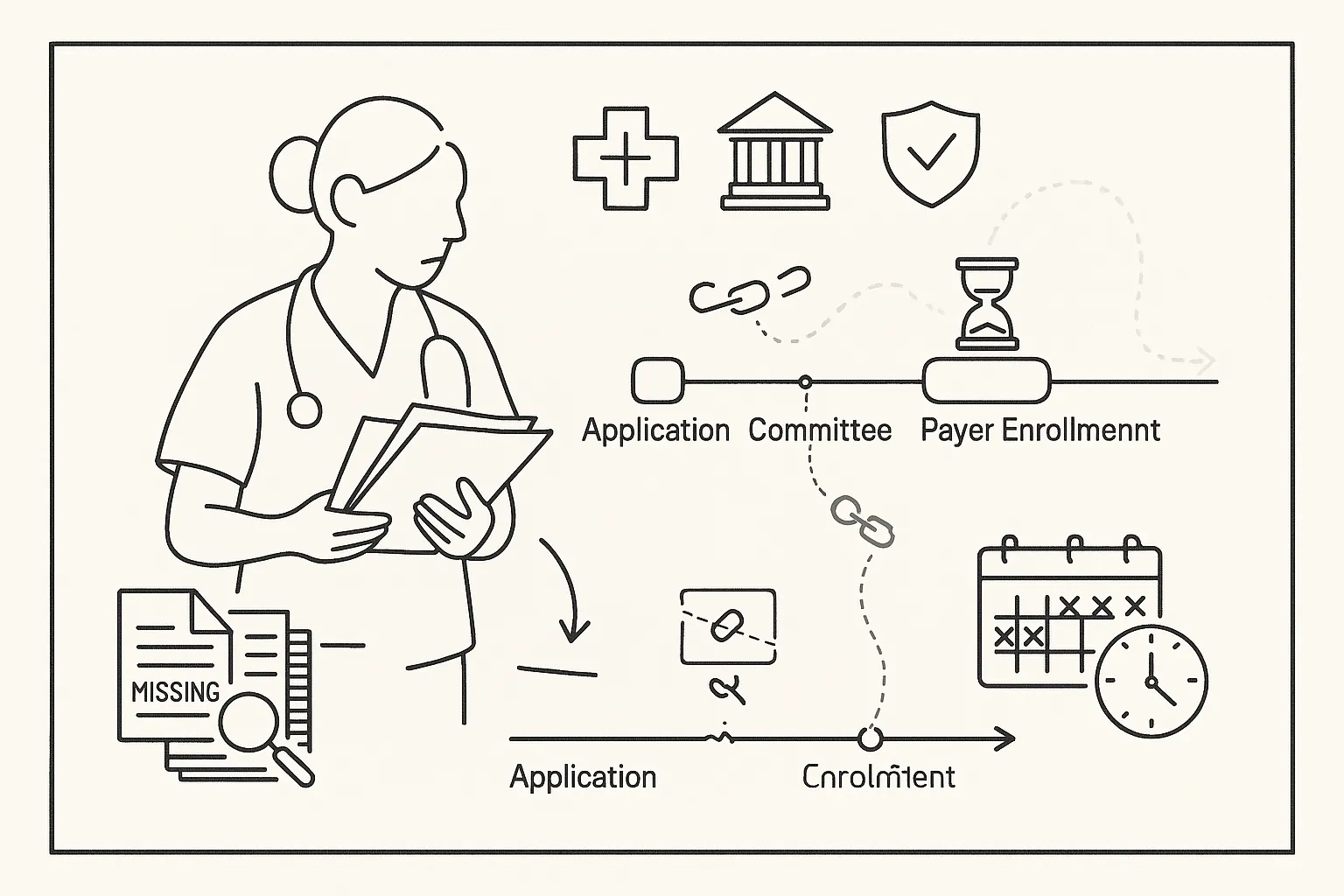
Employers often use “credentialing” as a broad label for several processes involving different organizations. A delay may originate with the NP, an employer, a credentialing vendor, a hospital committee, a licensing agency, Medicare, a state Medicaid program, or a commercial insurer. Identifying the unfinished step matters because it helps determine who controls the next action, whether another approval remains outstanding, and what work the NP can perform in the meantime.
Licensure, Employer Credentialing, and Facility Privileges
Professional licensure establishes authority to practice within the applicable jurisdiction and authorized scope. Employer credentialing usually verifies education, licenses, work history, references, malpractice history, background information, and other qualifications. A hospital or healthcare facility may also require a separate privileging decision that identifies which services the NP may perform at that location.
Incomplete forms, unexplained employment gaps, missing signatures, delayed primary-source verification, reference problems, malpractice-history questions, or committee schedules can slow these steps. Because no universal completion period applies across employers, facilities, and jurisdictions, an agreement is more useful when it defines submission duties and measurable milestones rather than relying on an assumed number of weeks.
Payer Enrollment, Reassignment, and Billing Activation
Payer enrollment determines whether services can be billed under a particular program or health plan. Current CMS provider-enrollment guidance explains that individual NPs generally enroll in Medicare as non-physician practitioners through PECOS or Form CMS-855I after obtaining and maintaining an NPI through NPPES. An NP may also reassign Medicare benefits to an employer or group, but enrollment and reassignment do not necessarily become effective at the same time as employment, internal credentialing, or facility privileges.
Medicaid and commercial payer enrollment are not uniform national processes. States may use different portals, provider categories, and organizational arrangements, while private plans establish their own documentation and effective-date requirements. A contract therefore needs to distinguish the employment start date from payer-specific approval and billing activation rather than treating every administrative step as interchangeable.
Application costs also require precise language. CMS guidance for 2026 states that physicians and non-physician practitioners, including NPs, generally do not pay the federal Medicare enrollment application fee, while the generally applicable fee for certain institutional providers and suppliers is $750. That distinction does not eliminate other possible expenses, including state enrollment, background-check, privileging, vendor, reapplication, or document-verification costs. The agreement can identify which party bears those expenses.
How an Administrative Delay Becomes a Compensation Gap
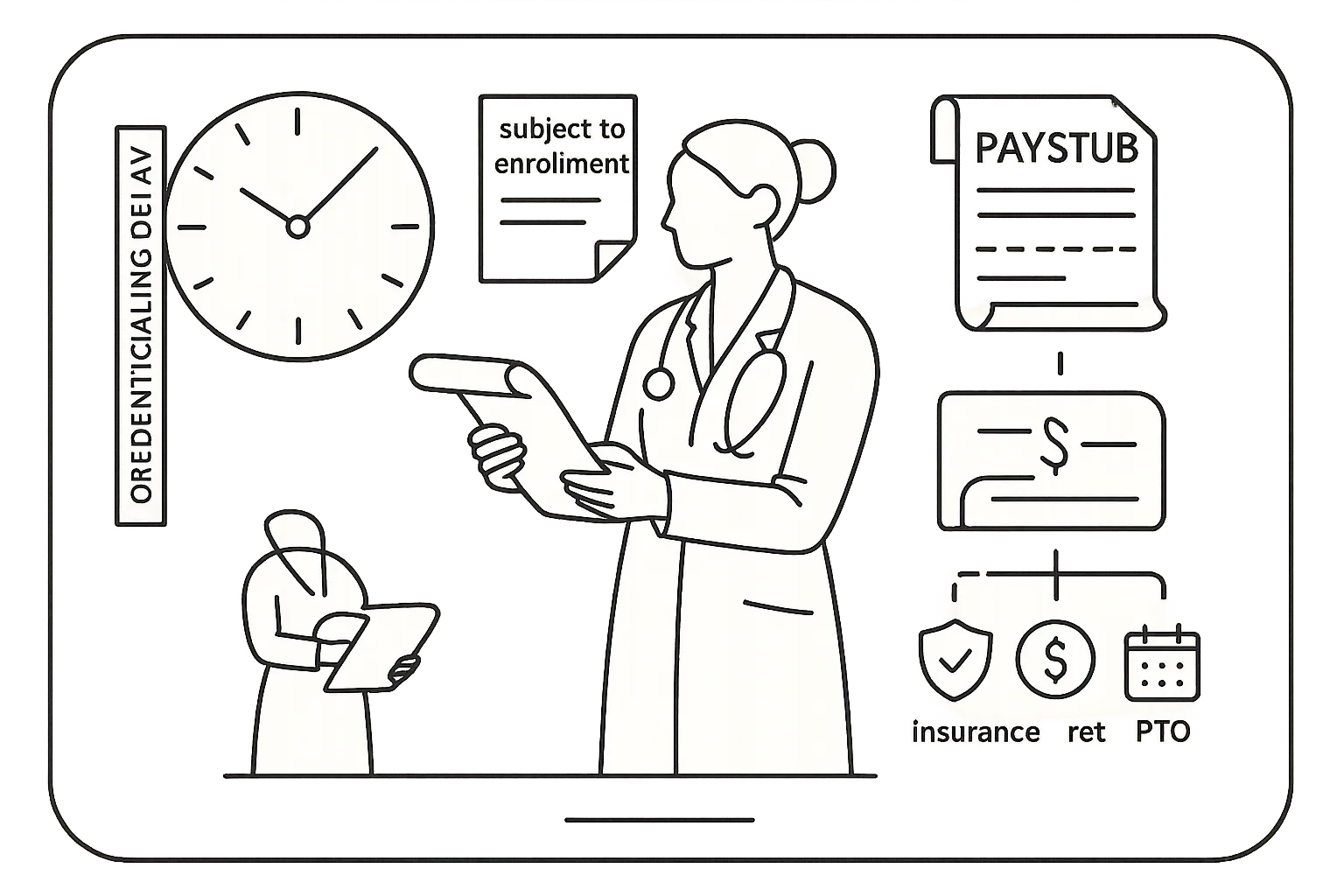
A credentialing delay does not produce the same financial result under every employment agreement. One contract may guarantee base salary from a fixed start date even if payer approval remains pending. Another may state that compensation begins only after credentialing, enrollment, or billing activation. A third may permit the NP to complete orientation or administrative duties but remain silent about how that time will be paid.
The distinction between performing services and generating reimbursable claims is critical. Federal enrollment and reassignment rules address whether and how a payer may reimburse covered services. They do not independently determine whether an employer owes the NP salary, hourly compensation, a draw, benefits, or productivity credit during the delay. Those obligations require analysis of the employment agreement, the work performed, and applicable employment or wage law.
The loss can extend beyond regular wages. A postponed employment effective date may delay health coverage, retirement eligibility, paid leave accrual, or other benefits. If compensation depends on collections, work relative value units, encounters, quality measures, or panel development, the NP may enter the first measurement period with little or no credited production. Understanding the complete NP compensation model is therefore essential.
Productivity provisions can magnify the problem when they contain reconciliation, deficit carryforward, or negative-accrual language. A delay outside the NP’s control may reduce a bonus or create a deficit that offsets later earnings. Contract analysis can determine whether the formula begins before the NP can generate credit, whether the initial target is prorated, and whether administrative delays are excluded from deficit calculations. A dedicated compensation and productivity review can clarify how these provisions distribute financial risk.
Contract Clauses That Allocate Credentialing Risk
No single provision controls every credentialing pay dispute. The practical answer usually emerges only after comparing the agreement’s dates, conditions, compensation terms, benefits language, termination rights, and repayment obligations. Inconsistent drafting creates additional risk. For example, a fixed employment start date may conflict with separate language making all compensation contingent on enrollment.
Dates, Conditions, and Compensation Triggers
An agreement may contain an execution date, effective date, anticipated start date, first-work date, compensation commencement date, benefits eligibility date, and productivity measurement period. Those dates are not necessarily interchangeable. The review needs to determine which obligations begin on each date and whether the employer may move a date unilaterally if an approval remains pending.
- Guaranteed compensation: Does salary or a defined draw begin on a fixed date, or only after a specified approval?
- Authorized work: How will orientation, training, chart review, administrative projects, telehealth, or other permitted duties be compensated?
- Employer responsibilities: Does the agreement identify submission deadlines, follow-up duties, or an escalation process?
- NP responsibilities: What documents must the NP provide, and how quickly must the NP respond to requests?
- Benefits eligibility: Do health coverage, retirement participation, and paid leave begin with employment or a later credentialing event?
Broad language stating that employment or compensation is “subject to credentialing” can be especially consequential when the term credentialing is undefined. The provision may not reveal whether it refers to licensure, internal approval, hospital privileges, Medicare enrollment, participation with every payer, or the ability to submit the first claim. Defining the triggering event reduces uncertainty.
Productivity, Termination, and Repayment Consequences
A salary provision cannot be evaluated separately from the incentive formula. Important questions include whether productivity targets begin during the delay, whether early deficits carry forward, whether the guarantee is recoverable, and how collections received after termination are credited. If the agreement uses negative accrual, the review can determine whether an administrative delay creates a balance that reduces future compensation. The related risks are discussed further in Chelle Law’s resource on negative accrual in NP agreements.
Termination language matters when credentialing takes longer than anticipated. The employer may reserve the right to withdraw the offer, postpone the start date, or terminate the agreement if approval is not obtained. The NP may have a separate without-cause termination right, but using it could activate notice obligations or repayment provisions. A termination provision review can identify how these clauses interact before a delayed start becomes a dispute.
Signing bonuses, relocation payments, training advances, and other recruitment incentives may become repayable if employment does not begin, ends before a stated anniversary, or fails to satisfy a service commitment. The agreement may not excuse repayment when the employer or its credentialing vendor caused the delay. Reviewing the conditions attached to signing bonus repayment can reveal whether an administrative problem may create unexpected debt.
Contract Terms That Can Reduce Financial Exposure
Credentialing risk can be allocated more clearly when the agreement addresses compensation and administrative responsibility directly. A guaranteed salary beginning on a fixed date may provide the strongest income protection. Other arrangements use a reduced guaranteed draw, hourly pay for authorized duties, or a defined interim rate until full clinical and billing activity begins.
- Payment for authorized services: The agreement can explain how clinical, administrative, orientation, training, or other approved work will be compensated while an enrollment remains pending.
- Defined administrative duties: Each party’s submission, response, and follow-up responsibilities can be identified, along with reasonable deadlines.
- A credentialing contact: A designated coordinator and escalation path can reduce confusion when a payer or facility requests additional information.
- Productivity adjustments: The initial measurement period may be delayed or prorated, and employer-controlled delays may be excluded from negative accrual.
- Repayment protection: Bonus, relocation, or training repayment may be excused when employment cannot begin because of an employer-controlled administrative failure.
- Expense allocation: The documents can clarify responsibility for payer, facility, background-check, vendor, and reapplication costs.
The usefulness of any protection depends on how it interacts with the rest of the agreement. A guaranteed draw may provide short-term income but still be recoverable from later productivity. A fixed salary may be undermined by a clause allowing the employer to postpone the effective date. Contract language needs to be evaluated as a coordinated allocation of risk rather than a collection of isolated promises.
Managing a Delay After the Agreement Is Signed
Methodical documentation can help establish what was submitted, which party controlled each step, and what compensation was lost. The NP can maintain a credentialing file containing applications, submission confirmations, requests for additional information, status updates, and relevant correspondence. Oral representations about pay, start dates, interim duties, and employer responsibilities are more useful when confirmed in writing.
- Track hours worked, training completed, clinical services provided, and administrative duties performed.
- Record missed salary, delayed benefits, and bonus opportunities using the contract’s actual compensation formula.
- Request written status updates and identify whether the pending step involves the employer, facility, payer, or NP.
- Confirm whether interim work changes benefits eligibility, productivity targets, professional liability coverage, or repayment obligations.
- Preserve versions of applications and records showing when requested information was supplied.
Medicare enrollment also requires continuing attention after initial approval. Current CMS revalidation guidance states that most providers and suppliers revalidate every five years. Late revalidation may lead to payment holds or deactivation of billing privileges, and CMS states that Medicare will not reimburse services furnished during a deactivated period. That revenue consequence can be significant, but it still does not independently decide whether an employer owes the NP contractual compensation.
An employer may offer temporary salaried or per diem work, a draw against future productivity, telehealth assignments, training, or administrative projects while an approval remains pending. Each arrangement requires evaluation of compensation, licensing, scope of practice, supervision or collaboration requirements, malpractice coverage, benefits, and future reconciliation. An informal workaround can create additional problems if it is inconsistent with the employment agreement or applicable practice requirements.
When a Credentialing Pay Gap Warrants Legal Review
Attorney review may be appropriate when compensation language is ambiguous, the employer misses a written obligation, or the employer’s actions conflict with its stated responsibilities. Warning signs include failure to submit materials as promised, an indefinite compensation contingency, unpaid authorized work, termination while compensation remains outstanding, or a demand to repay money after an employer-controlled delay.
Potential remedies depend on the agreement, governing law, work performed, and surrounding facts. The contract may require arbitration, establish notice procedures, restrict available damages, or set deadlines for raising a dispute. Early review can help assess unpaid-compensation, breach-of-contract, wage, repayment, and termination issues without assuming that every delayed approval creates a legal claim.
Frequently Asked Questions
Can an employer delay an NP’s pay until credentialing is complete?
The answer depends on the employment agreement, the work performed, and applicable law. Some contracts guarantee compensation from a fixed start date, while others condition pay on credentialing, payer enrollment, billing activation, or collections. Federal payer-enrollment rules do not independently create a nationwide right to salary during every delay.
Which dates matter most when credentialing remains pending?
Compare the effective date, anticipated start date, first-work date, compensation commencement date, benefits eligibility date, credentialing deadlines, and productivity measurement period. If the dates differ, the agreement needs to clarify which obligations begin at each stage and whether either party may change them.
Can a credentialing delay reduce an NP’s productivity bonus?
Yes. Bonuses based on RVUs, collections, encounters, patient panels, or quality measures may decline when the NP cannot generate credit during the delay. Reconciliation and negative-accrual provisions can further reduce future earnings unless the formula excludes or adjusts for administrative delays.
Does Medicare enrollment determine whether an employer must pay the NP?
No. Medicare enrollment, reassignment, and billing rules determine whether and how covered services may be reimbursed. They do not by themselves establish whether the employer owes salary, hourly pay, benefits, a draw, or productivity credit. Those obligations depend on the contract and applicable law.
What records should an NP preserve during a credentialing delay?
Preserve applications, submission confirmations, emails, requests for additional information, status updates, hours worked, services performed, and calculations of lost salary or incentive compensation. These records can help identify responsibility for the delay and document its financial effect.
When should an NP seek legal review over a credentialing pay gap?
Review may be appropriate when the compensation language is unclear, the employer misses written deadlines, unpaid work accumulates, employment is threatened or terminated, or the employer demands repayment because credentialing was delayed. The analysis needs to account for governing law and the agreement’s notice and dispute-resolution provisions.
Review a Credentialing Pay Gap Before It Escalates
Chelle Law reviews nurse practitioner agreements to identify compensation conditions, credentialing responsibilities, productivity risks, repayment obligations, and termination provisions that may affect income during an administrative delay.
Contact Chelle LawExplore Nurse Practitioner Contract Guidance
Review legal services, practical contract resources, and state-focused guidance for nurse practitioners.