
Credentialing delays are a common and consequential issue for nurse practitioners entering new employment or changing practice settings. A hold-up can disrupt income, delay benefits, reduce productivity compensation, or trigger repayment and negative accrual provisions when contract language favors the employer. A thorough nurse practitioner contract review can identify these risks before signing. This guide explains how credentialing delays arise, how they create pay gaps, which contract clauses control compensation, what steps can reduce financial exposure, and when legal review may be appropriate.
Key Takeaways
- NP credentialing delays can create immediate pay gaps when contracts tie compensation to active billing or payer enrollment.
- Review the start date, effective date, and credentialing-contingent language before signing to determine whether minimum pay is guaranteed.
- Guaranteed minimum compensation, payment-for-services language, and documented employer responsibilities can shift some credentialing risk away from the NP.
- During prolonged credentialing, preserve submissions, emails, hours worked, and lost-bonus calculations to create an audit trail.
- Legal review may be warranted when contract language is ambiguous, employer deadlines are missed, or repayment and clawback provisions create unexpected liabilities.
How Nurse Practitioner Credentialing Delays Occur
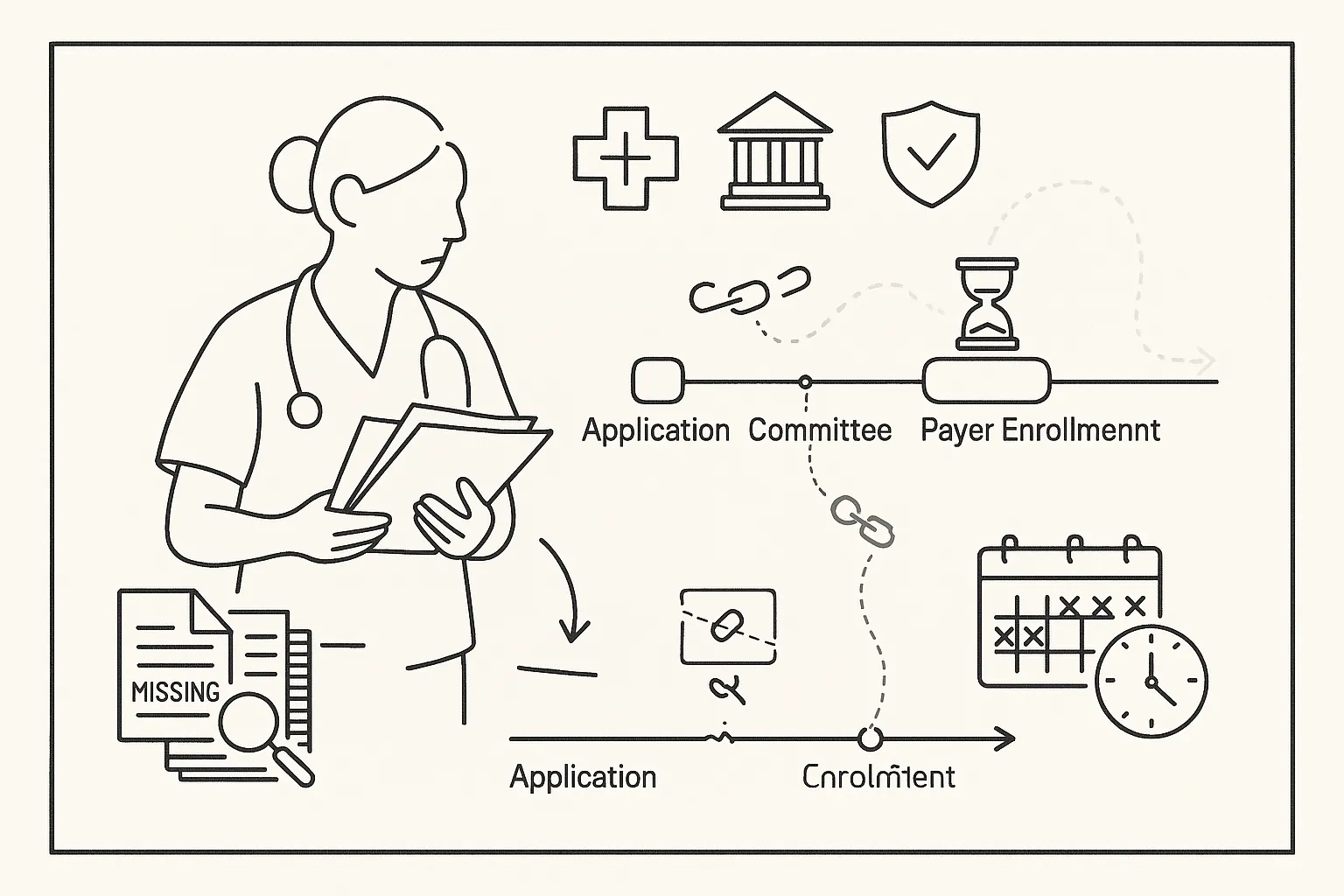
Credentialing is an administrative, credential-verification, privileging, and payer-enrollment process involving hiring organizations, health systems, hospitals, state licensing boards, and payers such as Medicare, Medicaid, and commercial insurers. Delays may arise from incomplete application materials, gaps in employment dates, missing references, incomplete signatures, employer or vendor backlogs, slow primary-source verification, payer enrollment cycles, infrequent committee meetings, or issues requiring manual follow-up during background, malpractice, DEA, or license verification.
Timelines vary by setting and payer. Internal health system privileging may take 2–8 weeks with complete documentation and 12 weeks or longer when committee review is required. Commercial payer credentialing and Medicare or Medicaid enrollment may take 60–120 days, while some backlogs extend beyond 180 days. These figures are benchmarks rather than guarantees, so the NP should obtain expected milestones in writing, including application submission dates, committee review windows, and payer enrollment submissions.
How Credentialing Delays Create Pay Gaps
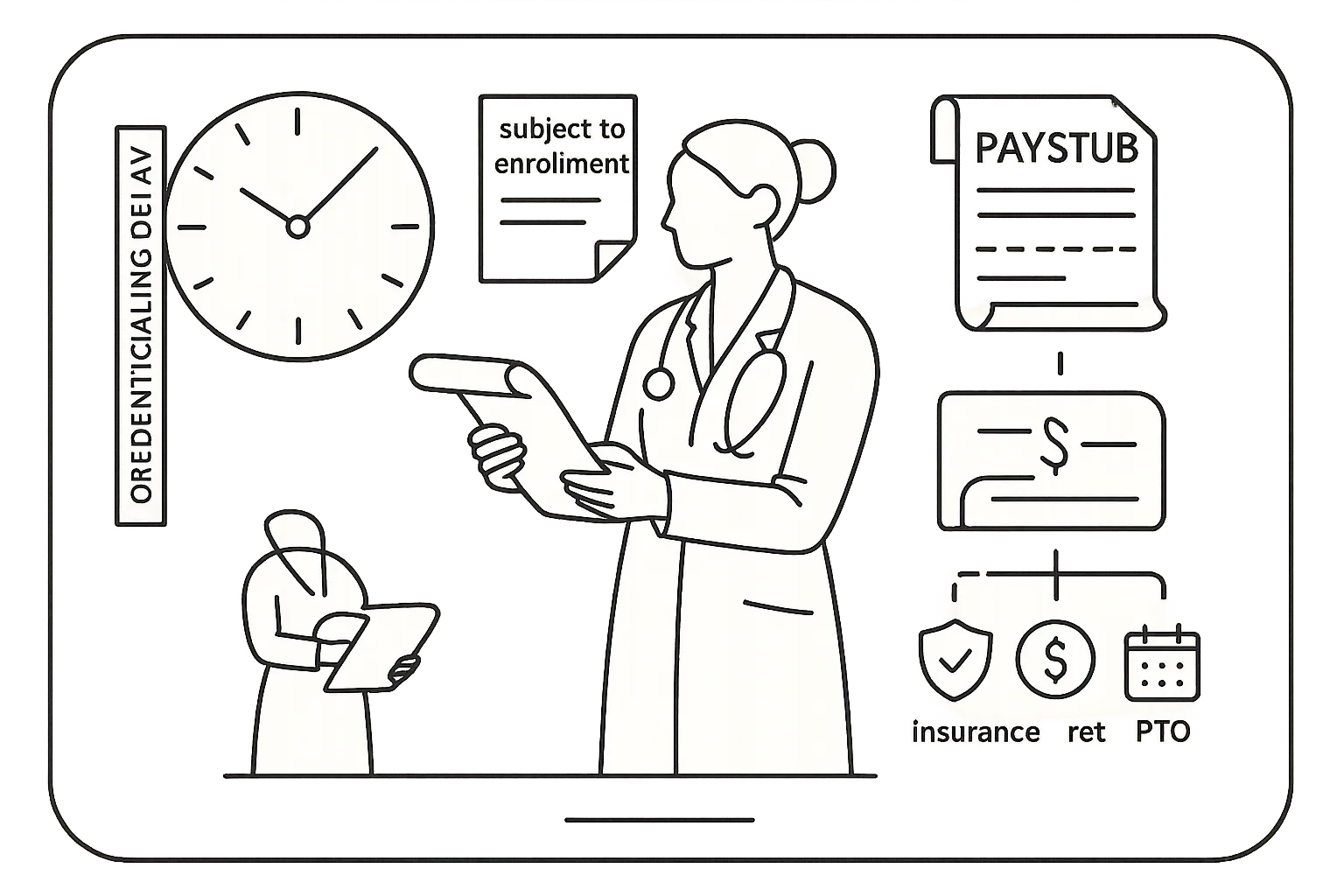
When credentialing prevents an NP from billing for professional services, the employer’s response depends largely on the contract. Some employers provide retroactive pay for services performed after the agreed start date once credentialing is complete. That protection should be stated clearly and should specify the employer’s obligation to compensate the NP for work performed during the credentialing period.
Other agreements make compensation contingent on active credentialing, payer enrollment, billing, or collections. Language such as “compensation commences upon completion of credentialing” or “subject to payer enrollment” can leave the NP without guaranteed compensation during an administrative delay. The agreement should clarify whether clinical, administrative, training, or onboarding work performed during that period will be paid.
The financial effect can extend beyond base salary. A delayed effective date may postpone health insurance, retirement participation, paid time off accrual, or other benefits. It can also reduce bonuses tied to collections, RVUs, panel metrics, or active billing. NPs considering these arrangements should understand their broader compensation model and whether the formula allows negative accrual when early production falls below a threshold for reasons outside the NP’s control.
Contract Terms That Control Pay During Credentialing
Start-date, effective-date, and credentialing-contingent clauses determine when contractual obligations begin. An employer may define the start date as the first day the NP performs work but delay the effective date for compensation and benefits until credentialing is complete. Broad contingency language without an employer deadline or corresponding duty to act places most of the administrative risk on the NP.
- Start date and effective date: Confirm whether employment, compensation, benefits, and bonus eligibility begin on the same date.
- Credentialing contingency: Determine which obligations depend on privileging or payer enrollment and whether the employer can delay those obligations indefinitely.
- Termination rights: Review whether the employer may terminate the agreement while credentialing is pending and whether notice or minimum compensation remains due. A focused termination provision review can clarify these consequences.
- Repayment and clawback provisions: Identify whether signing bonuses, relocation payments, or training advances become repayable if a delay shortens employment or prevents the NP from starting. These terms should be evaluated alongside the risks of signing bonus repayment provisions.
Collectively, these clauses can turn an administrative delay into unpaid work, lost benefits, reduced incentive compensation, or unexpected debt. They should be read together rather than reviewed in isolation.
Contract Protections That Can Reduce Credentialing Risk
Income protections can allocate credentialing risk more fairly when the employer controls much of the administrative process. A guaranteed minimum salary payable from the agreed start date can protect immediate income regardless of payer enrollment. Depending on the arrangement, this may be full base salary or a reduced guaranteed draw against future productivity.
- Payment-for-services language: Require compensation for bona fide clinical, administrative, training, or other authorized work performed during credentialing.
- Employer timelines: Document when the employer must submit applications, respond to requests, and pursue delayed or denied enrollment.
- A designated point person: Identify a credentialing coordinator and escalation path if expected milestones are missed.
- Fee responsibility: Clarify who pays initial application fees, reapplication expenses, and costs resulting from administrative errors.
- Protection from employer-caused delays: Address whether the NP will be held harmless from lost pay, reduced bonuses, negative accrual, or repayment obligations caused by the employer’s failure to act.
Accepting open-ended contingency language without guaranteed pay shifts most credentialing risk to the NP. The value of a proposed protection depends on how it interacts with the complete compensation, termination, and repayment provisions.
What to Do During a Prolonged Credentialing Delay
Methodical documentation can help establish what was submitted, which party controlled each step, and what compensation was lost. Maintain a credentialing packet and timeline containing applications, confirmations, emails, requests for additional information, and submission dates. Confirm oral representations about pay, start dates, and employer responsibilities in writing.
- Track hours worked, clinical services provided, training completed, and administrative duties performed.
- Record missed bonus opportunities and the metrics used to calculate productivity or collections-based pay.
- Request written status updates from the credentialing coordinator and preserve the employer’s responses.
- Review how an interim arrangement affects benefits, paid time off, productivity calculations, and repayment obligations.
Employers may offer temporary salaried or per diem work, a guaranteed draw against future productivity, or telehealth and administrative duties while credentialing continues. Each option should be evaluated for compensation, licensing, scope-of-practice, benefits, and contract consequences rather than treated as an informal workaround.
When Legal Review May Be Appropriate
Attorney review may be appropriate when the contract is ambiguous, the employer misses written deadlines, or the employer’s actions conflict with its stated obligations. Warning signs include failure to submit credentialing materials as promised, an indefinite compensation contingency without employer responsibilities, termination while funds remain unpaid, or a demand to repay compensation without clear contractual support.
Potential remedies depend on the contract, governing law, and facts. The agreement may require arbitration, limit available damages, or define notice and dispute-resolution procedures. Early review can help evaluate whether unpaid compensation, breach-of-contract, payment-for-services, wage, or other remedies may apply without assuming that every credentialing delay creates a legal claim.
Frequently Asked Questions
Can an employer delay an NP’s pay until credentialing is complete?
The answer depends on the employment agreement and applicable law. Some contracts guarantee compensation from the agreed start date, while others condition pay on credentialing, payer enrollment, billing, or collections. The contract should state clearly whether authorized work performed during the credentialing period will be paid.
Which contract dates matter most when credentialing is pending?
The start date, effective date, compensation commencement date, benefits eligibility date, and any credentialing deadline should be compared. If these dates differ, the NP should determine which obligations begin on each date and whether the employer may postpone them.
Can a credentialing delay reduce an NP’s productivity bonus?
Yes. Bonuses based on RVUs, collections, patient panels, or active billing may be reduced when the NP cannot generate credit during credentialing. Reconciliation and negative accrual provisions can also affect future compensation if the contract does not protect the NP from administrative delays.
What contract terms can protect income during credentialing?
Potential protections include guaranteed minimum pay, a defined draw, payment for authorized services, employer submission deadlines, a designated credentialing contact, clear fee responsibility, and protection from negative accrual or repayment obligations caused by employer-controlled delays.
What records should an NP preserve during a credentialing delay?
Preserve applications, submission confirmations, emails, requests for additional information, status updates, hours worked, services performed, and calculations of lost salary or bonus compensation. Written records can help identify responsibility for the delay and support later contract review.
When should an NP seek legal review over a credentialing pay gap?
Legal review may be appropriate when compensation language is unclear, the employer misses written obligations, unpaid work accumulates, employment is threatened or terminated, or the employer demands repayment because credentialing was delayed. Review should account for the contract’s governing law and dispute-resolution terms.
Concerned About a Credentialing Pay Gap?
Chelle Law reviews nurse practitioner agreements to identify compensation contingencies, credentialing responsibilities, repayment risks, and termination provisions before they create avoidable financial exposure.
Contact Chelle LawExplore Nurse Practitioner Contract Guidance
Review legal services, practical contract resources, and state-specific guidance for nurse practitioners.