
A nurse practitioner floating clause allows an employer to assign an NP beyond a single clinic, hospital unit, facility, or service line. Floating may involve occasional coverage for an absence, a regular rotation among worksites, telehealth services for patients in other jurisdictions, or reassignment when patient volume changes. Although this flexibility can broaden clinical experience and help an organization meet staffing needs, vague contract language may give the employer significant control over where, when, and under what conditions the NP works.
The practical consequences extend well beyond commuting to another location. A floating assignment can affect the NP’s authorized scope of practice, clinical privileges, orientation, supervision or collaboration arrangements, payer enrollment, malpractice coverage, schedule, call obligations, and productivity compensation. An assignment that appears operationally routine may create substantial risk if it involves a different patient population, higher-acuity setting, unfamiliar procedures, another billing entity, or patients located in a state where the NP lacks the required authority to practice.
Contract review focuses on the boundaries surrounding the employer’s reassignment power. Chelle Law evaluates the floating clause together with incorporated policies, compensation formulas, insurance provisions, scheduling terms, and termination language. The goal is to identify open-ended obligations, determine how related provisions interact, and clarify which assignment limits or financial protections may warrant revision before the agreement is signed.
Key Takeaways
- A floating clause can define permitted facilities, geographic boundaries, service lines, schedules, and clinical duties instead of allowing unrestricted reassignment.
- Employer assignment language cannot expand an NP’s legal scope of practice, licensure, certification, competency, or clinical privileges.
- Facility credentialing, payer enrollment, billing reassignment, orientation, and supervision or collaboration requirements may differ between locations.
- Malpractice coverage must be confirmed through the actual policy, endorsements, exclusions, covered entities, locations, and services—not merely the employment contract.
- Compensation terms can address travel expenses, floating differentials, non-billable coverage, productivity credit, and target adjustments.
How Floating Changes an NP’s Work

Floating generally means that an NP may be assigned outside the primary unit, clinic, facility, or service line identified in the agreement. The assignment may last for a single shift, continue while another employee is on leave, or become part of a recurring multi-site schedule. Floating provisions are common in hospitals, urgent care networks, multi-location primary care groups, specialty practices, and organizations using NPs for remote patient care.
The term can encompass very different responsibilities. Covering another primary care office may present limited clinical change, while moving from an outpatient practice to an emergency department, intensive care unit, surgical service, or unfamiliar specialty can raise questions about competency, privileges, support, and liability. Telehealth assignments add a separate patient-location analysis because remote care is generally treated as practice where the patient is located.
Employers often use floating to respond to fluctuating patient volume, vacancies, absences, and unexpected coverage needs. The central contract issue is therefore not whether floating is inherently inappropriate, but whether the employer’s authority has understandable limits. Broad phrases such as “other duties as assigned,” “any location as needed,” or “any facility within the system” may permit changes to commute time, patient acuity, scheduling, workload, and clinical responsibilities without a corresponding adjustment to compensation.
Define the Employer’s Reassignment Authority
A floating provision is easier to evaluate when it identifies both the NP’s primary assignment and the circumstances in which reassignment may occur. Contract language may be narrow, naming particular clinics and departments, or broad enough to cover future affiliates and facilities the employer later acquires. Incorporated handbooks and scheduling policies also matter, particularly when the agreement permits the employer to revise those policies unilaterally.
Locations, Units, and Clinical Responsibilities
The location language can identify approved facilities, departments, service lines, or a reasonable geographic boundary. It may also explain whether the employer can add worksites, make a temporary assignment permanent, or require services for a separate affiliated entity. These details become particularly important in large healthcare systems, where a reference to all affiliated facilities can encompass substantially different commutes, patient populations, staffing models, and workflows. Similar issues arise when an NP is regularly assigned to multiple practice locations.
Clinical limits deserve equal attention. A clause may restrict assignments to work consistent with the NP’s education, population focus, certification, demonstrated competency, privileges, and legal practice authority. It can also identify settings that require separate consent, additional training, or a different compensation arrangement. A general contractual promise to perform assigned duties does not itself establish that the NP is qualified, privileged, insured, or legally authorized to provide every requested service.
Schedules, Call, and Advance Notice
Reassignment can change more than the workplace. A floated shift may involve different start and end times, weekend coverage, overnight work, on-call duties, increased patient loads, or additional charting responsibilities. The employment agreement and incorporated policies must be read together to determine how much discretion the employer retains over those terms.
Potential protections include advance notice when practicable, limits on consecutive floating shifts, defined call expectations, and workload parameters appropriate to the assigned setting. An NP may also need to understand whether refusing a particular assignment could trigger discipline or a for-cause termination provision. A separate review of call coverage requirements can help clarify how reassignment interacts with after-hours availability and scheduled clinical work.
Licensure, Scope, Credentialing, and Billing
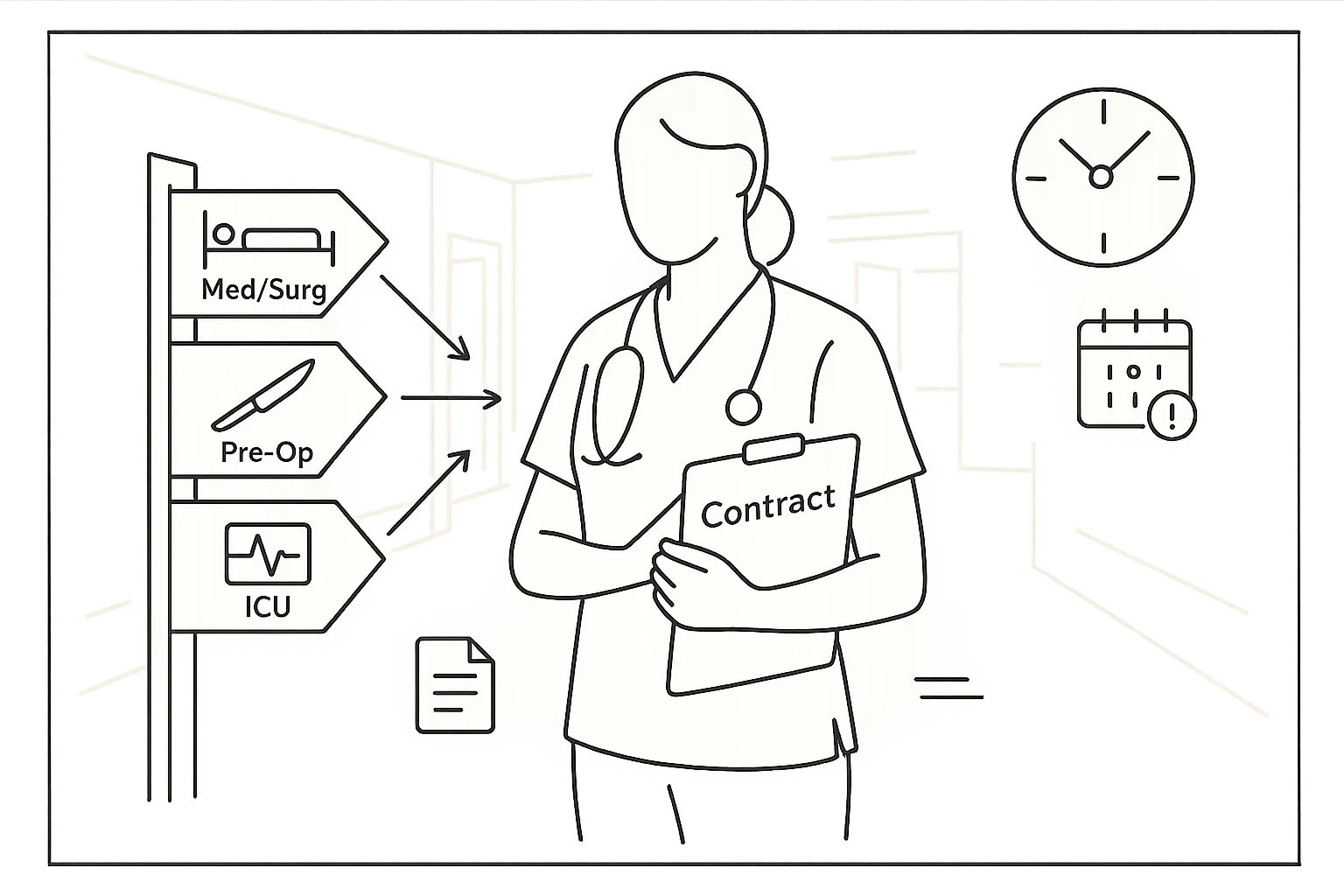
Professional licensure, facility credentialing, clinical privileges, payer enrollment, and billing reassignment are related but distinct requirements. Approval in one category does not necessarily satisfy the others. Before an NP begins working in a different facility or jurisdiction, the parties may need to confirm each requirement separately and determine who is responsible for applications, fees, administrative time, and delays.
Scope of Practice and Patient-Location Rules
An employer cannot enlarge an NP’s lawful scope through contract language. The assignment must remain consistent with the law governing the location of practice, as well as the NP’s education, certification, competence, and authorized population focus. The NCSBN’s current licensure guidance also explains that telehealth and other remote nursing services occur where the patient is located. An NP asked to provide virtual coverage across state lines must therefore evaluate the patient’s location, applicable license or privilege, prescribing authority, and any state-specific practice requirements.
A multistate privilege does not eliminate every jurisdiction-specific requirement, and an employer’s internal approval does not substitute for legal authority to practice. Contract analysis should examine whether the proposed role could extend beyond the locations or services originally contemplated. Broader scope-of-practice concerns in NP agreements may also affect supervision, collaboration, prescribing, delegation, and the procedures included in a floating assignment.
Credentialing, Privileges, Enrollment, and Supervision
Existing credentials and privileges may not automatically extend to another hospital, department, specialty, or affiliated entity. A new assignment can require facility credentialing, clinical privileges, payer enrollment, electronic health record access, unit-specific orientation, skills verification, or supervised training. The contract can clarify whether the NP remains paid while completing those requirements and what happens if administrative delays prevent scheduled work.
Billing also warrants review. CMS guidance for advanced practice registered nurses ties covered NP services to legal authorization under the law of the state where the services are provided. Multi-site assignments may additionally require confirmation of the billing entity, the NP’s enrollment status, any reassignment of benefits, place-of-service rules, and facility or payer requirements. Those issues can determine whether floated services are billable and whether they generate credit under a productivity formula.
Supervision and collaboration requirements vary by state, facility, service, payer, and billing method. Moving to another unit may change the collaborating clinician, reporting structure, delegation arrangement, or professional support available to the NP. Virtual supervision is not a universal substitute for in-person requirements; Medicare rules are service- and setting-specific. A focused review of supervision and collaboration terms can identify gaps between the employment agreement and the actual floating model.
Malpractice Coverage for Floated Assignments
Malpractice protection must cover the services actually performed, not merely the role initially described during recruitment. The review should examine whether the policy applies to each facility, affiliated entity, jurisdiction, patient population, and clinical service included in the floating arrangement. Assignments involving higher-acuity care, unfamiliar procedures, telehealth, or work in another state may implicate exclusions or conditions that are not apparent from the employment agreement alone.
The contract may summarize coverage, but the controlling details are found in the insurance policy, declarations, endorsements, exclusions, and definitions of covered professionals and entities. An NP should verify the policy limits, whether defense costs reduce those limits, and whether the employer’s coverage protects the NP individually. The presence of an employer policy does not necessarily eliminate the need to evaluate separate professional liability protection.
Coverage type also matters. Occurrence coverage generally responds based on when the event happened, while claims-made coverage generally depends on when the claim is made and whether coverage remains in effect. Claims-made arrangements may require extended reporting, commonly called tail coverage, after employment ends or the policy changes. A malpractice and tail insurance review can evaluate whether the allocated responsibility matches the NP’s floating duties and post-employment exposure.
Compensation, Productivity, Travel, and Workload
Floating can reduce total compensation even when base salary remains unchanged. Reassignment may create additional commuting time, parking costs, mileage, lodging expenses, or unpaid administrative work. Some agreements provide a floating differential, shift premium, travel reimbursement, or higher rate for assignments outside the primary location or in a higher-acuity environment. Others treat reassignment as part of the regular salary regardless of the added burden.
Productivity compensation creates additional complexity. A floated NP may see fewer patients, spend time in orientation, perform non-billable coverage, or work under a billing arrangement that does not generate the same RVUs or collections. The formula must be examined to determine whether these shifts count toward thresholds, how services are attributed, and whether time outside the NP’s control can cause a bonus shortfall. NPs paid under production-based models can benefit from a broader compensation and productivity review.
Negative accrual and reconciliation provisions can intensify the problem. If an NP remains responsible for the same target despite losing billable time to cross-coverage, orientation, or low-volume assignments, the shortfall may carry forward or reduce a later bonus. Possible contract approaches include productivity credit for floated work, target adjustments, guaranteed compensation for designated shifts, or a separate rate for coverage that cannot reasonably generate production.
Workload terms have financial and professional consequences as well. Patient caps, adequate clinical support, reasonable notice, rest between shifts, and limits on consecutive reassignments may reduce burnout and help preserve patient safety. These provisions are best evaluated with the agreement’s broader schedule-control, call, leave, and termination language rather than as an isolated floating issue.
Questions to Resolve Before Accepting a Floating Clause
A useful review converts broad reassignment language into practical questions. Depending on the position, an NP may need clarification on the following points:
- What is the primary worksite, and which other facilities, units, service lines, or geographic areas are included?
- Can the employer add a location, affiliate, patient population, or specialty assignment without the NP’s written agreement?
- Are assignments limited to work consistent with the NP’s licensure, population focus, certification, privileges, training, and demonstrated competency?
- Who is responsible for licensure, credentialing, payer enrollment, billing reassignment, orientation, and associated fees?
- How much scheduling notice applies, and can floating add call, weekend, overnight, or holiday obligations?
- Will the employer reimburse mileage, parking, lodging, licensure costs, or other travel expenses?
- How will orientation, cross-coverage, administrative time, and low-volume shifts affect RVU, collections, quality, or bonus calculations?
- Does the actual malpractice policy cover every contemplated location, entity, jurisdiction, and clinical service?
- What happens if the NP raises a competency, licensure, credentialing, or patient-safety concern about an assignment?
Verbal statements from a recruiter or manager may not modify a contract containing an integration clause or broad employer-discretion language. Material assignment limits, compensation protections, and coverage commitments are more reliable when incorporated into the signed agreement or a written amendment. A comprehensive NP employment agreement review can assess the floating provision alongside compensation, malpractice insurance, restrictive covenants, incorporated policies, and the consequences of declining or ending the arrangement.
Frequently Asked Questions
Can an employer require a nurse practitioner to float to any location?
The answer depends on the employment agreement, incorporated policies, and applicable professional requirements. Broad language may give the employer substantial reassignment authority, but it cannot expand the NP’s licensure, legal scope, competency, or clinical privileges. A narrower clause may limit floating to named facilities, departments, geographic areas, or qualified duties.
What details belong in an NP floating clause?
The provision may address the primary worksite, permitted locations and units, clinical limits, scheduling notice, travel reimbursement, orientation, credentialing, payer enrollment, supervision or collaboration, malpractice coverage, and productivity credit. The appropriate detail depends on the employer’s actual assignment model.
Can an NP decline an assignment outside their competency?
An NP should promptly raise concerns when an assignment appears inconsistent with the NP’s education, certification, population focus, privileges, demonstrated competency, or legal practice authority. The appropriate response depends on the circumstances, employer procedures, contract terms, patient-safety considerations, and governing professional obligations.
How should floating shifts affect an NP productivity bonus?
The agreement should explain how floating shifts, orientation, administrative time, non-billable coverage, and services billed through another entity affect RVU, collections, quality, or other incentive formulas. Possible approaches include full productivity credit, an adjusted target, guaranteed compensation, or a separate coverage rate.
Does malpractice insurance automatically cover every floating assignment?
No coverage assumption should be based solely on the employment contract. The actual policy, declarations, endorsements, limits, exclusions, covered entities, locations, jurisdictions, and services must be reviewed. Claims-made coverage also requires clarification of responsibility for tail insurance after employment ends.
When is legal review of a floating requirement especially useful?
Review is particularly useful when the clause permits open-ended reassignment, involves multiple states or high-acuity settings, changes compensation or scheduling, or leaves training, credentialing, billing, supervision, malpractice coverage, and travel costs unclear. It can also identify how the floating provision interacts with termination and disciplinary language.
Have Your NP Floating Clause Reviewed Before You Sign
Chelle Law reviews assignment limits, scope and credentialing concerns, compensation formulas, travel obligations, malpractice coverage, and related contract risks affecting floating work.
Contact Chelle Law