
A nurse practitioner quality bonus can look straightforward on an offer letter: meet defined performance goals and receive an additional payment. The actual calculation is often spread across the employment agreement, a compensation plan, quality-measure specifications, employer policies, and reports the NP may not receive until after the measurement period. A promised target bonus therefore does not establish how much the NP will earn unless the documents also explain the formula.
Quality incentives also need to be distinguished from productivity bonuses, RVU compensation, collections-based pay, and incentives tied to the financial performance of a practice. Many compensation plans combine several of these methods. When a plan blends quality and productivity, a strong quality score may not produce the expected payment if the NP misses a separate productivity threshold, quality gateway, or minimum-hours requirement.
Calculation disputes usually begin with an undefined term, an unexpected data source, or a reconciliation method that was not clear when the NP accepted the position. Chelle Law reviews the metric definitions, attribution rules, thresholds, weighting, payment timing, audit access, and repayment language that determine whether the stated bonus is realistically attainable and independently verifiable.
Key Takeaways
- A target bonus is incomplete without the formula, metric specifications, attribution method, data source, measurement period, weighting, thresholds, and payment schedule.
- Common errors involve the wrong denominator, excluded encounters, inconsistent weighting, changed benchmarks, rounding, delayed claims, or a different reporting period from the one stated in the plan.
- Quality measures need rules for patient refusal, loss to follow-up, payer attribution, incomplete data, and other factors the NP may not control.
- Scorecards, EHR reports, productivity records, calculation workpapers, and written communications can help identify where the employer’s result differs from the contractual formula.
- Clawbacks and payroll offsets require contract-specific and state-specific analysis; the agreement alone may not answer every wage-deduction or final-pay question.
How an NP Quality Bonus Formula Produces a Payment
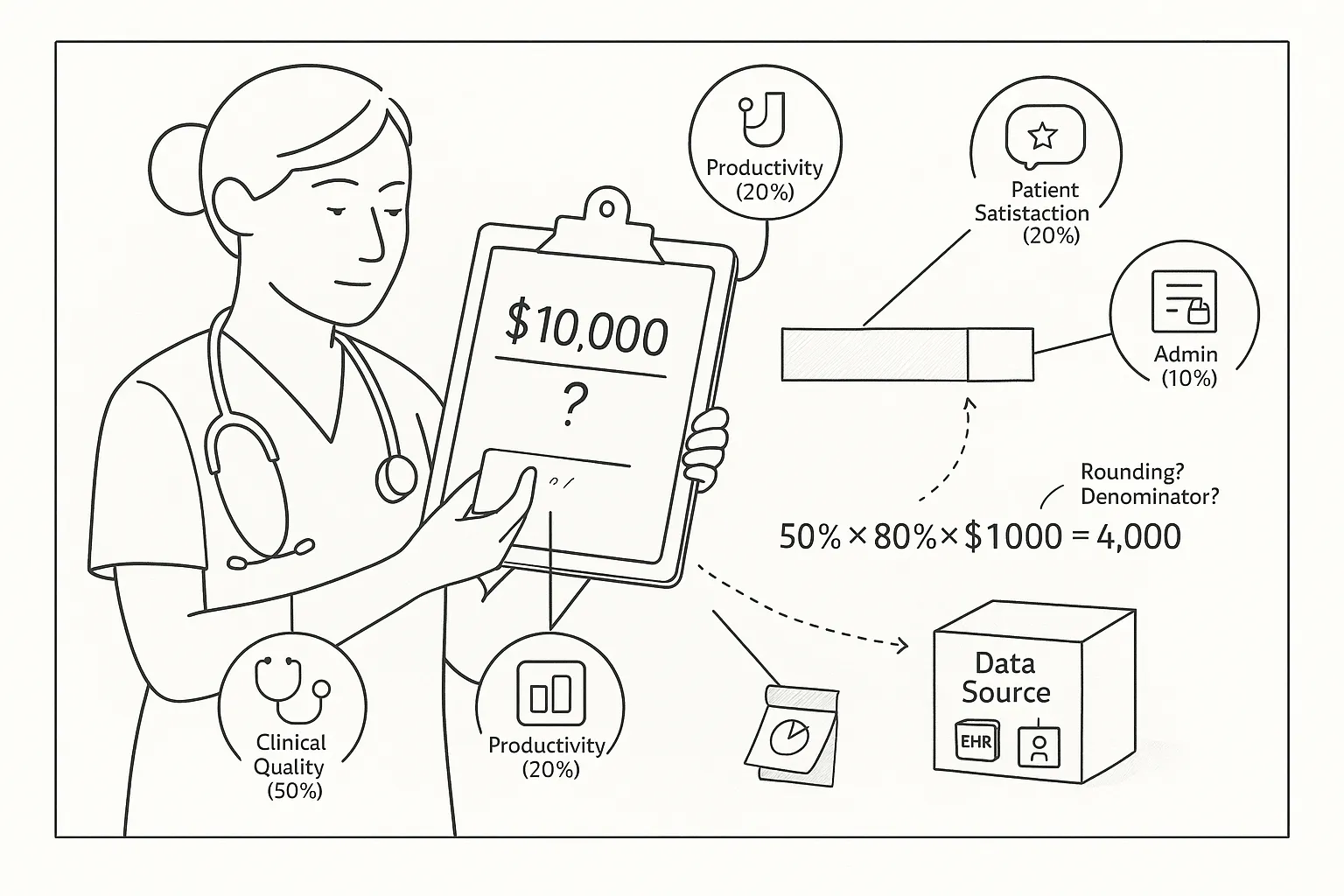
A quality plan may measure preventive screening rates, chronic-disease management, immunizations, patient experience, chart completion, coding accuracy, access, or another clinical or operational outcome. The employer might state the award as a fixed amount, a percentage of salary, or one component of a larger incentive pool. The plan must then translate the NP’s results into dollars through stated weights, achievement bands, and eligibility conditions.
Consider a $10,000 target bonus in which quality accounts for 50%. If the NP earns 80% of the available quality score, that component produces $4,000: $10,000 multiplied by 50%, then by 80%. That example changes if the plan imposes a 90% gateway before any quality credit is earned, rounds each individual measure before aggregation, or makes the entire award contingent on a productivity target. The contract must explain the sequence in which those rules apply.
The same label can also conceal different measurement methods. A screening rate derived from EHR documentation may differ from a claims-based rate because claims can be delayed, corrected, or attributed to another provider. A quarterly score may use a different patient population from an annual score. Payer, vendor, and program-year specifications can change, so the agreement needs to identify which version controls and what happens if the methodology changes during the measurement period.
Current professional guidance supports pre-specified, transparent performance goals and measures tied to matters the clinician can reasonably influence. The AMA’s pay-for-performance principles, although directed to physician payment policy rather than binding NP contract law, provide a useful drafting benchmark: explain the incentive calculation before implementation, use evidence-based measures, and account for factors outside the clinician’s control.
Calculation Errors That Commonly Reduce the Bonus
Denominators, Weighting, Thresholds, and Rounding
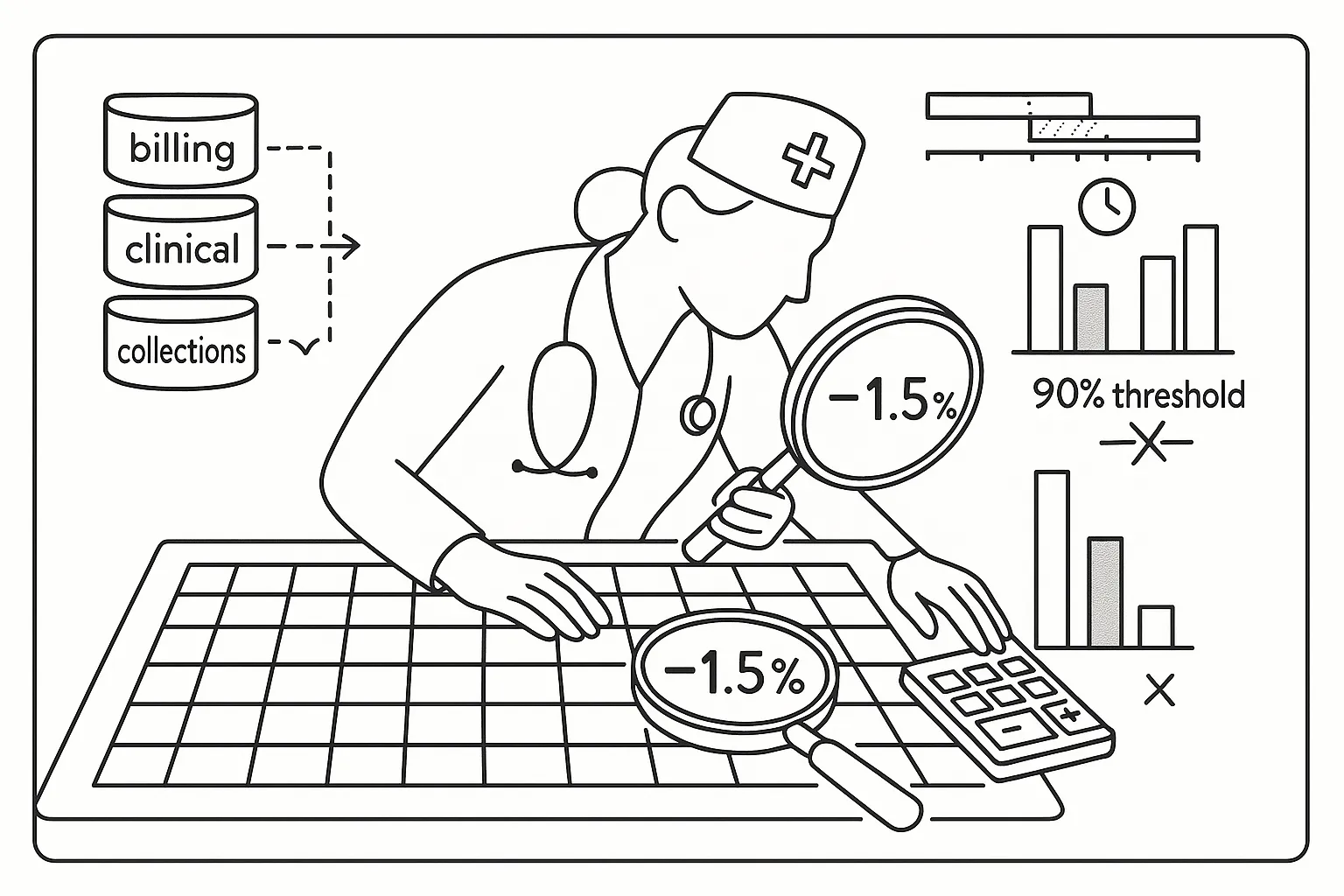
A percentage is only as reliable as its numerator and denominator. An employer may omit eligible encounters from the numerator while retaining the same patients in the denominator, use a patient panel that includes individuals the NP did not manage, or exclude completed services because a claim lacked a modifier. Even when the raw counts are correct, applying a weight to the wrong base or using an unstated achievement band can reduce the payment.
Threshold errors can be harder to see. A plan might award no credit below 85%, partial credit from 85% through 89.9%, and full credit at 90%. If the employer instead applies an all-or-nothing 90% threshold, the calculation does not follow the stated banding. Rounding each submeasure before calculating the domain score can also produce a different result from rounding only the final score. A one- or two-percentage-point difference can affect hundreds of dollars on a recurring bonus.
Attribution, Timeframes, and Factors Outside the NP’s Control
Attribution determines which patients, visits, and outcomes count for or against the NP. The plan needs to address shared visits, telehealth encounters, coverage provided for another clinician, transfers between panels, new patients without a full measurement history, and services rendered at multiple locations. If “attributable patient” or “eligible visit” is undefined, the employer’s internal reporting convention may effectively determine compensation after the work is complete.
Patient refusal and non-adherence also affect quality scores. The documents can specify whether a documented refusal, inability to contact the patient, loss of insurance, transfer of care, or another recognized exclusion removes the patient from the denominator. Without an exclusion rule, the NP may lose compensation because of conduct or barriers the NP could not control.
Performance programs can contain several technical layers beyond a simple percentage. For example, CMS payment and attribution methodologies use defined attribution rules, benchmarks, comparison populations, quality gateways, historical periods, and reconciliation calculations. Those federal program mechanics do not automatically govern a private NP employment agreement, but they illustrate why a bonus clause must identify each layer rather than refer generally to “quality performance.”
Contract Language That Creates Avoidable Disputes
Undefined Metrics and Employer-Controlled Methodologies
Terms such as “productive hours,” “timely chart closure,” “eligible patient,” and “quality target” sound objective but may have several operational meanings. Does productive time include administrative sessions? Is a chart timely if it is signed within 24, 48, or 72 hours? Does a telehealth encounter count as an eligible visit? The compensation documents need definitions that connect each metric to a specific data source and calculation rule.
A clause allowing the employer to change measures, weights, benchmarks, or algorithms at its discretion can make the target impossible to forecast. At minimum, the agreement can address when a change becomes effective, whether advance notice is required, whether the new methodology applies prospectively, and how the bonus will be calculated if a measure becomes unavailable. This issue is especially important when the quality plan is incorporated by reference but is not attached to the agreement.
Reconciliation, True-Ups, and Retroactive Adjustments
Some employers pay an estimated bonus before all claims or quality data are final. A later true-up can increase the award, reduce a future payment, or create an asserted repayment obligation. The contract can identify whether payments are provisional, when data become final, how long the reconciliation window remains open, and whether the employer may offset a claimed overpayment against wages or another bonus.
Catchall language authorizing “adjustments, reconciliations, or corrections” without a deadline gives the employer broad control after the measurement period closes. The NP needs to know which events permit an adjustment, what documentation supports it, whether the NP can challenge the result, and whether employer-caused coding or reporting errors are treated differently from an overpayment caused by inaccurate information supplied by the NP.
These provisions can interact with negative accrual language. If an overpayment carries into the next period, a future bonus may first be used to eliminate the prior balance. The result may resemble the compensation mechanics discussed in Chelle Law’s guide to negative accrual in nurse practitioner contracts, even if the plan never uses that phrase.
How to Verify a Suspected Quality Bonus Error
Start with the complete compensation documents, not only the bonus statement. Compare the employment agreement, incorporated compensation plan, metric specifications, amendments, employer policies, and any written explanation supplied before the measurement period. Then identify the promised formula and recreate the employer’s calculation one step at a time.
- Confirm the measurement dates, eligibility dates, and whether partial-year employment changes the target.
- List each metric’s numerator, denominator, weight, threshold, benchmark, and rounding rule.
- Compare the stated data source with the source actually used, including EHR, claims, revenue-cycle, survey, or third-party vendor data.
- Check attribution, exclusions, gateway requirements, and the treatment of patient refusal or incomplete follow-up.
- Determine whether the payment was final or provisional and whether a later reconciliation was authorized.
Useful records may include scorecards, EHR snapshots, panel-attribution reports, productivity logs, revenue reports, vendor quality reports, and the employer’s calculation spreadsheet. A request for workpapers can ask for the raw numerator and denominator counts, filters, inclusion and exclusion rules, timestamps, and the formula connecting the score to the payout. Access to patient-level information, query code, or internal systems remains subject to privacy, security, minimum-necessary, and de-identification requirements; an audit clause does not eliminate those obligations.
A concise side-by-side analysis is usually more useful than a general complaint. Show the contractual term, the employer’s reported value, the value supported by available records, and the resulting payment difference. Keep written copies of the request and response. If the employer denies access, repeatedly changes its explanation, or applies a substantial offset, a focused NP compensation review can assess whether the plan was applied as written and which provisions control the dispute.
Clawbacks, Wage Rules, and Other Legal Issues
A contract may describe repayment as a clawback, recoupment, correction, debit, or offset. The label does not resolve whether the employer can deduct the amount from regular wages, a future bonus, or final pay. The answer can depend on the contract’s governing law, applicable state wage-payment and deduction rules, written-consent requirements, final-pay restrictions, and the reason for the alleged overpayment. A broad statement that every clawback is enforceable or unenforceable would be inaccurate.
Bonus characterization can raise a separate federal wage-and-hour issue. The U.S. Department of Labor explains that announced bonuses tied to quality, production, efficiency, or similar criteria may be nondiscretionary for Fair Labor Standards Act purposes. That characterization can affect the regular-rate calculation for a nonexempt employee. Many NPs may qualify for an exemption depending on their duties and compensation, but the title “nurse practitioner” does not replace a fact-specific classification analysis.
A bonus disagreement may involve breach-of-contract questions, but it does not automatically create a legal claim. Billing rules, payer specifications, supervision or collaboration requirements, privacy restrictions, and wage laws may present separate issues. Counsel can identify which body of law applies without assuming that a calculation discrepancy has one universal remedy.
Questions to Resolve Before Accepting the Bonus Plan
Before signing, ask for a worked example using the actual formula. The example can reveal whether the target amount is multiplied by weights, reduced by a gateway, prorated for start date or leave, conditioned on continued employment through the payment date, or reconciled after the employer receives final data. It also shows whether quality, productivity, and financial-performance components operate independently or whether missing one requirement eliminates the entire award.
The documents can also state when scorecards will be delivered, how long the NP has to question them, what information will be available, and who decides a dispute. If the offer combines quality and productivity compensation, compare the language with the broader mechanics described in Chelle Law’s resources on nurse practitioner compensation models and productivity and quality incentives. The advertised target matters less than whether the formula is measurable, attainable, and protected from unexplained retroactive changes.
Frequently Asked Questions
What details should an NP quality bonus formula include?
The formula should identify each metric, its numerator and denominator, the controlling data source, attribution rules, exclusions, measurement period, benchmark, weight, threshold, rounding method, payment date, and any reconciliation process. It should also explain how quality interacts with productivity or other eligibility requirements.
Can an employer change quality metrics during the bonus period?
The answer depends on the contract and incorporated plan. Language granting unilateral amendment authority may permit some changes, but the documents still need to be reviewed for notice requirements, effective dates, prospective application, and any limits imposed by applicable law.
What records can help prove a quality bonus calculation error?
Relevant records may include bonus plans, amendments, scorecards, EHR reports, panel-attribution data, productivity logs, claims or revenue reports, vendor reports, calculation spreadsheets, and written explanations from the employer. Access to patient-level or proprietary data remains subject to privacy and security restrictions.
How should a bonus plan address patient refusal or non-adherence?
The plan can define when documented refusal, inability to contact a patient, transfer of care, loss of coverage, or another recognized exclusion removes the patient from a measure. Without clear exclusion and attribution rules, outcomes outside the NP’s control may lower the score.
Can an employer claw back an NP quality bonus?
A contract may authorize repayment or an offset after reconciliation, but enforceability and deduction procedures depend on the wording and applicable state law. The review should address notice, consent, documentation, look-back periods, wage deductions, final pay, and whether the payment was expressly provisional.
Can a quality bonus affect overtime calculations?
Potentially. An announced bonus tied to quality, production, or efficiency may be nondiscretionary under federal wage law and may affect the regular rate for a nonexempt employee. Whether an NP is exempt depends on the actual duties, compensation method, and applicable legal tests.
Have an Attorney Review Your NP Bonus Formula
Chelle Law can review the quality metrics, data sources, thresholds, reconciliation terms, and clawback language that determine how your incentive compensation is calculated.
Contact Chelle Law