
Severance provisions are an often-overlooked part of nurse practitioner employment agreements, yet they can materially affect income continuity, malpractice exposure, and career mobility after termination. In our experience reviewing hundreds of NP contracts, severance language is often employer-favorable, vague, or tied to conditions that substantially reduce its value. A meaningful review therefore goes beyond the stated payment amount and examines eligibility triggers, payment timing, offsets, releases, restrictive covenants, insurance obligations, and repayment provisions. This guide explains the common severance structures found in NP agreements, the contract terms that determine whether payment is actually received, and the issues nurse practitioners should evaluate before signing or ending an employment relationship.
Key Takeaways
- NP severance pay can be undermined by vague eligibility triggers, broad cause definitions, offsets, or clawbacks, so the agreement should clearly define qualifying termination events and payment timelines.
- Cash replacement, benefits assistance, and an employer contribution toward tail malpractice insurance may all carry significant value during a transition.
- The contract should state whether severance calculations include or exclude bonuses, RVUs, collections, and other variable compensation.
- Severance conditioned on a broad release, restrictive covenant compliance, or uncertain repayment obligations requires careful review.
- A line-by-line contract review can identify how severance interacts with termination rights, compensation, malpractice coverage, and post-employment restrictions.
Why Severance Matters for Nurse Practitioners
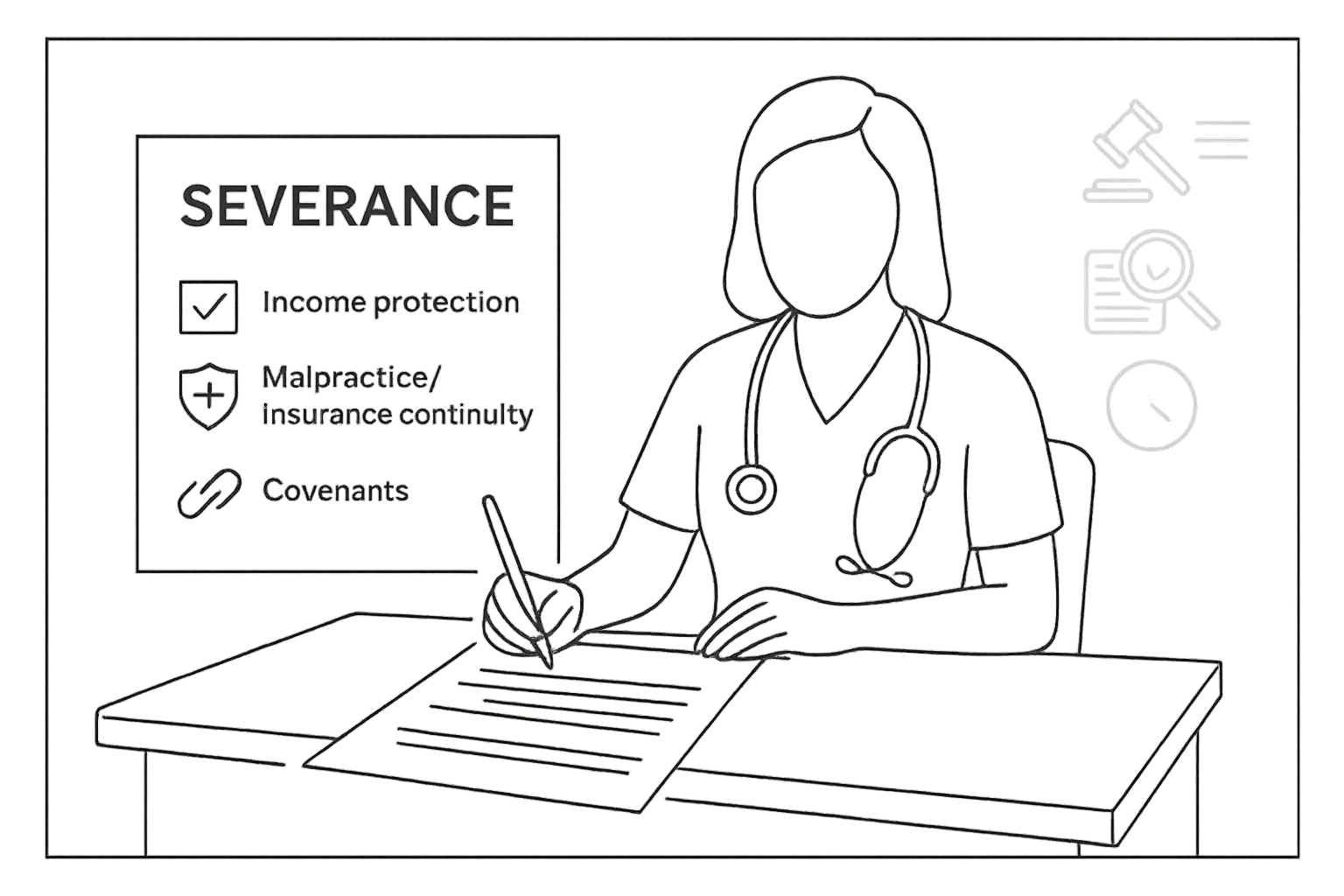
Severance can bridge the period between employment termination and financial stability, but its practical value depends on the contract mechanics. A payment or period of salary continuation may replace lost clinical income and help with loan payments, housing, family expenses, or the delay before a new position begins.
Termination may also create malpractice insurance concerns. If the employer uses claims-made coverage, the agreement may assign responsibility for tail coverage to the NP or condition an employer contribution on the reason for separation. Because this expense can affect the actual value of a severance package, the severance and insurance provisions should be evaluated together through a focused malpractice and tail coverage review.
Career mobility is another concern. Severance may be conditioned on a release of claims, non-disparagement obligations, confidentiality terms, or continued compliance with a non-compete or non-solicitation provision. A seemingly generous payment can lose much of its value when broad post-employment restrictions or repayment rights remain in effect.
Common NP Severance Payment Structures
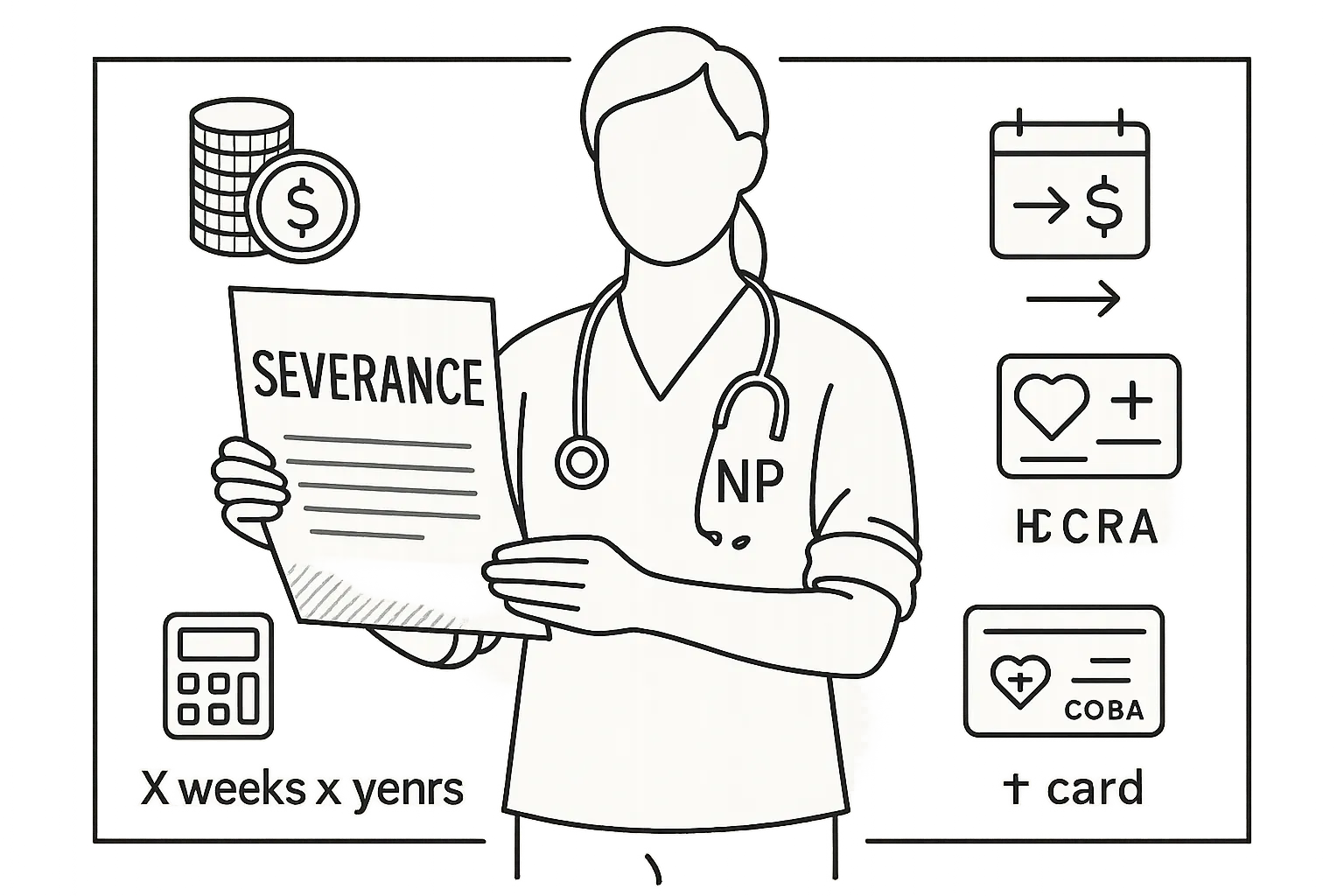
Severance may be documented through several payment mechanisms. Understanding the structure helps an NP assess predictability, continued benefits, tax withholding, and whether variable compensation is included.
- Fixed lump-sum payment: The employer makes one payment after a qualifying termination. This approach is straightforward, but the agreement may permit offsets, require a signed release, or leave the NP responsible for benefits and insurance expenses.
- Salary continuation: The employer maintains base pay through payroll for a stated period. The contract should clarify whether benefits continue and whether the payments stop when the NP obtains another position.
- Tenure-based formula: Severance may equal a certain number of weeks or months of pay for each year of service. The calculation should identify whether “pay” means base salary alone or includes average bonuses, productivity incentives, collections, or RVU compensation.
- Benefits or COBRA assistance: An employer may continue benefits, pay premiums directly, or provide a stipend. The agreement should distinguish actual employer-paid assistance from the NP’s right to continue coverage at personal expense.
Tail insurance contributions may be negotiated alongside these benefits because termination can activate a separate post-employment insurance obligation. The payment structure should also be reviewed against any bonus reconciliation, negative accrual, or repayment language that could reduce the final amount.
Contract Terms That Determine Severance Eligibility
The headline severance amount is only a starting point. Eligibility definitions, timing requirements, offsets, and post-payment obligations frequently determine whether the NP receives and keeps the stated benefit.
Termination Triggers and Payment Timing
Most agreements distinguish between termination for cause and termination without cause. Severance is commonly limited to employer-initiated termination without cause or another specifically defined separation event. An expansive cause definition involving broad concepts such as failure to meet expectations may give the employer substantial discretion to classify a termination in a way that eliminates severance.
Eligibility may also depend on minimum tenure, completion of a notice period, or the NP not resigning before a designated date. The agreement should identify when payment becomes due, whether there is a waiting period, and whether signing a separation agreement or release is a condition precedent. These provisions should be compared with the contract’s broader termination rights and notice requirements.
Offsets, Mitigation, and Clawback Provisions
An employer may attempt to reduce severance by income earned from a subsequent job or require the NP to make reasonable efforts to find other work. The language should explain whether an offset applies to gross or net earnings, how new income must be documented, and whether the employer can suspend payment while reviewing that information.
Clawback provisions create a different risk by allowing the employer to demand repayment after severance has been distributed. Review should focus on the time limit for recoupment, the conduct that triggers repayment, whether the alleged breach must be material, and the process for resolving a dispute. Similar repayment concerns may appear in signing bonus clawback provisions.
Releases, Confidentiality, and Non-Disparagement
Severance is frequently conditioned on signing a release of claims and accepting confidentiality or non-disparagement obligations. The scope matters. Review should identify the rights being released, any continuing reporting obligations, whether the promises are reciprocal, and whether the employer can stop or recover payments for an alleged violation.
The NP should also determine whether the separation documents introduce new restrictions that were not present in the original employment agreement. Severance should not be evaluated independently from the full package of obligations that survives termination.
Negotiating Clear and Practical Severance Terms
Negotiation begins with identifying the NP’s priorities and leverage. Specialty demand, competing offers, recruitment difficulty, and the employer’s operational needs may influence whether the most valuable objective is cash replacement, benefits continuation, tail insurance assistance, or a narrower release. Focusing on the provisions with the greatest financial effect is often more practical than treating every term as equally important.
- Use objective triggers: Define the termination events that qualify for severance and avoid language that depends entirely on an employer’s subjective judgment.
- State the calculation: Identify the exact salary figure, formula, and treatment of bonuses, RVUs, collections, and other incentive compensation.
- Set a payment deadline: Specify whether severance is paid as a lump sum or through payroll and when payments begin.
- Limit repayment exposure: Narrow clawback triggers, establish a reasonable time limit, and require a meaningful breach before repayment can be sought.
- Address insurance and benefits: Clarify health coverage assistance and responsibility for malpractice tail coverage instead of relying on general promises.
Severance may be negotiated against other economic terms, including base salary, bonuses, and signing incentives. A higher upfront bonus with limited separation protection presents a different risk profile from modest initial incentives paired with meaningful severance. An NP compensation review can help evaluate those trade-offs across the complete agreement.
How Severance Interacts With Other NP Contract Provisions
Severance does not operate in isolation. Its value depends on how it interacts with restrictive covenants, variable compensation, malpractice coverage, accrued leave, and other obligations triggered by separation.
- Non-compete and non-solicitation provisions: Payment may depend on continued compliance with post-employment restrictions, and an alleged violation may activate a clawback. A separate review of the restrictive covenant can clarify its scope, duration, and relationship to severance.
- Bonuses and productivity compensation: Severance formulas often use base salary while excluding bonuses, collections, or RVU-based earnings. Reconciliation and negative accrual provisions may further reduce amounts owed at termination.
- Malpractice insurance: Claims-made coverage may require tail insurance after employment ends. The agreement should state who pays, whether the responsibility changes based on the reason for termination, and whether severance is intended to offset that expense.
- PTO and benefit vesting: Accrued leave, retirement benefits, and other compensation may be addressed separately from severance. The contract and applicable plan documents should be reviewed together rather than assuming severance replaces those amounts.
Keeping records of performance metrics, productivity calculations, compensation statements, and communications surrounding termination can be important when eligibility, offsets, or repayment obligations are disputed. Documentation is particularly useful when variable compensation or subjective performance standards affect the separation payment.
When an NP Severance Clause Needs Legal Review
Legal review is especially useful when the agreement makes severance contingent on a broad release, leaves tail insurance responsibility unclear, permits long-term recoupment, uses an expansive cause definition, or includes uncertain offsets for later earnings. These provisions can turn an apparently valuable benefit into one that is difficult to collect or retain.
Provide the attorney with the complete employment agreement and any related offer letters, bonus plans, employee handbooks, separation documents, and malpractice policy summaries. Existing employees should also provide relevant compensation records and communications concerning performance or termination. A comprehensive nurse practitioner contract review can evaluate severance in context and identify clearer payment triggers, narrower repayment language, defined insurance obligations, and practical timelines without treating the clause as a standalone promise.
Frequently Asked Questions
Does every nurse practitioner employment contract include severance pay?
No. Some NP agreements provide a lump sum, salary continuation, or benefits assistance after a qualifying termination, while others omit severance entirely. The absence of severance should be evaluated with the contract’s notice period, termination rights, repayment obligations, and insurance provisions.
What usually makes an NP eligible for severance?
Eligibility commonly depends on an employer-initiated termination without cause or another event specifically defined in the agreement. Minimum tenure, notice compliance, a signed release, and other conditions may also determine whether payment is due.
Is a lump-sum severance payment better than salary continuation?
Neither structure is automatically better. A lump sum offers a defined payment, while salary continuation may preserve payroll treatment or certain benefits for a period. The better option depends on offsets, benefit eligibility, payment timing, and whether new employment stops continued payments.
Can bonuses or RVU compensation be included in severance?
They can be included if the agreement’s formula says so, but many clauses calculate severance using base salary alone. The contract should expressly address bonuses, RVUs, collections, reconciliation, and negative accrual to prevent uncertainty.
How does tail insurance affect the value of an NP severance package?
If the NP must purchase tail coverage after termination, that expense can substantially reduce the economic value of severance. The agreement should identify who pays for tail coverage, whether responsibility changes based on the termination reason, and whether the employer contributes.
What documents should an NP provide for a severance review?
Provide the complete employment agreement, offer letter, bonus or productivity plans, relevant handbook provisions, malpractice insurance information, and any proposed separation agreement or release. Existing employees should also include compensation records and relevant termination communications.
Have Your NP Contract Reviewed Before You Sign
Chelle Law reviews severance, termination, compensation, malpractice insurance, and post-employment restrictions so you can understand the financial and professional risks in your agreement.
Contact Chelle LawExplore Nurse Practitioner Contract Guidance
Review legal services, practical contract resources, and state-focused guidance for nurse practitioners.