
A nurse practitioner tail coverage dispute often begins after employment ends, when the parties discover that a brief malpractice clause does not answer the questions that now matter. The underlying policy may be claims-made, claims-made-and-reported, or occurrence-based; the employment agreement may allocate the premium differently depending on how the relationship ended; and the carrier may impose its own reporting deadlines. These details can determine whether an NP remains protected against a later claim arising from earlier clinical work.
The financial exposure can be substantial, but premium cost is only part of the risk. A gap in coverage may affect a job transition, independent contractor engagement, private-practice plans, or a new carrier’s willingness to accept prior exposure. Disputes also become more difficult when the agreement uses “tail coverage,” “prior acts,” and “extended reporting period” as though those terms are interchangeable, or when it gives the employer broad authority to recover costs from compensation.
Resolving the issue requires reading the employment contract together with the policy declarations, endorsements, retroactive date, termination documents, and applicable law. Chelle Law reviews these connected provisions to identify who agreed to obtain coverage, which events trigger payment, whether repayment language changes that allocation, and what terms may warrant clarification or revision before an NP signs or leaves a position.
Key Takeaways
- Tail coverage is primarily associated with claims-made professional liability policies, but the declarations and endorsements control the actual reporting requirements.
- An extended reporting period generally extends the time to report an otherwise covered claim; it does not ordinarily enlarge the policy limits, covered acts, entities, or retroactive date.
- No single nationwide rule automatically assigns the tail premium to an employer or nurse practitioner. The contract, policy, state law, and circumstances of separation may all matter.
- Repayment and final-paycheck deduction provisions require separate analysis because wage laws can limit how an employer recovers an asserted debt.
- Written proof of tail or qualifying prior-acts coverage is more reliable than a general promise that post-employment malpractice exposure will be handled.
What Tail Coverage Does—and Does Not—Protect
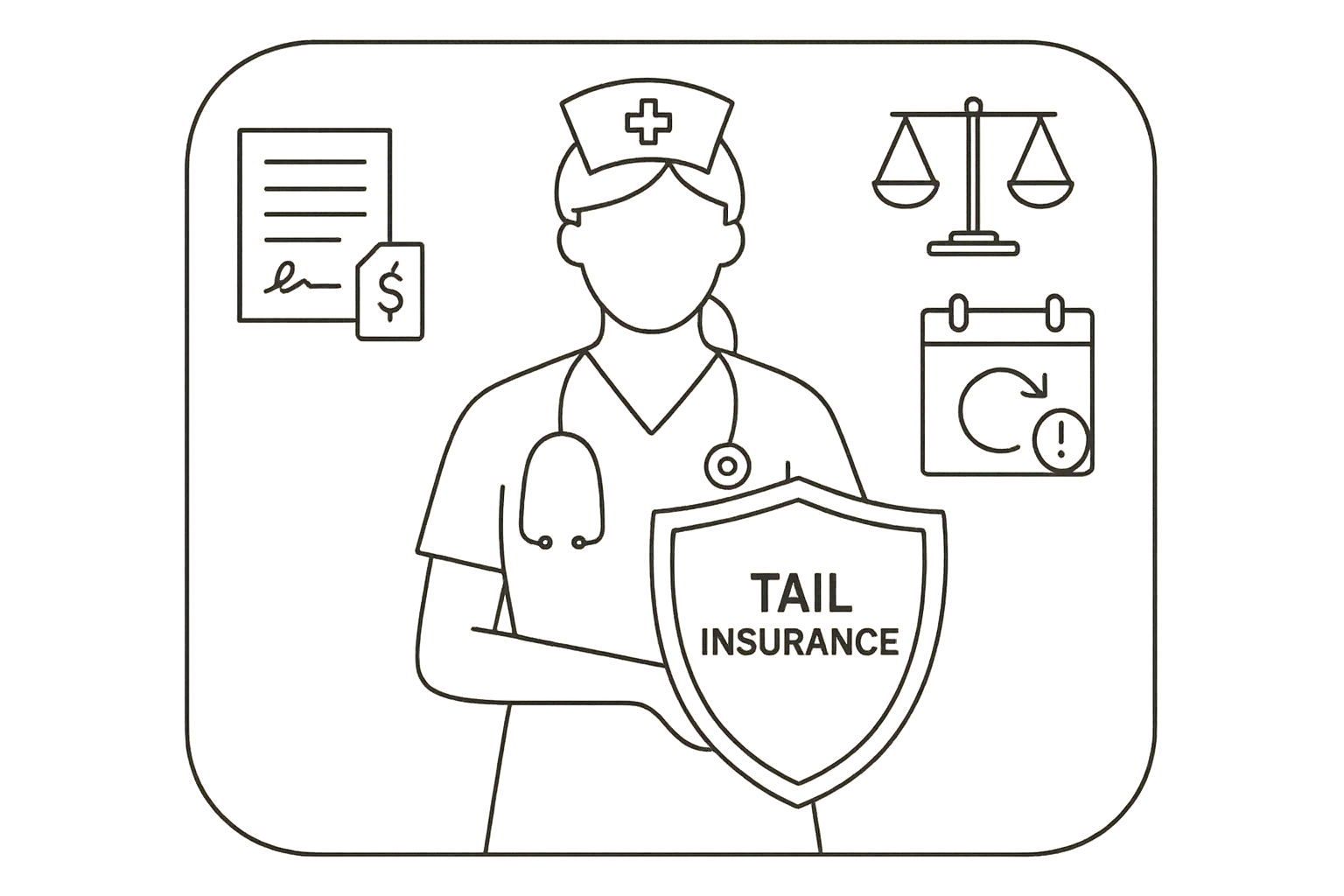
Claims-Made, Claims-Made-and-Reported, and Occurrence Policies
An occurrence policy generally responds to a covered event that took place while the policy was active, even if the claim is asserted after that policy period ends. Claims-made coverage usually focuses on whether a claim is first made while coverage is in force or during an applicable extended reporting period. A claims-made-and-reported policy may also require notice to the carrier within the particular reporting period stated in the policy.
Those distinctions make timing critical. The date of the clinical act, the policy’s retroactive date, when the claim was first made, and when the carrier received notice may all affect coverage. The National Association of Insurance Commissioners’ medical malpractice guidance confirms that policy structure matters, but the NP still needs the actual declarations and endorsements rather than a general description from an offer letter or recruiter.
An agreement that merely promises “malpractice insurance” does not establish which structure applies. Reviewing the differences between claims-made and occurrence coverage for nurse practitioners can help frame the issue, but carrier documentation is necessary to determine whether an extended reporting endorsement is needed.
The Limits of an Extended Reporting Period
Tail coverage is commonly used to describe an extended period for reporting claims arising from otherwise covered acts that occurred before a claims-made policy ended. It generally does not create a new policy for future clinical work. It also does not automatically increase limits, remove exclusions, correct an unfavorable retroactive date, or add entities, services, or locations that the underlying policy never covered.
Tail products are not uniform. A reporting period may be limited or indefinite, and endorsements may contain specific notice procedures. The review therefore needs to confirm the duration, applicable limits, covered insureds, effective date, retroactive date, and any conditions for reporting a claim. An NP working at multiple sites or through related entities also needs to know whether every relevant location and legal entity falls within the policy.
These limitations explain why a certificate of insurance or an employer’s statement that “tail is covered” may not resolve the issue. A focused malpractice and tail insurance review can compare the promised protection with the endorsement the carrier actually issued.
Why Tail Insurance Becomes a Contract Dispute

Payment Allocation and Separation Triggers
There is no nationwide rule that always makes either the employer or the nurse practitioner responsible for the tail premium. Some agreements provide employer-paid coverage after termination without cause but require the NP to pay after resignation or termination for cause. Others use cost sharing, a declining repayment schedule, or a service-based condition that changes responsibility after the NP completes a stated employment period.
The wording must distinguish among resignation, termination without cause, termination for cause, nonrenewal, expiration, and mutual separation. A clause that applies only “upon termination” can create uncertainty if another section characterizes expiration or nonrenewal differently. Notice compliance may also be a condition: an NP who gives less than the required contractual notice may face a different allocation than one who completes the full notice period.
Insurance provisions should therefore be evaluated alongside the agreement’s termination and notice terms, indemnification language, repayment obligations, and dispute-resolution clause. A promise that initially appears employer-funded may be narrowed elsewhere by reimbursement language or a broad definition of amounts owed at separation.
State insurance requirements can create a separate layer of analysis. For example, a West Virginia regulation requires covered insurers to offer tail coverage after specified terminations of an applicable claims-made professional malpractice policy, and the offer generally expires after 45 days. That insurer tail-offer requirement does not, by itself, decide whether the employer or NP must ultimately bear the premium. The insurance rule and the employment contract answer different questions.
Repayment Demands and Final-Paycheck Deductions
A dispute may concern reimbursement rather than the initial purchase of tail. The employer might procure the endorsement and then demand repayment under a broadly drafted separation clause. Important questions include whether the agreement defines the recoverable amount, permits cost sharing, caps the obligation, uses a declining schedule, or gives the NP a right to review an invoice or proof of payment.
A contractual deduction provision does not necessarily establish that every deduction from final wages, accrued compensation, or a bonus is lawful. Federal wage requirements can restrict deductions that cut into required minimum wages or overtime, while state laws may impose additional authorization, timing, and final-paycheck rules. The U.S. Department of Labor’s wage-deduction guidance provides the federal baseline, but jurisdiction-specific analysis may still be necessary.
The same issue can arise in an independent contractor agreement, although employee wage protections may not apply in the same manner. Contractor status also tends to shift more insurance obligations to the clinician. NPs considering that structure can review the broader W-2 and 1099 contract differences and then examine the actual classification and insurance terms in their agreement.
How to Investigate a Coverage Disagreement
The investigation begins with the signed agreement and every document incorporated into it. Relevant records may include amendments, compensation plans, handbooks referenced by the contract, policy declarations, endorsements, certificates of insurance, carrier correspondence, separation notices, premium invoices, and communications with human resources or risk management. Written representations from a recruiter or supervisor may also be important, particularly when they address who would pay for tail.
The policy records can then be used to build a coverage timeline. That timeline should identify the dates clinical services were provided, the retroactive date, the end of the policy period, the date of separation, any deadline for electing tail, and the date by which a claim must be reported. If the carrier changed during employment, the review also needs to determine whether the newer policy included prior-acts coverage or whether the earlier period remained dependent on a separate endorsement.
- Which carrier and named insured covered the NP’s work?
- Was the policy occurrence-based, claims-made, or claims-made-and-reported?
- What retroactive date appears in the declarations or endorsements?
- Did the policy cover every relevant entity, location, and clinical service?
- What event caused coverage to end, and how does the agreement characterize that event?
- Was an extended reporting endorsement offered, elected, paid for, and issued?
- Does the employer claim a repayment or deduction right under another contract section?
If the employer agreed to procure coverage but has not produced proof, a written request can identify the relevant contract provision and ask for the policy documentation, endorsement, and effective dates. The request should avoid assuming that a premium receipt alone proves the necessary scope. A dispute involving an approaching carrier deadline warrants prompt attention because an otherwise available tail option may expire while the parties debate payment.
Resolution Options and Their Practical Limits
Some disputes can be resolved through a documented exchange with the employer’s human resources, legal, or risk-management department. Depending on the policy and contract, potential outcomes may include employer payment, cost sharing, reimbursement after proof of purchase, a capped contribution, or issuance of the endorsement the agreement required. Any resolution needs to address both the financial obligation and the adequacy of the resulting coverage.
The employment agreement may prescribe mediation, arbitration, a notice-and-cure procedure, a particular governing law, or a designated forum. Mediation can permit practical solutions that a court or arbitrator might not order, while binding arbitration can affect discovery, procedure, cost allocation, and available review. Litigation may be considered when a sufficiently clear obligation remains unfulfilled, but the amount in dispute, available evidence, carrier deadlines, and contractual forum provisions all influence that decision.
Coverage and payment also need to remain separate in the analysis. An NP may need to preserve an available insurance option before the parties finally determine who pays. Conversely, purchasing an endorsement to avoid a lapse does not necessarily resolve a contractual reimbursement claim. The effect of any payment, reservation of rights, release, or settlement language needs to be evaluated in context.
Drafting Better Tail and Prior-Acts Provisions
A stronger malpractice clause identifies the policy type, coverage limits, carrier or minimum carrier qualifications, retroactive date, and party responsible for premiums during the relationship. It also explains what happens when the agreement ends. The triggering events, election deadline, required duration of the reporting period, proof-of-coverage obligation, and responsibility for payment should be stated with enough precision to work alongside the termination section.
If repayment applies, the contract can define the amount or formula rather than leaving exposure open-ended. A cap, service-based reduction, or prorated schedule may make the obligation more predictable. The language should also address whether an employer can recover the amount from compensation, whether separate written authorization is required, and how the parties will handle any legal restriction on a payroll deduction.
Prior-acts coverage can sometimes serve as an alternative to tail when a new carrier agrees to accept the earlier exposure. That option depends on written carrier approval, an appropriate retroactive date, and continuity for the relevant services, insureds, entities, and locations. It is not enough for a new policy to contain generic prior-acts language if its dates or endorsements leave part of the earlier work outside coverage.
Carrier changes, practice acquisitions, and transfers among affiliated entities deserve specific treatment as well. The agreement can allocate responsibility if the employer changes from occurrence to claims-made coverage or if a transaction causes one entity’s policy to end. Comparing these provisions with common nurse practitioner contract red flags can reveal inconsistencies before they become post-termination disputes.
An attorney-led nurse practitioner contract review can assess malpractice language together with termination, repayment, compensation, indemnification, and dispute-resolution provisions. The goal is not merely to locate the word “tail,” but to determine whether the contract and policy documents create a workable allocation of risk.
Frequently Asked Questions
How can an NP determine whether a malpractice policy is claims-made?
Review the declarations, endorsements, policy period, and retroactive date, and confirm the policy type with the carrier or employer. The documents also need to show whether the policy is claims-made-and-reported, because that wording may impose a specific deadline for reporting the claim in addition to requiring that it be made during the applicable period.
Who pays for nurse practitioner tail coverage after employment ends?
Payment responsibility depends on the agreement, policy arrangement, applicable law, and reason the relationship ended. The employer may pay, the NP may pay, or the parties may share the premium under conditions tied to resignation, termination, notice compliance, or length of service.
What if the employment agreement is silent about tail insurance?
Silence does not establish that the employer will purchase tail. The NP needs to confirm the policy type, determine whether post-termination reporting protection is necessary, review any applicable insurer requirements, and seek written clarification about coverage and premium responsibility before signing or leaving the position.
Does an occurrence malpractice policy require tail coverage?
Occurrence coverage generally responds to a covered act that happened during the policy period even if the claim is asserted later, so traditional tail coverage is ordinarily associated with claims-made policies. The declarations, exclusions, limits, and endorsements still need to be reviewed to confirm the actual protection.
Can prior-acts coverage replace a tail endorsement?
It can be an alternative when the new carrier accepts the earlier exposure and uses a retroactive date that preserves continuity. Written confirmation should establish that the policy covers the relevant time period, clinical services, entities, providers, and locations before the NP relies on it.
What records are important in a tail coverage dispute?
Important records include the signed agreement, amendments, incorporated policies, declarations, endorsements, certificates, termination notices, emails, written promises, premium invoices, proof of payment, and communications with the employer or carrier. These documents help establish the coverage timeline and each party’s stated obligations.
Get Help Reviewing an NP Tail Coverage Dispute
Chelle Law can analyze the agreement, policy documents, termination triggers, repayment language, and available coverage records to identify unresolved risks and provisions that may warrant clarification.
Contact Chelle Law