
Employment agreements for nurse practitioners commonly allow an employer to terminate employment “without cause.” Although the phrase sounds straightforward, its effect depends on the notice, compensation, insurance, restrictive covenant, and repayment provisions elsewhere in the contract. Understanding those connections before signing can help an NP assess potential income disruption and career limitations.
An attorney-led nurse practitioner contract review can identify ambiguous termination language, quantify potential financial exposure, and explain which obligations may survive the end of employment.
Key Takeaways
- A without-cause termination clause generally allows an employer to end employment without proving misconduct, subject to the contract and applicable law.
- The agreement should clearly address notice, pay in lieu of notice, severance, accrued compensation, and benefit termination.
- Termination may affect RVU or collections reconciliations, bonus eligibility, malpractice tail coverage, repayment obligations, and restrictive covenants.
- Clear post-termination payment formulas and deadlines can reduce uncertainty and disputes.
- The entire agreement must be reviewed together because protections in the termination clause can be limited by language elsewhere in the contract.
What Without-Cause Termination Means for Nurse Practitioners
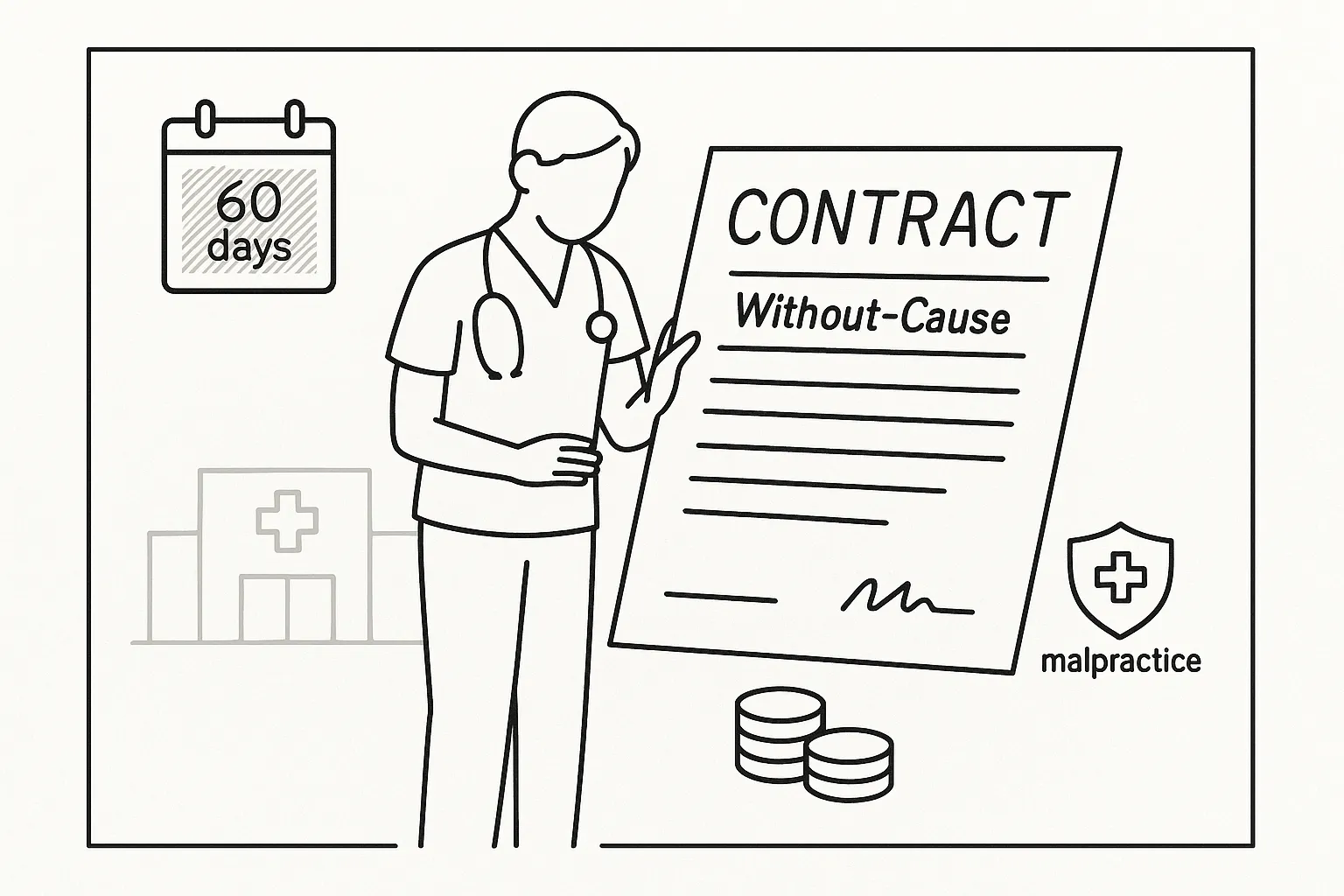
A without-cause provision gives one or both parties the contractual right to end the employment relationship without establishing a defined breach or misconduct. The party exercising that right must still comply with the agreement’s notice and procedural requirements. This differs from termination for cause, which ordinarily depends on listed events such as loss of licensure, fraud, material breach, or specified misconduct.
The practical effect depends on several contract mechanics:
- Who may terminate: The clause should state whether the right is mutual or reserved primarily for the employer.
- Required notice: The agreement may require written advance notice and explain when notice becomes effective.
- Work during the notice period: The employer may require continued work, remove the NP from clinical duties, or provide pay in lieu of some or all of the notice period if the contract permits it.
- Post-termination payments: The contract should address accrued salary, earned bonuses, productivity compensation, expense reimbursements, and any severance.
- Surviving obligations: Non-competes, non-solicitation terms, confidentiality duties, repayment clauses, and malpractice insurance obligations may continue after employment ends.
For example, assume an NP has a one-year agreement containing a 60-day without-cause notice requirement. If the employer terminates the relationship during the term, the contract—not simply the stated one-year duration—determines whether the NP receives compensation through the notice period, remains required to work, or receives any additional severance. The agreement’s separate bonus and reconciliation provisions determine whether other compensation remains payable.
Why Employers Use These Clauses and What Limits Apply
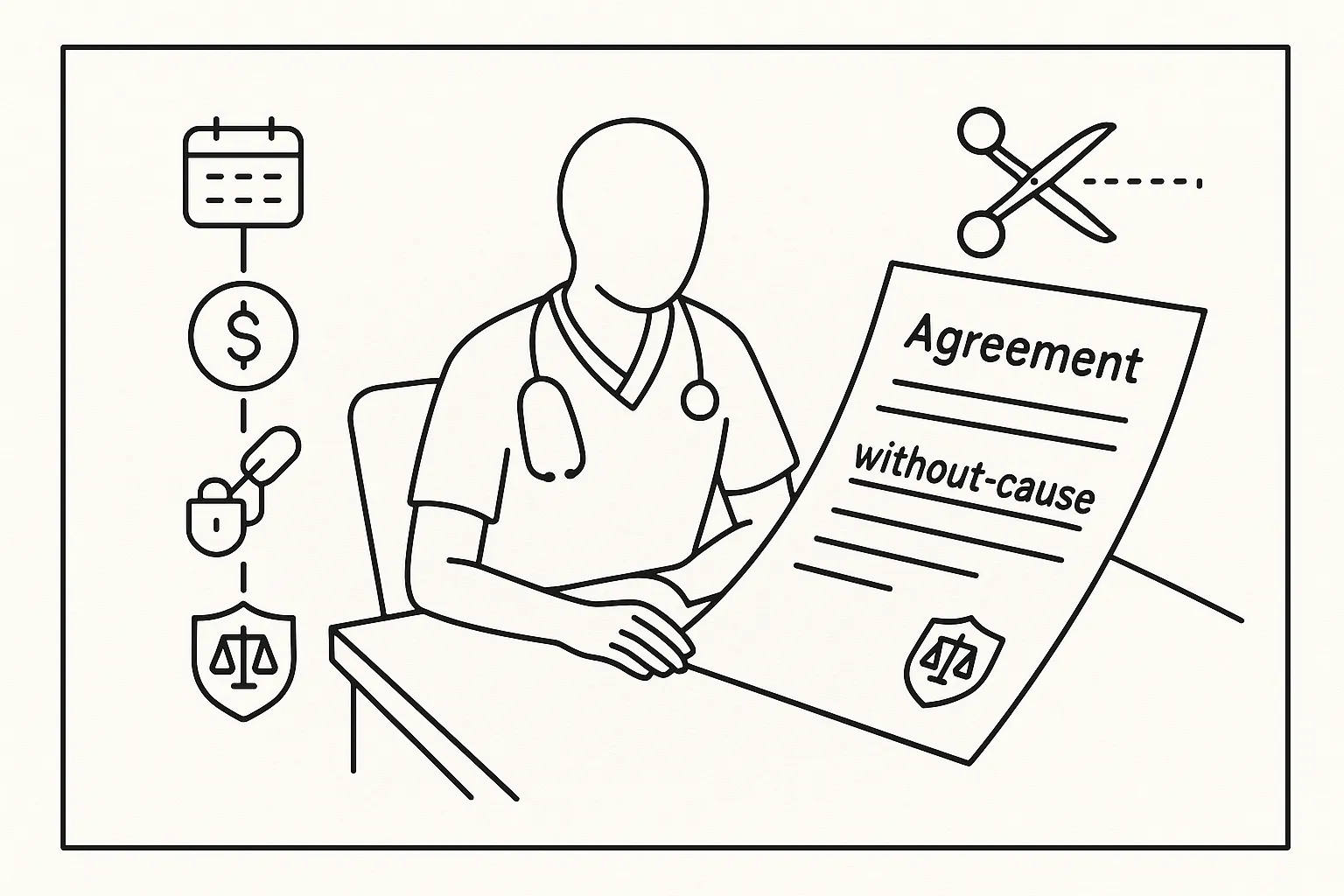
Healthcare employers use without-cause clauses to preserve staffing flexibility when service lines, budgets, patient volume, payer arrangements, or organizational priorities change. The clause may also simplify separation when the employer does not intend to allege conduct meeting a detailed for-cause standard. For the NP, however, that flexibility can create income volatility and an abrupt transition involving privileges, credentialing, patient responsibilities, and access to workplace systems.
A contractual termination right does not authorize an unlawful reason for termination. Federal and state laws may prohibit discrimination, retaliation, and other unlawful conduct, while the agreement may impose its own notice or payment requirements. The relevance of particular statutes, public-policy protections, implied obligations, or employer representations depends on the facts and governing law, so the phrase “without cause” should not be treated as eliminating every possible legal constraint.
Contractual notice also requires careful review. The agreement should explain the required delivery method, when the notice period begins, whether duties continue, and whether the employer may immediately remove the NP from patient care. If the employer fails to follow the agreed procedure, available remedies will depend on the contract and applicable law. NPs facing an actual separation can seek a focused termination contract review before signing a release or accepting the employer’s payment calculation.
Effects on Compensation, Benefits, and Malpractice Coverage
Without-cause termination can affect more than base salary. Fixed compensation may stop on the last day worked, continue through a required notice period, or be replaced by a contractually defined payment. Severance is not automatic merely because the employer ends the relationship without alleging misconduct; it generally must arise from the agreement, an applicable plan, or another enforceable obligation.
Productivity compensation deserves separate attention. RVU, collections, and hybrid models may use delayed data, quarterly measurements, collection windows, thresholds, chargebacks, or negative accrual. The agreement should state whether work performed before termination remains eligible, when the final calculation occurs, what deductions apply, and whether the NP can verify the underlying data. A detailed NP compensation and productivity review can help evaluate these formulas before they create a post-termination dispute.
- Bonuses: Determine whether eligibility requires active employment on the payment date and whether a formulaic bonus is treated differently from a discretionary award.
- Benefits: Review plan documents and the contract to determine when health, disability, retirement, and other benefits end.
- Expenses and leave: Confirm the treatment of unreimbursed business expenses and unused paid leave under the agreement and applicable policy or law.
- Repayment obligations: Identify whether early termination triggers repayment of a signing bonus, relocation allowance, training expense, or student-loan benefit. Pay particular attention to whether employer-initiated termination is excluded from repayment.
Malpractice coverage can create a significant separate obligation. Occurrence coverage generally protects covered incidents arising during the policy period even if a claim is later made. Claims-made coverage may require tail coverage after the policy ends. The contract should identify the policy type and allocate responsibility for tail coverage when the employer terminates without cause. A malpractice and tail insurance review can clarify this allocation and any conditions attached to employer-paid tail.
Post-Termination Restrictions and Career Mobility
Termination without cause does not necessarily release an NP from a non-compete or non-solicitation provision. Some agreements apply restrictions after any separation, while others contain exceptions based on who initiated termination or why employment ended. Enforceability and available remedies vary by jurisdiction, but the contract language still matters because it can influence hiring decisions, negotiations, and the cost of resolving a dispute.
A focused NP non-compete review should examine the restricted period, geographic area, prohibited activities, patient and employee solicitation terms, and any employer right to seek an injunction. The analysis should also address whether the restriction remains in effect after employer-initiated termination and whether the contract permits the employer to waive or modify it.
Repayment provisions can create another barrier to mobility. Signing bonuses and relocation benefits may be forgiven over time or become repayable if employment ends before a stated date. The agreement should distinguish voluntary resignation, termination for cause, and termination without cause. NPs should also review whether repayment is prorated and whether the employer may deduct an asserted balance from final compensation. The related guide to signing bonus repayment provisions explains common contract structures in more detail.
Credentialing and practice arrangements can affect the transition to a new position. Loss of facility privileges, payer enrollment, EHR access, or a required collaboration arrangement may interrupt clinical work even when the NP has already secured another opportunity. The agreement should address record custody, continuity-of-care responsibilities, return of property, and any required notifications without suggesting that an ordinary without-cause separation is itself professional misconduct.
Contract Safeguards to Evaluate Before Signing
The value of a termination protection depends on how clearly it is written and how it interacts with the rest of the agreement. A favorable notice period may provide little protection if the employer can stop productivity payments, enforce a broad non-compete, demand bonus repayment, and shift tail costs to the NP. The following provisions should therefore be evaluated together rather than in isolation:
- Mutual notice requirements: Compare the notice each party must provide and identify any shorter employer notice period.
- Pay in lieu of notice: Define the compensation included in the payment and whether benefits or productivity compensation continue.
- Severance terms: State the amount or formula, payment schedule, eligibility conditions, and effect of any required release.
- Final compensation accounting: Establish deadlines and methods for calculating salary, bonuses, RVUs, collections, deductions, and expense reimbursements.
- Tail insurance allocation: Specify who pays after each type of separation and whether partial service-based forgiveness applies.
- Restrictive covenant exceptions: Determine whether non-compete or non-solicitation obligations are waived after employer-initiated termination without cause.
- Repayment carveouts: Exclude or prorate repayment when the employer ends employment without cause.
- Dispute procedures: Review governing law, venue, arbitration, fee shifting, and any contractual deadline for raising a payment dispute.
It is also useful to model a realistic worst-case scenario before signing. Estimate income during the notice period, unpaid incentive compensation, potential repayment balances, tail insurance responsibility, and the time needed to begin another position. This exercise does not predict whether termination will occur; it shows how much risk the agreement assigns to the NP if it does.
Without-Cause Termination Review Checklist
Before signing an agreement containing a without-cause clause, review these questions against the complete contract:
- Is the termination right mutual, and how much notice must each party provide?
- Must notice be delivered in a particular way, and when does the notice period begin?
- Can the employer remove the NP from duties immediately, and what compensation continues afterward?
- Is severance available, and is it conditioned on signing a release?
- How are bonuses, RVUs, collections, quality incentives, and negative accrual handled?
- Who pays for malpractice tail coverage after employer-initiated termination?
- Do non-compete and non-solicitation restrictions apply after termination without cause?
- Does termination trigger repayment of a signing bonus, relocation allowance, or other benefit?
- How will privileges, credentialing, records, patient handoffs, and required supervision or collaboration be addressed?
- What law and dispute-resolution process govern a disagreement over termination or final pay?
Keep a complete copy of the signed agreement, amendments, compensation plans, policy documents, and relevant employment communications. If termination occurs, review those materials before signing a separation agreement, release, repayment acknowledgment, or final compensation statement.
Frequently Asked Questions
Can an employer terminate a nurse practitioner without giving a reason?
A without-cause clause may permit the employer to end employment without proving a contractual breach or misconduct. The employer must still comply with the agreement’s notice and payment terms, and the clause does not authorize discrimination, retaliation, or another unlawful reason for termination.
Does termination without cause guarantee severance pay?
No. Severance is not guaranteed simply because an employer terminates employment without cause. The right to severance generally depends on the employment agreement, an applicable severance plan, or another enforceable obligation.
What happens to an NP’s RVU or bonus compensation after termination?
The contract’s compensation provisions control how earned or pending incentives are calculated. Review measurement periods, active-employment requirements, collection windows, reconciliation dates, deductions, and negative accrual language to determine what may remain payable.
Who pays for malpractice tail coverage after a without-cause termination?
Responsibility depends on the policy type and contract language. Claims-made coverage may require tail insurance, and the agreement should state whether the employer or NP pays when the employer initiates termination without cause. Occurrence coverage generally does not require tail for covered acts during the policy period.
Can a non-compete still apply when the employer ends the contract?
It may. Some contracts apply restrictive covenants after any separation, while others create an exception for employer-initiated termination without cause. The wording, governing law, and circumstances must be reviewed before assuming the restriction is either enforceable or waived.
What should an NP review before accepting a without-cause termination clause?
Review the mutuality and length of notice, pay in lieu of notice, severance, final compensation formulas, bonus and repayment terms, malpractice tail responsibility, restrictive covenants, credentialing consequences, and dispute procedures. These provisions should be read together because language elsewhere in the agreement may limit the protection provided by the termination clause.
Review Your NP Termination Terms Before You Sign
Chelle Law reviews notice requirements, final compensation, repayment obligations, restrictive covenants, and malpractice coverage so you can understand the consequences of ending the employment relationship.
Contact Chelle Law