
A nurse practitioner’s work schedule affects far more than the hours printed on a calendar. Contract language governing clinic sessions, call, weekends, administrative time, telehealth, and coverage at additional locations can shape the NP’s compensation, workload, professional liability, and ability to maintain outside commitments. A provision that appears to give an employer ordinary scheduling flexibility may become significant when it contains no limits on hours, locations, notice, or additional duties.
Schedule terms also interact with provisions found elsewhere in the agreement. Employer-controlled patient volume may determine whether an NP can reach a productivity target, while mandatory cross-coverage may raise credentialing, scope-of-practice, and malpractice questions. A schedule dispute can even trigger termination, repayment, or restrictive-covenant consequences if the agreement treats refusal of an assignment as a contractual violation.
Chelle Law reviews these provisions as part of the entire contract rather than treating the schedule as an isolated administrative issue. The analysis considers what authority the employer retains, whether important obligations are measurable, how extra work is compensated, and which terms may warrant clarification or revision before signing.
Key Takeaways
- Schedule clauses can affect income, workload, malpractice exposure, credentialing, and career flexibility.
- Important terms include regular hours, change notices, call frequency, floating limits, administrative time, and compensation for added coverage.
- Productivity formulas need to account for employer-controlled volume, nonbillable work, leave, telehealth eligibility, and administrative assignments.
- Overtime and contractor-classification questions depend on the actual working relationship and applicable federal and state law, not the contract label alone.
- Schedule, termination, repayment, malpractice, and restrictive-covenant provisions need to be evaluated together.
What an NP Scheduling Clause Actually Controls
Regular Hours and the Employer’s Change Authority
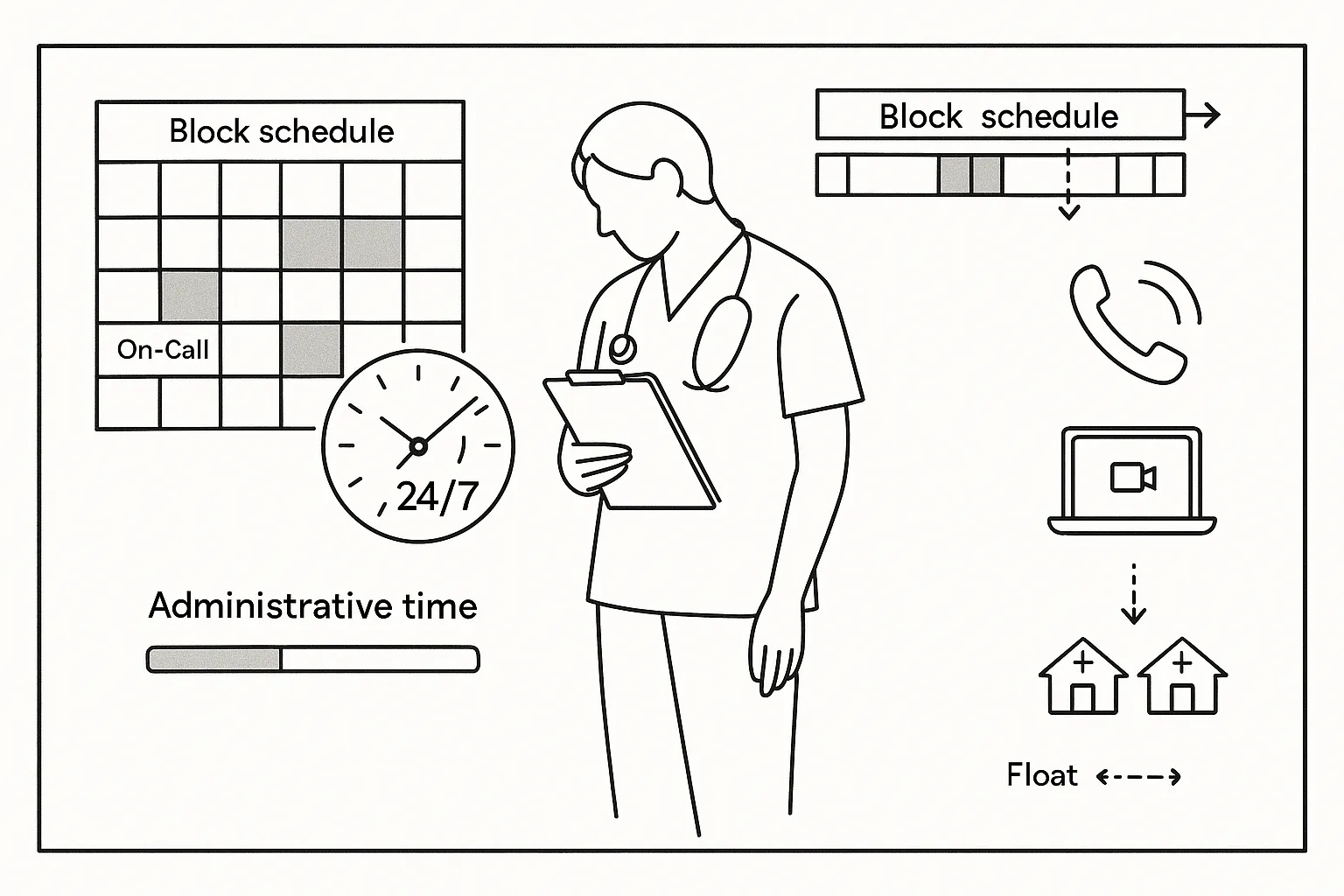
Some agreements identify regular clinic hours, expected shifts, and a primary location. Others state only that the schedule is determined by the employer or remains subject to operational needs. The broader formulation can permit substantial changes to start times, shift lengths, patient-facing hours, weekends, or work locations without defining how much advance notice the NP will receive.
Terms such as “reasonable additional hours” and “other duties as assigned” are especially difficult to evaluate without context. The agreement may need to distinguish occasional operational changes from a permanent expansion of the position. Relevant questions include who can modify the schedule, whether notice is required, whether the NP may be assigned consecutive shifts, and whether charting or administrative duties must be completed outside scheduled hours.
Call, Weekends, Floating, and Cross-Coverage
Call language may require an NP to participate in a rotation without stating the expected frequency, availability window, response time, patient-contact duties, or clinical support available during coverage. It may also be unclear whether call is remote, requires an in-person response, or includes time off after an overnight assignment. These details matter even when the agreement describes call as an ordinary part of the salary. A separate review of NP call coverage requirements can help identify the operational questions the contract needs to answer.
Floating and cross-coverage provisions create similar uncertainty. An NP may be assigned to another clinic, facility, or service line where travel, credentialing, patient population, support, and scope expectations differ from the primary role. Useful language can identify permitted locations, notice procedures, travel reimbursement, and reasonable boundaries on assignments outside the NP’s usual practice area. Broad multi-site language also warrants comparison with the practical risks of nurse practitioner floating requirements.
How Schedule Control Changes Compensation
Productivity Targets and Employer-Controlled Volume
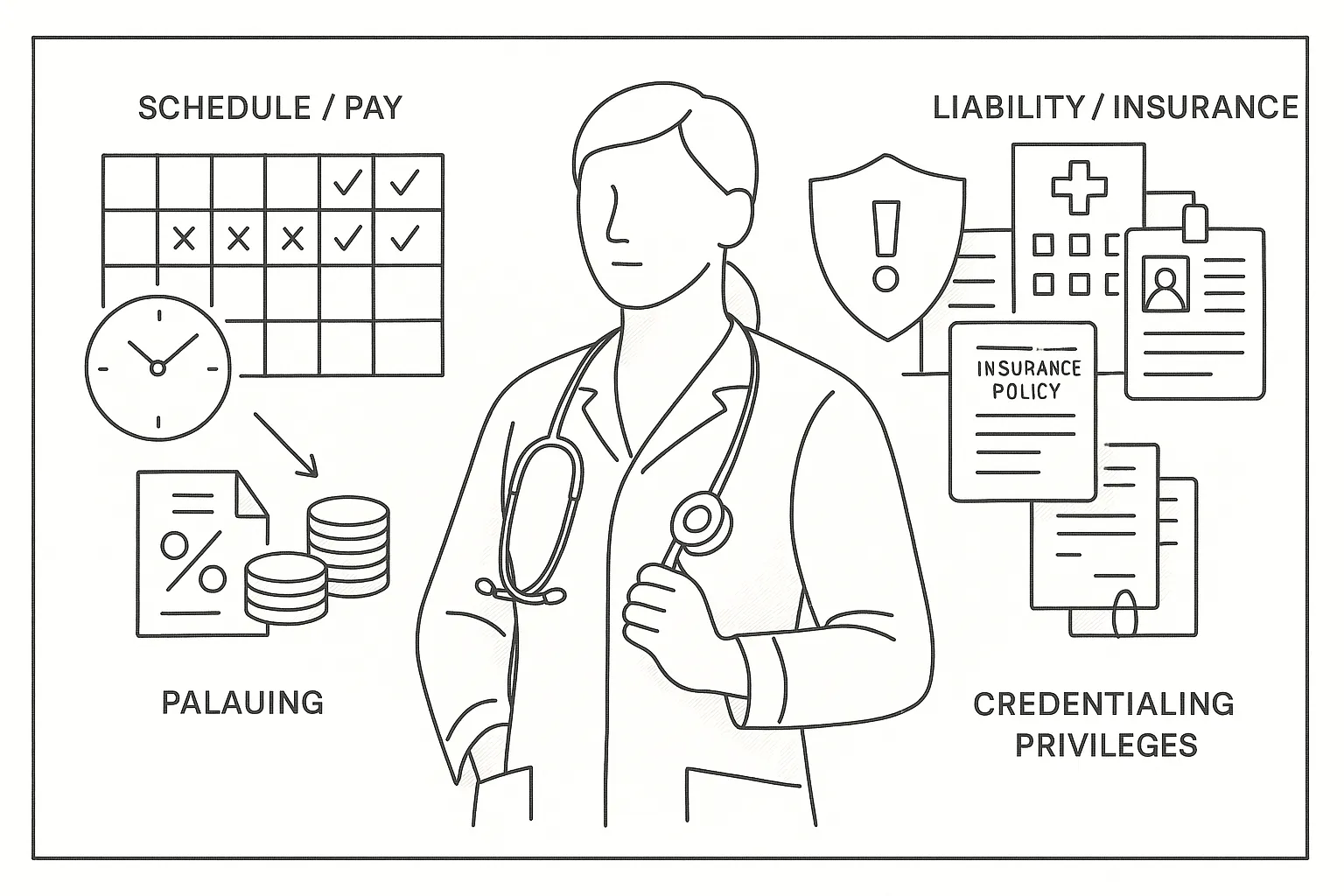
An NP paid partly through collections, work relative value units, patient encounters, or quality measures depends on the employer for scheduling opportunities. Low-volume shifts, blocked templates, mandatory meetings, call coverage, and administrative assignments can reduce production even when the contractual target remains unchanged. The result may be a smaller bonus or, where the agreement permits negative accrual, a deficit carried into a later measurement period.
The compensation formula needs to explain how approved leave, credentialing delays, unavailable support staff, administrative blocks, and other employer-controlled nonproductive time affect the target. It should also define whether weekend coverage, telephone work, chart review, or uncompensated follow-up generates credit. A focused compensation and productivity review can determine whether the scheduling and bonus provisions use compatible assumptions.
Telehealth introduces another layer. Not every virtual appointment is necessarily billable, and a scheduled encounter may fail because of patient location, technology, payer requirements, modality, or documentation. Current CMS telehealth guidance includes time-sensitive 2026 coverage rules and recognizes nurse practitioners as eligible distant-site practitioners only within the applicable service, billing, and state-law requirements. The contract can define how completed, failed, and nonbillable virtual encounters affect productivity calculations rather than assuming that every scheduled visit produces equivalent credit.
Overtime, Extra Shifts, and Contractor Classification
A salary does not automatically resolve whether additional shifts or after-hours work are compensable. Federal overtime coverage depends on employee status, duties, salary basis, and the applicable exemption, while state law may provide greater protection. After the 2024 federal overtime rule was vacated, the Department of Labor stated that it was applying the 2019 federal thresholds, including the $684-per-week standard salary level and the $107,432 highly compensated employee threshold. The current Department of Labor overtime materials provide the federal framework, but the result for a particular NP remains fact- and jurisdiction-specific.
A May 2026 Department of Labor opinion letter also addressed an exempt nursing professional performing additional hourly, nonexempt nursing work. The agency explained that the extra work did not inherently destroy exempt status when the employee’s primary duty remained exempt and the salary requirements continued to be met. That opinion is fact-specific, however, and it does not answer the separate contractual question of what the employer agreed to pay for added shifts, call, or coverage.
Independent-contractor agreements require a different analysis. A contract may call the NP a contractor, but classification depends on the actual economic relationship rather than the label alone. Under the Department of Labor’s multifactor economic-reality framework, control over schedules, locations, availability, and methods can be relevant, and state classification tests may differ. NPs evaluating a 1099 arrangement should therefore review both the scheduling restrictions and the broader W-2 versus 1099 implications.
Telehealth, Scope, Credentialing, and Malpractice Exposure
A schedule clause cannot be evaluated apart from the legal and clinical conditions under which the work occurs. APRN scope, prescribing authority, supervision or collaboration, and independent-practice rules continue to vary by state. The APRN Consensus Model is a regulatory framework rather than a uniform national law, and the National Council of State Boards of Nursing explains that an APRN practicing across state borders, including through telehealth, must satisfy the requirements where the patient is located.
A telehealth scheduling provision can therefore identify which patient states the NP will cover, who obtains and maintains required licenses, what happens when approval is delayed, and whether the employer supplies compliant technology. It can also address prescribing limitations, privacy obligations, documentation standards, payer eligibility, and whether the NP must remain available when no billable appointments are scheduled. These operational details belong alongside the broader telehealth contract terms, not in an informal scheduling policy that may change unilaterally.
Additional facilities and unfamiliar service lines may require credentialing, privileges, training, or a different supervision arrangement. The agreement can clarify who completes applications, pays fees, tracks renewal deadlines, and bears the income consequences of a delay. It should not assume that the NP can immediately provide every service at every employer location.
Malpractice coverage must also follow the actual assignment. Important questions include whether the policy covers telehealth, every patient location, additional facilities, call activities, and cross-coverage outside the NP’s usual service line. The contract may also allocate incident-reporting duties and responsibility for tail coverage after employment ends. A malpractice and tail insurance analysis can identify gaps between the schedule provision and the coverage promised elsewhere in the agreement.
Schedule Red Flags and Terms Worth Clarifying
Vague scheduling language usually gives the employer flexibility while making the NP’s obligation difficult to measure. That imbalance becomes more consequential when the same agreement imposes productivity thresholds, repayment obligations, or immediate consequences for refusing an assignment.
- Unlimited change authority: The employer may alter shifts, call, weekends, hours, or locations without notice or objective limits.
- Undefined additional duties: Administrative, educational, operational, or cross-coverage work can be added without protected time or compensation.
- Unmeasured call obligations: The agreement omits frequency, response expectations, clinical support, geographic boundaries, or payment.
- Unadjusted productivity targets: The same benchmark applies despite leave, low-volume assignments, nonbillable telehealth, or employer-directed administrative work.
- Broad floating language: The NP can be sent to any location or service line without addressing travel, credentialing, scope, or malpractice coverage.
- Schedule-related penalties: Declining an undefined assignment may trigger termination, forfeiture, or repayment of a signing or relocation benefit.
More workable language can identify the regular schedule, primary locations, anticipated clinic sessions, call frequency, minimum notice for material changes, and limits on consecutive or weekly assignments. It can also state how additional coverage is paid, whether travel is reimbursed, and when productivity targets are adjusted. If moonlighting or family obligations are important, the schedule provision also needs to be consistent with any approval requirements or outside-work restrictions.
The most serious risk may appear outside the scheduling section. A bonus repayment clause, for example, could require reimbursement if the NP resigns after a substantial schedule change. A restrictive covenant may make it difficult to accept nearby work, while a termination clause may define refusal of an assignment as cause. Reviewing those provisions together helps reveal consequences that would not be apparent from the schedule clause alone.
Responding When the Assigned Schedule Changes
When a schedule problem develops, the first step is to compare the new assignment with the complete agreement, incorporated policies, amendments, and relevant compensation documents. The NP can preserve schedules, emails, text messages, time records, pay statements, call logs, and written change notices. A dated written request for clarification is generally more useful than relying exclusively on an informal conversation.
Internal discussions may involve a supervisor, practice administrator, or human resources department, depending on the organization. The written communication can identify the disputed provision, describe the assignment, and ask how compensation, productivity credit, credentialing, malpractice coverage, or required notice will be handled. Careful documentation is particularly important when the employer characterizes the issue as a refusal to work rather than a request to clarify an undefined obligation.
If the conflict cannot be resolved, the NP may need to assess amendment options, notice requirements, repayment exposure, and the consequences of leaving. Before giving notice, a review of the contract’s termination provisions can identify financial and professional risks, including whether the agreement permits without-cause termination and what obligations continue after the relationship ends.
Frequently Asked Questions
Can an employer change an NP’s schedule after the contract is signed?
It depends on the agreement and applicable law. Broad language may give the employer substantial flexibility, while defined hours, locations, notice periods, or shift limits may provide clearer contractual boundaries.
What details belong in an NP on-call provision?
The provision can address frequency, availability windows, response times, geographic limits, patient-contact duties, clinical support, compensation, and time off after coverage. It should also distinguish remote availability from required in-person work.
How can employer scheduling affect an NP productivity bonus?
Scheduling decisions influence patient volume, collections, encounters, and RVU production. Administrative blocks, leave, low-volume shifts, call duties, or nonbillable telehealth may reduce productive time unless the agreement adjusts the target or awards appropriate credit.
Does a salary mean an NP is never entitled to overtime?
No. Federal overtime status depends on the NP’s employee status, duties, salary basis, and the requirements of an applicable exemption, while state law may be more protective. Contractual compensation for extra work is a related but separate question.
What should an NP preserve during a scheduling dispute?
The NP can retain schedules, written change notices, emails, messages, time records, call logs, compensation statements, and requests for clarification. Those records may help establish what was assigned, when notice was given, and how the employer responded.
When is attorney review of schedule language most useful?
Review is particularly useful when scheduling authority is broad or connected to productivity pay, call, floating, contractor status, bonus repayment, malpractice coverage, termination, moonlighting, or restrictive covenants. Evaluating the language before signing may expose interactions that are difficult to correct later.
Review Your NP Schedule Terms Before You Sign
Chelle Law can analyze scheduling authority, call, floating, productivity compensation, malpractice coverage, and termination provisions to identify terms that may warrant clarification or revision.
Contact Chelle Law