
Collections-based compensation links some or all of a nurse practitioner’s pay to revenue received for the NP’s services. The percentage stated in an offer is only the starting point. Actual compensation depends on how the agreement defines collections, which receipts receive credit, what deductions apply, when the employer measures revenue, and whether the NP receives a guaranteed salary while claims move through the billing cycle.
This structure can shift substantial financial risk to the NP. Payer adjustments, claim denials, refunds, billing delays, holdbacks, and retroactive recoupments may reduce pay months after services are performed. The result also depends on payer mix, coding practices, billing under the NP’s National Provider Identifier, reassignment of billing rights, and whether another billing methodology applies. A percentage that appears competitive may therefore produce less income than expected.
Contract review can identify how the formula operates alongside wage requirements, worker classification, malpractice obligations, restrictive covenants, and termination provisions. Chelle Law examines the complete compensation structure, including reporting access, audit rights, clawbacks, post-termination collections, and the documents needed to test the employer’s projections before the NP signs.
Key Takeaways
- The compensation percentage has limited meaning until the contract defines collections, permitted deductions, attribution rules, and payment timing.
- Payer mix, billing under the NP’s NPI, reassignment, coding practices, and incident-to billing can materially affect credited revenue.
- Holdbacks, negative accrual, clawbacks, and broad offset rights can create delayed income reductions or repayment exposure.
- Collections-based pay does not determine whether an NP is an employee or independent contractor and does not displace applicable wage laws.
- Historical reports, payer data, worked calculations, audit access, and a defined final reconciliation process make the financial terms easier to evaluate.
How Collections Become Nurse Practitioner Compensation
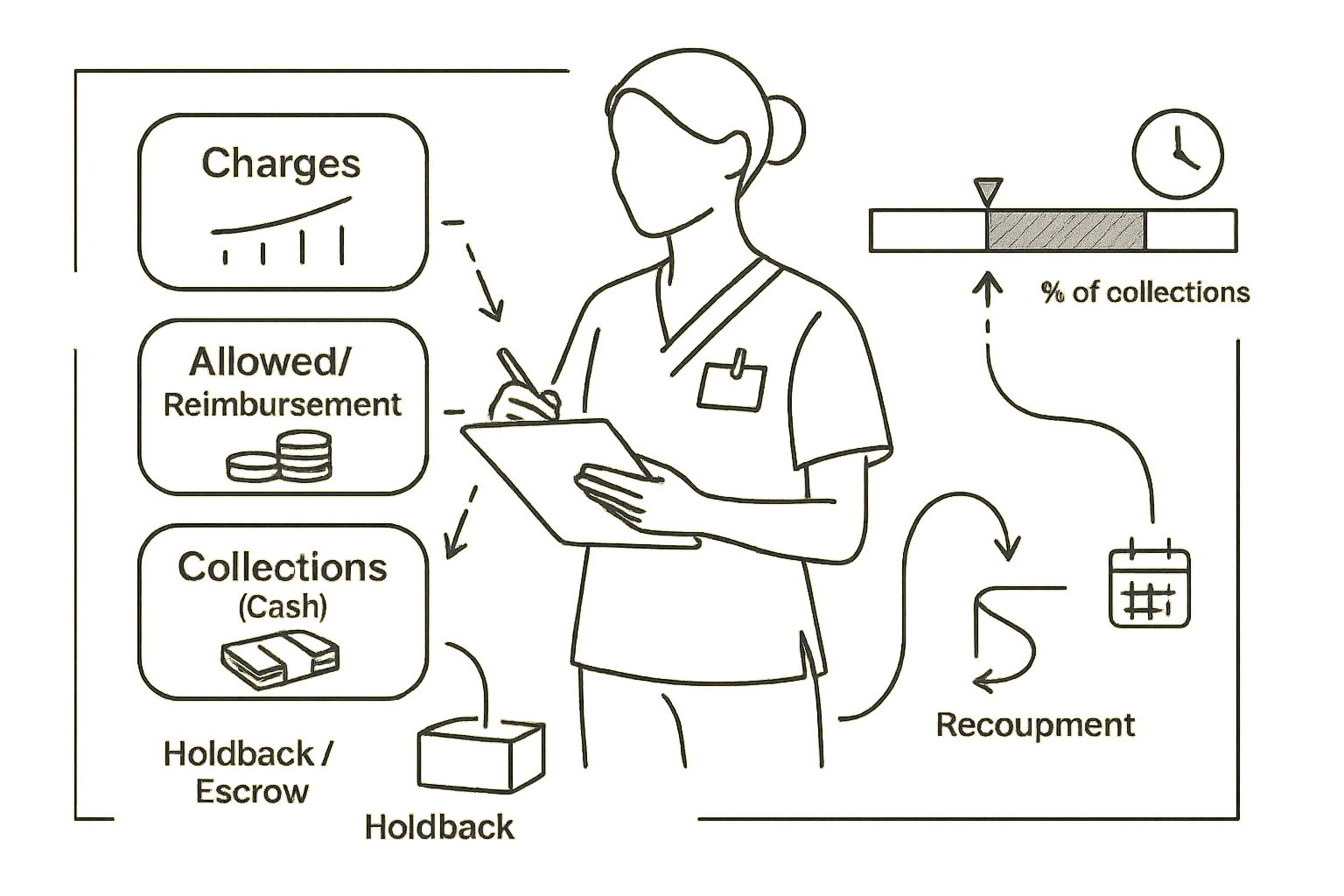
A collections formula may supplement a guaranteed base salary, replace fixed compensation, or operate as one part of a blended incentive plan. Some agreements pay a percentage from the first dollar collected. Others require collections to exceed a threshold before incentive compensation begins. The financial risk differs significantly among these structures, even when the stated percentage is the same. Comparing the offer with other nurse practitioner compensation models can help place the formula in context.
The Definition of Collections Controls the Formula
Billed charges are not the same as money received. A practice may charge $800 for a service but collect only $150 after the payer applies its contracted rate and other adjustments. If the NP receives 25% of cash collected after adjustments, that encounter produces $37.50 in compensation rather than 25% of the original charge.
The contract needs an objective revenue base. “Gross collections,” “net collections,” “receipts,” and “collected revenue” may produce different results depending on the definitions. Relevant questions include whether the calculation excludes contractual adjustments, refunds, discounts, bad debt, denied claims, credit-card charges, billing expenses, or other overhead. The agreement also may need to address how receipts are attributed when multiple clinicians participate in an encounter.
Thresholds and tiered percentages require the same precision. The documents can clarify whether the threshold resets monthly, quarterly, or annually; whether one weak period offsets a stronger period; and whether the employer may change the formula or attribution policy during the contract term. Worked examples often reveal ambiguities that are difficult to identify from a percentage alone.
Billing Method and Payer Mix Affect Credited Revenue
The billing pathway can be as important as the percentage. An NP may bill under the NP’s own NPI, reassign billing rights to an employer or contractor, or provide services billed under another practitioner when applicable requirements are met. The contract and compensation reports need to show which services are attributed to the NP under each method.
CMS guidance for advanced practice registered nurses explains that ordinary Medicare NP professional services outside hospital and skilled nursing facility settings are generally paid at 85% of the physician fee schedule amount. Incident-to services involve separate supervision, billing, and payment requirements. These distinctions can materially change collections and make it important to review NPI usage, payer-specific reporting, supervision arrangements, coding policies, and sample remittance data.
Payer mix also affects realistic earning potential. A practice with a high proportion of lower-reimbursing plans may generate different collections from one with more commercial or self-pay revenue, despite similar patient volume. Historical reports are more useful when they separate billed charges, allowed amounts, payments, adjustments, denials, and refunds by payer.
Where Collections-Based Formulas Create Risk
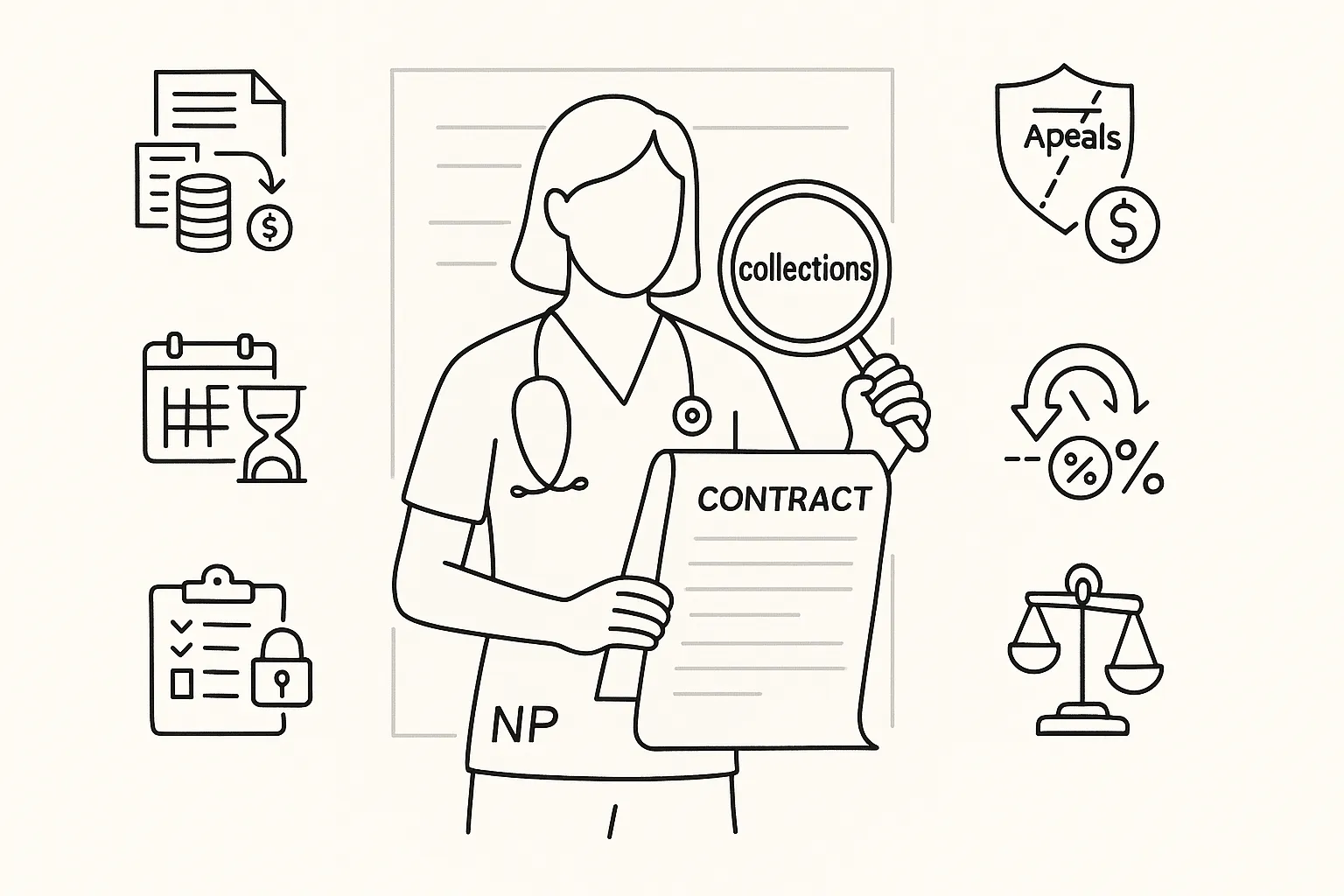
A collections model can make the NP responsible for revenue outcomes that the NP does not fully control. The employer may select the billing company, establish coding protocols, negotiate payer contracts, submit claims, process appeals, and decide when to write off an account. If compensation falls whenever those processes fail, the agreement needs a fair method for allocating responsibility and allowing the NP to verify the result.
Denials, Holdbacks, and Negative Accrual
Denied claims can delay or eliminate compensation even when the NP completed the clinical work. Contract analysis can determine who handles appeals, which denial reasons reduce the NP’s compensation, and whether an administrative or payer error is treated differently from an identified documentation problem. The NP may also need access to denial reports, appeal status, coding guidance, and supporting records rather than receiving only a net number.
A holdback allows the employer to retain part of otherwise earned incentive compensation against future refunds, denials, or chargebacks. The provision is more predictable when it identifies the percentage withheld, the purpose of the reserve, the release schedule, and what happens to the remaining balance after termination.
Some formulas instead advance compensation and carry a shortfall into later periods. This negative accrual structure can cause current production to repay an earlier deficit. The agreement may need to distinguish between an accounting balance used in future incentive calculations and a personal debt that the employer can demand from the NP.
Clawbacks, Audits, and Overpayment Exposure
Clawback language may authorize recoupment after a refund, payer audit, coding review, documentation dispute, or alleged overpayment. Important terms include the triggering events, look-back period, proof required, appeal process, and method of recovery. Broad language allowing the employer to determine an amount unilaterally and deduct it from future pay creates more uncertainty than a process with notice, records access, and a defined opportunity to dispute the calculation.
Contractual clawbacks are not identical to a provider’s or organization’s legal obligations concerning payer overpayments. The agreement can allocate who investigates a questioned payment, communicates with the payer, handles an appeal, reports and returns an identified overpayment, and ultimately bears the financial loss. It also can distinguish problems caused by the NP’s documentation from errors involving coding staff, billing systems, payer processing, or employer policies.
Audit rights need to be practical rather than theoretical. Monthly or quarterly statements may be insufficient if they omit encounter-level data, adjustments, payer details, and later reversals. Mutual access to relevant records and a method for resolving technical coding or accounting disputes can make the formula more verifiable. Vague or one-sided audit and offset provisions are among the contract red flags nurse practitioners can evaluate before accepting an offer.
Wage Rules, Classification, and Career Consequences
A contract formula describes promised compensation, but it does not replace applicable wage law. The federal Fair Labor Standards Act generally does not require commissions above minimum wage and overtime obligations. However, a collections model does not eliminate minimum-wage, recordkeeping, or overtime requirements for a covered nonexempt employee, and incentive payments may affect the regular-rate calculation. The U.S. Department of Labor’s FLSA guidance provides the federal framework, while state law may impose additional rules concerning deductions, earned commissions, clawbacks, and final-payment timing.
Payment by a collections percentage also does not determine whether the NP is a W-2 employee or an independent contractor. The IRS evaluates behavioral control, financial control, and the parties’ relationship rather than relying only on the contract label or issuance of Form 1099-NEC. Its current worker-classification guidance illustrates why the actual working relationship matters. Classification can affect withholding, employment taxes, benefits, retirement contributions, business expenses, insurance, and exposure to operating costs. A comparison of W-2 and 1099 arrangements for NPs therefore needs to consider the full economic package.
Collections provisions can also affect an NP’s ability to leave a position. An employer may claim continuing offset rights while unpaid collections remain outstanding, while the NP may be waiting for a final reconciliation. Signing-bonus repayment, tail insurance, notice obligations, and restrictive covenants can compound that pressure. The FTC’s nationwide noncompete rule is not currently in effect or enforceable, so the specific agreement and applicable state law remain central. A focused review of an NP noncompete can assess mobility restrictions together with the compensation terms.
Contract Terms That Improve Transparency
A workable compensation provision identifies what counts as a collection, when revenue is credited, and every category of permitted deduction. It also explains attribution for shared visits, refunds, bundled services, split billing, and receipts posted after the measurement period. If the employer uses a separate compensation plan, policy, fee schedule, or billing manual, the agreement needs to explain how that document applies and whether it can be changed unilaterally.
- Compensation floor: A guaranteed salary or draw may reduce short-term volatility while claims are submitted and paid.
- Defined deductions: The documents can list allowable adjustments rather than giving the employer unrestricted discretion to reduce collections.
- Detailed reporting: Statements may identify charges, receipts, payer adjustments, denials, refunds, holdbacks, and the resulting compensation.
- Records and audit access: The NP can receive the information reasonably necessary to confirm attribution and calculations.
- Limited recoupment: Clawbacks can specify causes, documentation, notice, time limits, and a dispute process.
- Change controls: The agreement can address whether compensation policies may change during the term and whether advance notice or written agreement is required.
Termination requires separate attention because services are often collected weeks or months after the NP performs them. The contract can state whether the NP remains eligible for those receipts, how long the collection window remains open, when the employer issues the final statement, and how later refunds or denials are handled. It also can explain whether an outstanding deficit is merely carried against future incentive compensation or becomes repayable when the relationship ends.
Malpractice obligations need to remain distinct from the collections calculation. If the policy is claims-made, the documents can identify who is responsible for tail coverage and whether that expense may be deducted from final compensation. A malpractice and tail insurance review can clarify this potential departure cost before it becomes part of a final accounting dispute.
Information to Request Before Signing
Historical data is essential when compensation depends heavily on collections. An NP can request representative monthly collection reports, payer-mix information, denial rates, adjustment categories, average payment lag, and sample calculations using the offered formula. The most useful examples show how billed services become allowed charges, cash receipts, deductions, and final compensation rather than presenting only aggregate revenue.
- Who controls coding, claim submission, appeals, write-offs, and refunds?
- Which NPI and billing entity are used for the NP’s services?
- How are shared services, incident-to billing, procedures, and ancillary revenue attributed?
- How often are compensation statements issued, and what supporting data is available?
- Can a deficit carry forward, become a personal repayment obligation, or be deducted from final pay?
- What happens to collections received after termination?
Attorney review is particularly useful when collections are undefined, the arrangement lacks meaningful guaranteed compensation, or the employer retains broad authority over deductions, audits, and recoupment. A line-by-line NP compensation and productivity review can evaluate the formula together with contractor status, restrictive covenants, termination rights, repayment obligations, and malpractice coverage.
Frequently Asked Questions
How is collections-based pay calculated for a nurse practitioner?
The employer applies the contract’s percentage or formula to the collections credited to the NP. The result depends on the definition of collections, permitted deductions, attribution rules, thresholds, and whether the arrangement includes a base salary or guaranteed draw.
Why can two identical collection percentages produce different pay?
Payer mix, reimbursement rates, billing method, NPI usage, claim denials, write-offs, payment delays, and deductions can differ substantially between practices. Historical reports and worked calculations are needed to compare the likely economic results.
Can a practice claw back collections compensation already paid?
An agreement may authorize recoupment after a refund, denial, audit, documentation issue, or alleged overpayment. Whether and how a clawback can be enforced may also depend on applicable wage and contract law, so the triggering events, time limit, records, dispute process, and recovery method require careful review.
Does collections-based pay make an NP an independent contractor?
No. Payment method and the contract label do not determine worker status by themselves. Classification depends on the actual relationship, including behavioral control, financial control, and other relevant circumstances.
What happens to collections received after the NP leaves?
The answer depends on the contract and applicable law. The agreement may provide a post-termination collection window, a final reconciliation date, access to supporting reports, and rules for later refunds, denials, holdbacks, or outstanding advances.
When is legal review especially useful for a collections-based offer?
Review is particularly useful when key terms are undefined, most compensation is variable, reports are limited, clawback or audit rights are one-sided, or termination and repayment provisions are unclear. Reviewing the entire agreement also shows how compensation interacts with malpractice coverage, classification, and mobility restrictions.
Review Your Collections Compensation Before You Sign
Chelle Law reviews nurse practitioner agreements to identify unclear revenue definitions, deductions, clawbacks, reporting limits, and post-termination payment risks.
Contact Chelle Law