
Floating assignments require a nurse practitioner (NP) to work across multiple units, clinics, service lines, or facilities rather than at one fixed practice location. Although floating can provide broader clinical experience and help an employer respond to staffing needs, an open-ended clause may also affect scope of practice, credentialing, supervision, scheduling, compensation, and malpractice exposure. The contract should explain where the NP may be assigned, what duties may be required, how competency will be verified, and whether additional travel or workload will be compensated. Before signing, NPs should evaluate both the written clause and the related employer policies that determine how floating will operate in practice.
Key Takeaways
- Floating requirements should define the permitted facilities, units, service lines, schedules, and clinical duties rather than give the employer unlimited reassignment authority.
- Orientation, competency verification, credentialing, and applicable supervision or collaboration arrangements should be in place before an NP works in a new setting.
- Malpractice insurance terms should cover the locations and services included in a floating assignment and clearly allocate responsibility for tail coverage when applicable.
- The agreement should address floating differentials, travel reimbursement, scheduling protections, and the treatment of reassigned work under RVU or other productivity formulas.
- Verbal assurances about assignment limits or additional compensation should be incorporated into the signed agreement or a written amendment.
What Floating Means for Nurse Practitioners

Floating describes a contractual or operational expectation that an NP may be assigned outside a single designated unit, clinic, facility, or service line. An assignment may be temporary, such as covering a shift or an employee’s leave, or it may involve an ongoing rotation among locations. Floating provisions appear in hospital employment agreements, urgent care networks, multi-site primary care groups, specialty practices, and telehealth arrangements.
Common assignments include inpatient cross-coverage, work at different outpatient clinics, coverage at urgent care locations, temporary support for specialty departments, and virtual services involving patients in multiple jurisdictions. These arrangements may overlap with broader concerns involving scope of practice in an NP contract. An assignment to another primary care clinic does not necessarily present the same competency, privileging, or liability considerations as reassignment to an emergency department, intensive care unit, or surgical setting.
Employers use floating to respond to changing patient volume, employee absences, and coverage needs. The concern for an NP is not the concept of floating by itself, but whether the employer’s discretion has meaningful boundaries. Undefined provisions may result in unpredictable schedules, longer travel, different patient acuity, or duties that do not align with the NP’s education, certification, privileges, or experience.
Contract Terms That Define Floating Assignments
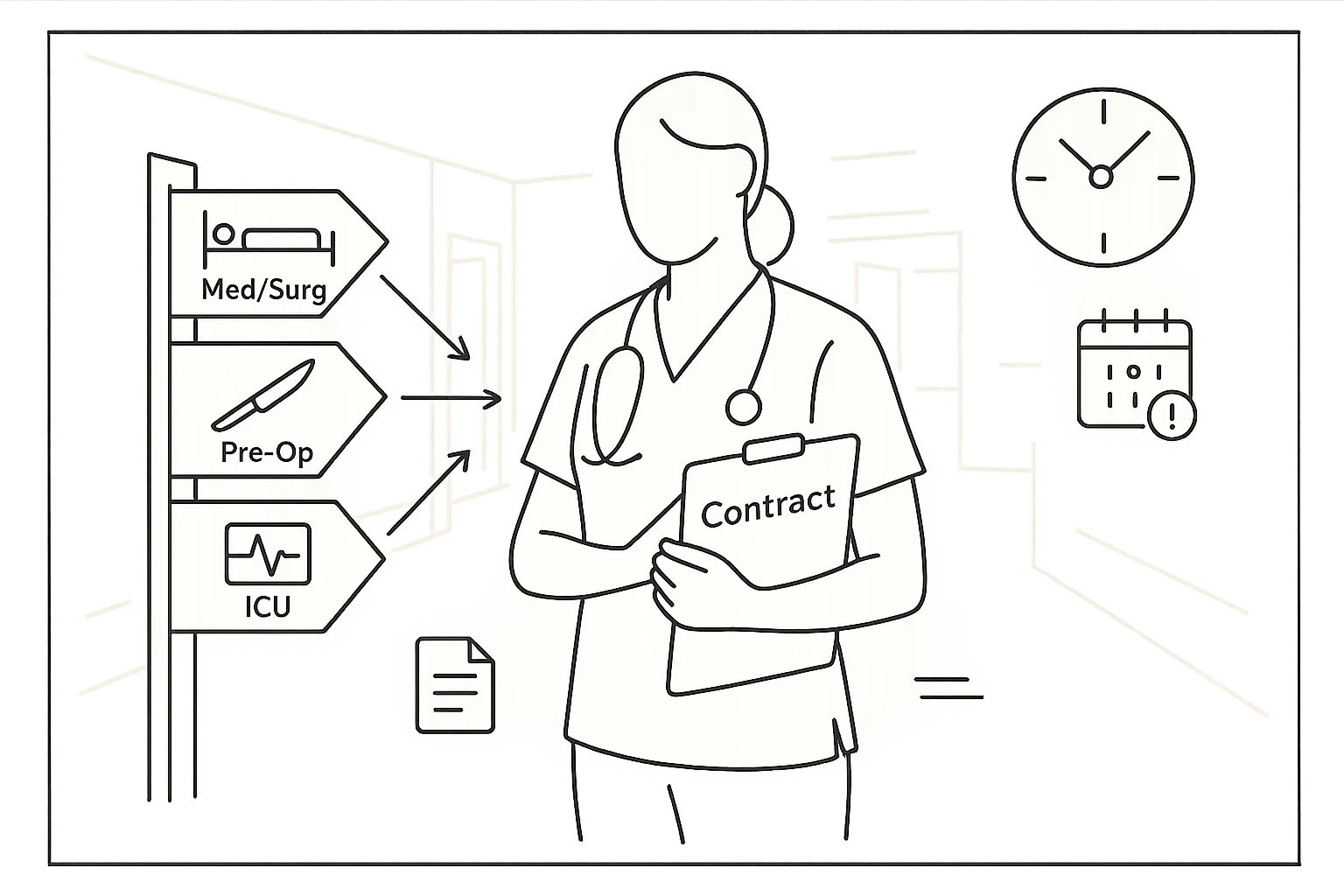
Floating language ranges from narrow clauses identifying specific facilities and departments to broad provisions allowing assignment to any location or service line selected by the employer. Phrases such as “duties as assigned,” “other locations as needed,” or “any facility within the health system” may give the employer substantial discretion unless the agreement includes corresponding limits.
Locations, Units, Duties, and Clinical Limits
A clear clause should identify the NP’s primary location and the other sites or units where floating may occur. It should also address whether the employer may add locations later, whether there is a geographic limit, and whether reassignment can become permanent. These details are especially important in large healthcare systems, where a general reference to affiliated facilities may encompass locations with materially different commutes, workflows, and patient populations. Similar concerns arise when an NP is expected to work at multiple practice locations.
The agreement should also align the assigned duties with the NP’s specialty, certification, training, and privileges. Broad procedural language may leave uncertainty about whether the NP can be required to manage a different acuity level or perform services outside the normal role. Protective language may limit floating to identified departments, exclude certain high-acuity settings unless separately agreed, and require competency verification before expanded duties begin.
Hours, Call Coverage, and Reassignment Notice
Floating can change more than the work location. A reassignment may involve different shift lengths, weekend obligations, on-call coverage, patient loads, or start and end times. The contract should be reviewed together with incorporated scheduling policies to determine whether the employer can change these expectations unilaterally.
Useful operational protections may include advance notice when reasonably possible, limits on consecutive floating shifts, defined call responsibilities, and workload expectations appropriate to the assigned setting. If those protections exist only in a policy that the employer may revise, they may not provide the same certainty as terms written directly into the employment agreement.
Credentialing, Training, and Supervision Requirements
An NP should not assume that existing credentialing and privileges automatically extend to every unit, facility, or service covered by a floating clause. Before work begins in a new setting, the employer may need to complete facility credentialing, obtain privileges, confirm payer enrollment, or document additional competency. The agreement should identify who is responsible for these processes, related fees, required administrative work, and delays that may affect compensation.
Orientation and cross-training obligations should be sufficiently clear to establish what the employer will provide before the NP accepts independent responsibility. Relevant protections may include supervised shifts, skills checklists, access to unit-specific protocols, electronic health record training, and objective competency criteria. Language stating that competency will be determined solely by the employer may provide little assurance about the amount or quality of preparation.
Floating may also change the supervising or collaborating clinician, reporting structure, and delegation arrangements. These terms must remain consistent with applicable law, facility policy, and the NP’s authorized practice. A focused review of supervision and collaboration terms can identify whether the contract adequately addresses changes among units or facilities. Cross-state telehealth or multi-state assignments require additional attention to licensure, prescribing authority, credentialing, and other jurisdiction-specific requirements.
Malpractice Insurance and Liability When Floating
Malpractice coverage should apply to every approved location, service line, and clinical duty included in the floating arrangement. An NP should confirm whether the employer provides occurrence or claims-made coverage, whether policy limits or exclusions change for higher-risk settings, and whether services at affiliated facilities or in other states fall within the policy’s coverage.
Claims-made coverage also raises the question of who must purchase tail insurance after employment ends or the policy is replaced. Silence on this issue may leave the NP responsible for a substantial expense or uncertain post-employment protection. A malpractice and tail insurance review can evaluate whether the policy obligations match the actual locations and duties contemplated by the agreement.
Liability risk may increase when an NP is placed in an unfamiliar clinical environment without adequate orientation, support, or clearly documented privileges. Contract language cannot replace professional judgment or regulatory compliance, but it can allocate responsibilities for training, insurance, credentialing, and assignment limits before a dispute occurs.
Compensation, Productivity, Travel, and Workload
Floating may affect total compensation even when the base salary does not change. Some agreements provide a floating differential, shift premium, or higher rate for work outside the primary location or in a higher-acuity setting. Others require reassignment without additional pay. The agreement should also state whether the employer reimburses mileage, parking, lodging, or other travel expenses associated with multi-site coverage.
Productivity Credit and Bonus Calculations
Productivity-based compensation requires particular attention because reassignment may reduce patient volume, alter billing opportunities, or involve non-billable coverage work. The contract should explain whether floating shifts, administrative time, orientation, and cross-coverage count toward productivity thresholds. NPs paid under an RVU formula should understand how reassigned work is credited by reviewing the agreement’s RVU compensation terms.
Bonus reconciliation and negative accrual provisions may create additional risk if an NP remains responsible for targets that floating makes harder to reach. A fair structure may credit the work toward the applicable metric, adjust the target, or provide a separate rate for affected shifts. The calculation method should be written clearly enough for the NP to verify compensation statements.
Workload protections can also have financial and professional consequences. Patient caps, limits on consecutive assignments, adequate support staff, and sufficient notice may help prevent floating from becoming a recurring source of excessive workload. These provisions should be evaluated alongside broader schedule-control language rather than treated as an isolated clause.
Negotiating and Documenting Floating Protections
Floating provisions are easier to evaluate when employer discretion is expressed in measurable terms. Depending on the proposed role, useful clarifications may include:
- Identifying the primary worksite and permitted floating locations or geographic boundaries.
- Limiting assignments to duties consistent with the NP’s specialty, certification, competency, privileges, and applicable practice authority.
- Requiring appropriate orientation, credentialing, and competency verification before work in a new unit or facility.
- Defining scheduling notice, call expectations, travel reimbursement, and any floating differential.
- Explaining how floating work will be credited under RVU, collections, quality, or other bonus formulas.
- Confirming malpractice coverage and responsibility for tail insurance when applicable.
Any negotiated limits or financial protections should appear in the signed agreement or an enforceable amendment. Informal assurances from a recruiter or manager may not control if the contract gives the employer broader authority or contains an integration clause. A comprehensive nurse practitioner contract review can assess the floating provision together with compensation, termination, restrictive covenants, malpractice insurance, and incorporated employer policies.
Frequently Asked Questions
Can an employer require a nurse practitioner to float to any location?
The answer depends on the employment agreement, incorporated policies, and applicable professional requirements. Broad language may give the employer substantial reassignment authority, while a negotiated clause can limit floating to named facilities, departments, geographic areas, or duties consistent with the NP’s qualifications.
What details should an NP floating clause include?
A useful clause should address the primary worksite, permitted locations and units, clinical duties, scheduling notice, travel reimbursement, orientation, credentialing, supervision or collaboration, malpractice coverage, and the effect of floating on productivity compensation.
Can a nurse practitioner decline an assignment outside their competency?
An NP should promptly raise concerns when an assignment appears inconsistent with the NP’s education, certification, privileges, competency, or applicable practice requirements. The appropriate response depends on the circumstances, employer procedures, contract terms, and governing professional obligations.
Should floating shifts count toward an NP productivity bonus?
The contract should state how floating shifts are treated under RVU, collections, quality, or other incentive formulas. If reassignment reduces billable volume or involves non-billable coverage, the parties may address that effect through productivity credit, an adjusted target, or separate compensation.
Does malpractice insurance automatically cover every floating assignment?
Coverage should be confirmed rather than assumed. The policy and contract should be reviewed for applicable locations, services, policy limits, exclusions, multi-state work, and responsibility for tail insurance if the employer provides claims-made coverage.
When should a floating requirement receive legal review?
Legal review is particularly useful when the clause permits open-ended reassignment, changes compensation or scheduling, involves multiple states or higher-acuity units, or does not clearly address training, credentialing, supervision, malpractice insurance, and travel costs.
Review Your NP Floating Requirements Before You Sign
Chelle Law reviews nurse practitioner employment agreements for assignment limits, compensation risks, credentialing obligations, malpractice coverage, and other terms that affect multi-location work.
Contact Chelle Law