
Moonlighting offers nurse practitioners (NPs) a way to supplement income, maintain clinical skills, and expand professional networks. However, outside clinical work can also create contractual, regulatory, and liability risks that may not become apparent until after the NP accepts a shift or signs another agreement. Employment contracts may restrict moonlighting through exclusivity clauses, non-competes, scheduling obligations, approval requirements, and insurance provisions. Before accepting per-diem, telehealth, locum tenens, or other outside work, an NP should understand how the arrangement affects compensation, licensure, malpractice coverage, and the primary employment relationship.
Key Takeaways
- Moonlighting restrictions often appear as broad exclusivity, non-compete, non-solicitation, scheduling, or conflict-of-interest clauses.
- Before beginning outside work, obtain any required written approval, complete facility credentialing, and confirm malpractice coverage.
- Review the policy type, coverage limits, retroactive date, and responsibility for tail insurance rather than assuming the primary employer’s policy applies.
- Clear contractual carve-outs and objective approval procedures can preserve reasonable moonlighting rights while protecting the employer’s legitimate interests.
- Maintain records showing that outside work complied with licensing requirements and did not interfere with primary scheduling, call, or productivity obligations.
What Moonlighting Means for Nurse Practitioners

Moonlighting generally means paid clinical work an NP performs outside the primary employment relationship. The outside role may involve work as an independent contractor, a per-diem or PRN employee, or a temporary clinician at another clinic, hospital, telehealth company, or urgent care center. Because the legal and financial consequences vary by classification, NPs considering contractor work should also understand the differences between W-2 and 1099 arrangements.
Moonlighting raises three central questions: whether the primary employment agreement permits outside clinical practice, what disclosures or approvals are required, and who bears the professional and financial risk. A contract may affect outside work even when it does not use the word “moonlighting.” Broad restrictive covenants, insurance provisions, productivity requirements, and repayment obligations may all apply.
Employer-favorable language is common in NP agreements. A line-by-line contract review can identify how moonlighting may affect compensation, including productivity or RVU models, malpractice exposure, and post-termination obligations. These concerns should be evaluated alongside the agreement’s broader compensation and productivity terms.
Contract Provisions That Can Restrict Moonlighting
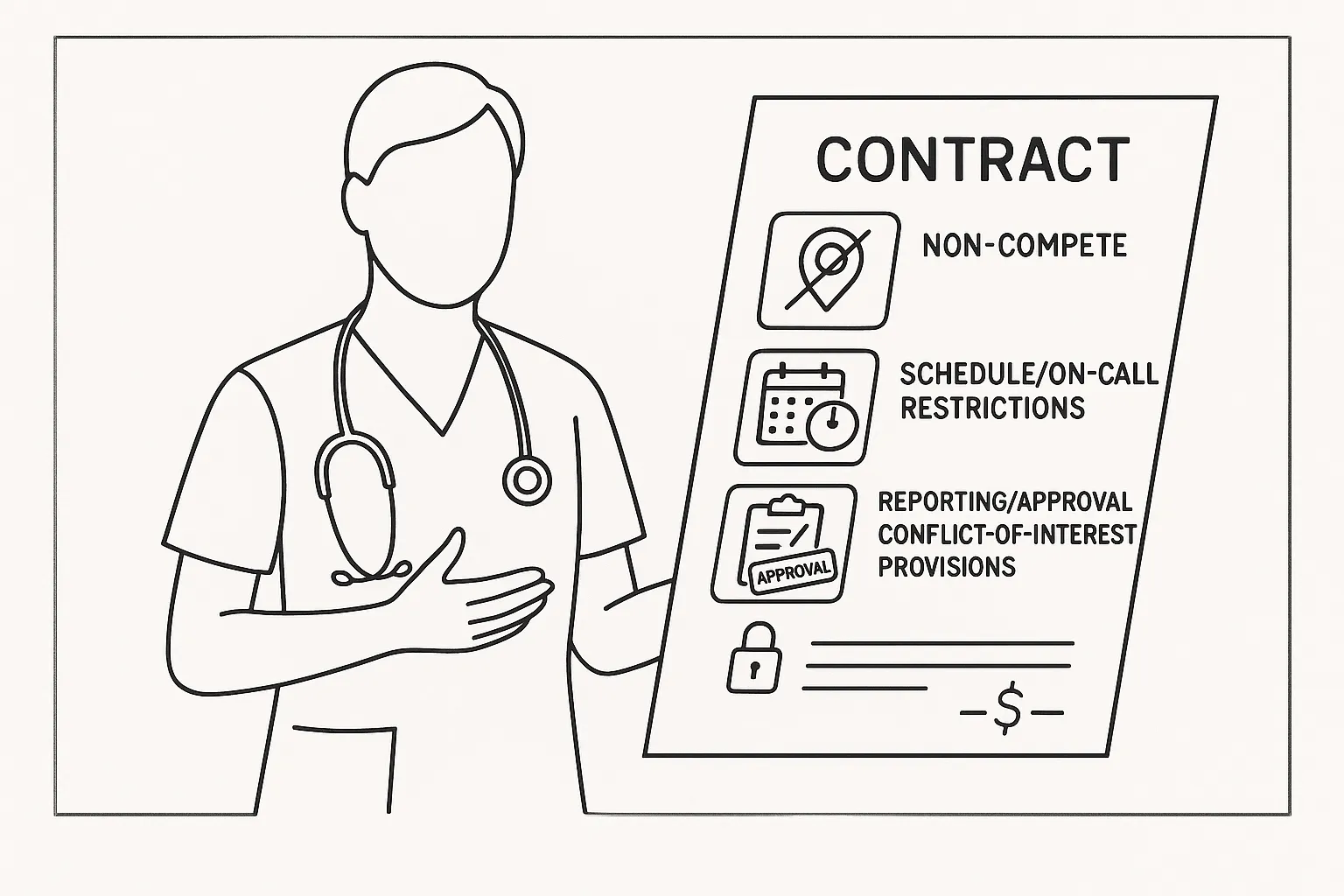
Employment and independent contractor agreements frequently include provisions that prohibit, limit, or condition outside work. The practical effect depends on how the restrictions interact, so an NP should not evaluate an exclusivity clause, schedule requirement, or approval process in isolation.
Exclusivity, Non-Compete, and Non-Solicitation Clauses
An express exclusivity clause may prohibit all outside clinical work during employment. A non-compete can reach the same result through broad geographic or functional language, such as a restriction on providing clinical services within a defined area or working for an organization that competes with the employer. Even where state law limits enforcement, broad wording can create disputes and discourage otherwise permissible work. NPs should obtain a focused review of non-compete restrictions before assuming a per-diem, telehealth, or locum tenens role falls outside the clause.
Non-solicitation language may also prohibit directing patients or employees to the moonlighting site. These provisions should clearly distinguish prohibited solicitation from ordinary patient choice, professional networking, and lawful outside practice.
Scheduling, Call, and Availability Requirements
Scheduling and availability clauses can restrict moonlighting indirectly. An agreement may require an NP to remain available for call, reserve particular days for the employer, cover multiple locations, or accept schedule changes with limited notice. Those requirements can make it difficult to commit to outside shifts even when moonlighting is technically permitted.
The financial consequences also matter. If bonuses or productivity thresholds depend on meeting scheduling demands, an alleged conflict with outside work could reduce compensation or trigger a clawback. The agreement should make clear which position receives priority and how schedule conflicts will be resolved.
Disclosure, Approval, and Conflict-of-Interest Rules
Many employers require disclosure of outside practice, proof of credentialing and malpractice coverage, and written consent before moonlighting begins. A reasonable review process can protect both parties by confirming that the outside role will not interfere with clinical duties, create a regulatory problem, or misuse employer resources.
Problems arise when the agreement provides no response deadline or allows denial for undefined reasons. An apparent right to moonlight may be illusory if the employer retains unrestricted veto power. Requirements to report outside income or limit hours should also be reviewed for their interaction with compensation, tax classification, and the separate moonlighting agreement.
Licensing, Scope of Practice, and Credentialing Requirements
Moonlighting is not governed solely by the primary employment contract. Nurse practitioner scope of practice, licensure, prescribing authority, supervision, and collaboration requirements vary by jurisdiction and practice setting. Depending on applicable requirements, an NP may need to update practice locations, supervisory arrangements, collaborative documentation, prescribing records, or other information maintained with the applicable state licensing or regulatory authority.
An outside position must fit within the NP’s authorized clinical role. NPs should assess any scope-of-practice issues in the contract and determine whether the moonlighting site has established compliant supervision or collaboration procedures. When such arrangements are required, the relevant supervision or collaboration agreement should accurately reflect the work being performed.
Hospitals and other facilities may also require separate credentialing, delineation of privileges, administrative approval, and proof of insurance. Privileges are facility-specific, and approval from the primary employer does not replace the moonlighting site’s credentialing process. Failure to satisfy applicable institutional requirements may affect privileges, the outside role, and the primary employment relationship.
Malpractice Coverage and Employment Risk
NPs should never assume that malpractice insurance provided by a primary employer covers work performed elsewhere. Written confirmation should identify the insured role and location, policy limits, policy type, retroactive date, exclusions, and responsibility for extended reporting coverage. A malpractice and tail insurance review can clarify whether a coverage gap or future tail obligation exists.
Occurrence coverage generally applies to covered events that occur during the policy period, regardless of when the claim is reported. Claims-made coverage generally depends on the claim being reported while the policy or applicable extended reporting coverage is active. If claims-made coverage ends, the agreement should explain whether the employer, moonlighting organization, or NP is responsible for tail coverage.
Moonlighting can also create employment risk when the NP fails to obtain required approval or when outside work allegedly interferes with scheduling, call, productivity, or clinical performance. An adverse event in the outside role may prompt the primary employer to review for-cause termination provisions. Repayment clauses, negative accrual terms, or unpaid compensation can increase the financial consequences, making a review of termination provisions and post-employment obligations especially important.
Negotiating Clear Moonlighting Rights
A contract that genuinely permits moonlighting should define the boundaries of that right. Clear drafting can identify permitted activities, exclude approved locations or services from restrictive covenants, and distinguish outside work from prohibited competitive activity. For example, the agreement may specifically address telehealth, urgent care, locum tenens, teaching, consulting, or occasional per-diem shifts.
The approval process should require written notice, establish a reasonable response period, and identify objective grounds for denial. It should also explain whether approval applies to a particular organization, location, schedule, or type of service and when renewed approval is necessary. These details reduce the risk that a general permission is later interpreted narrowly.
NPs should also review provisions addressing outside income, use of employer resources, confidentiality, patient solicitation, scheduling priority, productivity, and repayment obligations. The primary agreement and the moonlighting contract should not assign inconsistent responsibilities or leave gaps in insurance, supervision, or call coverage.
Pre-Moonlighting Contract and Documentation Checklist
Before accepting outside clinical work, an NP should confirm the contractual, regulatory, and insurance requirements that apply to both positions. Useful records include:
- Written, role-specific approval when the primary agreement requires disclosure or consent.
- The outside organization’s employment or independent contractor agreement.
- Written malpractice coverage confirmation identifying the policy type, limits, retroactive date, covered role, and tail responsibility.
- Credentialing, privilege, and prescribing documentation required for the outside location.
- Updated supervision or collaboration records where applicable.
- Schedule records showing that moonlighting did not interfere with primary employment duties.
Contract red flags include unrestricted employer discretion, broad exclusivity language, non-competes without appropriate carve-outs, vague for-cause termination standards, uncovered clinical services, and repayment or negative accrual provisions tied to scheduling or productivity. Attorney review is particularly valuable when these terms could affect income, licensure, malpractice exposure, or future practice options.
Frequently Asked Questions
Can an employer prohibit a nurse practitioner from moonlighting?
An employment agreement may prohibit or condition outside work through an exclusivity clause, non-compete, scheduling requirement, or conflict-of-interest policy. The effect of a restriction depends on its wording and applicable law, so the entire agreement should be reviewed before accepting another clinical role.
Should an NP obtain written approval before beginning outside work?
Yes, when the contract or employer policy requires disclosure or consent. Written, role-specific approval creates a record of what the employer authorized and can clarify the approved organization, location, schedule, and type of work.
Does an employer’s malpractice policy cover an NP’s moonlighting work?
Not necessarily. Coverage should be confirmed in writing for the outside role and location, including the policy type, limits, retroactive date, exclusions, and responsibility for tail coverage. The moonlighting organization may need to provide a separate policy.
How can a non-compete affect per-diem or telehealth work?
A broadly written non-compete may define competing services by geography, patient population, employer type, or clinical function. That language can reach per-diem, telehealth, urgent care, or locum tenens work unless the agreement includes a clear exception.
What licensing requirements should an NP check before moonlighting?
The NP should confirm applicable scope-of-practice, licensure, prescribing, supervision, collaboration, credentialing, and practice-location requirements. The specific obligations depend on the jurisdiction, clinical services, and facility where the outside work will occur.
Can moonlighting lead to termination from a primary job?
It can create termination risk if the NP violates an approval requirement, exclusivity clause, schedule obligation, restrictive covenant, or other contractual duty. The financial consequences may be greater when the agreement also includes repayment, clawback, negative accrual, or tail insurance obligations.
Review Your Moonlighting Restrictions Before Accepting Outside Work
Chelle Law reviews nurse practitioner contracts for exclusivity provisions, approval requirements, non-competes, malpractice obligations, compensation risks, and termination consequences.
Contact Chelle Law