
Schedule control provisions in nurse practitioner (NP) employment and contractor agreements may appear administrative, but they can carry significant financial, professional, and career consequences. Language governing shifts, call coverage, floating, telehealth availability, and administrative time may affect compensation, malpractice exposure, credentialing, and the ability to maintain outside commitments. Before signing, an NP should understand how much scheduling authority the employer retains, whether additional coverage is compensated, and what happens if scheduling demands change. This guide explains common schedule provisions, identifies contract red flags, and outlines practical negotiation and documentation strategies.
Key Takeaways
- Schedule clauses are material contract terms because they can affect income, workload, malpractice exposure, and career flexibility.
- Negotiations should address notice for schedule changes, maximum hours, call obligations, floating, and compensation for additional coverage.
- Productivity targets and bonus formulas should account for employer-assigned administrative, telehealth, or other nonproductive time.
- NPs should document schedule changes and communicate objections or clarification requests in writing.
- Attorney review is particularly important when scheduling obligations interact with repayment, termination, malpractice, or restrictive covenant provisions.
Schedule Control Provisions in NP Agreements
Call Coverage, Floating, and Weekend Requirements
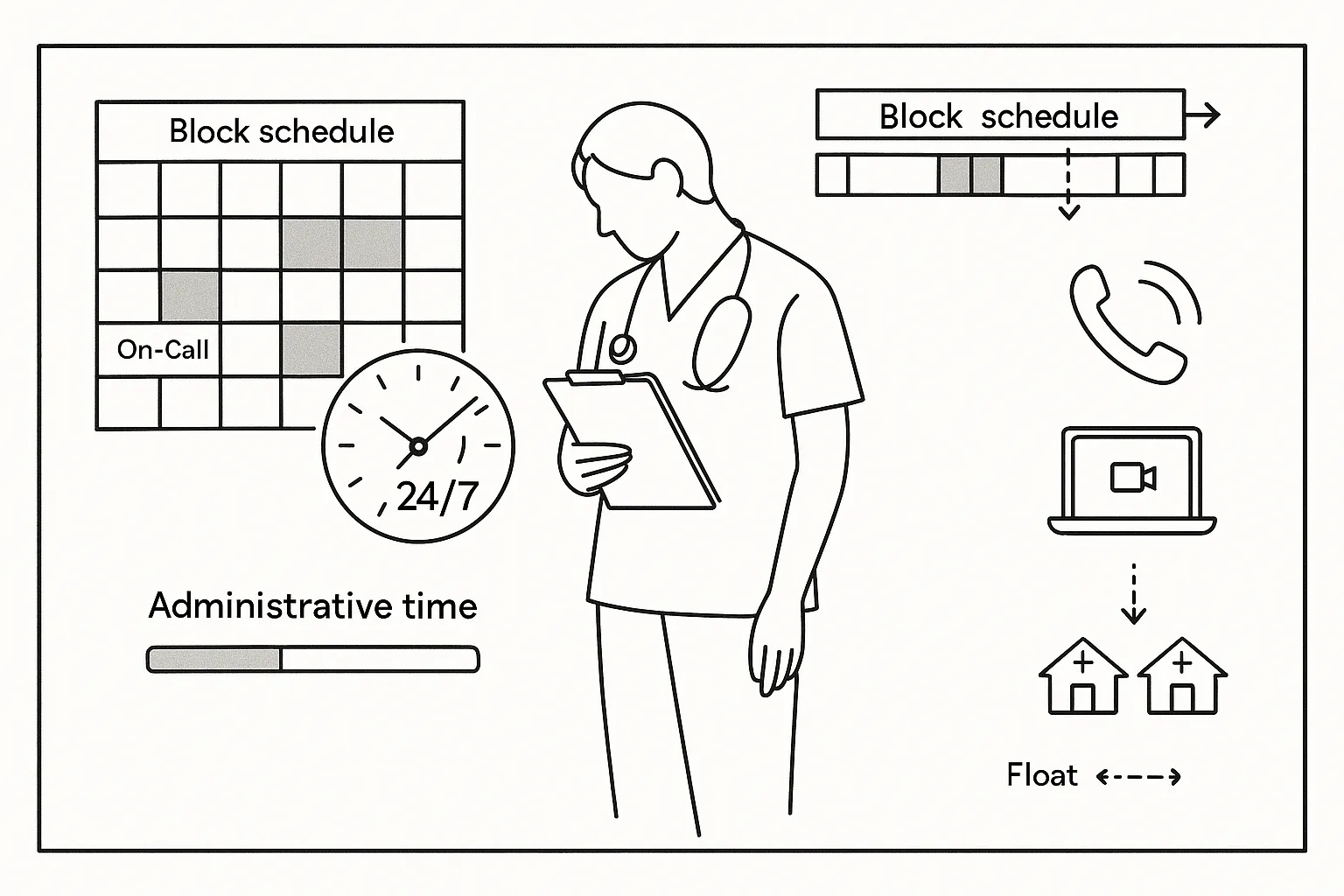
Agreements commonly address on-call obligations, cross-coverage, assignments at multiple sites, and weekend or holiday coverage. Language may state that the employer “may assign” call or that the NP “shall participate” in coverage without defining frequency, response expectations, geographic limits, or compensation. A clear provision should explain the required availability, whether remote or in-person response is expected, and how coverage is paid. NPs evaluating these terms may also benefit from reviewing common call coverage requirements.
Floating and cross-coverage provisions can require an NP to work at additional clinics, facilities, or within unfamiliar service lines. These assignments may increase travel and workload while raising scope-of-practice, supervision, and credentialing concerns. Contract language should identify permitted locations, reasonable notice, reimbursement for travel, and any limits on assignments. Similar concerns arise with broad floating requirements that give the employer unilateral authority to change the NP’s worksite.
Shift Lengths, Telehealth, and Administrative Time
Contracts may specify minimum or maximum shift lengths, mandatory overtime, block scheduling, or “reasonable” additional hours. Minimum notice for schedule changes is often omitted, leaving the NP with limited predictability for family responsibilities or secondary employment. Where wage-and-hour protections apply, unclear overtime language may also create compensation disputes.
Telehealth and hybrid arrangements require the same attention. The agreement should explain remote availability windows, location requirements, technology responsibilities, and whether virtual encounters count toward productivity. Broader telehealth contract terms may also affect licensure, liability coverage, and scheduling across jurisdictions.
Administrative time for charting, prior authorizations, meetings, and quality initiatives should be addressed expressly. If these duties are excluded from productive time or performed outside scheduled clinic hours, the NP’s effective hourly compensation may decline. Employer authority to alter clinic blocks or eliminate administrative time can therefore create both income and burnout risks.
How Scheduling Affects Compensation, Liability, and Credentialing
Productivity Pay and Bonus Calculations
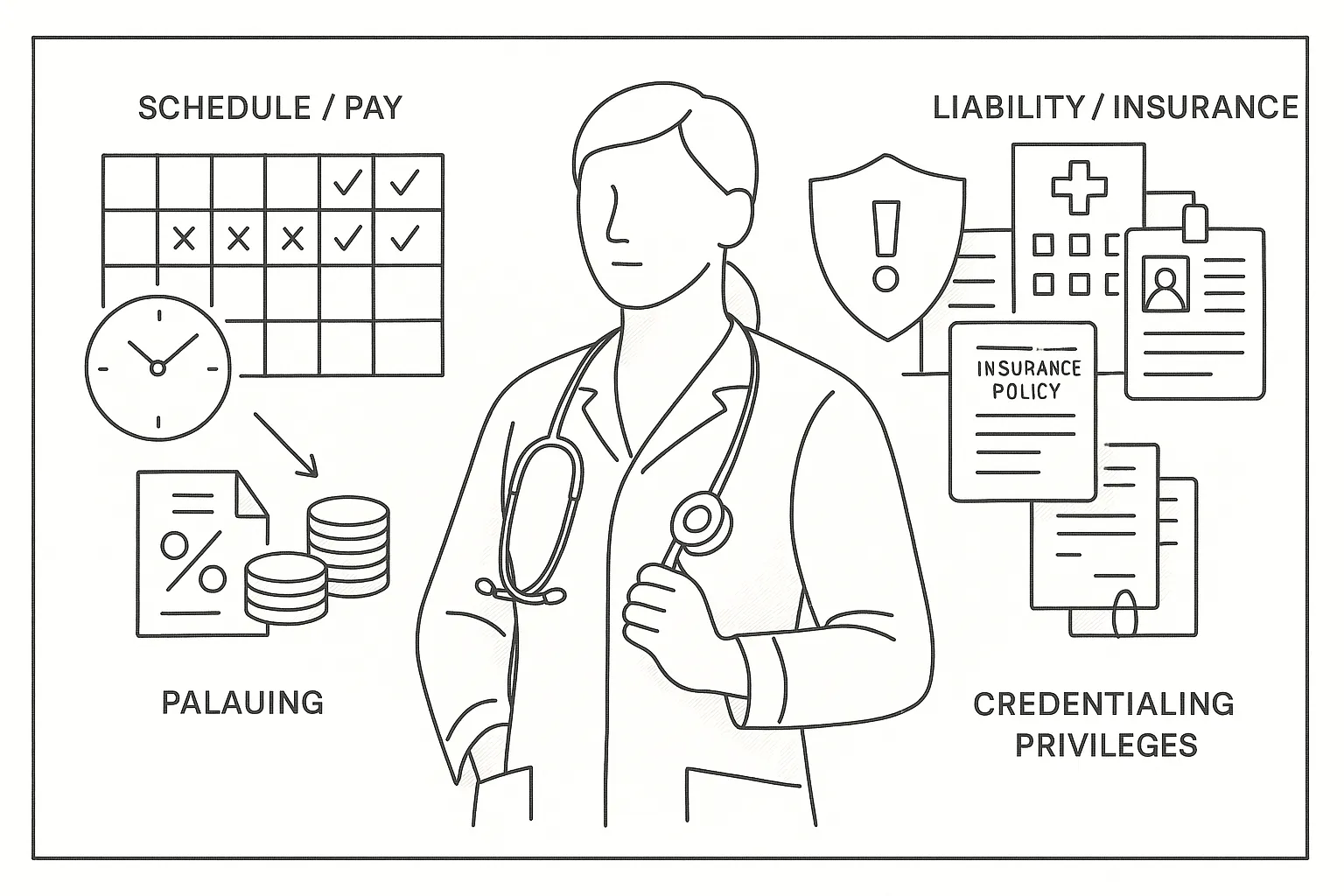
Compensation models may tie pay to collections, relative value units, patient encounters, or other productivity measures. Scheduling decisions directly affect an NP’s ability to meet those benchmarks. For example, employer-assigned administrative blocks, low-volume shifts, or uncompensated weekend coverage may reduce collections or productivity without reducing the contractual target.
The agreement should explain whether targets are prorated when the employer controls patient volume or assigns nonproductive duties. It should also address compensation for call, mandatory overtime, and unscheduled coverage. A focused NP compensation and productivity review can identify whether scheduling authority and incentive formulas work together fairly or expose the NP to avoidable pay dilution.
Malpractice, Supervision, and Credentialing Risks
Forced cross-coverage for unfamiliar patient populations or after-hours work without appropriate support may heighten malpractice risk. Scheduling provisions should remain consistent with applicable scope-of-practice, supervision, collaboration, and facility requirements. The agreement should not assume that an NP can immediately provide services at every location or within every specialty requested by the employer.
Assignments at additional facilities may also require credentialing or privileges. The contract should identify who handles applications, pays related fees, and bears the consequences of a delay. Malpractice terms deserve particular attention when expanded coverage could create additional exposure or when the NP may become responsible for tail coverage after termination. A malpractice and tail insurance review can clarify how those obligations interact with the schedule.
Schedule Control Red Flags
Vague language generally gives the employer more flexibility while making the NP’s obligations difficult to measure. Phrases such as “schedule subject to change” or “duties and schedules as needed” deserve careful review when the contract provides no limits on hours, locations, notice, or additional compensation.
- Unlimited scheduling authority: The employer can change shifts, hours, call frequency, or locations without objective limits.
- Undefined additional duties: Administrative, educational, operational, or cross-coverage responsibilities are added without protected time or compensation.
- Unpaid call obligations: The agreement does not define availability, response time, patient-contact compensation, or time off after call.
- Unadjusted productivity targets: The NP remains responsible for the same benchmark even when the employer assigns nonproductive work or controls patient volume.
- Schedule-related penalties: Refusing an undefined schedule change may trigger termination, bonus repayment, or relocation reimbursement obligations.
Repayment and termination language can turn a scheduling disagreement into a substantial financial dispute. A clause allowing termination or a bonus clawback whenever an NP “refuses” a schedule change is especially concerning if the employer’s scheduling authority is itself undefined. The schedule, repayment, and termination provisions should be reviewed together rather than as unrelated sections.
Negotiating Predictable and Measurable Schedule Terms
Useful schedule protections are specific enough to measure while still allowing reasonable operational flexibility. The agreement can identify the regular schedule, expected clinic sessions, primary work locations, call frequency, minimum notice for changes, and maximum consecutive or weekly hours. It should also explain how changes are communicated and who has authority to approve them.
- Define minimum notice for material schedule or location changes.
- Set limits on mandatory overtime, consecutive shifts, and call frequency.
- State whether call is paid through a stipend, hourly compensation, or payment for patient contact.
- Require productivity adjustments for administrative work, leave, low-volume assignments, or other employer-controlled nonproductive time.
- Address travel reimbursement, credentialing, and malpractice coverage for additional locations.
- Document approval procedures for moonlighting, childcare-related limitations, and protected or contractual leave.
Attorney review is particularly useful when schedule control is tied to compensation, repayment obligations, restrictive covenants, malpractice coverage, or termination. The goal is to identify how separate provisions interact before a dispute develops and convert broad expectations into workable contract standards.
Responding to Problematic Schedule Changes
NPs should document schedule changes, assignments, availability discussions, and objections in writing. Copies of emails, messages, schedules, and employer responses can help establish whether contractual notice requirements or hour limits were followed. Written clarification requests are generally more useful than relying on informal conversations that cannot later be verified.
Internal resolution may begin with a supervisor or HR process, supported by the relevant contract language. If the demand materially conflicts with the agreement, potential remedies depend on the contract and governing law. An attorney can assess whether the issue may be addressed through enforcement of an express term, a written amendment, or another negotiated resolution.
If the problem cannot be resolved, the NP may need to evaluate notice requirements, repayment exposure, possible amendments, or a negotiated exit. Reviewing the applicable contract termination terms before giving notice can help identify financial and professional consequences and reduce avoidable disruption.
Frequently Asked Questions
Can an employer change an NP’s schedule after the contract is signed?
It depends on the contract language and applicable law. A broad scheduling clause may give the employer substantial flexibility, while a contract that defines regular hours, locations, notice requirements, or maximum shifts may provide clearer limits.
What details should an NP on-call provision include?
An on-call provision should address frequency, availability windows, response expectations, geographic limits, compensation, patient-contact duties, and whether the NP receives time off after coverage. It should also identify the clinical support available during call.
How can schedule control affect an NP productivity bonus?
Employer-controlled schedules can affect patient volume, collections, encounters, and RVU production. If administrative blocks, low-volume shifts, leave, or call duties reduce productive time, the agreement should explain whether the target or bonus formula will be adjusted.
Should an NP contract address floating between locations?
Yes. The contract should identify permitted locations, notice requirements, travel reimbursement, credentialing responsibilities, scope-of-practice considerations, and any limits on cross-coverage or assignments outside the NP’s usual service line.
What records should an NP preserve during a scheduling dispute?
The NP should retain schedules, written change notices, emails, messages, time records, compensation statements, and written requests for clarification. These records can help establish what was assigned, when notice was provided, and how the employer responded.
When should an NP seek legal review of schedule language?
Legal review is particularly important when scheduling authority is broad or connected to compensation, bonus repayment, malpractice coverage, termination, moonlighting, or restrictive covenants. Review before signing may reveal risks that are difficult to correct after employment begins.
Review Schedule Terms Before They Control Your Practice
Chelle Law reviews nurse practitioner agreements for scheduling, call coverage, compensation, malpractice, termination, and other provisions that may affect your income and professional flexibility.
Contact Chelle Law