
Signing bonuses are a common inducement in nurse practitioner (NP) employment offers. They can provide immediate income and help with relocation or loan repayment, but the accompanying repayment obligations are frequently employer-favorable and legally consequential. Before accepting a bonus, an NP should understand the repayment period, triggering events, calculation method, collection rights, and interaction with termination or restrictive covenant provisions. This guide explains the mechanics of common signing bonus repayment clauses, the financial and career risks they create, and the contract terms that may reduce exposure. A line-by-line nurse practitioner contract review can help clarify those obligations before the agreement is signed.
Key Takeaways
- Signing bonus clauses can convert an upfront payment into contractual debt when a specified repayment trigger occurs.
- Definitions of resignation, cause, termination without cause, credentialing failure, and breach determine when repayment may be required.
- Proration, full acceleration, payroll setoff, interest, collection costs, and tax treatment can substantially change the amount an NP ultimately owes.
- Prorated repayment, reasonable caps, narrow cause definitions, and appropriate carve-outs can reduce financial uncertainty.
- The signing bonus provision should be reviewed together with termination, non-compete, malpractice, compensation, and credentialing terms.
What Signing Bonus Repayment Clauses Cover
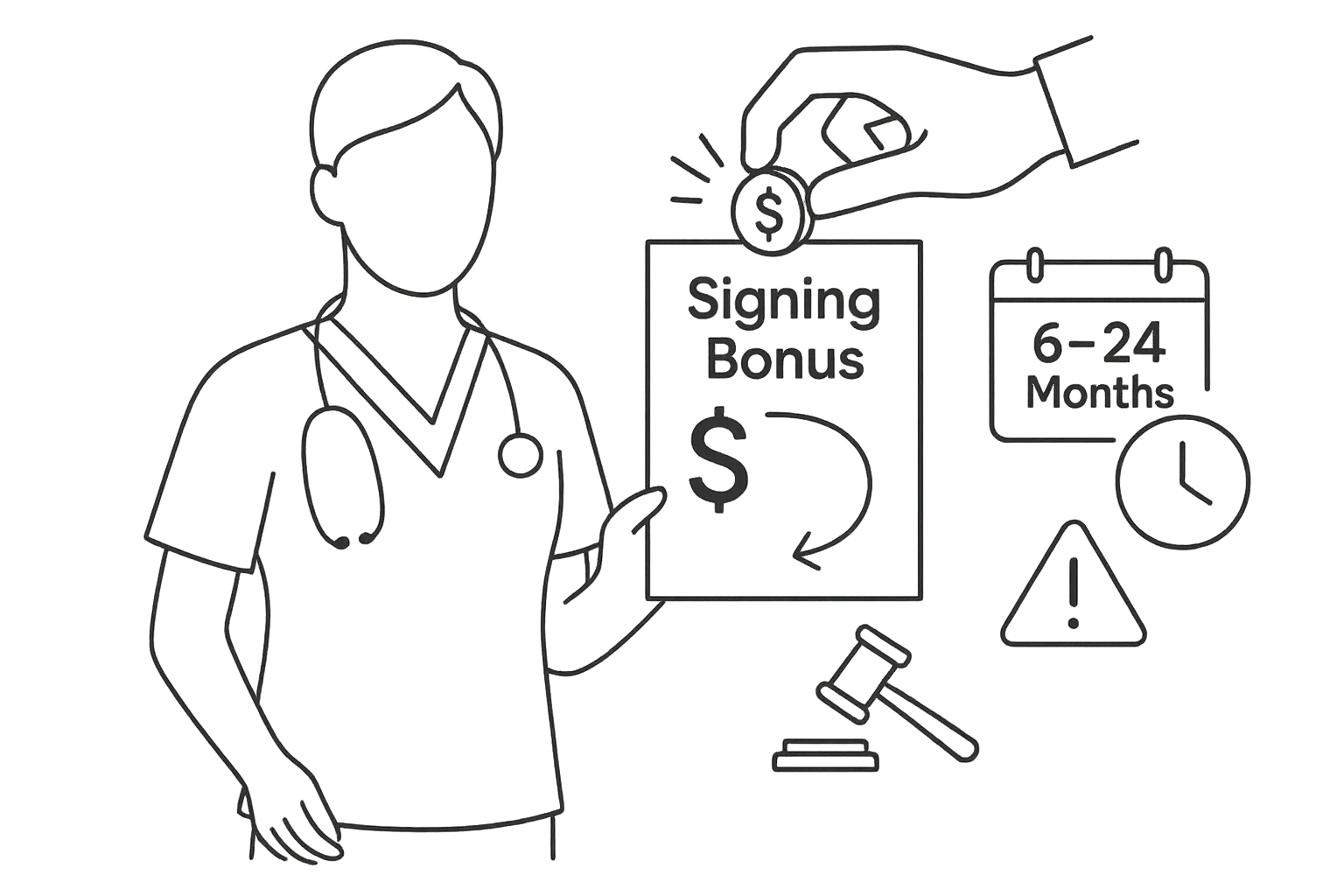
A signing bonus repayment clause defines when an employer may recover a previously paid bonus because employment ended or another contract condition was not satisfied. The provision may apply not only to a traditional signing bonus but also to relocation assistance, loan repayment, tuition reimbursement, or another payment tied to continued service. NPs evaluating these terms may also benefit from reviewing the broader guide to signing bonus repayment provisions.
- The bonus amount and payment timing, including lump-sum or staged payments.
- The repayment or clawback period, which may extend for months or years.
- The events that trigger repayment, such as resignation, termination for cause, or breach of contract.
- The employer’s collection remedies, including invoicing, interest, setoff, or deductions where permitted.
- Exceptions for events such as disability, death, termination without cause, or an organizational sale or merger.
Many clauses are drafted broadly to preserve employer remedies. Some accelerate the entire unpaid obligation after any listed trigger, while others permit deductions from compensation or impose collection costs. The agreement should identify exactly which payments are subject to repayment and whether the obligation decreases as the NP completes the required service period.
Events That Can Trigger Bonus Repayment
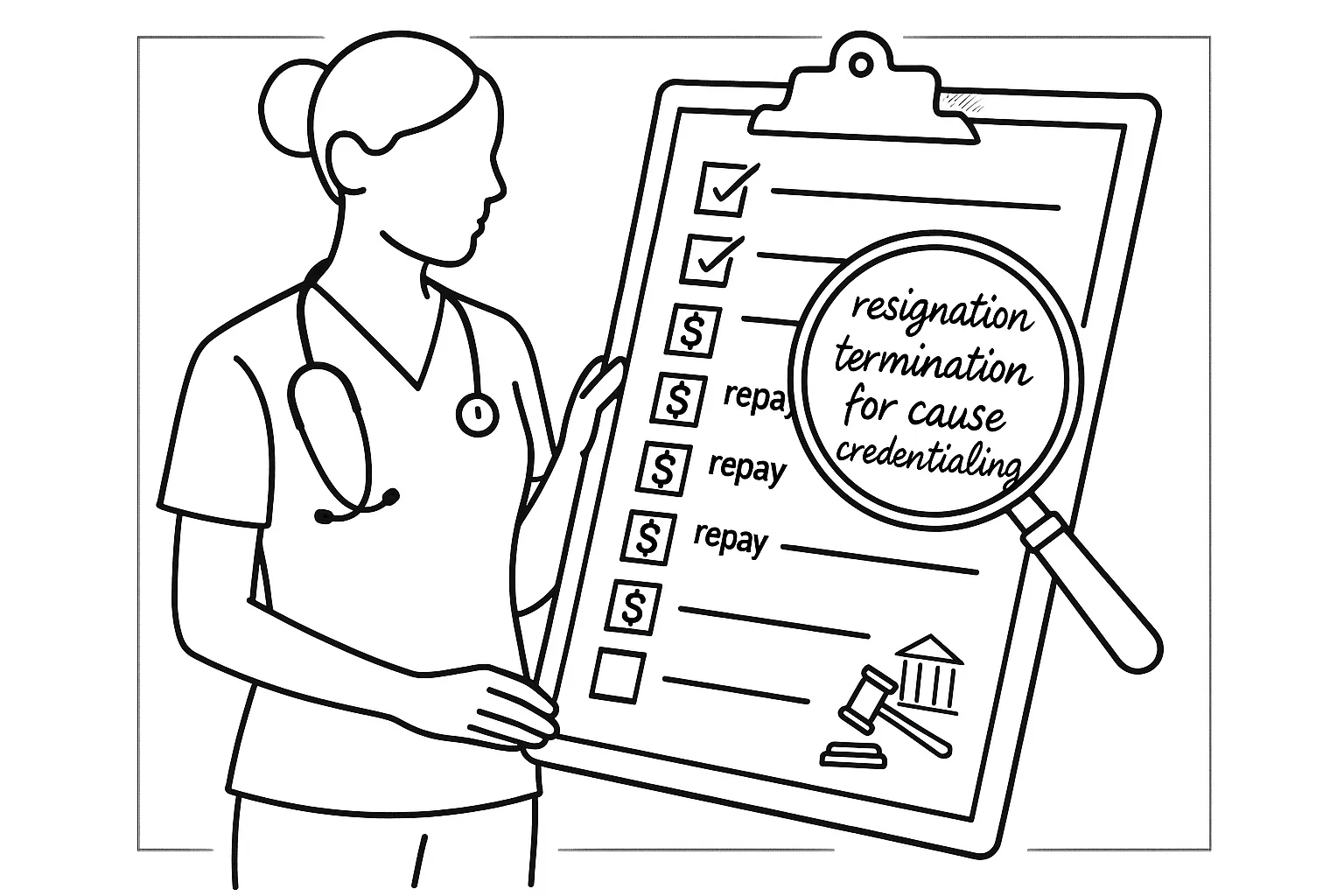
Employers commonly identify several events that can create a repayment obligation. The wording matters because a provision that treats voluntary resignation, an employer-initiated termination, and a credentialing problem in the same manner can expose the NP to repayment even when the circumstances differ significantly.
- Voluntary resignation during the repayment period.
- Termination for cause, particularly when “cause” includes broad categories such as policy violations, alleged misconduct, or patient-safety concerns.
- Termination without cause when the contract does not expressly exclude it from repayment.
- Failure to complete credentialing or satisfy a supervision, collaboration, licensure, or scope-of-practice condition.
- Material breach of the employment agreement, including an alleged violation of a non-compete or non-solicitation provision.
- Failure to maintain a required credential or malpractice insurance coverage.
The repayment clause should therefore be read alongside the agreement’s termination language. A separate termination provision review can help determine whether the employer retains repayment rights after a without-cause termination and whether notice or cure rights apply. If repayment is tied to post-employment restrictions, the scope and enforceability of the non-compete terms also require close attention.
How Repayment Amounts Are Calculated and Collected
The repayment formula can be as important as the trigger. Some agreements reduce the obligation as service is completed, while others require the full bonus to be returned until the final day of the clawback period. Common calculation and collection methods include:
- Proration: The obligation decreases based on the completed portion of the service period. For example, a $12,000 bonus prorated over 12 months may decline by $1,000 for each completed month.
- Full repayment or acceleration: The entire bonus becomes due after a trigger regardless of how much of the service period the NP completed.
- Staged clawbacks: The amount decreases at specified milestones rather than month by month.
- Withholding or setoff: The employer seeks to deduct the obligation from final wages, accrued compensation, or another payment, subject to applicable law.
- Interest and collection costs: The agreement permits interest, attorney fees, or other collection expenses to be added to the balance.
- Gross or net repayment: The contract determines whether the NP must repay the stated gross bonus or the amount received after tax withholding.
Collection may occur through a separate invoice, an asserted payroll deduction, or a collection action. Ambiguous language can create disputes over wage deductions, previously withheld taxes, payment deadlines, and the employer’s right to add interest or legal expenses. The agreement should state the formula and collection process clearly enough for the NP to estimate the maximum exposure before signing.
Financial and Career Risks for Nurse Practitioners
A signing bonus is not necessarily unconditional income. Until the repayment period ends, it may operate as a contingent obligation tied to future employment events. That can create several practical risks beyond the loss of the original payment:
- Immediate cash pressure: A lump-sum demand can create a shortfall after the NP has used the money for relocation, debt, or ordinary expenses.
- Tax and payroll complications: Disagreement over gross-versus-net repayment can complicate tax reporting and communication with payroll.
- Reduced career mobility: A substantial repayment demand may make it financially difficult to leave an unsuitable position.
- Collection consequences: An unresolved balance may lead to collection activity, litigation, or other financial consequences.
- Disputes over performance or credentialing: The employer may contend that an alleged policy, credentialing, or performance issue triggered repayment.
- Overlapping exit costs: Repayment may become due at the same time as relocation expenses, lost compensation, or a malpractice tail obligation.
The final risk is especially important when the position uses claims-made malpractice coverage. A malpractice and tail insurance review can identify whether the NP may face both a bonus clawback and tail coverage costs when employment ends.
Contract Terms That Can Reduce Repayment Risk
The appropriate protections depend on the bonus structure and the rest of the employment agreement. However, several contract terms can reduce uncertainty and make the potential obligation easier to evaluate:
- A proration schedule tied to completed service rather than full repayment until the final day.
- A defined cap on the amount subject to repayment.
- Carve-outs for termination without cause, disability, death, or another event outside the NP’s control.
- A narrow definition of cause with appropriate notice and an opportunity to cure when applicable.
- Clear payment deadlines and collection procedures rather than unrestricted payroll setoff language.
- Specific language addressing whether repayment is based on the gross bonus or the net amount received.
- A complete definition of the payments covered, including whether relocation, loan assistance, or tuition reimbursement is part of the obligation.
These provisions do not eliminate every risk, but they can make the obligation more proportionate and predictable. They should be evaluated with the agreement’s compensation, termination, restrictive covenant, credentialing, and insurance sections rather than reviewed in isolation.
When an Attorney Should Review the Agreement
Legal review is most useful before the offer is accepted and while the complete agreement is available for analysis. Review is particularly important when the bonus is substantial, the repayment period is lengthy, the obligation is not prorated, repayment can follow termination without cause, or the employer claims broad deduction and collection rights.
The attorney should receive the full offer letter and employment agreement, all exhibits, bonus and relocation documents, termination and restrictive covenant provisions, payment schedules, and relevant communications. A complete review can identify how trigger definitions, collection remedies, tax language, state law, and other contract sections affect the actual exposure. It also allows the NP to quantify the potential loss and understand whether repayment could interfere with a future job transition.
Frequently Asked Questions
Do nurse practitioners always have to repay a signing bonus after resigning?
No. Repayment depends on the contract’s trigger language, the timing of the resignation, any proration schedule, and applicable exceptions. The agreement should be reviewed to determine the amount, if any, that remains due.
Can an employer require the full bonus back after partial service?
Some contracts require full repayment until the entire service period is completed, while others reduce the balance through monthly proration or staged milestones. The written repayment formula controls the contractual calculation.
What happens to the bonus if the NP is terminated without cause?
The result depends on whether termination without cause is a repayment trigger or an express exception. If the agreement is silent or broadly written, the parties may dispute whether repayment remains due.
Can the employer deduct a signing bonus repayment from final wages?
An agreement may authorize withholding or setoff, but collection methods can also be affected by applicable wage laws. The deduction language and governing state law should be reviewed before assuming that the employer may take the full amount from final pay.
Is repayment based on the gross bonus or the amount received after taxes?
Contracts vary. Some require repayment of the gross stated bonus, while others address the net payment or tax adjustments. Clear tax language is important because the difference can materially affect the amount owed.
What documents should an NP provide for a signing bonus review?
Provide the complete offer letter, employment agreement, exhibits, bonus or relocation documents, payment schedules, termination provisions, restrictive covenants, and related written communications. Reviewing the complete package helps identify how the provisions interact.
Review Your Signing Bonus Before You Commit
Chelle Law reviews nurse practitioner employment agreements to identify repayment triggers, collection rights, termination risks, and other terms that may affect your income and career mobility.
Contact Chelle LawExplore Nurse Practitioner Contract Guidance
Review legal services, practical resources, and state-specific information for nurse practitioner agreements.