
Whether a nurse practitioner is a W-2 employee or a 1099 independent contractor affects much more than the tax form issued at year-end. Classification can change who handles payroll taxes, whether employment benefits are available, which wage protections may apply, and how the parties allocate business expenses. It also influences the financial assumptions an NP must use when comparing two job offers.
The title printed on the agreement does not settle the issue. A practice may call an NP an independent contractor while controlling the schedule, assigning patients, setting fees, supplying the workspace, directing billing, and limiting the NP’s ability to work elsewhere. Government agencies and courts generally examine the actual relationship under the legal test applicable to the particular tax, wage, benefit, or state-law question.
Contract review therefore requires two inquiries: what the agreement says and how the arrangement is expected to operate. Chelle Law evaluates the classification language alongside compensation, scheduling, billing, insurance, termination, restrictive covenant, and expense provisions. That analysis helps an NP identify inconsistencies before accepting tax obligations or business risks that the economics of the offer may not support.
Key Takeaways
- A W-2 or 1099 label is evidence of how the parties structured payment, but it does not conclusively determine legal status.
- Federal wage law, federal tax law, and state law may apply different classification standards to the same working relationship.
- Mandatory schedules, practice-controlled fees, assigned patients, billing control, and restrictions on outside work can be relevant evidence of control.
- Malpractice coverage, workers’ compensation, benefits, and restrictive covenants must be evaluated separately under the contract, policy documents, plan terms, and governing law.
- An NP comparing W-2 and 1099 offers must account for taxes, insurance, unpaid time away, benefits, expenses, and compensation mechanics rather than comparing headline rates alone.
Worker Status Depends on the Actual Relationship
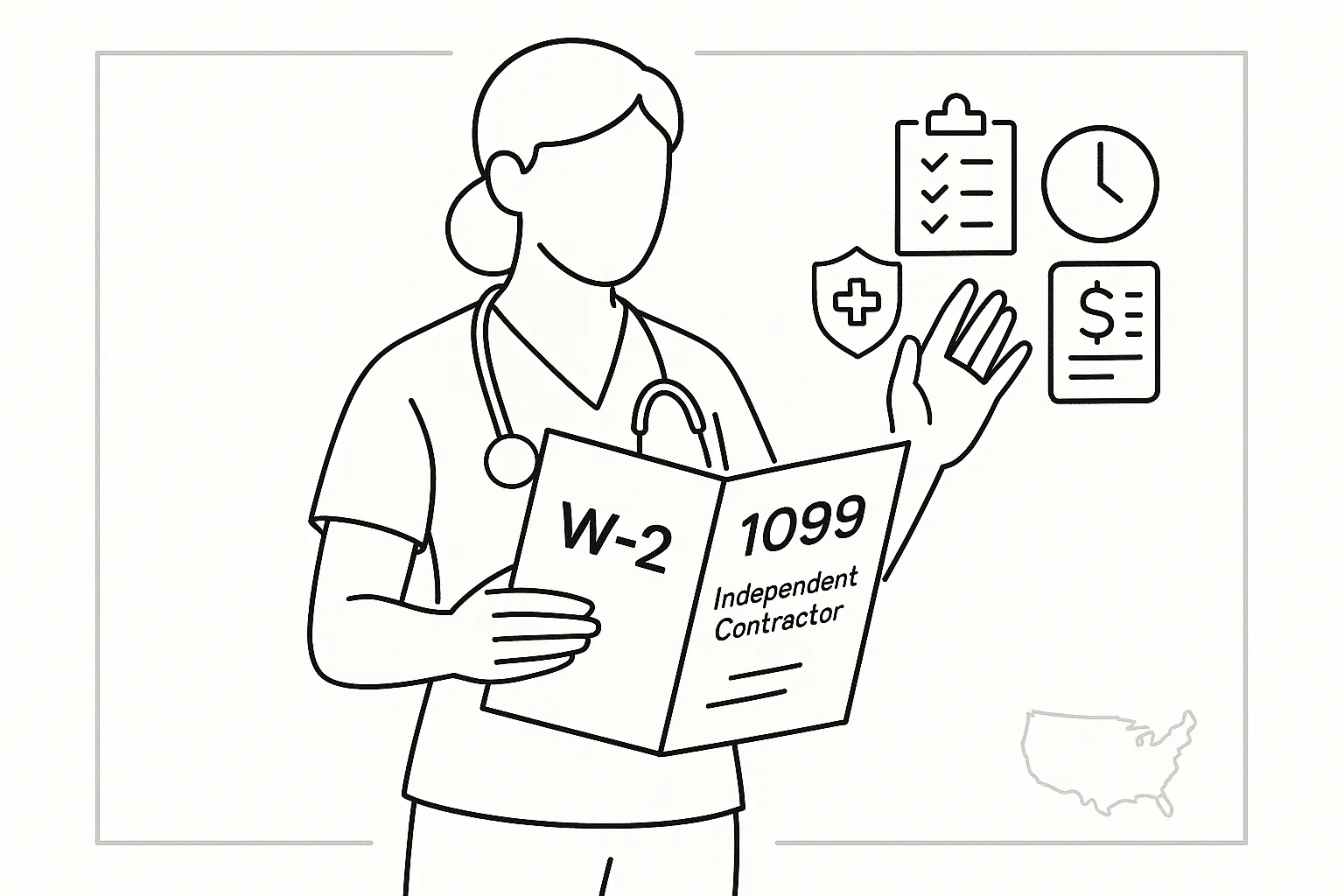
What the W-2 and 1099 Labels Usually Indicate
A W-2 employee ordinarily has payroll taxes withheld by the employer. The employer also pays its share of applicable payroll taxes and may offer health coverage, retirement benefits, paid leave, continuing education funds, or other benefits. Employee status often comes with closer practice control over working hours, assigned duties, patient scheduling, policies, and performance expectations.
A 1099 contractor generally receives gross compensation without employee payroll withholding and is responsible for estimated taxes, self-employment taxes, and business expenses. A genuine contractor relationship also tends to involve meaningful independence in how the work is organized and an opportunity to make business decisions that affect profit or loss. Clinical skill alone, however, does not establish contractor status.
An NP considering contractor work can use a detailed comparison of W-2 and 1099 arrangements to identify the expenses and protections that may differ. The comparison must use total economic value rather than hourly rates alone.
Contract Language Versus Day-to-Day Operations
A contract can describe an NP as an independent contractor while imposing employee-like controls. For example, the practice might require fixed shifts, prohibit substitutes, assign every patient, mandate attendance at employee meetings, set all fees, collect all revenue, and restrict outside work. Those provisions do not automatically decide classification, but they can conflict with the independence suggested by the contract title.
The reverse problem also occurs. An agreement may omit important operational details even though the parties expect the NP to run an independent business, select assignments, purchase insurance, maintain equipment, and perform services for several organizations. An independent contractor agreement review can compare the written allocation of responsibility with the proposed working conditions.
Federal and State Laws Use Different Classification Tests
The Current Federal Wage-and-Hour Framework
For Fair Labor Standards Act purposes, the central question is whether the worker is economically dependent on the potential employer or is operating a business for the worker’s own account. Relevant considerations include control, opportunity for profit or loss, investment, permanence, whether the work is integral to the business, and the worker’s use of skill and initiative. No contract label or single factor resolves the inquiry.
The federal enforcement framework is currently in transition. In May 2025, the Department of Labor instructed Wage and Hour Division investigators not to apply the 2024 independent-contractor regulation in current enforcement matters while the agency reviews that rule. The Department’s 2025 enforcement guidance instead directs investigators to earlier agency materials while preserving applicable judicial precedent.
In February 2026, the Department proposed replacing the 2024 rule with a streamlined economic-reality analysis emphasizing control and opportunity for profit or loss, followed by several additional factors. That 2026 proposal is pending, not an operative final rule. An NP should therefore avoid relying on summaries that treat either the 2024 regulation or the 2026 proposal as the complete, uncontested answer.
IRS Rules and State Standards Are Separate
The IRS applies a common-law analysis for federal employment-tax purposes. It groups relevant facts into behavioral control, financial control, and the type of relationship between the parties. Either the business or the worker may request a federal tax-status determination through Form SS-8, although the process can take at least six months and does not decide wage claims, workers’ compensation eligibility, benefit rights, or every state-law issue. The IRS provides additional guidance on the distinction between an employee and a self-employed contractor.
State wage, unemployment, workers’ compensation, and tax laws may use their own tests. Some jurisdictions apply an ABC-style standard for particular purposes, while others rely on control or economic-reality factors. The same NP could therefore be evaluated under several legal frameworks, and an answer reached for federal tax withholding may not control a state wage claim.
Contract Terms That Can Signal Misclassification Risk

No provision proves status by itself. The following terms are still important because they show how control, financial risk, permanence, and business independence may operate:
- Scheduling and availability: Who chooses shifts, approves time away, sets minimum hours, and controls call coverage?
- Patient and site assignments: Can the practice move the NP among facilities, service lines, or patient panels without consent?
- Fees and billing: Who sets charges, submits claims, handles denials, collects accounts, and bears the risk of nonpayment?
- Compensation: Is the NP paid a salary, hourly rate, per-visit amount, percentage of collections, or productivity bonus? Can business decisions change the NP’s profit or loss?
- Equipment and expenses: Who provides the clinical space, support staff, technology, supplies, travel, licensing costs, and continuing education?
- Exclusivity and outside work: Can the NP serve other organizations, hire qualified assistance where legally permissible, or decline assignments?
- Policies and supervision: Does the practice control business methods beyond the clinical and regulatory requirements that apply regardless of worker status?
- Duration and termination: Is the relationship indefinite, project-based, or tied to specific coverage needs, and how may either party end it?
Healthcare regulation complicates this analysis. Required clinical protocols, supervision, collaboration, documentation, or quality safeguards may reflect professional law rather than ordinary employer control. The contract must distinguish regulatory obligations from discretionary business control instead of assuming that every clinical requirement points toward employee status.
Financial, Benefit, and Insurance Consequences
A contractor rate may look higher because the practice is not withholding payroll taxes or funding employee benefits. The NP may need to budget for self-employment taxes, estimated tax payments, health coverage, retirement contributions, unpaid leave, accounting, licensing, credentialing, equipment, and other operating costs. A sound comparison converts both offers into estimated annual net value using realistic patient volume and time-off assumptions.
Compensation formulas require close attention. If a contractor is paid from collections but cannot control billing, coding support, fee schedules, payer participation, or collection efforts, the NP bears revenue risk without controlling the process that produces payment. A focused NP compensation review can identify undefined collection terms, adjustable conversion factors, unreachable thresholds, negative accrual, and post-termination payment issues.
Misclassification can also lead to disputes over minimum wages, overtime, payroll taxes, unemployment contributions, benefits, and workers’ compensation. In one healthcare enforcement action, the Department of Labor alleged that a staffing company misclassified nurses and nursing assistants and sought back wages and liquidated damages for overtime. That type of case illustrates the exposure, but it does not mean every nurse receiving a 1099 has been misclassified; the applicable law and working facts still control.
Malpractice insurance is a related but distinct contract issue. Employee status does not guarantee that an employer will provide a particular policy, and contractor status does not automatically determine who must purchase tail coverage. The agreement and insurance documents must identify the policy type, limits, effective dates, covered services, reporting duties, and responsibility for post-termination coverage. Chelle Law’s malpractice and tail review addresses those provisions separately from the worker-classification analysis.
How Contract Review Reduces Classification Uncertainty
The review begins by comparing the classification clause with the operative provisions. If the agreement calls the NP a contractor but gives the practice unilateral authority over hours, sites, fees, patient assignments, and outside work, that inconsistency deserves attention. The same is true when the contract shifts taxes and expenses to the NP without explaining the independence or business opportunity that supposedly supports contractor status.
Next, the financial terms must be modeled under realistic conditions. Questions include whether compensation is based on billed or collected revenue, who bears payer delays, whether the NP is paid after termination, and which expenses reduce the stated rate. Bonus language can also reveal control when the practice can change targets, quality measures, or conversion factors during the compensation period.
Finally, the surrounding clauses must be read together. An exclusivity requirement combined with a broad noncompete may limit the NP’s ability to operate an independent business, while a long notice period can delay departure from an arrangement that no longer works. Classification does not itself decide whether a restriction is enforceable, so the wording and governing state law still require a separate noncompete analysis.
When an NP Should Seek Legal Review
Review is especially helpful when the agreement uses a 1099 label but requires fixed shifts, exclusive service, practice-controlled billing, employee-style policies, or substantial notice before departure. It is also appropriate when the parties have changed the working arrangement without updating the contract, or when the NP is being moved from W-2 to 1099 status while performing substantially the same role.
Counsel can identify conflicting provisions, explain which facts may matter under different legal standards, and estimate the costs transferred to the NP. The analysis is not a guarantee that an agency or court will reach a particular result. It gives the NP a fact-based way to evaluate the offer, ask focused questions, and decide whether the written allocation of taxes, insurance, expenses, and operational control matches the proposed relationship.
Frequently Asked Questions
Does receiving a 1099 automatically make a nurse practitioner an independent contractor?
No. A Form 1099 shows how the business reported payments, but classification depends on the legal test and the actual working relationship. Scheduling control, billing practices, financial risk, investment, permanence, and the parties’ conduct may all be relevant.
Can an NP be a contractor if the practice sets the schedule?
Possibly, because no single fact necessarily controls. A mandatory schedule is relevant evidence of control, but it must be considered with the NP’s financial independence, ability to accept other work, investment, business discretion, and the reason for any clinical or regulatory requirements.
Which worker-classification test applies to a nurse practitioner?
More than one test may apply. Federal wage law, IRS tax rules, and state wage, unemployment, workers’ compensation, and tax laws can use different standards. The governing test depends on the specific claim or legal question being evaluated.
Must a 1099 nurse practitioner purchase malpractice insurance and tail coverage?
Not automatically. Responsibility for malpractice premiums and tail coverage depends on the agreement, the type of policy, the insurance documents, and applicable law. The contract must identify who provides coverage and who pays for any required post-termination protection.
Can an NP ask the IRS to determine federal tax classification?
Yes. A worker or business may submit Form SS-8 for an IRS determination concerning federal employment-tax and withholding status. The process can take at least six months and does not resolve wage-hour, benefit, workers’ compensation, insurance, or state-law questions.
What contract provisions deserve attention in a W-2 versus 1099 review?
The review should address classification language, scheduling, patient assignments, billing, compensation, expenses, malpractice coverage, benefits, outside work, restrictive covenants, termination, and post-termination payments. These provisions show both the economic value of the offer and how the relationship is expected to operate.
Have an Attorney Review Your NP Classification Terms
Chelle Law can analyze the agreement’s classification, compensation, insurance, expense, restrictive covenant, and termination provisions before you accept the proposed arrangement.
Contact Chelle Law