
Malpractice coverage can affect a nurse practitioner long after an employment or independent contractor relationship ends. The distinction between claims-made and occurrence insurance determines which policy may respond, when a claim must be reported, and whether additional protection is needed for care provided before a policy terminates. Because coverage ultimately depends on the policy language, the contract and insurance documents must be evaluated together.
The financial consequences can be significant. A nurse practitioner may be responsible for an extended reporting endorsement, commonly called tail coverage, or may discover that promised prior-acts protection was never issued. Policy limits, deductibles, defense expenses, settlement authority, exclusions, and reporting duties can also create exposure even when the agreement identifies the correct policy type.
Chelle Law reviews how malpractice obligations are allocated in nurse practitioner agreements, including who maintains coverage during the relationship and who bears post-termination costs. A careful nurse practitioner contract review can identify unclear insurance language, conflicts between the agreement and policy documents, and provisions that may warrant clarification before signing.
Key Malpractice Coverage Points for Nurse Practitioners
- Claims-made coverage generally responds to claims first made and reported as required by the policy while coverage or an applicable extended reporting period remains active.
- Occurrence coverage generally responds when the covered incident happens during the policy period, even if the claim is asserted later.
- Tail coverage is one possible solution after claims-made coverage ends, but continuing coverage or valid prior-acts coverage may also protect earlier services.
- The contract may allocate tail costs differently depending on whether the nurse practitioner resigns, is terminated without cause, is terminated for cause, retires, or becomes disabled.
- Policy limits, exclusions, defense control, settlement authority, deductibles, and notice requirements remain important under either policy type.
How Claims-Made and Occurrence Insurance Differ
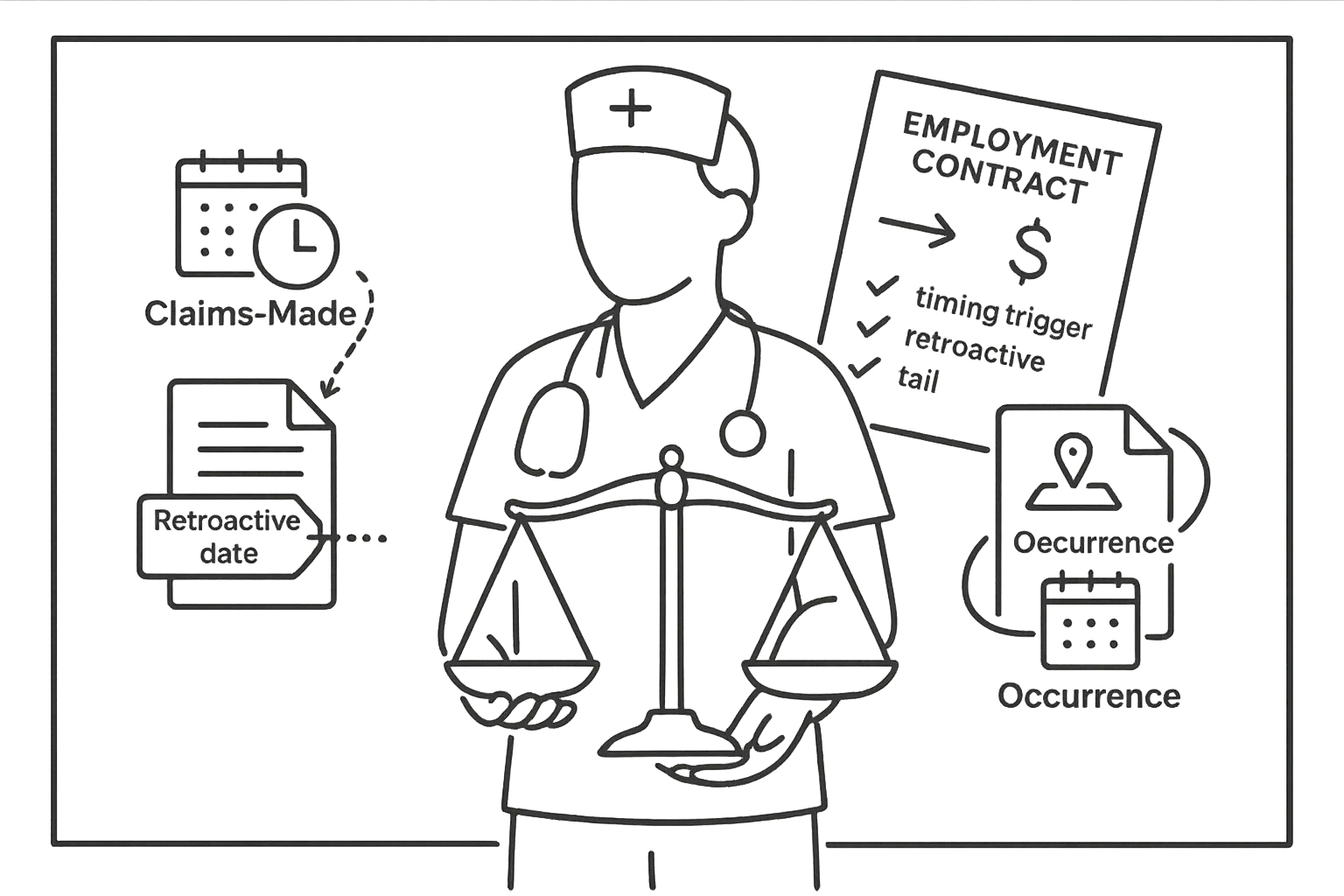
The National Association of Insurance Commissioners explains that medical malpractice policies are commonly written on either a claims-made or occurrence basis. That label provides an essential starting point, but it does not replace a review of the policy’s definitions, exclusions, endorsements, reporting conditions, and applicable law.
Claims-Made Coverage and the Reporting Trigger
A claims-made policy generally responds to a claim first made and reported in the manner required by the policy while the policy is in force or during an applicable extended reporting period. The precise trigger is policy-specific. Notice requirements, the definition of a claim, retroactive dates, and provisions governing known incidents can all affect whether coverage is available.
The retroactive date identifies how far back qualifying professional services may extend. A claim reported during the current policy period may still fall outside coverage if the underlying care occurred before that date. Conversely, keeping continuous claims-made coverage with an unchanged retroactive date may preserve protection for earlier services without requiring a separate tail endorsement at every job transition.
Occurrence Coverage and the Date of the Incident
Occurrence coverage generally focuses on when the alleged professional incident occurred. If the event happened during the policy period and otherwise falls within the policy, that policy may respond even if the patient asserts the claim after the nurse practitioner changes jobs or the policy expires. Tail coverage is therefore generally unnecessary for incidents already protected by occurrence insurance.
Occurrence coverage does not eliminate every post-employment concern. Exclusions, limits, notice and cooperation duties, settlement provisions, insurer solvency, and disputes over the date or scope of an incident may still matter. The policy must also cover the nurse practitioner, the services performed, and the location where the care occurred.
Financial and Career Risks Under Each Policy Type
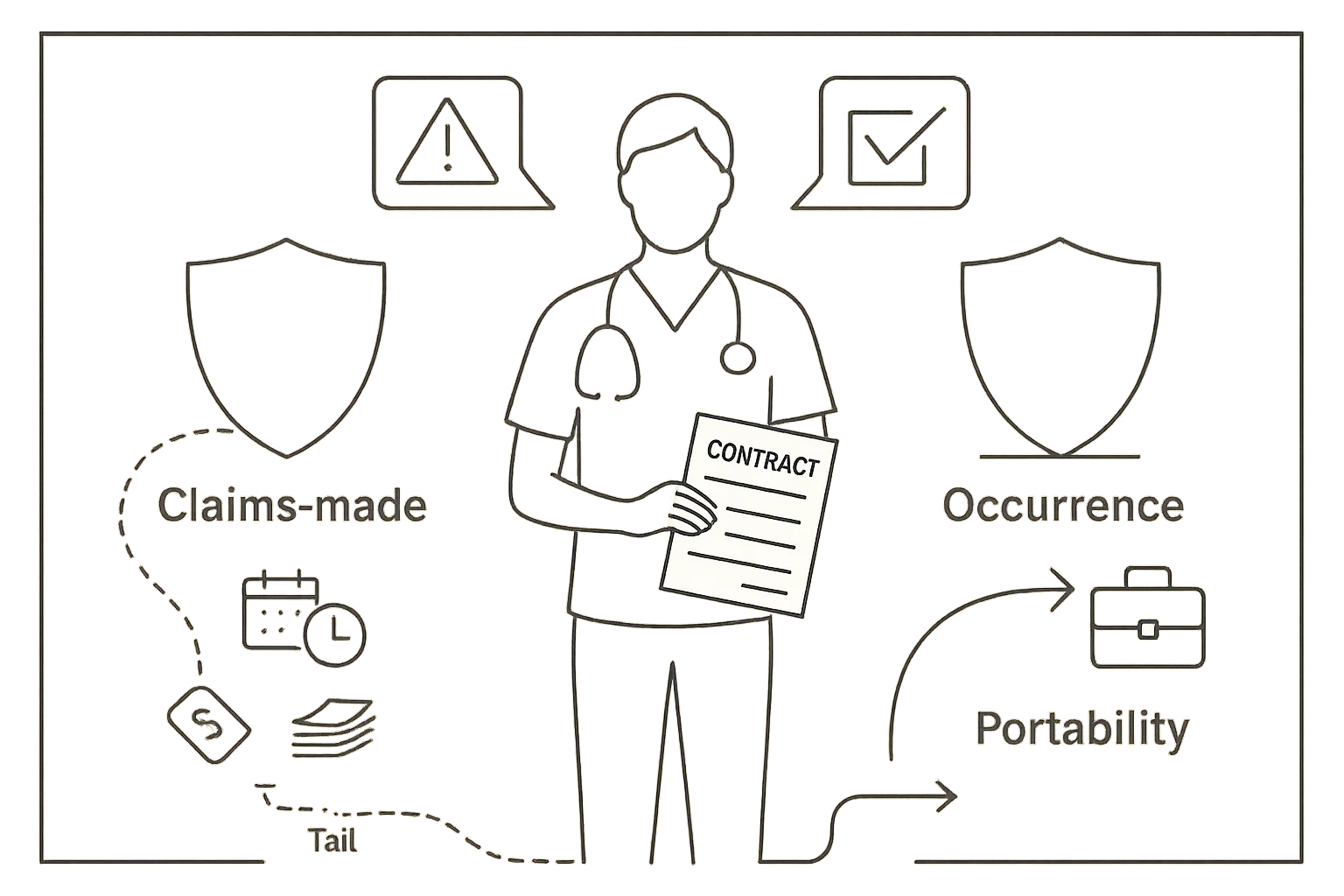
Claims-made coverage may be convenient while an employer maintains a group policy, but the end of that coverage can create a costly transition issue. An agreement may require the nurse practitioner to purchase tail insurance after a voluntary resignation or termination for cause while making the employer responsible after a termination without cause. That allocation can substantially change the practical cost of leaving a position.
- Post-termination exposure: A gap may arise if claims-made coverage ends without tail, continuing coverage, or valid prior-acts protection.
- Cost allocation: The agreement may assign premiums, tail costs, deductibles, or other claim-related expenses to the nurse practitioner.
- Portability: A new insurer may decline to cover prior services or may issue an endorsement with a retroactive date that does not reach the beginning of the nurse practitioner’s earlier work.
- Separation triggers: Resignation, termination without cause, termination for cause, retirement, disability, and failure to complete an initial service period may produce different obligations.
- Repayment exposure: Some agreements treat employer-funded tail as a reimbursable expense when the nurse practitioner leaves within a stated period.
Occurrence coverage may offer greater certainty for covered incidents arising during the policy period, but it can have higher ongoing premiums or may not be available through the employer’s program. Neither policy type is automatically preferable in every situation. The more useful question is whether the available policy and contract create dependable protection at a cost the nurse practitioner understands.
Insurance obligations must also be considered alongside the agreement’s separation language. Reviewing the rules for terminating a nurse practitioner contract can help explain how notice periods, repayment clauses, and post-employment obligations interact with tail responsibility.
Tail Coverage, Prior Acts, and Employment Transitions
Three Ways Earlier Services May Remain Protected
Tail coverage extends the time for reporting certain claims involving services performed before a claims-made policy ended. It generally does not insure new professional services performed after termination. The endorsement may be limited or unlimited in duration, and its limits, exclusions, reporting procedures, and effective date must be confirmed in the actual insurance documents.
Tail is not the only possible transition solution. An existing claims-made policy may continue to cover the relevant exposure, or a new insurer may issue prior-acts coverage—sometimes called nose coverage—that reaches back to an accepted retroactive date. Prior-acts protection is not established by an employer’s informal promise; the insurer must issue coverage on terms that protect the relevant period and services. This distinction is examined further in Chelle Law’s guide to tail insurance for nurse practitioners.
State requirements can also affect extended reporting rights. For example, Virginia regulations require specified supplemental extended reporting offers for medical professional liability insurance. That is a jurisdiction-specific rule, not a nationwide standard. The availability and required terms of an extended reporting period depend on the governing law, policy type, insurer, and endorsement.
Before former coverage ends, the nurse practitioner can request written confirmation of the applicable solution. Useful documentation may include the tail endorsement, declarations page, prior-acts endorsement, retroactive date, certificate of insurance, and confirmation of the covered entities, services, and locations.
Malpractice Provisions to Compare With the Policy
The employment agreement may summarize insurance coverage in only a few sentences, while the policy documents contain the operative definitions and conditions. A comprehensive malpractice and tail insurance review compares those documents and identifies promises that are incomplete, conditional, or inconsistent.
Coverage Scope, Defense Rights, and Cost Allocation
- Policy type and insured parties: Determine whether the coverage is claims-made or occurrence and whether the nurse practitioner is individually named or insured through a group policy.
- Covered work: Confirm that the policy reaches the nurse practitioner’s clinical services, specialty, practice locations, telehealth activities, and any approved outside work.
- Limits: Identify the per-claim and aggregate limits, whether defense costs reduce those limits, and whether multiple clinicians share an aggregate amount.
- Retroactive date: Verify the date in the issued policy or endorsement rather than relying solely on the employment agreement.
- Tail responsibility: Determine who obtains and pays for extended reporting coverage under each form of separation.
- Deductibles and retentions: Identify any deductible, self-insured retention, defense expense, or other amount that can be charged to the nurse practitioner.
- Defense and settlement control: Review who selects counsel, directs the defense, authorizes settlement, and decides whether the insured’s consent is required.
- Notice and cooperation duties: Understand when an incident or claim must be reported and what cooperation the insurer or employer can require.
- Indemnification: Examine separate indemnity language that may shift uninsured losses, defense expenses, or third-party liabilities to the nurse practitioner.
Settlement terms deserve particular attention because a settlement can have professional consequences beyond the payment itself. Current professional guidance on evaluating malpractice coverage likewise emphasizes limits and settlement-control provisions, including whether the insured’s consent is required.
Independent contractor agreements often place more insurance responsibility on the clinician, including the obligation to purchase an individual policy and provide evidence of coverage. Nurse practitioners considering that structure can compare the insurance clause with the broader risks explained in the guide to independent contractor agreements for nurse practitioners.
How to Evaluate Coverage Before Signing
A nurse practitioner may have little control over the policy selected by an employer, but the agreement can still clarify how coverage operates and who bears the financial risk. The review begins by obtaining enough information to compare the employer’s description with the actual insurance terms.
- Identify whether the policy is claims-made or occurrence and request the available declarations, certificate, and relevant endorsements.
- Confirm the named or covered insureds, covered services and locations, policy limits, retroactive date, and reporting requirements.
- Review every separation event that can alter tail responsibility or trigger repayment of an employer-funded premium.
- Determine whether proposed prior-acts protection is guaranteed or remains subject to future underwriting and insurer approval.
- Clarify deductibles, defense expenses, settlement authority, notice obligations, indemnification, and any duty to maintain separate coverage.
- Require material insurance commitments to appear in the written agreement or issued endorsements rather than relying on informal assurances.
Claims-made insurance can be workable when continuous coverage, dependable tail protection, or a valid prior-acts endorsement addresses earlier services. Occurrence insurance can simplify post-employment protection for covered incidents, but its exclusions, limits, and defense provisions still require review. The correct analysis depends on the agreement, the issued policy, the nurse practitioner’s work, and the circumstances in which the relationship may end.
Frequently Asked Questions
Does a nurse practitioner always need tail coverage with a claims-made policy?
No. Tail may be unnecessary if the claims-made policy continues to protect the relevant exposure or a new insurer issues valid prior-acts coverage. The nurse practitioner must verify the policy, retroactive date, endorsements, and reporting conditions before allowing former coverage to end.
Who pays for a nurse practitioner’s tail insurance?
Responsibility depends on the agreement. An employer may pay after a termination without cause but assign the expense to the nurse practitioner after a resignation or termination for cause. The provision must also be reviewed for repayment conditions, deadlines, required limits, and proof-of-coverage obligations.
Can prior-acts coverage replace tail insurance?
Prior-acts coverage may protect qualifying earlier services if the new insurer issues an appropriate endorsement with a sufficient retroactive date. Because coverage remains subject to underwriting and policy terms, a proposed endorsement should be verified before the former claims-made protection terminates.
Is occurrence malpractice coverage always better for an NP?
No. Occurrence coverage can provide useful protection for covered incidents that happen during the policy period, but availability, premiums, limits, exclusions, reporting duties, and defense provisions still matter. Claims-made insurance can also provide appropriate protection when transition risks are addressed clearly.
What happens if a claim is filed after the NP leaves an employer?
The answer depends on the applicable policy. An occurrence policy may respond if the covered incident happened during its policy period. A claims-made policy may require continuing reporting rights through the original policy, an extended reporting endorsement, or qualifying prior-acts coverage.
What insurance documents should an NP request before signing?
Useful documents include the declarations page, certificate of insurance, relevant policy provisions, and any tail or prior-acts endorsements. The information should identify the policy type, insured parties, limits, retroactive date, covered services, deductibles or retentions, reporting duties, and post-termination coverage terms.
Review Your Malpractice Coverage Before You Sign
Chelle Law reviews claims-made and occurrence provisions, tail obligations, prior-acts language, policy limits, and related contract risks for nurse practitioners.
Contact Chelle Law