
Collections-based pay ties some or all of a nurse practitioner’s compensation to money the practice actually receives for attributed services. Unlike a fixed salary, the amount earned may depend on payer reimbursement, patient payments, claim processing, contractual adjustments, and the employer’s billing systems. It is one of several nurse practitioner compensation models used by private practices, urgent care centers, specialty groups, telehealth companies, and other productivity-focused organizations.
The percentage stated in an offer does not reveal the model’s actual value. The agreement must also explain what qualifies as a collection, how services are credited, which deductions reduce the compensation base, when reconciliation occurs, and whether later refunds or payer recoupments can reduce future pay. Because the employer typically controls billing and collection activity, an NP may otherwise assume financial risk for administrative decisions outside the NP’s control.
A thorough contract analysis connects the compensation formula to reporting rights, guarantees, repayment provisions, termination language, worker classification, malpractice coverage, and applicable practice requirements. Chelle Law reviews these interacting terms to identify ambiguity, open-ended offsets, and other provisions that may warrant clarification before an NP accepts the arrangement.
Key Takeaways
- Collections-based compensation depends on receipts rather than billed charges, so the definition of gross or net collections directly affects income.
- Billing control, payer mix, claim denials, attribution rules, and collection delays can change compensation even when clinical productivity remains steady.
- Negative accrual, recoupment, draw, and repayment provisions can shift prior-period losses into future compensation periods.
- Provider-level reports and a defined process for questioning discrepancies help make the formula verifiable.
- Worker classification, supervision or collaboration requirements, restrictive covenants, malpractice coverage, and termination terms require separate analysis.
How Collections-Based NP Compensation Works
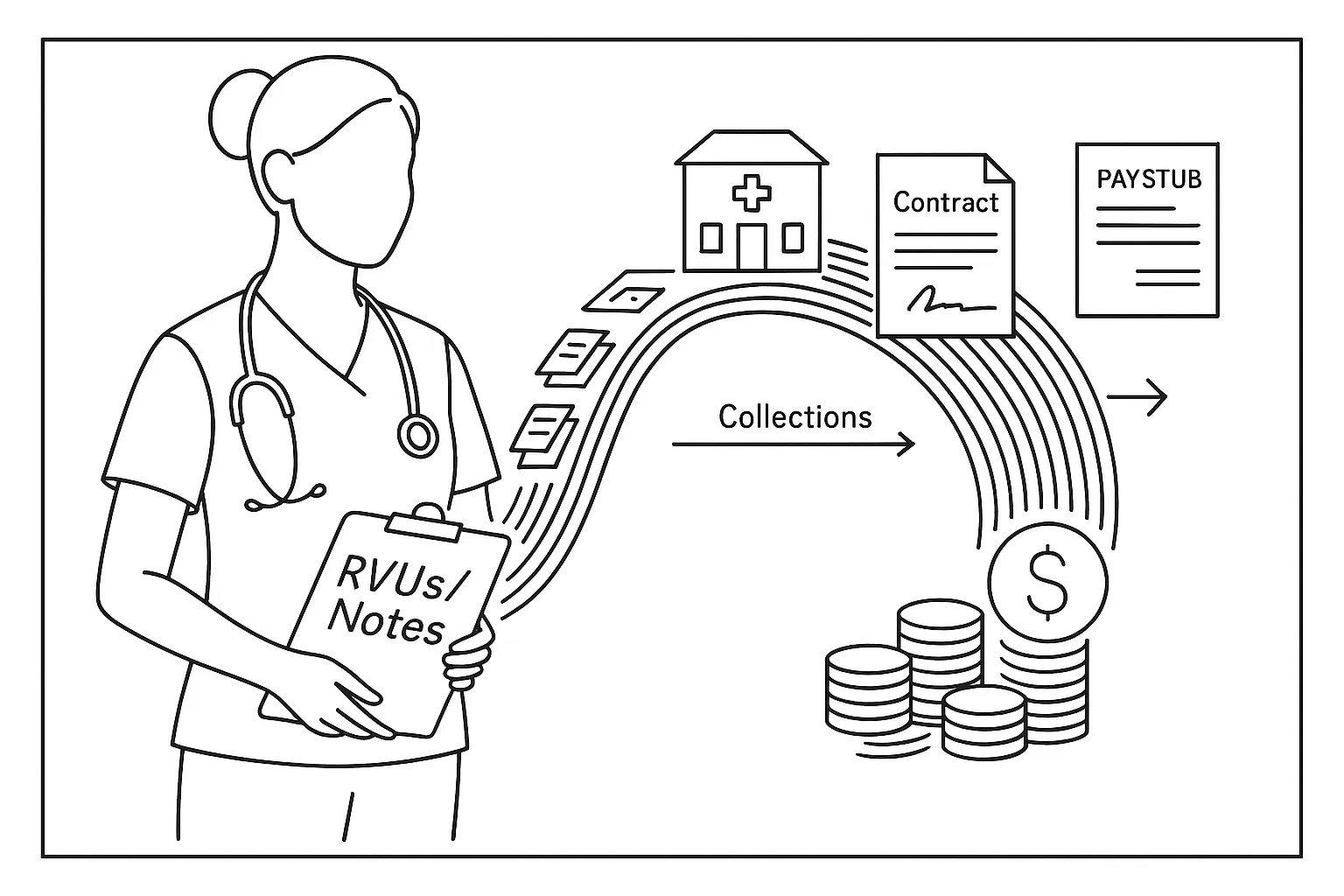
A collections formula generally applies a stated percentage to qualifying receipts attributed to the NP. That calculation differs from compensation based on hours worked, patient encounters, work relative value units, or charges submitted. The employer may receive substantially less than the amount billed because of contractual write-offs, denials, refunds, uncollected patient balances, and payer-specific allowed amounts.
Gross Collections, Net Collections, and Deductions
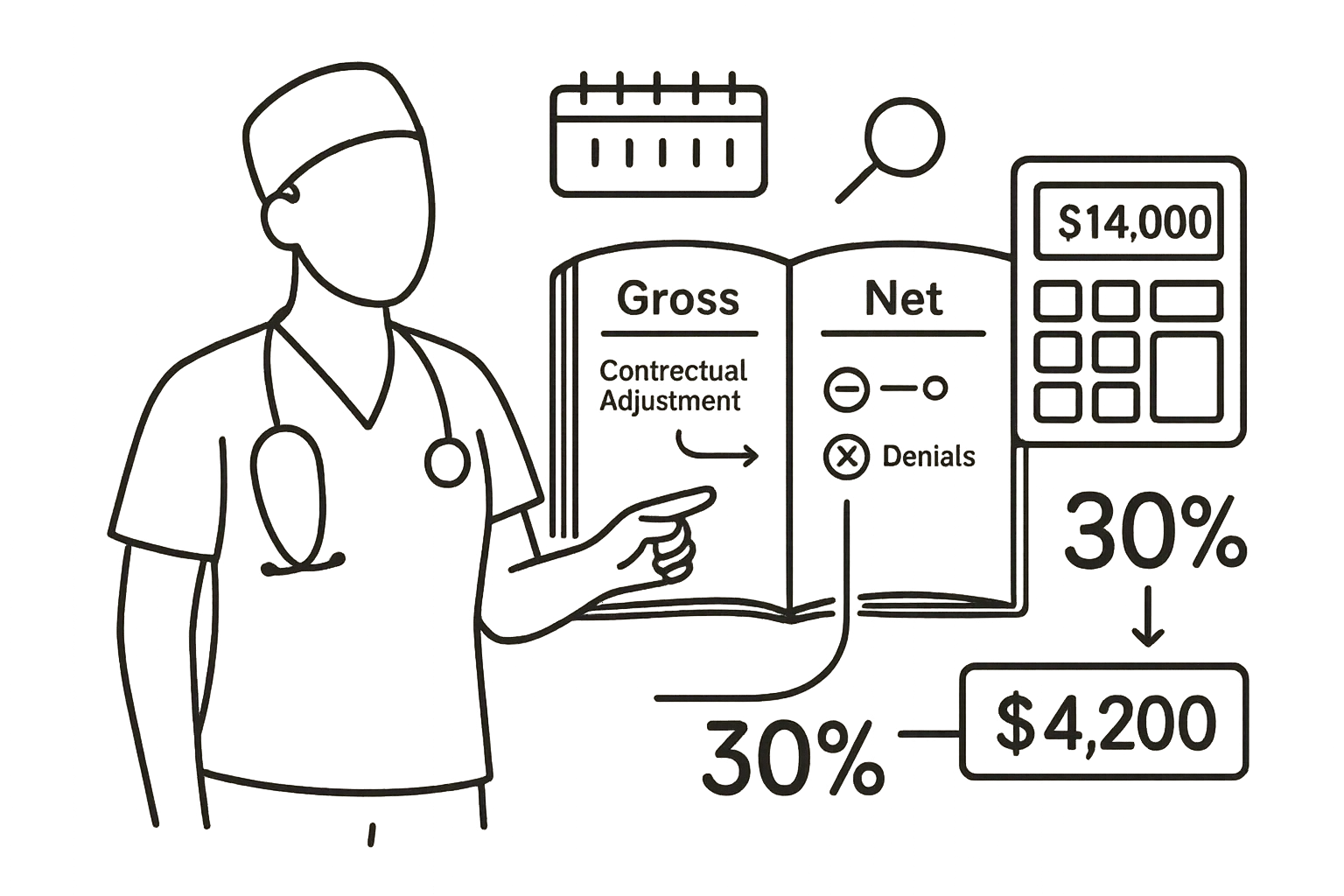
“Gross collections” may refer to all cash received for attributed services, while “net collections” may permit specified amounts to be subtracted before the NP’s percentage is applied. Those labels are not enough by themselves. The contract must define the compensation base and identify whether refunds, chargebacks, billing fees, supplies, overhead, bad debt, or other expenses may reduce it.
Consider a hypothetical period in which attributed services generate $20,000 in receipts, but permitted adjustments reduce qualifying net collections to $14,000. A 30% formula applied to that net amount produces $4,200. This example illustrates the calculation only; it does not represent a prevailing percentage, a universal definition of collections, or a current payer reimbursement rate.
Service Attribution, Billing Status, and Reconciliation
Attribution language determines which receipts count toward the NP’s compensation. The agreement may need to address office visits, procedures, shared care, split services, telehealth encounters, and services involving another clinician. It also should identify when collections are credited, how often compensation is reconciled, and how outstanding claims move between payment periods.
Billing status can materially affect the result. CMS guidance for advanced practice registered nurses addresses NPI-based billing, payment to another entity, and reassignment under employment or contractual arrangements. Separate CMS incident-to guidance demonstrates why the billing provider, supervision conditions, service setting, and payer rules can affect both reimbursement and attribution. A contract formula therefore needs more precision than a general reference to revenue “generated” by the NP.
Contract Provisions That Can Increase or Reduce NP Pay
The collections clause must be read with the rest of the compensation and termination language. An apparently favorable percentage may have limited value if the employer can change deductions, delay reconciliation, assign revenue elsewhere, or apply broad offsets without supporting records. A focused NP compensation review can evaluate the formula together with the provisions that control its practical operation.
Guarantees, Draws, Negative Accrual, and Recoupment
A guaranteed minimum may be true base compensation, or it may operate as an advance against later collections. If it is a draw, the agreement may permit the employer to carry a shortfall forward or demand repayment after specified events. The language needs to distinguish earned compensation from a recoverable advance and explain when any alleged balance becomes due.
Later claim denials, refunds, audits, and payer recoupments may also be charged against future earnings. A negative-accrual provision can cause an unfavorable balance to follow the NP into a later month or quarter. Important questions include how long adjustments remain open, whether the employer must provide documentation, whether losses can cross compensation years, and whether a negative balance survives termination.
Reporting Rights and Post-Termination Collections
Useful reports identify receipts attributed to the NP, permitted deductions, prior-period adjustments, and the resulting compensation calculation. The contract may also establish how often reports are delivered, how long the NP has to question an error, and what supporting records are available. Without provider-level information, verifying a collections formula can be difficult.
Termination creates a separate timing problem because claims for services already performed may remain unpaid when the relationship ends. The agreement can define a post-termination collection window, final reconciliation date, continuing deductions, and any offsets against the last payment. These terms need to be compared with the broader rules for ending a nurse practitioner contract.
Who Bears Billing and Administrative Risk?
Collections depend on more than the NP’s clinical work. Credentialing delays, payer enrollment, coding processes, claim submission, appeals, payer mix, patient balances, and the employer’s collection efforts can all affect revenue. If the practice controls those functions while the NP bears every resulting reduction, the compensation model transfers significant administrative risk to the clinician.
- Billing and coding: The agreement can clarify who selects codes, submits claims, corrects errors, and pursues denials without encouraging unsupported coding or medically unnecessary services.
- Credentialing and enrollment: Delayed payer approval may postpone collections even though the NP is ready to work or has begun providing services.
- Payer mix: Different allowed amounts, reimbursement policies, and patient-payment patterns can change collections independently of encounter volume.
- Shared services: The formula needs a consistent method for allocating revenue when multiple professionals participate in care.
- Policy changes: The contract can identify whether the employer may revise the formula, deductions, or attribution methodology through a separate policy.
Contract language cannot eliminate ordinary reimbursement uncertainty, but it can make the allocation of that uncertainty visible. Precision about billing control, attribution, payment timing, and adjustment authority allows an NP to evaluate whether the potential upside reasonably corresponds to the assumed risk.
Related Employment, Practice, and Insurance Terms
A collections formula does not determine whether an NP is an employee or an independent contractor. The label and payment method are only part of the analysis. The IRS evaluates worker status through factors involving behavioral control, financial control, and the parties’ relationship. The U.S. Department of Labor has also proposed a 2026 change to its federal classification analysis, but that proposal is not a final rule. Actual working conditions remain important, and an NP can review the broader differences between W-2 and 1099 arrangements.
Practice authority also varies by jurisdiction. Licensure, prescribing authority, supervision, collaboration, delegation, service setting, and payer requirements may affect how the NP can perform and bill for contracted duties. Any related supervision or collaboration terms need to align with the applicable state framework and the operational arrangement described in the employment documents.
Other provisions can change the economic value of the offer. Malpractice language may allocate premiums, claims-made coverage, and any required tail expense. Restrictive covenants may limit post-employment options, while bonus, expense, and repayment clauses may permit deductions from final compensation. The FTC’s 2024 federal Noncompete Rule is currently not in effect, so the enforceability of NP non-compete clauses continues to depend substantially on applicable state law and current legal developments.
Questions to Clarify Before Accepting the Formula
Before relying on a projected earnings figure, an NP can request enough detail to reproduce the calculation. The following questions help expose whether the percentage is based on a transparent formula or on terms the employer can change after signing:
- What receipts qualify as collections, and what deductions reduce the calculation base?
- How are shared visits, procedures, incident-to services, and group-billed claims attributed?
- When are collections credited, reported, reconciled, and paid?
- Can refunds or payer recoupments create a negative balance, and how long may that balance carry forward?
- Is a minimum payment guaranteed compensation or a recoverable draw?
- What happens to outstanding collections and alleged offsets after termination?
- Which reports and supporting records will be available to verify the calculation?
Answers contained only in a compensation illustration, handbook, or verbal explanation may not carry the same force as the signed agreement. The controlling documents need to be reviewed together so that definitions, payment procedures, and adjustment rights do not conflict.
Frequently Asked Questions
What is the difference between billed charges and collections?
Billed charges are the amounts submitted for services. Collections are the amounts the practice actually receives from payers or patients. Contractual adjustments, denials, refunds, and unpaid balances can make collections substantially lower than billed charges.
Is gross collections compensation always better than net collections compensation?
Not necessarily. The value depends on how each term is defined, which receipts are attributed to the NP, and what adjustments are permitted. A clearly defined net formula may be more predictable than a gross formula that contains ambiguous exclusions or attribution rules.
Can prior claim adjustments reduce an NP’s future compensation?
They may if the agreement authorizes recoupment or negative accrual. The contract can identify which adjustments qualify, the period during which they may be applied, the required documentation, and whether a negative balance carries forward or survives termination.
What information helps an NP verify a collections payment?
Useful reporting identifies attributed receipts, permitted deductions, prior-period adjustments, payment dates, and the resulting compensation calculation. The agreement may also provide a process for requesting supporting records and questioning discrepancies.
Does collections-based pay make an NP an independent contractor?
No. Worker status depends on the actual relationship and applicable classification standards, not merely the compensation formula or the label in the agreement. A collections-paid NP may still be an employee, while a properly classified contractor may have separate tax, benefit, insurance, and business-expense obligations.
Will an NP receive collections after the contract ends?
That depends on the agreement. The termination provisions may establish a collection window, final reconciliation date, continuing deductions, and offsets. Without clear language, compensation tied to services performed before departure may remain disputed after the practice receives payment.
Have Your NP Compensation Formula Reviewed
Chelle Law can analyze the collections definition, attribution rules, reporting rights, recoupment language, and final reconciliation provisions in your nurse practitioner agreement.
Contact Chelle Law