
A nurse practitioner contract does far more than establish a salary and start date. It allocates responsibility for productivity, billing, malpractice coverage, scheduling, regulatory compliance, and the financial consequences of leaving the position. Employment and independent contractor agreements may use familiar language while placing substantial income, liability, or career risk on the NP.
Many contract mistakes occur because related provisions are considered separately. A signing bonus may be paired with a broad repayment clause, an incentive formula may depend on billing rules outside the clinician’s control, and termination may activate tail insurance obligations or restrictive covenants. The practical effect becomes clear only when the agreement, its attachments, and incorporated policies are evaluated together.
Chelle Law reviews nurse practitioner agreements to identify ambiguous compensation terms, insurance gaps, classification concerns, post-employment restrictions, and obligations involving scope of practice, collaboration, credentialing, and payer enrollment. This guide explains recurring nurse practitioner contract mistakes and the questions that can help an NP understand the financial and professional consequences before signing.
Review the Complete Contract Package

A common mistake is reviewing only the document labeled as the employment agreement. Material terms may also appear in an offer letter, compensation plan, job description, employee handbook, malpractice summary, collaboration agreement, or policy incorporated by reference. A separate document can control bonus eligibility, call coverage, repayment, or professional duties even when it is not attached to the signature page.
Oral assurances present another risk. Statements about a future schedule, guaranteed patient volume, remote work, support staff, partnership opportunities, or bonus potential may conflict with a written agreement that gives the employer broad discretion. Important promises and accepted revisions are best reflected in the final agreement or a signed attachment rather than left in recruiting conversations.
- Undefined productivity, collections, or quality metrics can make projected compensation difficult to verify.
- Reconciliation, negative accrual, and chargeback provisions can reduce future payments or create repayment exposure.
- Claims-made malpractice coverage may leave the NP responsible for tail coverage after departure.
- Non-compete, non-solicitation, and confidentiality clauses may restrict future clinical work more broadly than expected.
- Termination can activate bonus repayment, final compensation adjustments, insurance costs, and other obligations at the same time.
- Scope, collaboration, prescribing, telehealth, credentialing, and billing terms may not align with the jurisdictions or practice settings involved.
Compensation Terms That Create Hidden Pay Risk
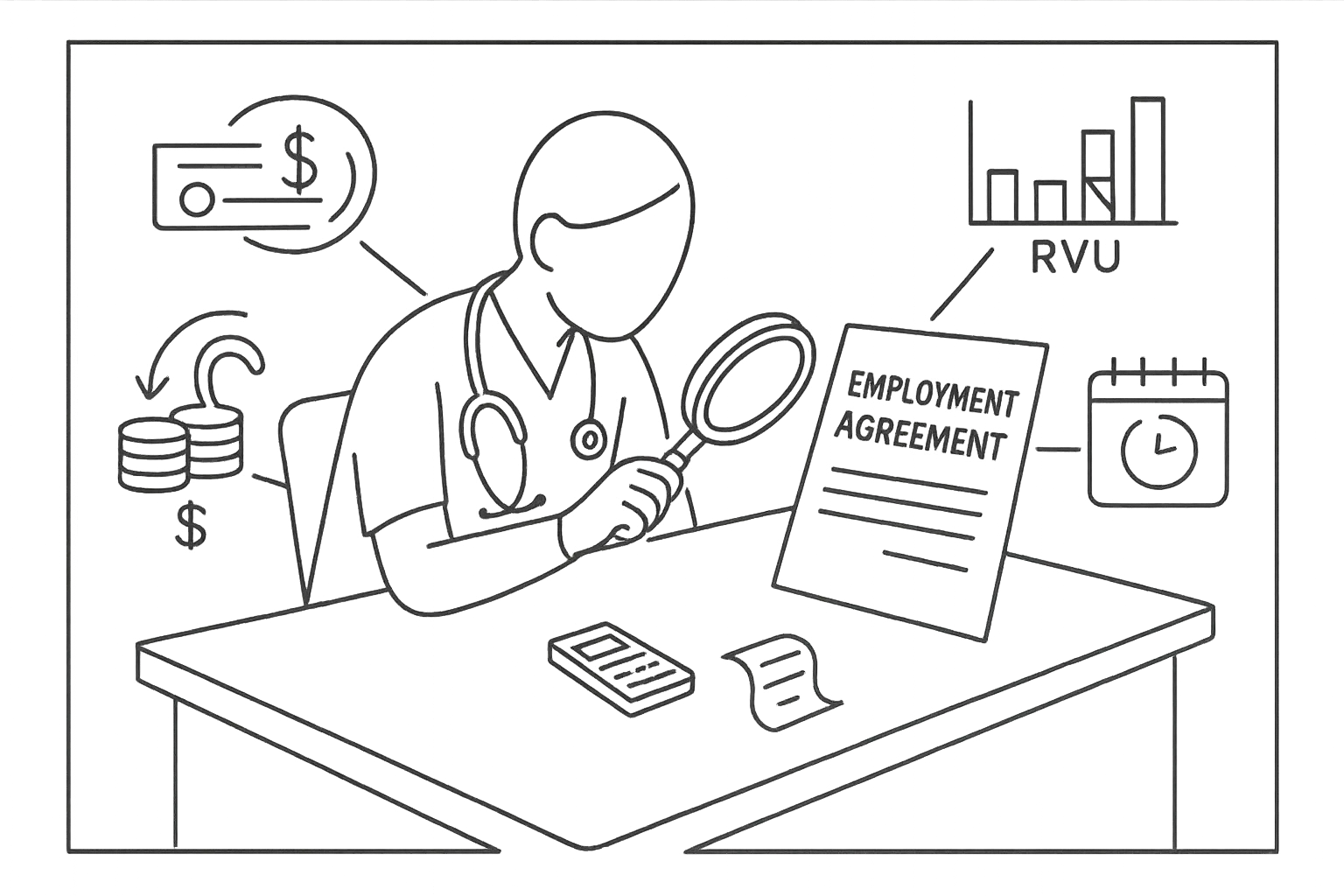
Compensation provisions are frequently presented as a base salary plus an incentive, but the calculation details determine whether the projected income is attainable. An agreement may reserve employer discretion over patient attribution, billing data, exclusions, quality measures, expense deductions, or reconciliation timing. Those details can matter as much as the stated percentage, threshold, or conversion rate.
Undefined Productivity and Billing Metrics
An RVU, encounter-based, or collections formula needs defined inputs. Important questions include which services receive credit, how shared visits are allocated, whether administrative work counts, when collections are measured, and how denials, refunds, write-offs, or payer recoupments affect compensation. Comparing the formula with established nurse practitioner compensation models can expose missing definitions before they affect pay.
Payer rules can make apparently similar encounters financially different. The Centers for Medicare & Medicaid Services identifies specific conditions for incident-to services, including requirements involving supervision, prior treatment, billing, and payment. Primary care agreements may also need to account for Advanced Primary Care Management services and their documentation workflows. When compensation depends on billed or collected services, the plan needs to explain how payer-specific requirements affect attribution and incentive credit.
A sample calculation can test the formula using realistic patient volume, payer mix, billing delays, and exclusions. It can also reveal whether the employer controls the underlying data while the NP lacks access to reports or a process for questioning errors.
Reconciliation, Negative Accrual, and Worker Classification
Reconciliation language may allow an employer to compare prior payments with later productivity or collections data. If the formula permits deficits to carry forward, the NP may begin a new period below zero or lose future incentive compensation. Reviewing negative accrual provisions can clarify whether a shortfall expires, carries forward, offsets future earnings, or becomes a direct repayment obligation.
The agreement also needs to address payment timing, look-back periods, expense deductions, access to supporting reports, and the treatment of outstanding collections after termination. Without those terms, an NP may have difficulty confirming the final reconciliation or determining whether compensation attributable to pre-departure services will be paid.
An independent contractor label does not resolve worker classification. The IRS evaluates behavioral control, financial control, and the relationship of the parties; a contract label or Form 1099 alone is not controlling. Classification can affect withholding, employment taxes, benefits, business expenses, and insurance, while state standards may use different tests. NPs considering this arrangement can examine the broader distinctions discussed in the guide to W-2 and 1099 nurse practitioner agreements.
Malpractice Coverage and Practice Compliance
Professional liability and regulatory provisions can create obligations during the relationship and after it ends. The contract must be considered alongside the actual malpractice policy, the NP’s authorized role, applicable board requirements, and the jurisdictions in which patients will receive care.
Policy Terms, Tail Coverage, and Indemnification
Occurrence coverage generally responds to covered events that happen during the policy period, even if a claim is reported later. Claims-made coverage generally depends on when the claim is reported and may require tail coverage or another extended reporting arrangement after the policy ends. The agreement needs to identify the policy type, limits, retroactive date, defense-cost treatment, prior-acts coverage, consent-to-settle terms, and responsibility for post-employment protection.
The policy itself controls the available coverage, so the occurrence-versus-claims-made label is only the beginning of the analysis. The National Association of Insurance Commissioners’ malpractice insurance overview provides general background, but the policy language and endorsements remain critical. A focused review of tail insurance obligations for nurse practitioners can identify who pays, when proof is due, and whether the allocation changes based on the reason for termination.
Indemnification provisions can create additional exposure when they require the NP to reimburse the employer for claims, losses, billing disputes, or conduct beyond the clinician’s control. The scope of the indemnity, available insurance, defense rights, exclusions, and any liability limits need to be evaluated together rather than treated as routine boilerplate.
Scope, Collaboration, Telehealth, and Credentialing
Nurse practitioner authority is not uniform nationwide. States differ in their treatment of independent practice, prescribing, collaboration, supervision, and delegation. Telehealth adds another layer because professional requirements commonly depend on the patient’s location rather than only the clinician’s office. The National Council of State Boards of Nursing’s APRN materials provide a useful regulatory framework, but the contract still must be compared with the current statutes and board rules for every jurisdiction involved.
Employment terms and a separate collaboration or supervision document can also conflict. One document may assign responsibility for prescribing oversight, chart review, coverage, fees, or maintaining the professional relationship while the other remains silent. A review of the supervision or collaboration agreement can identify inconsistent duties and determine whether the documents address the proposed role coherently.
Credentialing and payer enrollment affect when services can be billed and credited. Medicare enrollment for NPs depends on state authorization, qualifying education, recognized certification, and applicable enrollment requirements. If compensation starts only when billing privileges are active, the agreement needs to address who manages the process, who pays associated costs, and what happens when approval is delayed through no fault of the clinician.
Restrictive Covenants and the Cost of Leaving
Post-employment restrictions and termination provisions must be reviewed as a connected risk allocation system. A broad non-compete, patient non-solicitation clause, repayment obligation, and tail insurance requirement can make departure substantially more expensive than any one provision suggests.
A non-compete analysis considers its duration, geographic area, prohibited activities, covered locations, and effect on realistic employment opportunities. State law remains central. The Federal Trade Commission’s nationwide Noncompete Rule is not currently in effect or enforceable, although the FTC may still address particular agreements through other enforcement activity. The contract therefore requires state-specific and fact-specific analysis rather than an assumption that all non-competes are either valid or prohibited.
Non-solicitation, confidentiality, patient relationship, and property provisions can extend the practical restriction beyond the formal non-compete. Patient lists, electronic records, prescribing accounts, telehealth platforms, and practice data may be defined as employer property. The guide to NP non-compete clauses explains how these restrictions can affect future in-person and remote practice.
Termination language determines when these obligations take effect. Relevant provisions include the definition of cause, any cure period, without-cause notice, scheduling and compensation during the notice period, final incentive calculations, and access to records after departure. Signing bonuses, relocation assistance, loan repayment, and educational benefits may also become repayable. The agreement needs to state which events trigger repayment, whether the amount decreases over time, when it becomes due, and whether it may be deducted from final compensation.
Scheduling and Administrative Terms That Change the Job
Operational language determines how the position functions from day to day. Broad phrases such as “clinical duties as assigned” may allow responsibilities to expand without a corresponding change in compensation. Schedule, call, weekends, holidays, floating, work locations, administrative time, remote duties, and patient-message coverage need enough detail for the NP to evaluate the actual workload.
Multi-site and floating provisions can affect travel time, mileage, licensure, patient volume, and access to support staff. Telehealth terms may address platform access, cross-state patient care, response-time expectations, documentation, prescribing, and productivity measures tied to systems the NP does not control. These provisions become especially important when the employer can change locations or service lines unilaterally.
Recordkeeping and administrative clauses may govern electronic medical record access, chart-completion deadlines, correction of records, payer audits, billing cooperation, and access after separation. The agreement also needs to account for the practical effect of credentialing delays on the start date, billability, patient attribution, collections, and incentive eligibility.
How to Prepare for Contract Review
Contract review is a protective step intended to clarify expectations and translate legal language into financial, professional, and mobility consequences. Warning signs include undefined compensation formulas, employer-only control over productivity data, claims-made coverage with unclear tail responsibility, broad restrictions, open-ended repayment duties, and practice terms that do not match the proposed role.
Before the review, collect the complete agreement, offer letter, compensation and bonus plans, job description, incorporated handbook provisions, malpractice information, and written communications concerning promised terms. The reviewer also needs to know the anticipated practice locations, patient locations for telehealth, licensure status, payer enrollment status, and whether the position is structured as employment or independent contracting.
Potential revisions are most useful when they focus on precise definitions, objective calculations, reporting access, payment timelines, reasonable notice, and clear allocation of financial responsibility. A comprehensive nurse practitioner contract review can identify how separate clauses interact and which provisions may warrant clarification or revision before the agreement is signed.
Frequently Asked Questions
What are the most common mistakes in a nurse practitioner contract?
Common mistakes include accepting undefined compensation metrics, overlooking reconciliation or repayment terms, failing to identify tail insurance responsibility, agreeing to broad restrictive covenants, and reviewing termination provisions without considering their combined financial consequences.
How can an NP evaluate a productivity compensation formula?
The formula needs to identify the measurement method, threshold, conversion rate, credited services, exclusions, payment schedule, reporting source, deductions, and reconciliation process. A sample calculation using realistic volume and payer data can reveal whether the projected incentive is attainable.
Does a 1099 contract automatically make an NP an independent contractor?
No. A contract label or Form 1099 does not determine federal tax classification by itself. The IRS considers behavioral control, financial control, and the parties’ relationship, and state classification standards may apply different tests.
Who pays for tail insurance when an NP leaves a job?
Responsibility depends on the malpractice policy and the contract. If the employer provides claims-made coverage, the documents need to clarify whether the employer or NP purchases tail coverage and whether that allocation changes based on how the relationship ends.
Are nurse practitioner non-competes prohibited nationwide?
No. The FTC’s nationwide Noncompete Rule is not currently in effect or enforceable. State law, the wording of the restriction, and the facts surrounding the relationship remain important to evaluating a nurse practitioner non-compete.
When should a nurse practitioner obtain a contract review?
The review is most useful before the agreement is signed or the NP relies on oral promises. The reviewer needs the complete contract package, including the offer letter, compensation plan, job description, incorporated policies, malpractice information, and written communications about important terms.
Have Your Nurse Practitioner Contract Reviewed Before You Sign
Chelle Law can identify compensation, classification, insurance, termination, repayment, and restrictive covenant risks and explain how the proposed terms may affect your practice.
Contact Chelle LawExplore Nurse Practitioner Contract Guidance
Review legal services, practical contract resources, and state-focused information for nurse practitioners.