
An independent contractor agreement defines the business relationship between a nurse practitioner and a clinic, private practice, telehealth platform, urgent care operator, staffing company, or other healthcare organization. Although these arrangements may offer scheduling flexibility and attractive gross compensation, the stated rate does not reveal the full economic value of the opportunity. A contractor may assume responsibility for taxes, benefits, professional expenses, malpractice coverage, licensing costs, and other obligations commonly paid by an employer.
The contract also affects more than compensation. Its provisions may determine how services are billed, whether the NP can work for other organizations, who controls scheduling and clinical procedures, what happens when payer enrollment is delayed, and whether compensation continues for collections received after termination. Classification language must be considered alongside the actual working relationship because calling someone a contractor or issuing a Form 1099 does not, by itself, establish independent-contractor status.
Chelle Law reviews contractor agreements to identify financial, professional, and post-termination risks before an NP signs. That analysis may include the compensation formula, billing procedures, scope-of-practice terms, malpractice insurance, restrictive covenants, termination rights, assignment provisions, and incorporated policies. A focused NP independent contractor agreement review can also explain how provisions interact—for example, whether ending the relationship triggers tail coverage costs, bonus repayment, lost collections, or a non-compete restriction.
Key Terms in an NP Independent Contractor Agreement
- A contractor arrangement may shift taxes, benefits, insurance premiums, licensing expenses, and ordinary business costs to the nurse practitioner.
- Compensation provisions need clear definitions for rates, productivity, collections, attribution, deductions, chargebacks, reconciliation, and payment timing.
- The parties must address billing responsibility separately from worker classification, including NPI use, claim submission, payer enrollment, and access to supporting reports.
- Scope-of-practice, supervision, collaboration, prescribing, and telehealth requirements vary by the state where the patient receives care.
- Malpractice, termination, restrictive-covenant, assignment, and final-payment terms can create substantial obligations after the relationship ends.
Evaluating the Contractor Model and Worker Classification

A contractor model may work well for an NP who serves several organizations, wants control over available shifts, operates through a professional business entity, or provides temporary, weekend, locum tenens, or telehealth coverage. The trade-off is that a higher encounter, hourly, or shift rate may replace employer-sponsored health insurance, retirement contributions, paid time off, payroll tax withholding, continuing education allowances, and other benefits. Comparing W-2 and 1099 arrangements for nurse practitioners requires evaluating net compensation rather than the headline rate alone.
For example, a telehealth company may offer an appealing per-visit fee while requiring the NP to maintain several licenses, purchase insurance, absorb unpaid documentation time, and bear the risk of patient no-shows. A private practice may offer predictable weekend shifts but require the practitioner to follow fixed workflows and use only the practice’s systems. Neither arrangement is necessarily inappropriate, but the written terms and operational expectations need to match the parties’ intended relationship.
A 1099 Label Does Not Resolve Classification
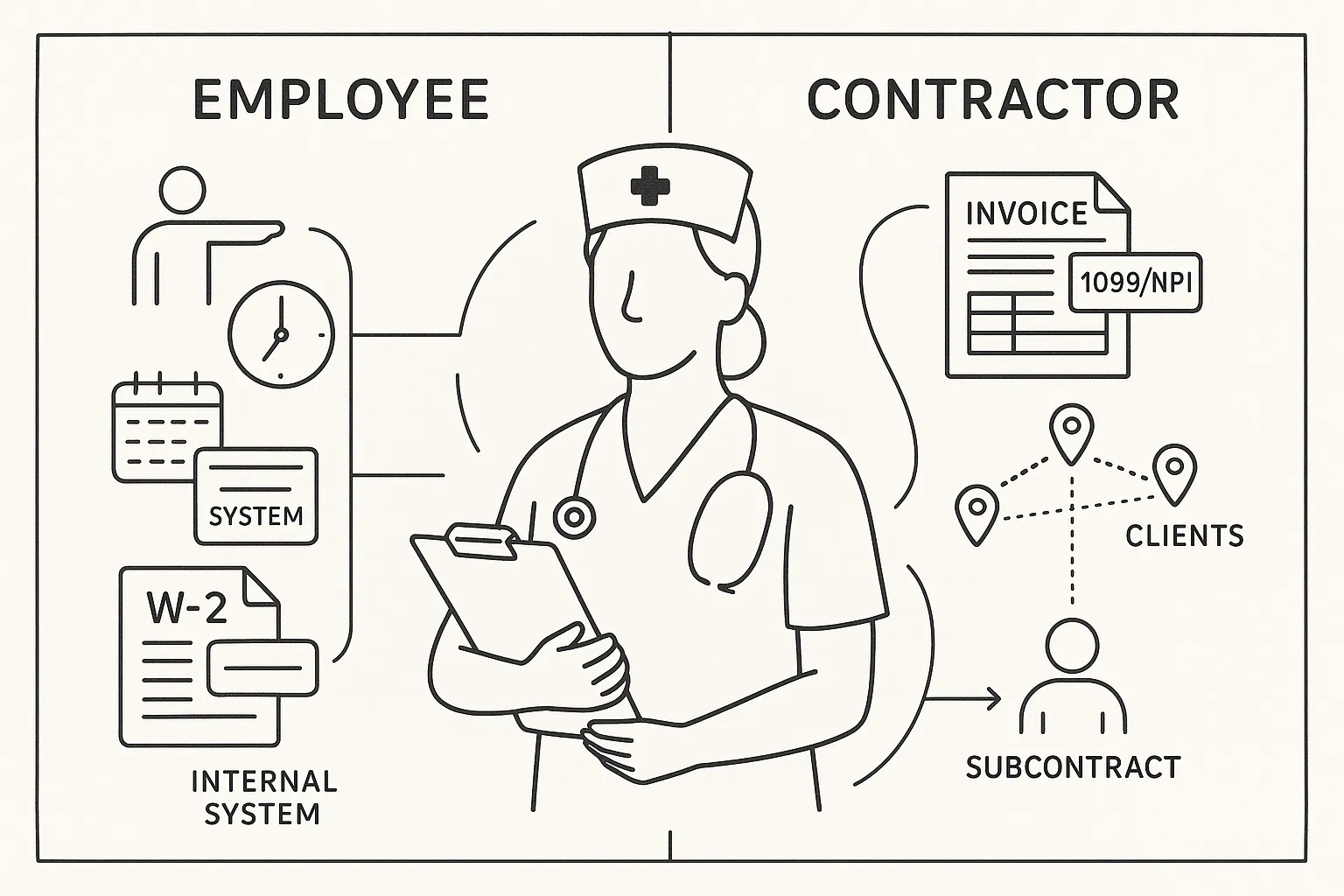
Different laws use different worker-classification standards. The IRS common-law analysis considers behavioral control, financial control, and the nature of the parties’ relationship. For federal wage-and-hour purposes, the Department of Labor applies an economic-reality analysis under the Fair Labor Standards Act. The Department’s independent-contractor guidance explains that its test is specific to the FLSA and does not replace tax, state-law, or other federal standards.
Contract terms that warrant closer examination include mandatory hours, exclusivity, detailed control over how work is performed, required use of supplied equipment, limits on serving other clients, and broad authority to change duties unilaterally. Clinical quality standards and regulatory oversight do not necessarily establish employee status, but extensive employer-style control may conflict with the contractor label. Misclassification can create tax, wage, benefit, and regulatory exposure, so the agreement must be evaluated together with the actual working arrangement.
Tax responsibilities also deserve separate attention. Self-employed NPs generally report business income and expenses and may owe federal income tax, self-employment tax, and estimated tax payments, as well as applicable state or local taxes. The IRS states that self-employment tax may apply when net earnings from self-employment reach $400 or more, but thresholds, forms, and payment dates can change. Current IRS self-employment tax guidance and advice from a qualified tax professional can help the NP evaluate obligations outside the contract review.
Compensation, Billing, and Collection Risk
Compensation provisions need to explain how services become payable, not merely advertise an hourly, daily, encounter, collection, or productivity rate. Important definitions include the measurement period, payment schedule, patient or encounter attribution, refunds, payer denials, chargebacks, documentation deadlines, reconciliation procedures, and the NP’s access to reports. The agreement may also allocate credentialing, licensing, travel, equipment, staffing, technology, and continuing education expenses.
A comprehensive compensation and productivity review can identify provisions that reduce expected earnings. A percentage of collections, for example, has limited meaning until the contract defines gross versus net collections, permitted deductions, write-offs, refunds, payer recoupments, and the period during which payments are credited. Similarly, an RVU formula needs a conversion factor, attribution rules, treatment of modifiers, a defined source for the RVU values, and a process for reviewing the underlying data.
Payment Formulas and Reconciliation
- Hourly, daily, or shift fees: The document can clarify minimum commitments, cancellation rights, chart-completion time, call coverage, travel, and whether administrative work is compensable.
- Per-encounter compensation: The definition of a completed encounter may address no-shows, same-day services, procedures, asynchronous care, denied claims, and incomplete documentation.
- Collections-based pay: The formula needs definitions for included revenue, excluded amounts, overhead deductions, refunds, reserves, reconciliation, and post-termination receipts.
- Productivity or RVU compensation: The contract can identify the applicable schedule, conversion factor, attribution method, reporting frequency, threshold, and effect of later coding changes.
- Bonuses: Objective metrics, measurement dates, payment timing, eligibility at payout, and the effect of termination can determine whether an earned incentive is actually paid.
Negative accrual and open-ended chargebacks can shift substantial payer risk to the practitioner. The agreement may allow current compensation to be reduced because of earlier denials, refunds, alleged overpayments, or coding changes. Contract analysis can identify whether adjustments are time-limited, supported by reports, subject to dispute rights, and restricted to claims attributable to the NP.
Medicare Billing, NPI Use, and Payer Enrollment
Independent-contractor status does not determine how Medicare or another payer permits a service to be billed. The agreement needs to identify which entity submits claims, whose tax identification number is used, whether the NP reassigns billing rights, how the NP’s NPI will be used, and who is responsible for enrollment, coding, documentation, and refunds. It can also address delayed credentialing and whether the NP is paid for services rendered before payer enrollment becomes effective.
CMS distinguishes services personally furnished by an advanced practice registered nurse from services billed incident to another practitioner. Its incident-to billing guidance includes requirements involving the initiating practitioner, supervision, active involvement, expenses, and the billing practitioner’s NPI. A contract cannot override payer rules, so billing language should not assume that a contractor label authorizes a particular reimbursement method.
Scope of Practice, Collaboration, and Telehealth
The agreement must fit the law of every state in which the NP treats patients. State requirements differ concerning scope of practice, physician involvement, collaboration, prescribing, chart review, protocols, and professional entity structure. The AANP’s state practice environment resource categorizes jurisdictions as full, reduced, or restricted practice, but the governing statutes, regulations, and licensing-board requirements still require state-specific review.
If a separate collaboration or supervision document is required, it needs to align with the services, schedule, locations, and responsibilities described in the contractor agreement. A review of the related supervision or collaboration terms may address physician availability, documentation, chart review, prescribing, quality oversight, replacement of a collaborating professional, and responsibility for associated fees. Conflicting documents can create operational and regulatory problems even when each agreement appears reasonable in isolation.
Telehealth arrangements require particular attention to patient location. The contract can define where the NP is authorized to provide care, who monitors licensing and renewal deadlines, which platforms and record systems must be used, and what happens if a license, credential, payer enrollment, or platform relationship is delayed or lost. It may also allocate expenses for multi-state licensing and establish whether the organization can add jurisdictions or services without the NP’s consent.
Clinical-autonomy language must be reconciled with classification language. A healthcare organization may impose legitimate compliance, patient-safety, and quality requirements while still intending a contractor relationship. The document should distinguish those professional standards from extensive day-to-day control over the manner and means of work, particularly when the NP is expected to maintain an independent business or serve other clients.
Malpractice Insurance and Risk Allocation
A contractor agreement may require the NP to obtain professional liability insurance, reimburse the organization for coverage, or participate in a group policy. The provision needs to identify coverage limits, the named insured, approved carriers, proof-of-coverage requirements, and whether the policy is occurrence-based or claims-made. An occurrence policy generally responds to covered incidents occurring during the policy period, while a claims-made policy commonly requires coverage to be active when the claim is made, subject to the policy’s terms and retroactive date.
Claims-made coverage can create a need for tail coverage after the relationship ends. Responsibility may vary depending on who terminates the agreement, whether the termination is for cause, and whether replacement coverage preserves the retroactive date. A focused review of NP tail insurance obligations can clarify who purchases the endorsement, when proof is due, whether the NP may choose the carrier, and whether the cost can be deducted from final compensation.
The policy itself matters as much as the contract summary. Definitions, exclusions, consent-to-settle terms, defense obligations, reporting deadlines, retroactive coverage, and carrier requirements can materially affect protection. Related indemnification language also requires careful review because a broad indemnity may obligate the NP to reimburse the organization for claims, billing losses, or legal expenses beyond what the malpractice policy covers.
Ending the Relationship and Protecting Future Work
Termination provisions establish how long the arrangement lasts, whether it renews automatically, and how either party may end it. Without-cause termination usually depends on written notice, while for-cause termination may permit an immediate or accelerated exit after specified events. The agreement can identify whether a correctable breach receives a cure period and how termination affects scheduled shifts, access to records, pending claims, repayment obligations, malpractice coverage, and compensation.
Collections-based arrangements need a clear post-termination accounting process. The document may state whether the NP receives compensation on claims collected after departure, how long reconciliation continues, when reports are delivered, and whether the organization can retain reserves or offset alleged debts. Reviewing NP contract termination issues before signing can reveal obligations that would otherwise become apparent only when the relationship ends.
Restrictive Covenants, Assignment, and Outside Work
Non-compete, non-solicitation, confidentiality, and exclusivity clauses can limit future work even when the NP is classified as an independent contractor. Relevant details include the restricted services, geographic area, duration, patient and referral-source limitations, triggering events, and exceptions for preexisting relationships. The 2024 FTC Noncompete Rule is currently not enforceable following federal litigation and later agency action concerning vacatur. As the FTC’s rule page reflects, analysis therefore remains centered on applicable state law, the contract language, and the specific facts.
A contractor’s expected flexibility can also be undermined by broad exclusivity, prior-approval, or conflict-of-interest language. A nurse practitioner non-compete review can evaluate how those restrictions interact with the NP’s other clients, telehealth work, future employment, and professional relationships. Assignment clauses deserve similar attention because they may permit the organization to transfer the agreement to an affiliate, purchaser, or successor without the NP’s approval.
Subcontracting and change-of-control provisions determine whether either party can delegate duties or continue the relationship after a sale. A broad assignment right may leave the NP bound to a new operator, compensation system, or business model under the original terms. The agreement can provide notice, consent, or termination rights when ownership or control changes materially.
Pre-Signing Review Checklist
A useful contract review connects provisions that are often evaluated separately. Termination language, for example, may determine whether the NP loses unpaid collections, must repay an advance, purchases tail coverage, or becomes subject to a restrictive covenant. Incorporated policies and compensation plans are equally important because they may give the organization discretion that is not apparent from the main agreement.
- Confirm the intended worker classification and compare the written terms with the actual schedule, control, expenses, and ability to serve other clients.
- Calculate expected net compensation after taxes, benefits, insurance, licensing, travel, equipment, and other professional expenses.
- Request definitions for collections, RVUs, encounters, bonuses, deductions, denials, refunds, chargebacks, and reconciliation.
- Identify the billing entity, NPI and tax-identification-number arrangements, payer-enrollment duties, reporting rights, and responsibility for coding or documentation errors.
- Compare scope-of-practice, prescribing, collaboration, supervision, and telehealth provisions with the law of each state where patients will be located.
- Verify malpractice policy type, limits, retroactive date, premium responsibility, reporting duties, indemnification, and tail obligations.
- Review termination notice, cure rights, repayment triggers, final accounting, post-termination collections, and access to supporting reports.
- Evaluate non-compete, non-solicitation, confidentiality, exclusivity, assignment, subcontracting, and change-of-control provisions.
- Obtain every incorporated document, including fee schedules, compensation plans, clinical protocols, billing policies, and contractor handbooks.
Undefined formulas, unlimited offsets, unilateral fee changes, vague clinical obligations, missing insurance terms, and one-sided post-termination duties are common warning signs. Not every unfavorable provision makes an agreement unacceptable, but the NP needs enough information to understand the financial and professional consequences before accepting the arrangement.
Frequently Asked Questions
What terms belong in a nurse practitioner independent contractor agreement?
The agreement should define the services, compensation formula, billing responsibilities, schedule, expenses, insurance obligations, scope-of-practice requirements, termination rights, restrictive covenants, and final-payment procedures. It should also identify every policy, fee schedule, compensation plan, or clinical protocol incorporated by reference.
Does receiving a Form 1099 establish that an NP is an independent contractor?
No. Tax, wage-and-hour, state, and other laws may apply different classification tests. Authorities can examine the actual relationship, including control over the work, financial risk, supplied equipment, exclusivity, permanence, and the NP’s opportunity to serve other clients.
How can an NP evaluate contractor compensation?
The NP can compare expected gross pay with taxes, insurance, benefits, licensing, travel, technology, and other business expenses. The written formula also needs clear rules for attribution, deductions, refunds, denials, chargebacks, reporting, reconciliation, and payment after termination.
Who pays for malpractice and tail coverage in a 1099 arrangement?
Either party may agree to pay, so the contract and insurance policy control. The documents need to identify the policy type, limits, retroactive date, premium responsibility, reporting obligations, and who purchases tail coverage under each termination scenario.
Can an NP contractor agreement include a non-compete?
Yes, although enforceability depends on applicable state law, the wording, and the facts. The federal FTC Noncompete Rule is not currently enforceable, so the NP needs to evaluate the restricted services, duration, geography, triggering events, and patient or preexisting-business exceptions.
What happens to unpaid collections after the contractor relationship ends?
The result depends on the agreement. It can specify whether post-termination receipts remain payable, how long billing and reconciliation continue, when final reports are provided, and whether the organization may retain reserves or offset alleged debts.
Have Your NP Contractor Agreement Reviewed Before You Sign
Chelle Law can analyze classification, compensation, billing, malpractice, termination, and restrictive-covenant provisions so you understand the agreement’s practical risks.
Contact Chelle LawExplore Nurse Practitioner Contract Guidance
Find legal services, practical resources, and state-focused contract information for nurse practitioners.