
Malpractice insurance protects a nurse practitioner against certain professional-liability claims, but the existence of a policy does not answer every coverage question. The policy type, insured definition, retroactive date, reporting requirements, exclusions, and limits determine whether a particular matter falls within coverage. The employment or independent contractor agreement may create additional obligations involving premiums, tail coverage, indemnification, or repayment.
These details can affect an NP long after a position ends. A claim may involve substantial defense costs, professional reporting, licensing concerns, reputational consequences, and potential liability for amounts the insurer does not pay. Coverage also can become uncertain when an NP changes employers, performs telehealth services, works at multiple locations, moonlights, or provides services through an entity not identified in the policy.
A careful review compares the contract with the actual insurance documents rather than relying on a brief statement that malpractice coverage is “provided.” Chelle Law evaluates how the agreement allocates coverage responsibilities, whether the policy appears consistent with the permitted duties, and which provisions may warrant clarification before signing. The analysis is especially important when tail costs, broad indemnification language, or post-employment reporting obligations could create unexpected financial exposure.
How Malpractice Coverage Allocates Professional Risk
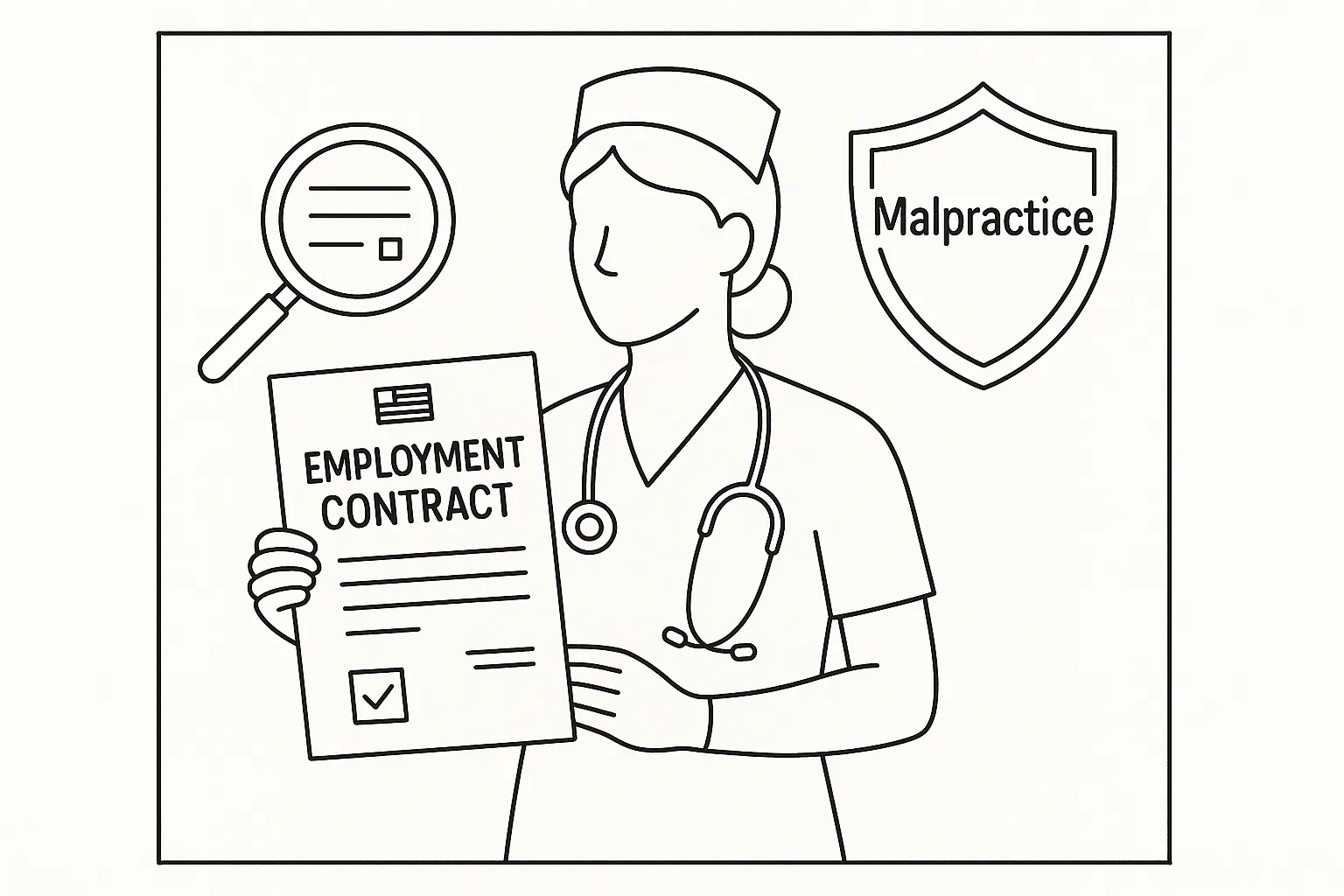
Malpractice coverage is only one part of the risk allocation between an NP, an employer or contracting entity, and an insurer. The policy establishes the insurer’s obligations, while the contract may determine who purchases coverage, pays premiums, obtains tail protection, supplies proof of insurance, or reimburses another party for an uncovered loss. If those documents use inconsistent terms, the NP may have a contractual obligation that is broader than the available insurance.
A practical review focuses on several connected questions:
- Is the coverage claims-made, claims-made-and-reported, or occurrence-based?
- Is the NP a named insured or otherwise included within the policy’s insured definition?
- Do the covered professional services and territory match the NP’s duties, locations, telehealth work, and permitted outside activities?
- What limits, deductibles, exclusions, and defense-cost provisions apply?
- Who controls the defense, selects counsel, and decides whether a claim may be settled?
- Who is responsible for tail coverage, prior-acts protection, premiums, and any repayment obligation when the relationship ends?
Claims-Made, Occurrence, Tail, and Prior-Acts Coverage
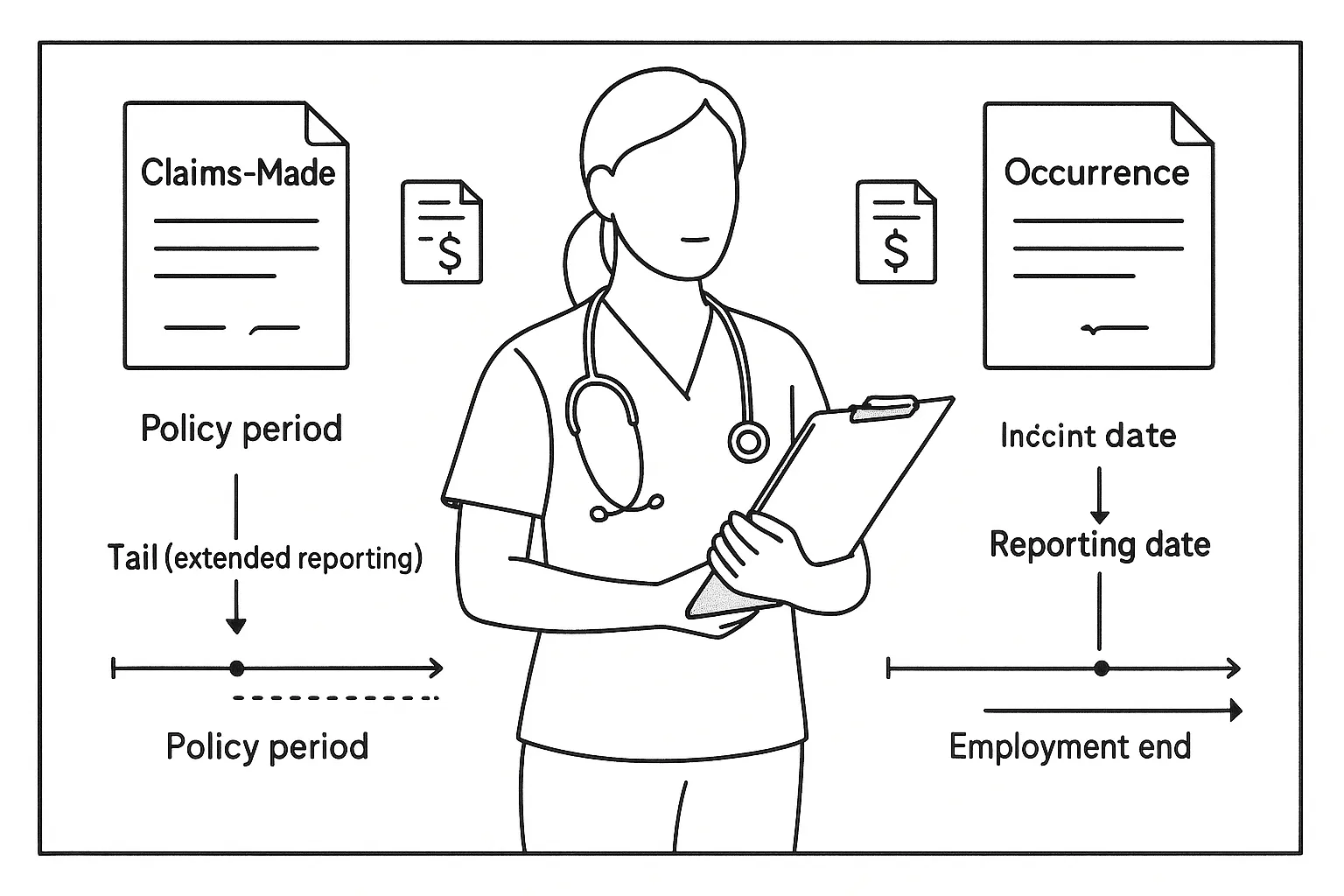
The distinction between claims-made and occurrence coverage affects when a policy responds and what protection may be needed after a job ends. The policy language controls, including any requirement that a claim be both made and reported within a specified period. A label on a contract summary is not a substitute for reviewing the declarations and policy terms.
How Claims-Made and Occurrence Policies Respond
A claims-made policy generally requires the professional incident to occur on or after the applicable retroactive date and the claim to be made while coverage is active. Some policies are written on a claims-made-and-reported basis and also require timely notice to the insurer. The National Association of Insurance Commissioners’ malpractice insurance guidance explains that an extended reporting period may allow covered claims to be reported after a claims-made policy ends, subject to the policy’s specific conditions.
An occurrence policy generally responds when the covered incident occurred during the policy period, even if the claim is asserted later. This structure commonly eliminates the need for tail coverage for an incident that was covered when it occurred. It does not eliminate every post-employment issue, however; the NP must still have qualified as an insured, the services must have fallen within the coverage grant, and the applicable limits and exclusions remain controlling. A more detailed comparison of claims-made and occurrence coverage can help an NP evaluate these timing differences.
Why Tail Coverage Is Different From Prior-Acts Coverage
Tail coverage, also called an extended reporting period, generally extends the time for reporting otherwise covered claims arising from services performed before the underlying claims-made policy ended. It ordinarily does not move the retroactive date backward, add excluded services, expand the coverage territory, or increase policy limits. The underlying policy therefore remains central to determining whether the matter is covered.
Prior-acts coverage, sometimes called nose coverage, works differently. A new policy may cover eligible services performed after an agreed retroactive date but before the new policy began. When an NP changes employers or carriers, the documents must clarify whether protection will come from an extended reporting period under the former policy or prior-acts coverage under the new one. General explanations of liability insurance coverage reinforce why the precise policy period and triggering language matter.
Responsibility for purchasing tail coverage often depends on the agreement and the circumstances of departure. The allocation may differ when the NP resigns, the contract expires, the employer terminates without cause, or either party terminates for cause. The provision also may address the required carrier, reporting period, coverage limits, purchase deadline, and proof-of-coverage requirements. Chelle Law’s guide to tail insurance for nurse practitioners examines these post-employment obligations in greater detail.
Reading the Insurance Policy and Contract Together
An employment agreement may promise professional-liability insurance without identifying the actual carrier, policy form, retroactive date, or exclusions. Conversely, a policy may provide coverage only for services performed within the scope of assigned duties for the named organization. Reviewing both documents helps identify gaps that a contract summary alone may conceal.
Insured Status, Services, Locations, and Exclusions
The NP’s insured status should be clear. Coverage may identify the NP by name, include the NP within a defined class of professionals, or extend protection through an endorsement. The declarations and endorsements also can reveal the applicable retroactive date, coverage territory, limits, deductible, and any entity-specific restrictions.
The description of covered professional services must correspond to the work the NP will actually perform. Relevant activities may include prescribing, procedures, call coverage, supervision or collaboration duties, telehealth, work at satellite facilities, and services performed for affiliated entities. NPs with remote responsibilities can use a focused guide to reviewing a telehealth agreement to assess how insurance terms interact with licensure, work location, and assigned duties.
Exclusions may address intentional or criminal conduct, fraud, sexual misconduct, services outside the authorized scope, certain controlled-substance matters, or work performed for an organization not insured under the policy. Whether a particular exclusion applies depends on its wording and the facts. State insurance requirements also vary, so disclosure rules, extended reporting provisions, and carrier obligations cannot be assumed to be uniform nationwide.
Defense Control, Settlement Authority, and Contractual Liability
A liability policy may state whether defense expenses are paid in addition to the liability limit or reduce the amount available to resolve a claim. It may also determine who selects defense counsel and whether the NP’s consent is required before settlement. These provisions matter because a settlement may have professional reporting, credentialing, reputational, or licensing consequences even when the insurer funds the payment.
The employment agreement may create obligations that do not fit within the policy’s coverage. A broad indemnification clause, for example, could require the NP to reimburse the employer for losses, legal expenses, or third-party claims that the insurer excludes. The contract may also require repayment of premiums or insurance expenses if the NP leaves before a specified date. A dedicated malpractice and tail insurance review can compare these contractual obligations with the stated coverage.
Employer Coverage and Independent Contractor Obligations
Employer-provided coverage may reduce the NP’s direct premium expense and simplify policy administration, but the arrangement can give the employer or carrier substantial control over reporting, defense, and settlement. Coverage also may end when employment ends. Before relying on an employer policy, the NP can request the declarations page, relevant endorsements, claims-reporting instructions, and written confirmation of post-employment protection.
An individual policy may provide continuity across certain professional activities, but it does not automatically cover every job, entity, location, or outside engagement. The NP must determine how an individual policy coordinates with employer-provided insurance and whether either policy treats the other as primary or excess coverage. Duplicate policies do not necessarily produce duplicate protection.
Independent contractor agreements frequently place more insurance responsibility on the NP. The contract may require an individual policy with stated limits, proof of annual renewal, notice of cancellation, specified carrier qualifications, and tail or prior-acts protection. It also may require the contractor to indemnify the practice or name an entity as an additional insured when the policy permits. These provisions belong in the broader analysis of an NP independent contractor agreement, including its compensation, tax, termination, and compliance terms.
Policy Limits, Deductibles, Carrier Quality, and Claims Handling
Malpractice policies commonly state a per-claim limit and an aggregate limit. The per-claim amount caps covered payments for one claim, while the aggregate generally caps covered payments during the applicable policy period. The practical protection also depends on whether defense expenses are outside or inside those limits, whether a deductible applies to defense costs, and whether multiple related claims are treated as a single matter.
Premiums and available terms may vary by specialty, procedures, practice setting, geographic area, claims history, policy form, selected limits, and scope of services. Cost is therefore only one part of the comparison. Carrier financial strength, experience handling professional-liability claims, access to qualified defense counsel, responsiveness, settlement practices, and tail availability may materially affect the value of coverage. Professional guidance on evaluating malpractice carriers and claims handling identifies these administrative considerations in addition to policy price and limits.
Telehealth, moonlighting, work at multiple facilities, and services for separate entities should never be assumed to fall within a primary employer’s policy. The NP can compare the permitted outside-activity provisions in the contract with the policy’s insured entities, locations, territory, and covered-services definition. Written confirmation from the carrier or authorized insurance representative may be important when the documents leave a material question unresolved.
Malpractice Insurance Checklist Before Signing
Before accepting an employment or contractor agreement, an NP can request enough information to understand both current coverage and post-employment exposure. Important items include:
- The complete policy type, including whether it is claims-made, claims-made-and-reported, or occurrence-based.
- The NP’s insured status, retroactive date, policy period, territory, covered services, and applicable endorsements.
- Per-claim and aggregate limits, deductibles, exclusions, and the treatment of defense expenses.
- The procedures for reporting an incident, circumstance, demand, or formal claim.
- The party that selects counsel, controls the defense, and approves or consents to settlement.
- Coverage for telehealth, multiple facilities, call duties, moonlighting, and work for affiliated or outside entities.
- Tail or prior-acts obligations following resignation, expiration, termination without cause, or termination for cause.
- Indemnification, premium repayment, reimbursement, and proof-of-coverage requirements in the contract.
- The carrier’s financial strength, claims-handling resources, defense counsel arrangements, and extended-reporting options.
Unclear insurance language may be only one of several connected contract risks. Termination provisions can trigger tail expenses, restrictive covenants can limit the next job, and compensation or repayment clauses can magnify the financial cost of leaving. A comprehensive nurse practitioner contract review evaluates malpractice provisions alongside the rest of the agreement rather than treating coverage as an isolated issue.
Frequently Asked Questions
What is the difference between claims-made and occurrence malpractice insurance?
Claims-made coverage generally requires a covered claim to be made while the policy or an applicable extended reporting period is active, and some policies also require the claim to be reported within that period. Occurrence coverage generally responds when the covered incident occurred during the policy period, even if the claim is asserted later. The actual policy language controls both forms of coverage.
How is tail coverage different from prior-acts coverage?
Tail coverage generally extends the time to report otherwise covered claims arising from services performed before a claims-made policy ended. It ordinarily does not move the retroactive date or broaden the underlying coverage. Prior-acts coverage may protect eligible services performed before a new policy began, subject to the new policy’s retroactive date and terms.
Who pays for a nurse practitioner’s malpractice tail insurance?
The employment or contractor agreement often allocates the cost, but the policy determines whether tail coverage is available and on what terms. Responsibility may change depending on whether the NP resigns, the contract expires, or the employer terminates the relationship with or without cause. The provision should be compared with the carrier’s requirements.
Is employer-provided malpractice coverage always sufficient?
No. Employer-provided coverage may limit insured services, locations, outside work, settlement rights, or post-employment protection. An NP can confirm insured status, limits, exclusions, reporting requirements, defense terms, and the availability of tail or prior-acts coverage before relying on the policy.
Which malpractice insurance terms should an NP review before signing?
Important terms include the policy type, insured definition, retroactive date, covered services, territory, exclusions, limits, deductibles, defense costs, reporting requirements, settlement authority, tail responsibility, indemnification, and premium repayment obligations. The NP’s actual duties and work locations should match the coverage documents.
Do independent contractor nurse practitioners need their own malpractice policy?
Many independent contractor agreements require the NP to obtain and maintain an individual policy, but the requirement depends on the contract and practice arrangement. The agreement may specify policy type, limits, carrier qualifications, proof of coverage, notice of cancellation, and responsibility for tail or prior-acts protection.
Have Your Malpractice and Tail Terms Reviewed
Chelle Law reviews nurse practitioner agreements to identify coverage gaps, tail obligations, indemnification provisions, and insurance costs that may create unexpected professional or financial exposure.
Contact Chelle Law