
Negative accrual is a compensation mechanism that allows an employer or contracting entity to record a deficit when a nurse practitioner’s calculated production, collections, or incentive earnings fall below an advance, draw, guarantee, or prior payment. Depending on the agreement, the balance may carry into a later compensation period, reduce future earnings, affect a final paycheck, or become the basis for a repayment demand. The label used in the contract is less important than the actual formula and recovery language.
This issue matters because an arrangement presented as guaranteed compensation may operate more like an advance against future performance. Billing delays, payer denials, credentialing problems, scheduling limits, attribution rules, refunds, and employer-controlled collection practices can all affect the calculation. An NP may therefore generate substantial patient volume yet still receive a report showing a negative balance. The financial consequences can become especially significant when employment ends before the balance is resolved.
Chelle Law reviews negative accrual provisions as part of the complete compensation and termination structure. That analysis includes the formula, definitions, incorporated policies, reconciliation schedule, access to supporting records, dispute rights, payroll-offset language, and post-termination obligations. Federal wage protections and state deduction laws may also limit how an alleged deficit can be collected, so contractual authorization does not necessarily make every deduction or repayment demand lawful.
Key Takeaways About Negative Accrual
- A compensation guarantee may function as a recoverable draw or advance if the agreement requires a later true-up.
- Negative accrual can arise under collections-based, RVU, productivity, bonus, and guaranteed-pay models.
- An accounting deficit is not automatically the same as a lawful payroll deduction or an enforceable debt.
- Billing, credentialing, scheduling, attribution, and payer activity outside the NP’s control can materially affect the balance.
- Definitions, lookback limits, recovery caps, written notice, audit rights, and post-termination terms can determine the practical exposure.
What a Negative Accrual Balance Actually Represents
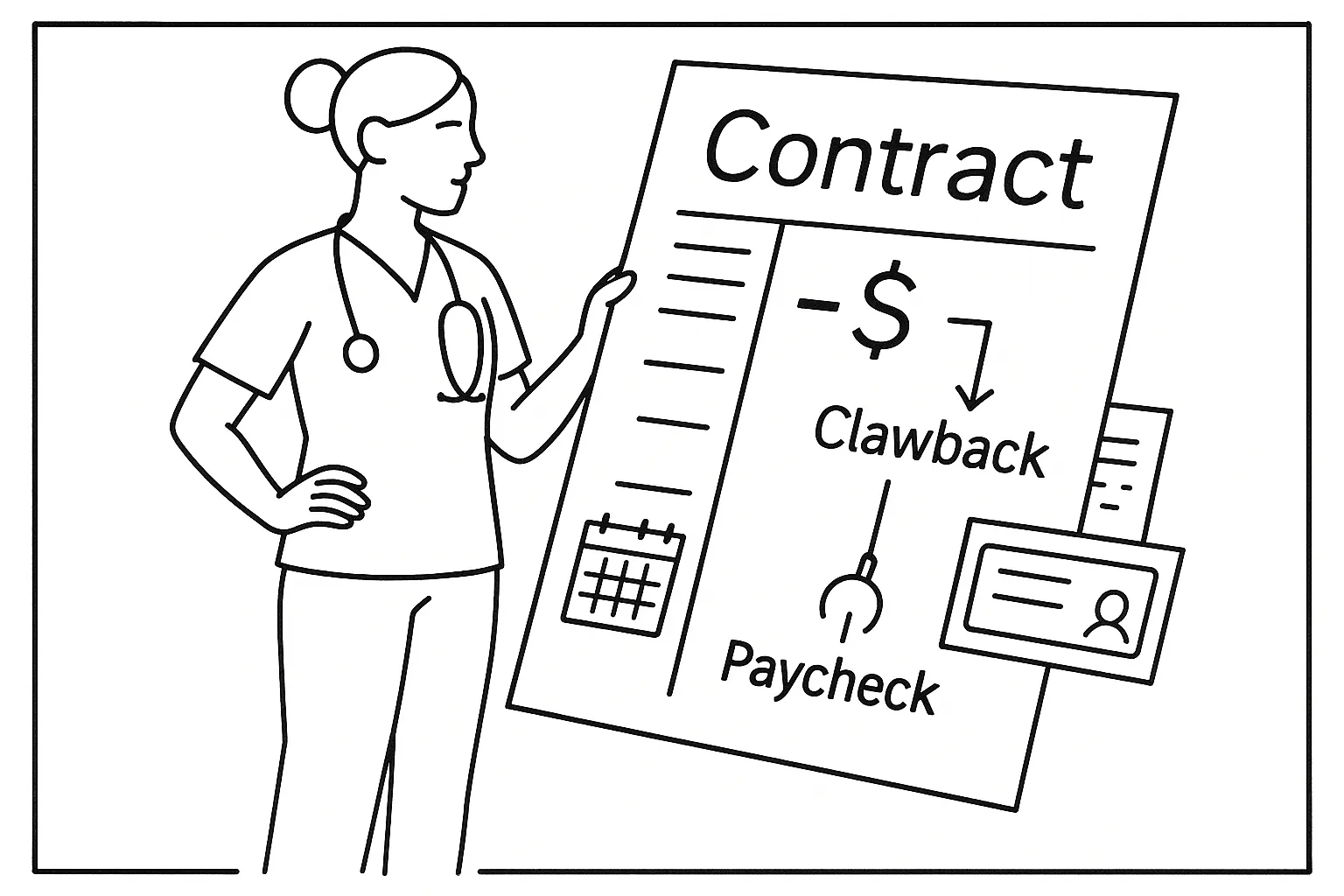
A negative accrual provision typically compares compensation already paid with earnings calculated under a contractual formula. If the calculated amount is lower, the difference is recorded as a negative balance. The agreement may then authorize the employer to carry the balance forward, subtract it from a future bonus, reduce later productivity compensation, or request repayment.
Several legally distinct concepts may sit behind that accounting entry. The payment could be earned guaranteed compensation, a recoverable draw, a bona fide wage advance, an overpayment, or a disputed contractual debt. A clawback is the recovery mechanism, while negative accrual describes the recorded shortfall. Those concepts should not be treated as interchangeable because different contract, wage-payment, and collection rules may apply.
- Income volatility: Compensation that initially appears fixed may later be adjusted against production or collections.
- Cash-flow exposure: An NP may receive income in one period and encounter a deduction or repayment demand after a later reconciliation.
- Exit liability: Resignation or termination may accelerate the reconciliation or affect final compensation.
- Verification problems: The employer may control the billing, coding, attribution, and reporting systems used to calculate the alleged deficit.
The provision must therefore be read with the entire compensation plan rather than as a stand-alone clause. A focused NP compensation and productivity review can identify how the formula, reporting rules, incorporated policies, and termination terms allocate risk.
Compensation Models That Can Produce a Deficit
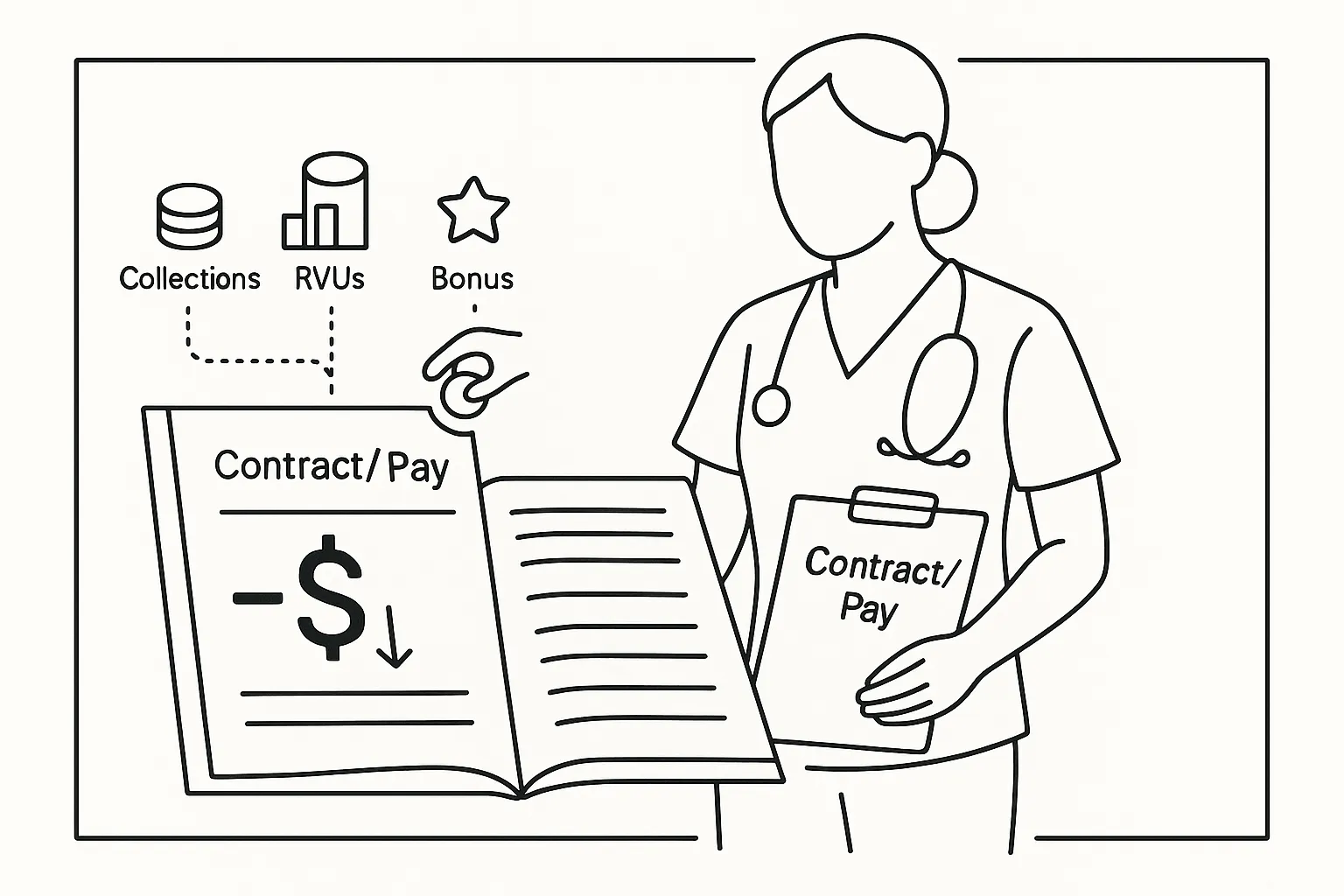
Negative accrual is not limited to one type of payment arrangement. The risk depends on how compensation is earned, when it is calculated, which inputs can change after payment, and whether the employer treats base compensation as fixed salary or an advance against expected performance.
Collections-Based and RVU Formulas
Under a collections model, an NP may receive a monthly draw and later earn a percentage of net collections attributed to the NP. If credited collections do not support the amount advanced, the reconciliation can produce a deficit. The agreement needs workable definitions for gross and net collections, payer adjustments, refunds, bad debt, billing expenses, patient attribution, and the time allowed for delayed receipts. The broader risks of collections-based NP compensation are particularly important when the employer controls billing and collection activity.
An RVU or productivity formula can create similar exposure if base pay is treated as an advance against a production threshold. The calculation may depend on the applicable RVU schedule, conversion factor, threshold, credit for shared visits, and treatment of work that does not generate billable units. Reviewing the agreement’s RVU compensation methodology can reveal whether a shortfall merely affects incentive eligibility or becomes a balance carried against future earnings.
Guarantees, True-Ups, and Bonus Recalculations
A ramp-up guarantee can protect an NP while credentialing, referrals, and patient volume develop. The same provision can create substantial liability if the agreement later compares every guaranteed payment with formula-based earnings and treats the difference as recoverable. The contract should clarify whether the guarantee is fixed compensation, a nonrecourse minimum, a draw, or an advance.
Bonus plans can also include retroactive adjustments. A preliminary incentive may be paid before quality scores, collections, coding reviews, refunds, or payer activity are final. If the employer can reverse the payment or charge an adjustment against a later period, the plan effectively contains a clawback feature. A review of the applicable NP bonus structure can determine whether the formula clearly explains when an incentive becomes final and earned.
How to Measure the Potential Financial Exposure
The most useful way to evaluate a negative accrual clause is to model it under more than one realistic scenario. Calculations can compare expected performance with a slower ramp-up, a credentialing delay, reduced scheduling capacity, a payer disruption, or an early departure. The analysis should use the contract’s actual definitions and reconciliation periods rather than relying only on a recruiter’s compensation estimate.
Consider a hypothetical arrangement in which an NP receives $7,000 per month for six months while the compensation formula credits 30% of net collections:
- During months one through three, net collections are $10,000 per month. Formula earnings are $3,000 per month, creating a $4,000 monthly difference between calculated earnings and the $7,000 payment.
- During months four through six, net collections are $15,000 per month. Formula earnings are $4,500 per month.
- Total formula earnings for the six months are $22,500, while total payments equal $42,000. The mathematical difference is $19,500.
The example establishes only how a balance might be calculated. It does not establish that the $19,500 is legally recoverable. The result depends on whether the payments were earned compensation or advances, what the contract authorizes, how the employer calculated net collections, and which federal and state laws govern the proposed recovery method.
Other questions include whether the balance expires, carries indefinitely, accrues interest, or becomes due when employment ends. An unlimited lookback period can expose an NP to revised calculations long after a compensation period closes. The agreement may also permit offsets against bonuses, expense reimbursements, paid leave, or final compensation, each of which may require a separate legal analysis.
Payroll Deductions, Worker Classification, and State Law
A contract can describe how the parties intend to handle a deficit, but it cannot automatically override wage-and-hour protections or state collection rules. The legal analysis may differ depending on whether the NP is an employee or an independent contractor, whether the payment was earned, and whether the employer proposes a payroll offset, invoice, lawsuit, or garnishment process.
Federal Wage Protections and Bona Fide Advances
For covered nonexempt employees, the Fair Labor Standards Act guidance from the U.S. Department of Labor explains that deductions or kickbacks generally cannot reduce pay below the federal minimum wage or reduce required overtime compensation. Productivity payments, bonuses, and deductions may also affect the regular-rate calculation used for overtime. The FLSA generally does not establish a collection procedure for every amount promised above its minimum-wage and overtime requirements, which leaves the agreement and applicable state law especially important.
A longstanding Department of Labor opinion addressing bona fide wage advances recognizes that a genuine advance or loan of wages may be recouped in circumstances where an ordinary deduction could not be made, although interest or administrative charges that cut into protected wages can present a different issue. Whether an NP’s payment is truly an advance rather than earned guaranteed compensation depends on the documents and facts; inserting the word “advance” into a contract does not end the analysis.
If an employer seeks to collect an alleged debt through garnishment rather than an ordinary payroll adjustment, separate federal and state restrictions may apply. A contract does not eliminate statutory limits governing the collection method.
Employee Status, 1099 Labels, and State Deduction Rules
Classification is based on the actual relationship, not merely the contract title or method of payment. The IRS classification framework considers behavioral control, financial control, and the parties’ relationship. A negative accrual provision or exposure to profit and loss does not, by itself, establish independent-contractor status. NPs evaluating these provisions should also understand the broader distinctions between W-2 employment and 1099 contracting.
State law can impose additional requirements for deductions, wage advances, commissions, final pay, and written authorization. For example, the New York Department of Labor’s wage-advance guidance describes a specific written-authorization framework and ties repayment to the authorization’s terms. Requirements differ substantially among states, so a clause permitting an offset should not be read as nationwide authority to make the deduction.
Tax consequences may also arise when an NP repays compensation reported in an earlier tax year. The contract can allocate repayment risk, but it cannot determine the tax treatment. An NP facing a significant repayment may need advice from a qualified tax professional in addition to contract counsel.
Contract Terms That Can Reduce Negative Accrual Risk
Effective drafting focuses on how the balance is created, verified, disputed, and collected. The appropriate language depends on the compensation model, but the agreement should provide enough detail for the NP to reproduce the calculation and understand when compensation becomes final.
Definitions, Reports, and Reconciliation Deadlines
- Define collections, net collections, RVUs, conversion factors, production thresholds, chargebacks, refunds, and allowable deductions.
- Explain how revenue and productivity are attributed when services involve shared visits, multiple locations, or team-based care.
- Identify when compensation reports will be delivered and when each reconciliation becomes final.
- Limit the period during which the employer may recalculate a prior compensation period.
- Provide access to supporting billing, collections, RVU, adjustment, and attribution records.
- Allow a reasonable period to question the calculation and require a written response to a documented dispute.
Incorporated compensation policies deserve the same attention as the signed agreement. If the employer can revise an external policy unilaterally, the economic terms may change without a formal contract amendment. The documents can instead identify which policy version controls and whether material changes require written agreement.
Recovery Caps, Carve-Outs, and Exit Terms
Potential protections include a cap on total recovery, limits on the amount withheld from any payment, written notice before collection, and a defined repayment schedule. The agreement may also exclude deficits caused by delayed credentialing, inadequate staffing, employer billing errors, scheduling restrictions, payer processing delays, or adjustments made after the NP loses the ability to influence the result.
Termination language determines whether a balance is forgiven, reconciled, accelerated, or invoiced after the relationship ends. It may also address final reports, pending collections, later refunds, interest, collection costs, attorney fees, and the deadline for raising a dispute. A review of the termination provisions can identify whether an apparently routine resignation triggers a separate repayment obligation.
Documents to Gather for Contract Review
Negative accrual language can be difficult to evaluate without the documents that supply the formula’s inputs. Before signing, the NP can gather the complete offer, employment or contractor agreement, compensation exhibits, bonus plans, productivity schedules, billing policies, chargeback rules, and any documents incorporated by reference. A complete nurse practitioner contract review can then assess how those materials operate together.
If a negative balance has already been asserted, useful records include pay statements, compensation reports, RVU or collections data, attribution records, written explanations of the guarantee, credentialing dates, scheduling records, prior reconciliation notices, and correspondence about billing adjustments. The amount claimed by the employer can then be compared with the contract’s definitions, timelines, and recovery provisions.
- Is the guarantee expressly fixed, nonrecourse, or recoverable?
- Can the NP reproduce the calculation using the reports provided?
- Does the employer have unlimited authority to revise prior periods?
- What happens to the balance when employment ends?
- Does the contract authorize deductions, repayment, or both?
- Which state’s law governs the employment relationship and proposed recovery method?
Frequently Asked Questions
Is negative accrual the same as a compensation clawback?
Not necessarily. Negative accrual describes a deficit recorded under a compensation formula. A clawback is a contractual or legal mechanism used to recover compensation already paid. An agreement may use both concepts by recording a negative balance and then authorizing an offset, invoice, or repayment demand.
Can an employer deduct a negative balance from an NP’s paycheck?
Not automatically. The answer depends on the contract, whether the NP is an employee or independent contractor, the nature of the original payment, federal wage protections, and applicable state law. Written contractual authorization may not be sufficient if the proposed deduction conflicts with wage-payment or overtime requirements.
Does a negative balance disappear when NP employment ends?
It depends on the agreement. Some contracts forgive the balance, while others authorize a final reconciliation, accelerate repayment, reduce unpaid incentive compensation, or permit a post-termination claim. The termination, final-pay, and repayment provisions must be analyzed together.
What records can help verify a negative accrual calculation?
Relevant records may include compensation reports, RVU or collections data, attribution records, payer adjustments, refunds, chargebacks, pay statements, credentialing dates, and the employer’s reconciliation worksheet. The agreement can also establish when those records must be provided and how long the NP has to dispute them.
Can negative accrual language be revised before signing?
Proposed revisions may address clearer definitions, limited lookback periods, recovery caps, exclusions for employer-controlled problems, written notice, audit rights, and a structured dispute process. Whether an employer accepts a revision depends on the circumstances and the overall compensation arrangement.
Why can collections-based pay show a deficit when the NP is busy?
Patient volume does not always translate immediately into credited collections. Billing delays, payer denials, credentialing, coding, refunds, attribution rules, and employer-controlled collection practices can reduce or delay the amount credited to the NP under the formula.
Have a Negative Accrual Provision in Your NP Contract?
Chelle Law can review the compensation formula, reconciliation process, supporting policies, repayment language, and termination terms so you can understand the potential financial exposure.
Contact Chelle Law