
Nurse practitioner compensation often combines a guaranteed salary or hourly rate with one or more bonus opportunities. Those incentives may reward productivity, collections, patient encounters, quality measures, retention, or other defined results. Although a bonus can add meaningful income, the stated award or percentage does not reveal whether the compensation is realistically attainable, when it becomes earned, or what may cause it to be reduced or forfeited.
The financial consequences depend on details scattered throughout the employment agreement and any incorporated compensation plan. Thresholds, attribution rules, billing delays, employer discretion, reconciliation rights, termination provisions, and repayment obligations can all affect the final amount. A formula that appears favorable may provide limited value if the employer controls the underlying data, can revise the methodology during a measurement period, or requires continued employment through a much later payout date.
This guide explains the principal nurse practitioner bonus structures, how common formulas operate, and which contract terms deserve closer analysis. It also addresses current considerations involving 2026 RVU sources, supplemental-wage withholding, independent-contractor classification, referral-based compensation, and the interaction between bonus provisions and post-employment restrictions.
Key Takeaways About Nurse Practitioner Bonuses
- A productivity formula needs more than a percentage or conversion factor. It also needs a defined threshold, measurement period, attribution method, data source, payout schedule, and reconciliation process.
- Collections, charges, encounters, and RVUs measure different activity and allocate billing and operational risk differently between the nurse practitioner and employer.
- Quality incentives are easier to evaluate when the agreement identifies the metrics, target levels, attribution rules, and consequences of changes outside the clinician’s control.
- Signing, retention, and relocation awards may become repayable after a resignation or early termination, even when the money has already been taxed.
- Bonus terms must be read together with termination, amendment, restrictive-covenant, tax, classification, and repayment provisions.
Types of Bonuses in Nurse Practitioner Agreements

Productivity, Collections, and RVU Incentives
Productivity compensation may be based on patient encounters, billed charges, net collections, work relative value units, or revenue above a stated threshold. Each method rewards a different result. Encounter-based pay emphasizes volume, collections formulas depend on cash received, and RVU plans assign standardized values to designated services before applying a contractual conversion factor.
These arrangements can transfer operational risk to the nurse practitioner. Patient scheduling, payer denials, coding practices, credentialing delays, staffing shortages, billing performance, and the availability of support personnel may affect results even when the clinician performs the expected work. A useful formula identifies which services receive credit, when credit is posted, which exclusions apply, and whether a later reconciliation can reverse a prior payment. The broader guide to NP productivity and quality incentives examines these variables in greater detail.
Quality and Patient-Experience Bonuses
Quality incentives may use patient-satisfaction scores, preventive-care measures, readmission rates, documentation completion, care coordination, or other value-based metrics. The target may apply to the individual clinician, a department, or the organization as a whole. Group-based measures can make part of an NP’s compensation depend on results the individual cannot directly control.
The written plan needs enough detail to show where the data comes from, how patients are attributed, when performance is measured, and what happens if the employer changes the metric. It is also important to determine whether leave, reduced schedules, reassignment, or a change in clinical duties results in a prorated target rather than automatic ineligibility.
Signing, Retention, Relocation, and Referral Awards
Signing, retention, and relocation payments are usually discrete awards rather than recurring productivity compensation. They often include a service commitment and a repayment obligation if employment ends before a specified date. The agreement may require full repayment or reduce the balance over time, and the trigger may differ depending on whether the NP resigns, is terminated without cause, loses required credentials, or cannot begin work as scheduled.
Repayment language deserves careful attention because the amount demanded may be based on the gross award even though the clinician received a smaller net payment after withholding. Monthly proration, exceptions for termination without cause, and a defined repayment period can materially change the exposure. See the focused resource on NP signing bonus repayment terms for additional considerations.
A referral bonus raises separate compliance concerns when payment is connected to directing patients, items, or services reimbursable by a federal healthcare program. The federal Anti-Kickback Statute generally restricts remuneration intended to induce or reward covered referrals, subject to statutory and regulatory protections that depend on the facts. A provision is not automatically permissible merely because it appears in an employment agreement or identifies the recipient as an employee.
How Bonus Formulas Convert Performance Into Pay
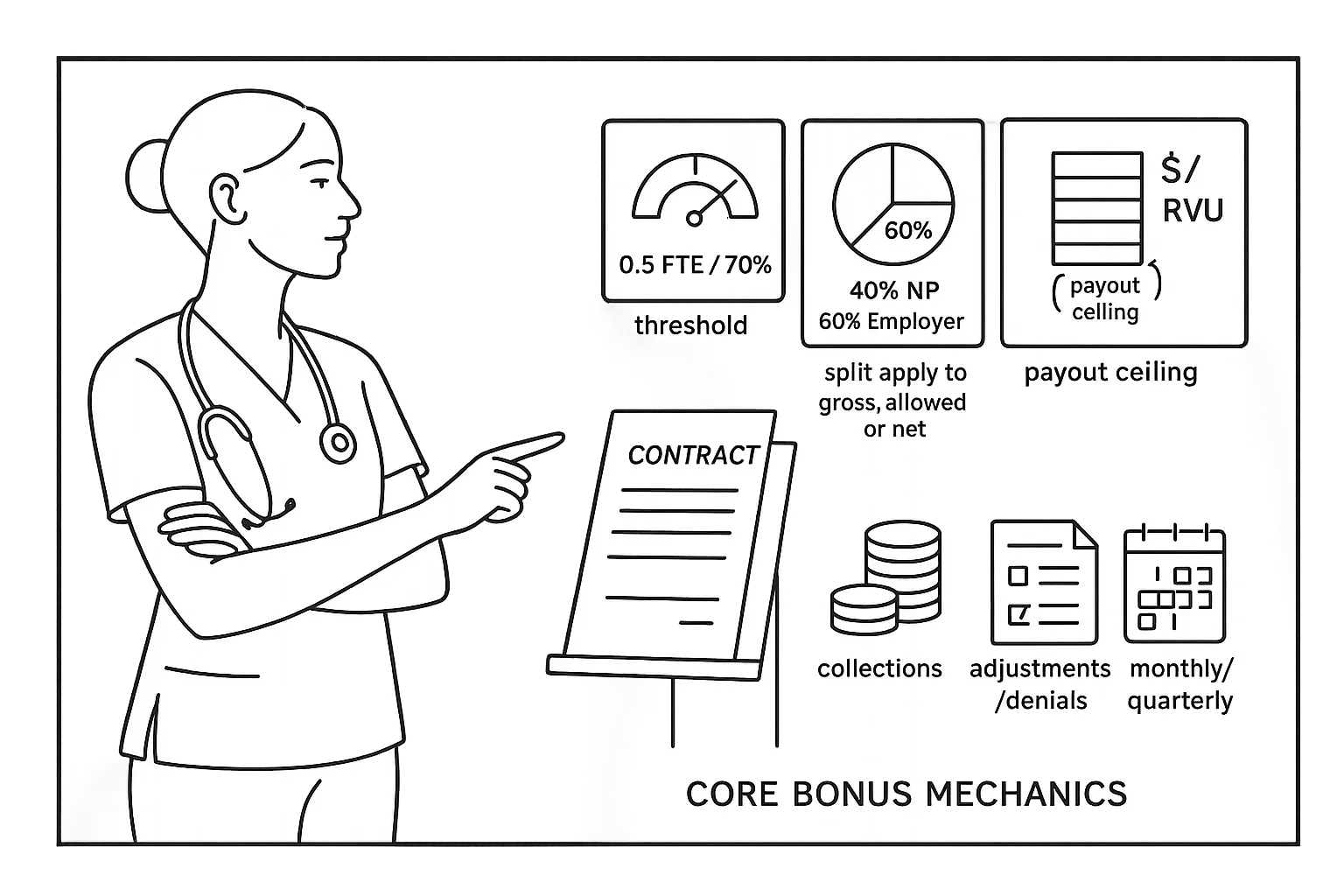
A common plan guarantees base compensation and pays an incentive only after the NP crosses a productivity threshold. For example, the clinician might receive a percentage of collections above a target or a fixed dollar amount for each RVU beyond a stated benchmark. The economic result depends on whether the threshold resets monthly, quarterly, or annually and whether a deficit from one period carries forward as negative accrual.
The threshold must be considered in light of specialty, schedule, administrative duties, call obligations, expected patient volume, and the time needed to build a panel. A target designed for an established clinician may produce little realistic upside for a new graduate or an NP entering a newly created position. Comparing the arrangement with other nurse practitioner compensation models can help distinguish a genuine incentive from compensation that is largely theoretical.
Collections-based plans require precise definitions. Billed charges, allowed amounts, and cash actually received are not interchangeable. A net-collections formula can make compensation dependent on payer mix, write-off policies, billing quality, refund activity, and collection timing. The plan needs to identify permitted deductions, reporting frequency, treatment of denied claims, and whether money collected after termination remains attributable to the NP. These issues are explored further in the guide to collections-based NP compensation.
RVU arrangements require equally careful definitions. The contract should identify the RVU type, applicable year, valuation source, conversion factor, threshold, cap, and treatment of split or shared services. The Centers for Medicare & Medicaid Services publishes 2026 Physician Fee Schedule relative-value files, but CMS values do not automatically control every employment formula. An employer may use Medicare RVUs, a commercial-payer methodology, or an internally created production metric. A review of RVU compensation for nurse practitioners can help identify inconsistencies between the stated benchmark and conversion factor.
Contract Terms That Can Reduce, Delay, or Eliminate a Bonus
The formula is only one part of the analysis. Eligibility, amendment, reconciliation, and termination provisions determine whether calculated compensation is actually paid. Some agreements require the NP to remain actively employed on the payout date, even when the relevant work was completed months earlier. Others characterize the bonus as discretionary or permit the employer to revise benchmarks, attribution rules, or conversion factors during an active measurement period.
Clawback language may authorize recovery for billing errors, payer denials, refunds, or a later accounting reconciliation. The agreement needs to distinguish an advance against future earnings from compensation that becomes fully earned after stated conditions are satisfied. It should also establish a reasonable deadline for final calculations rather than leaving the NP exposed to an open-ended repayment demand.
- Unilateral authority to change the formula, threshold, benchmark, conversion factor, or attribution rules
- Retroactive offsets that are not limited to documented billing or calculation errors
- Forfeiture based solely on the NP not being employed on a later payment date
- Undefined quality standards or data controlled exclusively by the employer
- Negative accrual that carries a deficit into a later month, quarter, or contract year
- No right to receive production reports or question an apparent calculation error
- No deadline for paying the final bonus or crediting post-termination collections
Bonus treatment at separation must be reviewed with notice requirements, repayment provisions, and the broader terms governing termination of a nurse practitioner agreement. State wage-payment law may also affect when compensation is considered earned or whether forfeiture language is enforceable. Post-employment restrictions require their own state-specific analysis; the FTC reports that its federal Noncompete Rule is not currently in effect or enforceable, so the agreement cannot be evaluated under an assumed uniform federal rule.
Tax, Classification, and Real-World Compensation Issues
Employee Bonuses and Independent Contractor Payments
Employee bonuses are taxable compensation and are generally treated as supplemental wages for federal payroll-withholding purposes. Under IRS Publication 15 for 2026, an employer may generally use an authorized flat-rate or aggregate method for separately identified supplemental wages within the applicable limit. Payroll withholding is only a prepayment toward the employee’s federal income-tax liability; it does not determine the final amount owed when the employee files a return.
A contract’s use of the term “independent contractor” or issuance of Form 1099 does not conclusively establish worker status. The IRS explains that classification depends on the factual right to control the work. A properly classified independent contractor generally reports business income, may owe self-employment tax, and may need to make estimated tax payments because ordinary employee withholding does not apply. An independent contractor agreement review can also assess payment timing, offsets, documentation duties, access to billing data, insurance responsibilities, and other financial provisions.
Benefits and other forms of compensation may be affected by how the bonus is defined. Retirement contributions, paid-time-off calculations, disability benefits, and loan-repayment programs may include or exclude incentive compensation under their governing documents. A headline bonus amount therefore needs to be assessed as part of the full compensation package rather than as a stand-alone payment.
A new graduate with a signing award and an immediate productivity threshold may face two related risks: limited bonus potential while building a patient panel and repayment exposure if the position ends early. By contrast, an experienced NP entering a hospital model may receive a blended incentive based on individual RVUs and departmental quality measures. Shared visits, administrative time, call coverage, pooled performance, and organizational metrics can materially change the expected payout in either situation.
Telehealth and contractor arrangements may pay per encounter, completed chart, or collected claim. Credentialing problems, rejected claims, documentation standards, delayed collections, and retrospective offsets can move substantial payment risk to the clinician. The contract needs to show when the payment is earned, which party controls billing, what records support the calculation, and whether the NP receives credit for services collected after the relationship ends.
How to Evaluate an NP Bonus Before Signing
A useful review begins by reconstructing the formula from the written documents. The employment agreement, offer letter, compensation exhibit, policy manual, and referenced bonus plan may not use identical terms. If the employer can amend an incorporated document, the agreement needs to clarify which document controls, how notice is provided, and whether a change can affect work already performed.
- Identify the metric. Determine whether the formula uses encounters, charges, collections, RVUs, quality scores, or a combination of measures.
- Define the threshold and period. Confirm when the target resets and whether deficits carry forward.
- Trace the data. Identify the report, billing system, RVU source, quality dataset, and attribution rules used for the calculation.
- Test realistic scenarios. Estimate results during ramp-up, leave, schedule reductions, reassignment, credentialing delays, and lower-than-expected patient volume.
- Review payment and reconciliation. Determine when the bonus becomes earned, when it is paid, and how long the employer may make adjustments.
- Analyze separation consequences. Check forfeiture, post-termination collections, clawbacks, repayment duties, and continued-employment conditions.
- Read related provisions together. Consider amendment rights, duties, call, restrictive covenants, malpractice coverage, taxes, benefits, and termination.
Regular reports and access to supporting data make incentive compensation more verifiable. A defined process for questioning errors is preferable to language giving one party final and unreviewable discretion. Depending on the position, provisions that may warrant clarification include prorated targets, ramp-up protection, limits on retroactive changes, treatment of leave, post-termination collections, and a deadline for final reconciliation. Chelle Law’s NP compensation and productivity review evaluates how these terms work together and where the agreement places financial risk.
Frequently Asked Questions
What should a nurse practitioner bonus formula define?
The formula should define the performance metric, threshold, conversion factor or percentage, measurement period, payout date, exclusions, and reconciliation process. It should also identify the reports used to verify the calculation and explain what happens to earned compensation when employment ends.
Can an employer change an NP bonus plan after the contract is signed?
That depends on the employment agreement and any incorporated compensation plan. Language granting unilateral amendment authority can make future pay uncertain, especially if a revision may apply during an active measurement period. The documents need to clarify how notice is provided, when a change takes effect, and whether completed work remains governed by the prior formula.
What happens to an earned bonus when an NP leaves the employer?
The contract may call for payment, proration, reconciliation, or forfeiture. Important questions include whether the NP must remain employed on the payout date, whether collections received after termination still count, and when the employer must complete the final calculation. Applicable state law may also affect earned-wage and forfeiture issues.
How does an RVU bonus threshold work?
An RVU threshold is the production level the NP generally must reach before additional compensation begins. The plan needs to identify the RVU type and year, valuation source, measurement period, conversion factor, payout cap, and treatment of deficits. It should also clarify whether the employer uses CMS values or a separate internal methodology.
Are signing bonus repayment obligations negotiable?
They may be negotiable depending on the employer and circumstances. Potential revisions include monthly proration, a shorter repayment period, exceptions for termination without cause, and repayment based on the amount actually received rather than the gross award. The provision also needs to explain when repayment is due.
How should a 1099 nurse practitioner evaluate a bonus?
A 1099 NP should examine the payment trigger, collection risk, documentation requirements, offsets, reconciliation rights, and access to billing data. Worker status depends on the actual relationship rather than the contract label alone. A properly classified independent contractor may also need to account for self-employment tax, estimated tax payments, expenses, benefits, and insurance not provided by the contracting entity.
Review Your NP Bonus Terms Before You Sign
Chelle Law reviews productivity formulas, quality incentives, payout conditions, clawbacks, and termination-related bonus risks so you can understand how the compensation provisions may operate.
Contact Chelle LawExplore Nurse Practitioner Contract Guidance
Find attorney review services, practical contract resources, and state-focused guidance for nurse practitioners.