
Call coverage can extend a nurse practitioner’s responsibilities well beyond scheduled clinic hours. Depending on the agreement, an NP may need to remain available by phone, respond to portal messages, provide remote triage, travel to a facility, or manage patients across several locations. A clause that refers only to “call as assigned” leaves important questions unanswered about frequency, response times, clinical scope, backup, and the difference between standby availability and active work.
Those details can materially affect compensation, productivity, professional liability, scheduling, and career mobility. Call encounters may or may not generate separate pay, RVUs, collections credit, or credit toward a bonus threshold. Remote coverage can also raise patient-location, licensure, privacy, billing, and malpractice issues, while an expanding call schedule may interfere with outside work, family obligations, or the NP’s ability to meet ordinary productivity expectations.
Chelle Law reviews how call obligations fit with the entire employment or independent contractor agreement. That analysis includes the assignment process, covered sites and patients, compensation formula, supervision or collaboration terms, insurance coverage, incorporated policies, termination rights, repayment provisions, and post-employment restrictions. Reviewing these provisions together helps reveal risks that broad on-call language may conceal.
Key Call Coverage Issues to Identify Before Signing
- The agreement should identify the call schedule, response window, covered patients and locations, required services, and circumstances requiring an in-person response.
- Call frequency, holiday assignments, schedule notice, shift trades, backup coverage, and limits on changes can determine whether the obligation remains manageable.
- Compensation may take the form of a stipend, hourly pay, per-encounter payment, RVU credit, collections credit, or compensation already included in salary.
- Remote care may involve cross-state licensure, patient-location verification, privacy, consent, payer, documentation, and professional-liability requirements.
- Malpractice coverage, applicable supervision or collaboration requirements, escalation resources, termination rights, repayment obligations, and restrictive covenants must be evaluated together with the call clause.
Define the Actual Scope of the Call Obligation
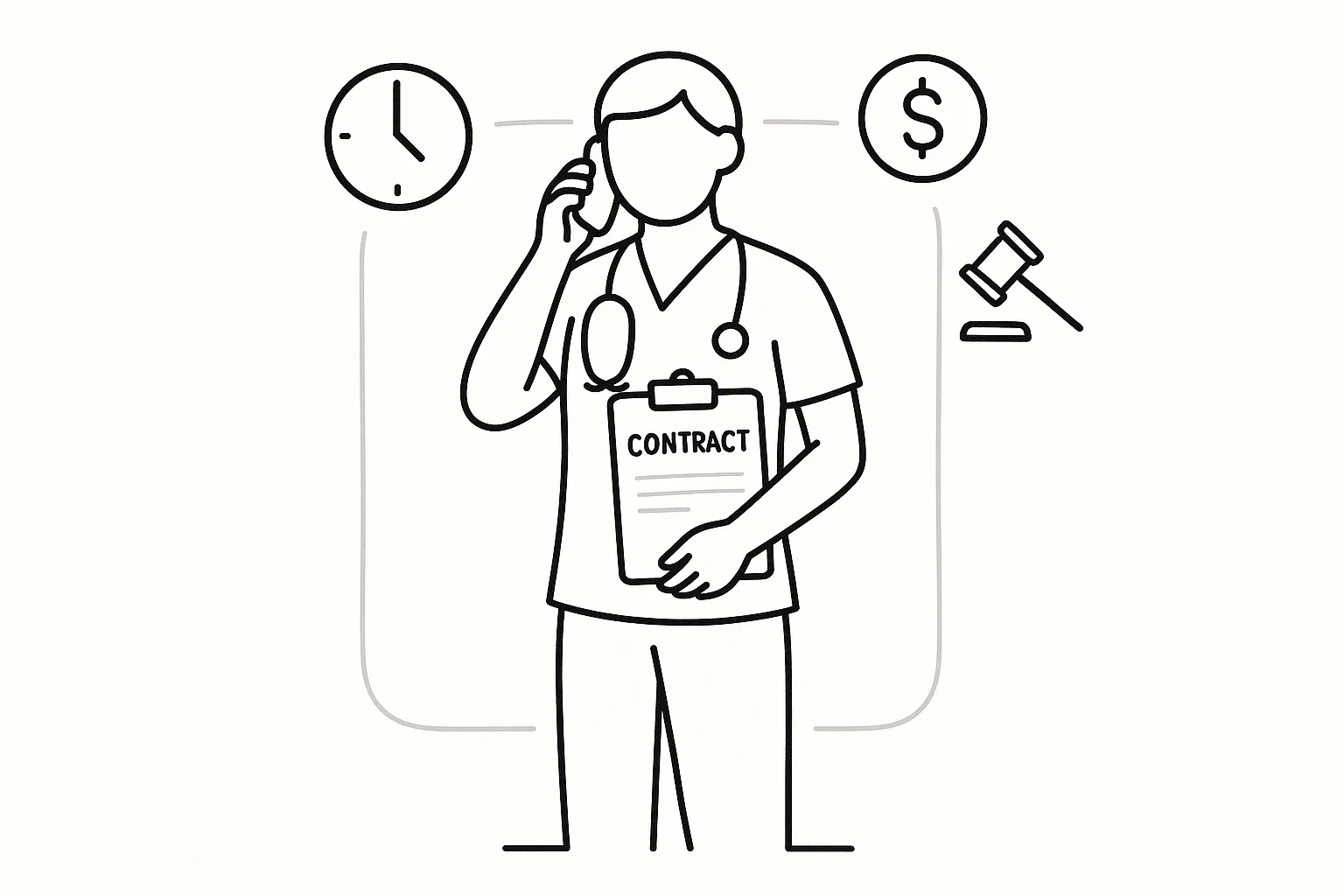
A useful call provision explains when the NP must be available, who may contact the NP, which patients or service lines are covered, and what clinical services may be required. It can also distinguish telephone advice from portal messaging, prescription management, video visits, admissions, rounds, emergency evaluations, and in-person returns. Without that detail, the practical burden may be much broader than the phrase “on call” suggests.
Geographic scope matters as much as clinical scope. The agreement may assign coverage to one facility, every location operated by the employer, future sites, or an entire service area. Contract analysis can identify whether added facilities require the NP’s consent, trigger travel reimbursement or additional compensation, and fall within the NP’s credentialing and professional-liability coverage.
The call clause should also be compared with job descriptions, schedules, handbooks, compensation plans, and clinical policies incorporated by reference. An agreement may appear specific while allowing a separate policy to change the rotation, response time, documentation process, or covered locations. The review therefore needs to determine which document controls if the terms conflict and whether the employer can revise incorporated policies unilaterally.
Common Call Models and Their Practical Differences
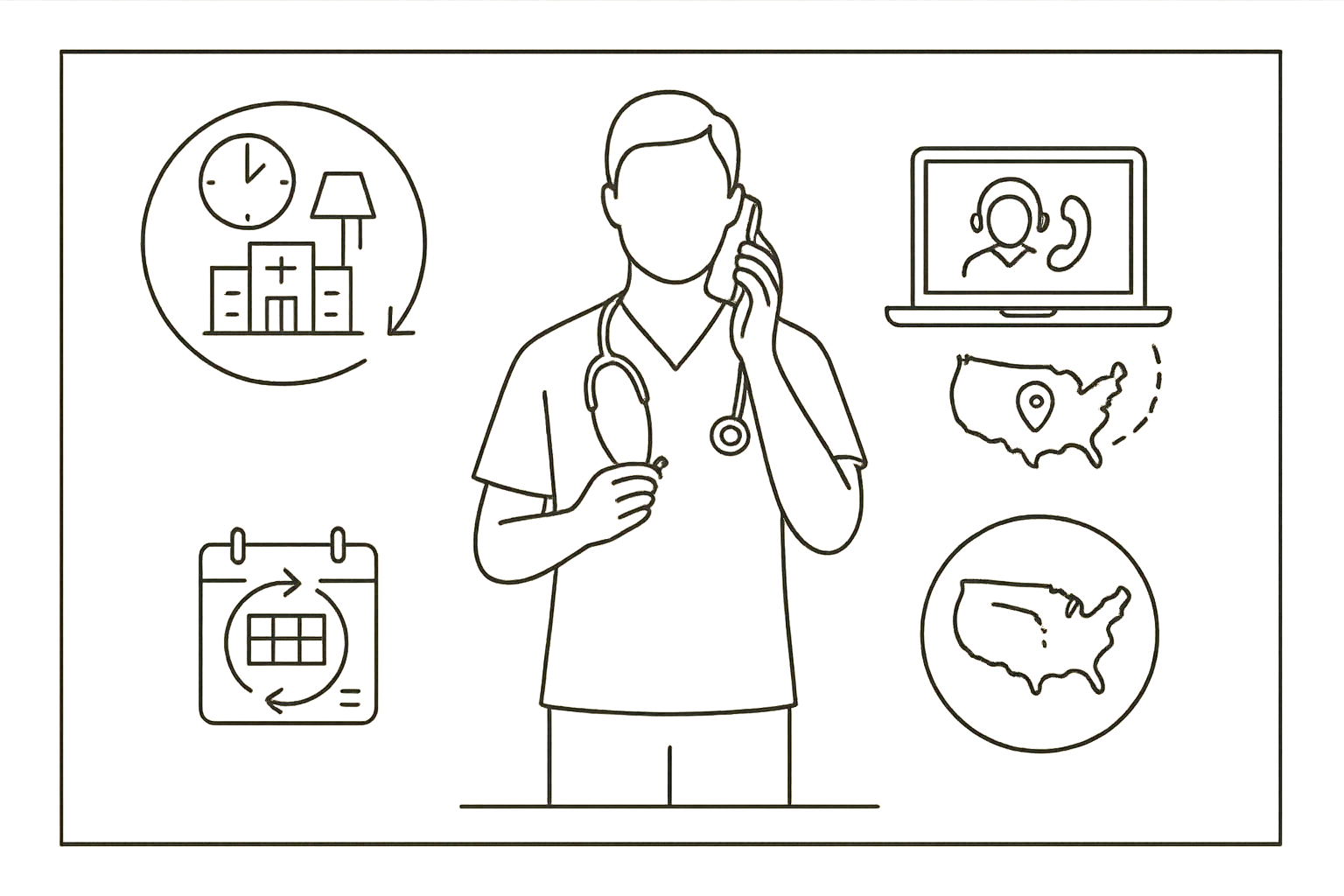
Home Call and In-House Coverage
Home call usually allows the NP to remain away from the facility while staying reachable and prepared to respond. In-house call requires physical presence at the workplace during the assigned period. The label is not controlling, however; frequent interruptions, short response windows, travel restrictions, and repeated facility returns can make home call function much like an additional shift.
The agreement can distinguish standby time from time spent answering calls, reviewing records, documenting care, traveling, or treating patients. It should also clarify whether the NP may trade shifts, use another qualified clinician for coverage, consume alcohol, travel outside a defined radius, or engage in other work while available.
Rotating Pools, Fixed Shifts, and Holiday Assignments
A rotating pool may divide call among clinicians weekly, monthly, or according to another recurring schedule. A fixed-shift model assigns defined evenings, nights, weekends, or holidays. Either approach can work, but the agreement needs a measurable assignment method so that an “equal rotation” does not become unpredictable when staffing changes.
Important details include the expected number of shifts, how far in advance schedules are posted, who covers vacancies, and whether the NP’s burden increases when colleagues leave. Holiday frequency, leave coverage, reduced schedules, and changes between full-time and part-time status also deserve attention. A percentage-based rotation can produce a different commitment from a fixed maximum number of shifts.
Remote Triage and Telehealth Call
Remote call may involve telephone triage, portal messages, prescription requests, follow-up care, remote monitoring, or video encounters. The agreement needs to identify which activities count as call work, how they are documented, and whether they generate separate pay or productivity credit. It should also address access to the electronic medical record, secure communications, support staff, and the handoff of unresolved matters.
When a patient is located in another state, the NP may need to evaluate the destination state’s licensure or registration pathway rather than relying only on the NP’s location. Federal cross-state telehealth guidance emphasizes confirming the patient’s location and the applicable licensure framework. The related telehealth agreement terms also warrant separate review because call language alone may not address privacy, consent, prescribing, documentation, payer, and insurance requirements.
Scheduling, Call Pay, and Productivity Credit
A workable schedule provision identifies call frequency, response windows, required locations, assignment procedures, and the notice provided before a change. It may also address emergencies, staffing shortages, new facilities, shift trades, and reassignment. Language giving the employer unlimited discretion can materially expand the commitment after the NP accepts the position, particularly when no cap, notice period, or additional-compensation mechanism applies.
Call compensation may consist of a flat stipend, hourly pay, a per-shift or per-encounter amount, RVU credit, a percentage of collections, or compensation already included in salary. Each method allocates risk differently. A stipend may undervalue unusually busy nights, while RVU and collections models depend on coding, billing, attribution, payment timing, and reconciliation. A careful review of nurse practitioner compensation models can help determine whether the formula matches the work required.
Federal wage-and-hour law does not automatically treat every period of on-call availability as compensable time. Under 29 C.F.R. § 785.17, on-call restrictions that prevent an employee from using the time effectively for personal purposes may make the time compensable, while ordinary reachability away from the employer’s premises may not. Exempt status, state wage law, actual duties, travel, response time, and other facts can change the analysis. The contract should separately identify how active call work is recorded and paid rather than assuming that standby availability and completed clinical work receive identical treatment.
Productivity terms need the same level of precision. If call reduces clinic availability or produces encounters excluded from the bonus calculation, an NP may perform required work without moving closer to the stated target. The documents can clarify whether call encounters generate RVUs or collections credit, who controls the underlying data, when credit appears, and whether a deficit can create negative accrual. A focused compensation and productivity review can trace those rules through the full formula.
Clinical Authority, Billing, and Professional Liability
Call assignments must remain consistent with the NP’s license, state scope-of-practice rules, prescribing authority, credentials, privileges, and authorized clinical role. Supervision or collaboration requirements are not uniform across states or services. The need for physician involvement may depend on state law, the service provided, the payer, facility policy, and whether the encounter is billed as the NP’s own professional service or incident to another practitioner.
CMS guidance for advanced practice registered nurses distinguishes independently billable NP services from arrangements subject to other billing conditions. Medicare incident-to rules apply only to qualifying services and carry specific treatment-plan, supervision, billing, and state-law requirements. Physician backup language therefore should not be treated as proof that every call encounter must be supervised or can be billed under another practitioner.
Virtual Supervision Does Not Replace State Practice Requirements
The CY 2026 Medicare Physician Fee Schedule made real-time audio-video virtual direct supervision permanently available for specified services, including applicable incident-to services. That Medicare billing policy does not authorize audio-only direct supervision, eliminate service-specific conditions, or override state scope, collaboration, supervision, credentialing, and facility requirements. Contract language should identify the actual escalation resource and the technology available during call instead of relying on a general reference to remote supervision.
Operational support also affects patient care and liability. Relevant provisions may address who receives the initial call, required escalation steps, backup when the designated clinician is unavailable, secure messaging, documentation deadlines, follow-up responsibility, and access to ancillary staff. Separate supervision and collaboration documents must be consistent with the employment agreement and the actual call arrangement.
Professional-liability coverage needs to include the services, facilities, and jurisdictions within the call obligation. The NP should determine whether the policy is occurrence or claims-made, whether telehealth and cross-state services are covered, and who bears the cost of tail insurance when required. Reviewing malpractice insurance terms can reveal exclusions, policy limits, consent-to-settle language, and post-employment costs that a general benefits summary does not explain.
How Call Duties Interact With the Rest of the Contract
Call cannot be evaluated in isolation from termination, repayment, restrictive-covenant, and amendment provisions. If the employer materially increases the call burden, the agreement may or may not allow the NP to leave without completing a lengthy notice period or repaying a signing bonus, relocation allowance, or other benefit. The documents should identify what triggers repayment, whether the amount is prorated, and whether an employer-initiated schedule change affects those obligations.
Post-employment restrictions may also use locations where the NP worked, provided services, or covered patients as the basis for a geographic restriction. A broad call assignment spanning several sites could therefore affect the practical reach of a non-compete or nonsolicitation clause. The wording and applicable state law control, making it important to compare the call provision with the agreement’s restrictive covenant terms.
Classification presents another layer of risk. Calling an NP an independent contractor does not, by itself, resolve the legal classification analysis, particularly when the organization controls call assignments, schedules, locations, methods, and working conditions. The economic effect also differs because a contractor may be responsible for taxes, benefits, expenses, and insurance that an employer would otherwise address. Comparing W-2 and 1099 arrangements can place the call clause in its broader contractual context.
Potential warning signs include an undefined on-call obligation, unspecified facilities, no meaningful schedule notice, unclear compensation, productivity targets that disregard after-hours encounters, and claims-made insurance without an identified tail obligation. Other concerns include unilateral amendment rights, no identified backup, inconsistent supervision documents, broad repayment triggers, and restrictions tied to every call location. Attorney review can trace those issues across the agreement and identify provisions that may warrant clarification or revision before signing.
Frequently Asked Questions
What details belong in a nurse practitioner call coverage clause?
The clause should identify the schedule, frequency, response time, covered patients and locations, required clinical services, circumstances requiring an in-person return, available backup, documentation duties, and compensation method. It should also explain how assignments may change and whether separate policies control any part of the obligation.
Is home call the same as in-house call?
No. Home call generally allows the NP to remain away from the facility while staying reachable, whereas in-house call requires physical presence. Short response windows, frequent calls, travel restrictions, and repeated facility returns can nevertheless make home call nearly as demanding as an in-house shift.
Is all nurse practitioner on-call time compensable?
Not automatically. Federal treatment depends partly on whether the restrictions allow the employee to use the time effectively for personal purposes, and state wage laws or exempt status may alter the analysis. Time spent responding, documenting, traveling, or treating patients may also be treated differently from merely remaining reachable.
How can a nurse practitioner be paid for call coverage?
Call compensation may be included in salary or paid through a stipend, hourly rate, per-shift amount, per-encounter payment, RVU credit, or collections-based formula. The agreement should explain how the amount is calculated, when it is paid, whether call is additional to base compensation, and how canceled or traded shifts are handled.
What additional requirements can apply to cross-state remote call?
The NP may need to verify the patient’s location and the destination state’s licensure, registration, prescribing, consent, and practice requirements. The arrangement should also address secure communications, documentation, payer rules, and whether professional-liability coverage applies to telehealth services in every relevant jurisdiction.
Can an employer change an NP’s call schedule after signing?
The answer depends on the agreement, incorporated policies, and applicable law. Some contracts reserve operational flexibility, while others establish limits, notice requirements, consent provisions, or additional compensation for increased duties. The amendment, scheduling, termination, and repayment sections must be read together.
Have an Attorney Review Your NP Call Requirements
Chelle Law can analyze how call duties affect scheduling, compensation, productivity, malpractice coverage, supervision, termination, and future practice options before you sign.
Contact Chelle LawExplore Nurse Practitioner Contract Guidance
Review legal services, practical contract resources, and state-focused information for nurse practitioners.