
Nurse practitioner compensation is rarely limited to a single annual salary. An employment agreement may combine guaranteed pay with collections, work relative value units (wRVUs), productivity thresholds, quality incentives, signing payments, benefits, expense reimbursements, and malpractice coverage. Each component can operate under a different formula and payment schedule, making the overall economic value of an offer more complicated than the headline number suggests.
The details matter because an attractive compensation figure can be reduced by negative accrual, billing delays, chargebacks, repayment obligations, limited benefits, or an employer’s ability to revise a formula. Termination language may also determine whether the nurse practitioner receives an earned bonus, trailing collections, or a final productivity payment after employment ends. Insurance obligations and restrictive covenants can create additional costs or limit future opportunities.
This guide explains the principal NP compensation models and the contract provisions that control how compensation is calculated, reported, paid, and reconciled. Chelle Law reviews these terms together so nurse practitioners can evaluate income stability, potential upside, financial exposure, and the practical assumptions behind an offer before signing.
Key Takeaways
- A compensation package may include salary, productivity pay, bonuses, benefits, reimbursements, insurance, and repayment obligations. The provisions must be evaluated together.
- Definitions such as “net collections,” “attributable collections,” and “credited wRVUs” can materially change the amount an NP earns.
- Measurement periods, reconciliation provisions, negative accrual, and chargeback windows can shift financial risk to the nurse practitioner.
- Productivity models require reliable reports, clear attribution rules, and a reasonable process for questioning calculation errors.
- Termination, malpractice coverage, repayment provisions, and restrictive covenants can alter the offer’s value even when the stated compensation is competitive.
Read the Entire Compensation Package, Not Just the Salary
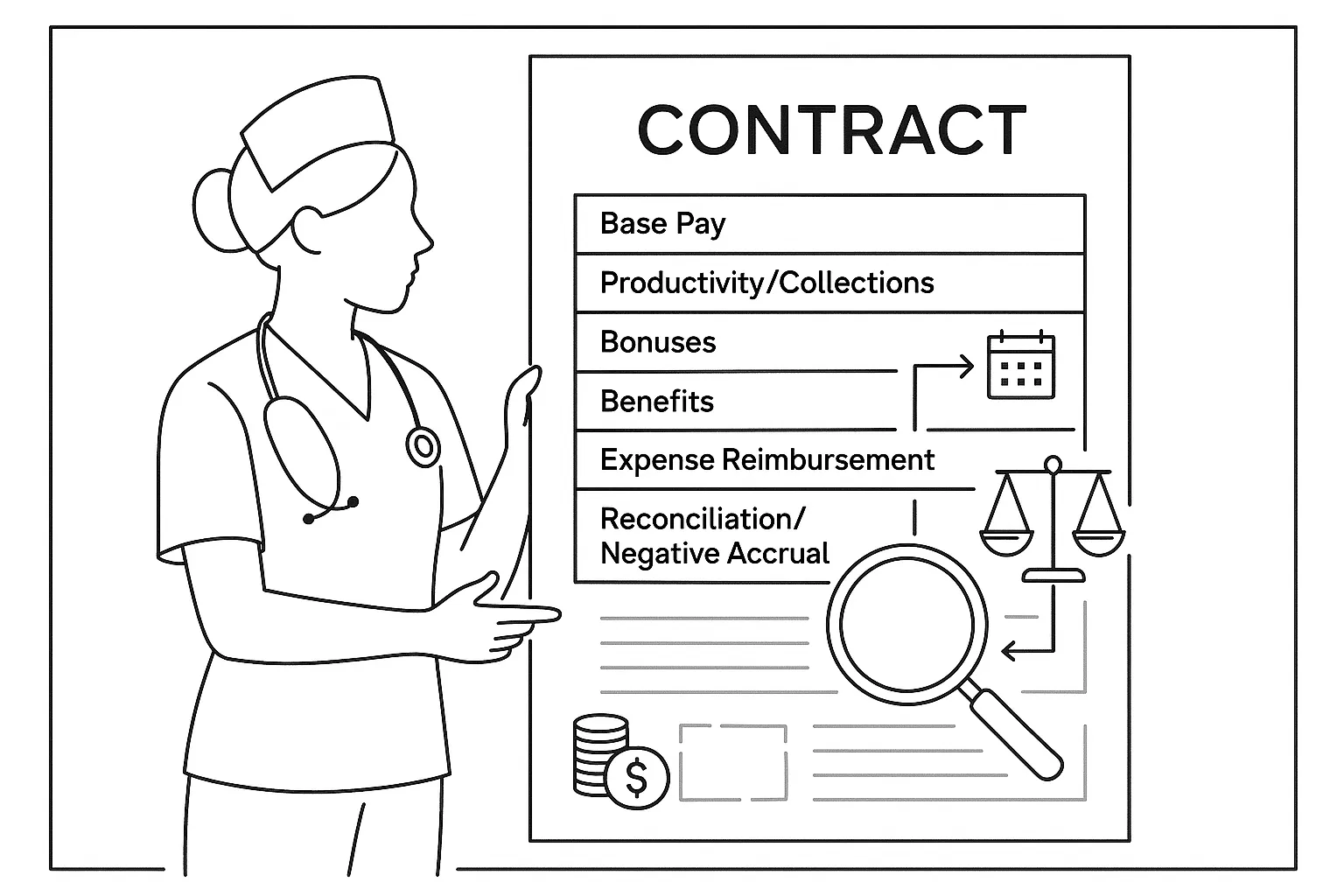
An NP agreement may divide compensation among several provisions rather than presenting the complete package in one section. Base pay may appear in the agreement, while bonus criteria, benefits, expense policies, and productivity schedules are contained in exhibits, handbooks, or separate plans. Contract analysis must therefore account for incorporated documents and determine whether the employer may change them without the NP’s consent.
Core financial mechanics include the measurement period, the calculation basis, the payment date, and the reconciliation process. The agreement may measure performance monthly but reconcile annually, creating a substantial delay between the work and the corresponding payment. It may also permit the employer to carry a shortfall forward, recover an alleged overpayment, or deduct payer recoupments months after compensation was initially credited.
- Calculation basis: Determine whether compensation depends on billed charges, allowed amounts, collected revenue, net collections, credited wRVUs, or another metric.
- Measurement and reconciliation: Identify the period used to measure performance and when the employer finalizes the calculation.
- Reporting access: Confirm whether the NP receives the billing, coding, collections, or productivity reports used to calculate pay.
- Employer-controlled variables: Evaluate how scheduling, staffing, credentialing, payer enrollment, and coding decisions affect the formula.
- Post-employment payments: Determine how the agreement treats earned bonuses, final productivity pay, and collections received after departure.
Compensation data can provide useful context, but it does not establish the value of a particular contract. The U.S. Bureau of Labor Statistics reports a May 2025 median annual wage of $132,300 for nurse practitioners, while the AANP’s 2024 Nurse Practitioner Compensation Report addresses salary, total compensation, call, and benefits. These figures are reference points rather than universal market rates because specialty, geography, schedule, clinical setting, call responsibilities, benefits, and incentive design all affect compensation.
Compare the Main Nurse Practitioner Compensation Models
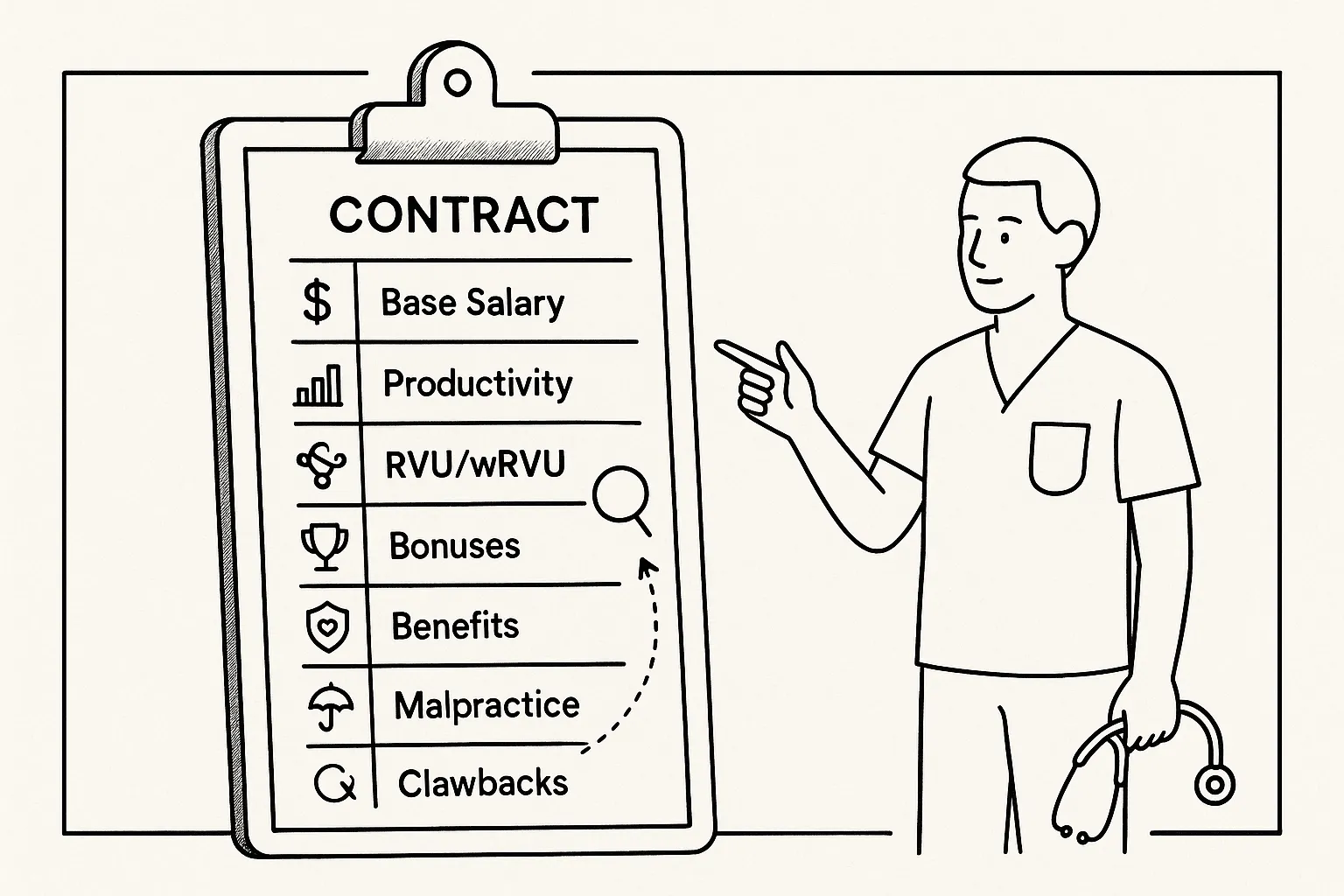
Guaranteed Salary and Base-Plus-Productivity Pay
A fixed salary generally offers the greatest income predictability, but the word “salary” does not necessarily mean the amount is fully guaranteed. Some agreements characterize the base as an advance against future productivity, permit reductions for missed shifts, or allow a productivity deficit to become negative accrual. Those provisions can make the stated salary conditional or recoverable.
A base-plus-productivity model combines a salary with additional compensation after the NP exceeds a threshold. For example, an agreement might provide a $95,000 annual base and pay 30% of net collections above $300,000. The formula’s value depends on the definition of net collections, the expenses or adjustments deducted from revenue, the crediting rules, and the timing of the calculation.
The review should determine whether the threshold is realistic for the anticipated schedule and patient volume. It should also examine how leave, credentialing delays, employer-controlled scheduling, call coverage, and administrative duties affect the NP’s ability to meet the target. A focused NP compensation and productivity review can identify whether the apparent guarantee and incentive opportunity match the written formula.
Collections-Based Compensation
Collections-based compensation ties earnings to money the employer receives from patients or payers. The formula may use a straight percentage, increase the percentage at specified thresholds, or subtract allocated expenses before calculating the NP’s share. Because the employer typically controls billing and collection activity, the agreement needs clear rules for attribution, deductions, payment delays, and recoupments.
- Attribution: Explain how revenue is assigned when services are shared, co-billed, billed under a group identifier, or divided among clinicians.
- Net-collection deductions: Identify refunds, payer adjustments, administrative charges, overhead, bad debt, or other amounts that can reduce credited revenue.
- Payment lag: State when collections will appear on a report and when the corresponding compensation becomes payable.
- Chargebacks: Define the circumstances and period in which the employer may reverse previously credited compensation.
- Trailing collections: Address revenue received after employment ends for services the NP performed while employed.
An unrestricted chargeback provision may allow the employer to deduct compensation when a payer reverses an earlier payment, even if the reversal occurs months later. The broader guide to collections-based pay for nurse practitioners explains how vague attribution, extended recoupment windows, and employer-controlled deductions can shift collection risk to the clinician.
RVU and wRVU Compensation
RVU-based models commonly use credited work relative value units and a contractual dollar conversion factor. If an agreement credits 4,000 wRVUs at $40 per unit, the initial calculation is $160,000. The amount actually paid may differ after applying a salary guarantee, productivity threshold, cap, excluded services, reconciliation provision, or negative-accrual balance.
The formula needs to identify which services generate credit, who controls coding, how corrections are handled, and whether the employer may change the conversion factor or benchmark. Telehealth encounters, procedures, shared visits, care coordination, and administrative work may receive different treatment or no productivity credit at all. The NP also needs timely reports and a process for questioning missing or incorrectly assigned units.
CMS publishes Medicare RVU data and issued updated policies and relative value files for the 2026 Medicare Physician Fee Schedule. Those federal payment inputs do not automatically determine an employer’s contractual wRVU methodology, credited services, benchmark, or compensation conversion factor. The contract controls the employment formula, even when it refers to CMS data. A detailed guide to RVU compensation for nurse practitioners addresses these contractual distinctions.
Bonuses, Benefits, Reimbursements, and Clawbacks
Bonuses may be discretionary or tied to a defined formula involving productivity, quality, patient satisfaction, access, documentation, or other metrics. A discretionary bonus leaves substantial control with the employer. A formula-based bonus provides more certainty only when the agreement identifies the measurement period, data source, threshold, payment date, and eligibility requirements.
Eligibility language becomes especially important when employment ends near the close of a bonus period. A contract may require the NP to remain employed and in good standing on the scheduled payment date, even when the performance was completed earlier. The agreement may also permit forfeiture after notice of resignation or termination. These details can determine whether an apparently earned incentive is ever paid. The guide to nurse practitioner bonus structures examines common formula and payout issues in greater depth.
Benefits and reimbursed expenses also contribute to the package’s value. Relevant items may include health and retirement benefits, paid leave, continuing education, licensing fees, DEA registration, professional dues, malpractice premiums, travel, and required equipment. The documents need to clarify whether the employer pays each expense directly, reimburses it later, imposes a cap, or reserves the right to change the benefit under a separate policy.
Signing bonuses, relocation allowances, student-loan assistance, and training payments often include repayment provisions. Important terms include the events that trigger repayment, the length of the repayment period, whether the balance decreases over time, and whether termination without cause or another employer-initiated separation still produces a debt. A full repayment obligation after substantial service can create financial exposure disproportionate to the remaining benefit.
Contract Terms That Can Reduce the Offer’s Economic Value
Malpractice coverage is part of compensation because premium and post-employment insurance obligations can create significant costs. The agreement needs to identify whether the policy is claims-made or occurrence-based, the applicable limits, who pays the premium, and whether tail coverage is necessary when employment ends. The financial effect cannot be assessed from a general promise that malpractice insurance will be provided. Chelle Law’s resource on claims-made and occurrence coverage explains why the policy form matters.
Restrictive covenants may reduce the practical value of an offer by limiting where or how the NP can work after departure. The FTC states that its nationwide Noncompete Rule is not in effect and is not enforceable. Analysis therefore continues to depend on applicable state law, court decisions, profession-specific rules, the contract’s wording, and future legal developments. Duration, geographic scope, restricted activities, exceptions, and termination triggers all warrant review. The resource on nurse practitioner noncompete clauses provides additional context.
Supervision, collaboration, scope-of-practice, credentialing, and payer-enrollment requirements can also affect compensation. If an employer does not maintain a required relationship, complete enrollment, or provide adequate support, the NP may be unable to work, bill, or meet a productivity target. These issues are jurisdiction-specific and must be evaluated under the rules governing the applicable state and clinical setting.
Employee and independent contractor arrangements allocate taxes, benefits, expenses, insurance, and operational risk differently. A 1099 rate may appear higher while shifting payroll taxes, benefits, professional expenses, and insurance obligations to the NP. The label used in the contract does not by itself resolve legal classification, which depends on applicable law and the facts of the working relationship.
Evaluate How Compensation Changes When Employment Ends
Termination provisions interact directly with compensation. The agreement may allow termination without cause after notice, identify immediate termination events, or impose different financial consequences depending on which party ends the relationship. Contract review can determine whether salary continues during the notice period and whether the employer may remove the NP from the schedule, accelerate the final day, or stop access to productivity data.
Final compensation language needs to address earned but unpaid bonuses, trailing collections, wRVU calculations, expense reimbursements, negative accrual, chargebacks, and repayment obligations. A provision requiring active employment on the payment date may forfeit compensation for work already completed. Conversely, a broad reconciliation clause may allow deductions from the final paycheck or create a claimed debt after employment ends.
When comparing offers, calculate the likely value under realistic patient volume and scheduling assumptions rather than relying exclusively on the employer’s projected maximum. Identify which variables the employer controls, what information the NP can verify, and what happens in a low-volume period. A useful comparison also accounts for benefits, insurance, call, leave, repayment exposure, restrictions, and the cost of leaving the position.
- Is the base compensation guaranteed, or is it an advance against future productivity?
- Are the threshold, conversion factor, percentage, and credited services stated clearly?
- Can the employer revise the formula, benchmark, or incorporated compensation plan unilaterally?
- Will the NP receive enough data to reproduce and challenge the calculation?
- How do leave, credentialing delays, call, administrative duties, and employer-controlled scheduling affect the formula?
- What compensation survives termination, and what debts or repayment obligations may arise?
Frequently Asked Questions
Which nurse practitioner compensation model offers the most income stability?
A genuinely guaranteed salary generally provides more predictable income than compensation based entirely on collections or productivity. The agreement still needs to be reviewed for reconciliation, negative accrual, missed-shift deductions, and other provisions that may make the stated salary conditional or recoverable.
How can an NP verify a productivity compensation calculation?
The NP needs regular access to the billing, collections, coding, or wRVU data used in the formula. The agreement should also identify the reporting schedule and provide a reasonable process for questioning missing credit, attribution errors, or disputed calculations.
What does negative accrual mean in an NP compensation agreement?
Negative accrual generally means that a productivity shortfall or prior overpayment can be carried forward and deducted from later compensation. The agreement may address how the balance is calculated, whether it is capped, when it resets, and whether it remains payable after employment ends.
How does collections-based pay differ from wRVU compensation?
Collections-based pay depends on money the employer receives from patients or payers. A wRVU model generally credits specified services and applies a contractual conversion factor. Both models require clear attribution rules, reliable reporting, defined payment timing, and limits on unilateral formula changes.
What happens to an earned bonus when an NP’s employment ends?
The result depends on the agreement’s eligibility, termination, and payout provisions. Some contracts require active employment on the payment date or permit forfeiture after notice is given, even when the performance period has already been completed.
Do malpractice insurance and tail coverage count as compensation?
They are important parts of the offer’s economic value. Premium responsibility and a post-employment tail obligation can create substantial expenses. The contract needs to identify the policy type, coverage limits, premium responsibility, and the circumstances in which either party pays for tail coverage.
Understand Your NP Compensation Before You Sign
Chelle Law can review the salary, productivity formula, bonus criteria, repayment obligations, insurance provisions, and termination terms that determine the financial value of your agreement.
Contact Chelle LawExplore Nurse Practitioner Contract Guidance
Review legal services, practical contract resources, and state-focused guidance for nurse practitioners.