
A nurse practitioner employment agreement does more than record salary and benefits. It determines how the NP will be paid, who controls clinical and administrative responsibilities, what insurance obligations continue after departure, and how easily the NP can move to another position. A favorable offer can become financially unattractive when the written terms include discretionary bonuses, open-ended duties, repayment obligations, or broad post-employment restrictions.
Contract risks also arise from the interaction between separate provisions. For example, a long without-cause notice period may become more burdensome when paired with a non-compete, unpaid productivity compensation, or a requirement to purchase tail coverage. Similarly, a compensation formula may look competitive until its definitions, reconciliation process, chargebacks, and negative-accrual language are examined together.
This guide explains the nurse practitioner contract red flags that commonly affect income, professional mobility, liability exposure, regulatory compliance, and the ability to leave a position. Chelle Law reviews the complete agreement and its incorporated policies, exhibits, compensation plans, malpractice terms, and collaboration documents to identify provisions that may warrant clarification or revision before the NP signs.
Key Contract Risks to Identify Before Signing
- Compensation language may obscure how productivity, collections, bonuses, deductions, and reconciliation affect actual earnings.
- Malpractice provisions can transfer premium, tail-coverage, defense, or indemnification costs to the NP.
- Non-compete, non-solicitation, exclusivity, and moonlighting restrictions may limit future clinical, telehealth, teaching, or ownership opportunities.
- Termination clauses may impose lengthy notice, broad for-cause standards, repayment obligations, or uncertain rights to final compensation.
- Scope, scheduling, call, work-location, collaboration, credentialing, and billing provisions may leave important duties to employer discretion.
Read the Agreement as an Allocation of Risk
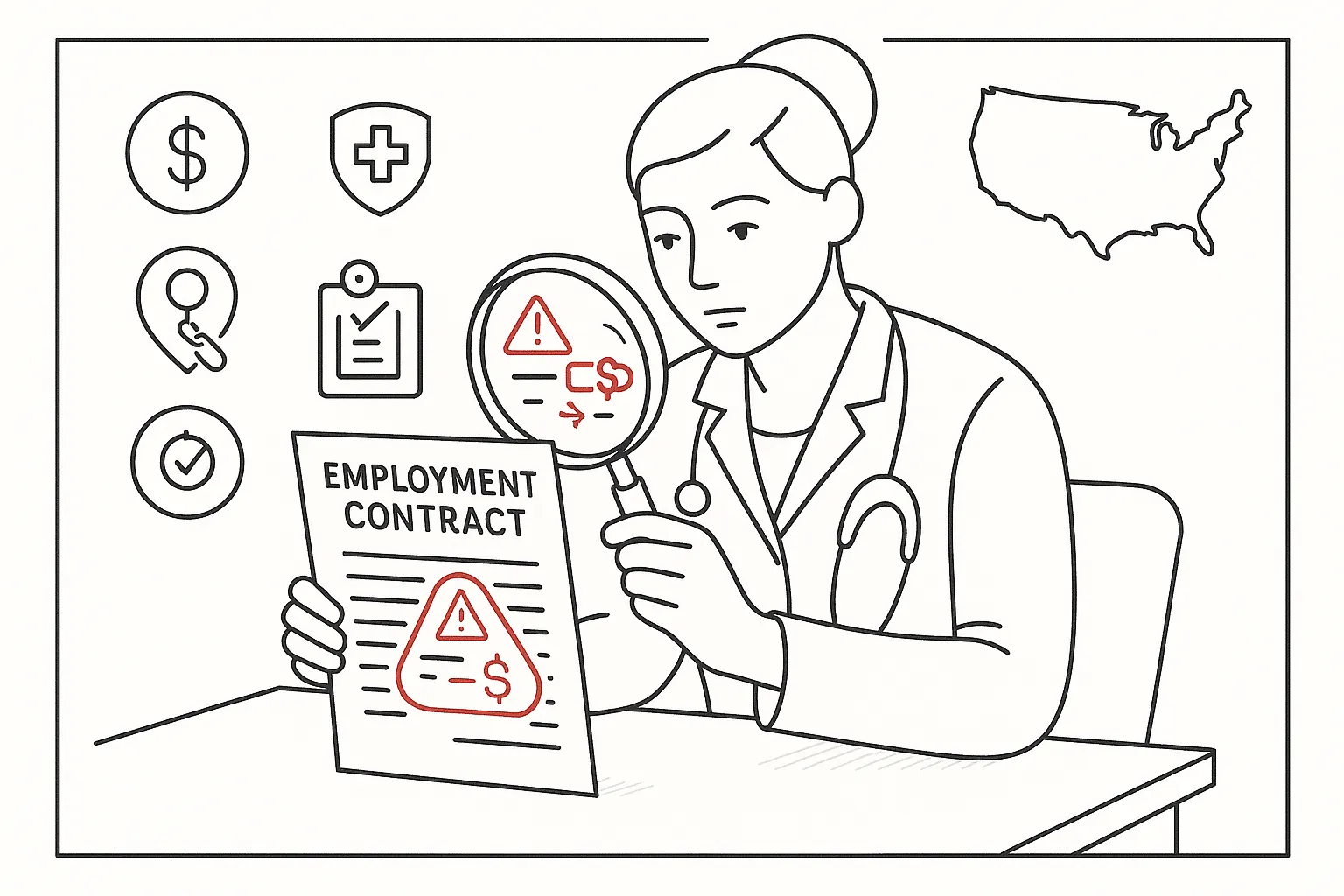
The headline terms in an offer letter rarely tell the whole story. The employment agreement allocates financial risk, establishes the employer’s operational authority, and defines the events that may end the relationship. It may also incorporate policies or compensation plans that the employer can revise separately, making those referenced documents as important as the primary agreement.
Ambiguity often benefits the party with more control over payroll records, scheduling, billing data, and workplace policies. Terms such as “productive,” “collections,” “good standing,” “full-time,” or “cause” can have significant consequences when the contract does not define them. A comprehensive nurse practitioner contract review evaluates how the provisions operate together rather than treating each clause in isolation.
The review also needs to account for the NP’s practice setting. A hospital-employed NP may face facility privileging and call obligations, while an outpatient position may place greater emphasis on patient volume, collections, restrictive covenants, or multiple work locations. Telehealth, independent-contractor, and multi-state arrangements can introduce additional licensure, billing, scheduling, and professional-liability issues.
Compensation Terms That Can Reduce Expected Earnings

Productivity, Collections, and Bonus Formulas
A stated base salary may be only one part of the compensation structure. The agreement may condition additional pay on work relative value units, collections, patient encounters, quality measures, or a combination of metrics. Red flags include an undefined threshold, an unspecified conversion factor, discretionary adjustments, delayed reporting, and no method for challenging inaccurate data. A clear formula identifies the measurement period, calculation method, payment date, and records available to the NP.
Collections-based compensation requires equally careful definitions. The contract may need to explain how refunds, write-offs, denials, late payments, payer adjustments, and collections received after termination are treated. RVU provisions warrant review of coding modifiers, attribution rules, excluded services, and whether the employer can change the conversion factor or threshold. Chelle Law’s guide to nurse practitioner compensation models provides additional context for comparing these structures.
Billing provisions must also be consistent with applicable healthcare requirements. The contract should not treat use of the NP’s NPI, billing rights, or reassignment of benefits as unrestricted employer property. Productivity calculations, coding practices, chargebacks, and billing adjustments require appropriate documentation and must operate within Medicare, payer, and other applicable compliance rules.
Negative Accrual, Deductions, and Repayment Exposure
Negative accrual can turn an apparent compensation guarantee into a recoverable advance. If production falls below a threshold, the employer may carry the deficit into later periods and reduce future incentive pay. The agreement needs to reveal when a deficit arises, whether it resets, how long it carries forward, and whether the employer may seek repayment from wages, bonuses, or final compensation. The practical effect is examined in more detail in Chelle Law’s resource on negative accrual in NP contracts.
Signing bonuses, relocation allowances, student-loan support, training expenses, and other incentives may also become repayable. Important questions include whether repayment is prorated, which termination events trigger it, and whether the obligation applies when the employer ends the relationship without cause. Broad deduction or offset clauses deserve particular attention because they may allow the employer to reduce amounts otherwise due at departure.
Malpractice Insurance and Post-Employment Liability
Policy Type, Tail Coverage, and Indemnification
The agreement should identify whether the professional-liability policy is claims-made or occurrence-based, the applicable coverage limits, and the party responsible for premiums. Occurrence coverage generally responds to covered incidents occurring during the policy period even if the claim is reported later. Claims-made coverage ordinarily requires the policy to be active when the claim is made, which can create a need for tail coverage after the employment relationship ends.
No universal rule assigns tail responsibility to the employer or the NP. The result depends on the policy and negotiated contract language. A problematic clause may require the NP to purchase tail coverage after any separation, provide proof within a short period, or reimburse the employer for coverage without defining its form or cost. A review should also determine whether responsibility changes when the employer terminates without cause, breaches the agreement, or elects not to renew it. The distinctions between policy structures are discussed in claims-made and occurrence coverage for nurse practitioners.
Indemnification and hold-harmless provisions can create exposure beyond ordinary malpractice obligations. Language requiring an NP to defend or reimburse the employer for broadly defined claims may transfer liability for billing practices, staffing decisions, system failures, or conduct outside the NP’s control. These clauses need to be read alongside insurance exclusions, notice requirements, cooperation duties, and the employer’s control over the defense.
Clinical Authority, Credentialing, and Billing Compliance
Scope, Collaboration, Scheduling, and Work Locations
An NP contract may refer generally to supervision, collaboration, prescribing, or scope of practice without explaining how those requirements will function in the position. APRN authority is jurisdiction-specific, and telehealth requirements may depend on the law of the state where the patient is located. The National Council of State Boards of Nursing’s APRN guidance emphasizes the need to evaluate applicable nurse practice acts and board rules rather than assuming one nationwide practice model.
The employment agreement, job description, and any separate supervision or collaboration document need to be consistent. Contract analysis can identify unclear physician-availability expectations, conflicting documentation duties, unsupported prescribing responsibilities, or obligations that do not match the actual practice setting. Chelle Law’s guide to scope-of-practice issues in NP contracts explains why these provisions require state-specific context.
Scheduling language can create similar operational risk. The contract may permit unilateral changes to shifts, call, patient volume, floating assignments, administrative duties, or work locations without addressing notice, travel, added expenses, or compensation. Exclusivity provisions may separately restrict moonlighting, teaching, volunteer work, consulting, telehealth services, or passive ownership interests.
Credentialing, NPI Use, and Reassignment of Benefits
An employment start date conditioned on credentialing, payer enrollment, or facility privileging can result in weeks or months without expected compensation. The agreement should clarify who submits the applications, which documents the NP must provide, whether a delayed start affects compensation or benefits, and what happens if a payer or facility does not approve the application.
Credentialing is not limited to hospital privileges. According to CMS guidance for advanced practice registered nurses, NPs may bill Medicare under their own NPI and may reassign benefits to an employer or contractor when applicable requirements are met. Contract terms concerning NPI use, billing authority, reassignment, records, and post-termination claims therefore need to align with enrollment and program rules.
The transition out of employment matters as well. The parties may need to update practice locations, end a reassignment relationship, or make other payer-enrollment changes after termination. A contract that grants the employer continuing authority over the NP’s billing credentials without appropriate limits can create compliance and payment risks after the NP has left.
Restrictions and Termination Terms That Affect Mobility
Post-employment restrictions can include non-compete, patient and employee non-solicitation, confidentiality, non-disparagement, and limits on using professional information. The practical burden depends on the restricted activities, duration, geographic reach, triggering events, and available exceptions. A clause may extend beyond traditional clinical employment by covering telehealth, part-time work, ownership, referral relationships, or services for a prospective competitor.
Non-compete enforceability cannot be evaluated through a single nationwide rule. The Federal Trade Commission states that its 2024 Noncompete Rule is not in effect following federal litigation, although federal enforcement activity and state restrictions remain relevant. State laws continue to vary and can change materially; Oregon, for example, enacted provisions affecting certain agreements that restrict the practice of medicine or nursing. The contract language, governing state law, profession-specific restrictions, and circumstances of departure all require review. Chelle Law’s resource on nurse practitioner non-compete clauses addresses the provisions that shape this analysis.
Termination rights determine how long the parties remain obligated after notice is given and which liabilities survive. Red flags include unequal without-cause notice periods, immediate termination based on vague standards, no meaningful cure period, and repayment obligations triggered even when the employer ends the relationship. The agreement also needs to address final salary, earned productivity compensation, unused leave where applicable, patient-transition duties, records access, insurance obligations, and payer-enrollment updates.
Dispute provisions may compound these risks. Mandatory arbitration, a distant venue, employer-selected governing law, shortened filing periods, prevailing-party attorney-fee clauses, or mandatory internal procedures can affect the cost and timing of a claim. These terms deserve attention before a dispute exists, particularly when the contract also gives the employer broad offset, injunctive-relief, or enforcement rights.
A Practical Contract Review and Response Plan
A useful review starts with the entire contract package rather than the signature document alone. Relevant materials may include the offer letter, compensation plan, productivity reports, benefit summary, job description, restrictive-covenant addendum, malpractice declarations, handbook provisions incorporated into the agreement, and supervision or collaboration documents. Earlier emails can also reveal promised terms that never appeared in the final draft.
- Confirm the base salary, bonus eligibility, productivity threshold, conversion factor, collections definition, reporting rights, and reconciliation schedule.
- Identify every deduction, chargeback, negative-accrual mechanism, repayment trigger, and right to offset final compensation.
- Determine the malpractice policy type, limits, premium responsibility, tail obligation, and effect of indemnification language.
- Evaluate duties, schedule, call, patient volume, work locations, collaboration terms, prescribing expectations, and unilateral-change provisions.
- Review non-compete, non-solicitation, confidentiality, exclusivity, moonlighting, and ownership restrictions together.
- Examine termination notice, for-cause standards, cure rights, final compensation, continuing obligations, and payer-enrollment transitions.
- Check credentialing responsibilities, NPI and reassignment language, anticipated start dates, and the consequences of enrollment delays.
- Identify arbitration, governing-law, venue, notice, remedy, filing-deadline, and attorney-fee provisions.
Potential revisions often focus on replacing discretion with objective standards. Examples include defining compensation metrics, requiring regular reports, limiting retroactive deductions, prorating repayment obligations, allocating tail responsibility, narrowing restrictive covenants, and establishing credentialing deadlines. The appropriate priorities depend on the financial value of the offer, the NP’s alternatives, the practice setting, and the provisions carrying the greatest long-term risk.
If a problem develops after signing, preserve the agreement, amendments, pay statements, productivity data, policy documents, credentialing records, and written communications. A dispute may be addressed through a written amendment, release, or other documented resolution, but applicable notice procedures and deadlines need to be evaluated promptly. Before resigning or responding to an employer’s termination decision, review the practical consequences described in Chelle Law’s guide to terminating a nurse practitioner contract.
Frequently Asked Questions
What does it mean when an NP bonus is discretionary?
A discretionary bonus generally gives the employer substantial control over whether it will pay the bonus, even when the NP performs well. The agreement can reduce uncertainty by identifying objective eligibility requirements, calculation methods, payment dates, and the circumstances in which compensation may be withheld.
How can negative accrual affect nurse practitioner compensation?
Negative accrual can carry a productivity deficit into a later measurement period and reduce future incentive compensation. The contract needs to explain when a deficit arises, whether it resets, how long it carries forward, and whether the employer may recover it from wages, bonuses, or other payments.
Who pays for tail insurance when an NP leaves a job?
Responsibility depends on the malpractice policy and negotiated contract language; there is no universal rule assigning the cost to one party. The agreement needs to identify whether tail coverage is required, who purchases it, when proof is due, and whether responsibility changes based on how employment ends.
Can an employer change an NP’s schedule or work location?
The employer’s authority depends on the agreement and applicable law. A broad unilateral-change provision warrants review for geographic limits, notice requirements, travel obligations, schedule protections, compensation consequences, and the NP’s options if the change is material.
What documents are needed for an NP contract review?
A complete review may include the proposed agreement, offer letter, exhibits, compensation and bonus plans, benefit summaries, restrictive-covenant addenda, malpractice terms, job description, and supervision or collaboration documents. Prior written communications can help identify promised terms omitted from the final contract.
Can a nurse practitioner agreement be changed after signing?
The parties can generally amend an agreement when they accept the change and comply with the contract’s amendment requirements. Material revisions are better documented in a signed written amendment or side letter than left to an informal verbal understanding.
Have Your Nurse Practitioner Contract Reviewed
Chelle Law can analyze compensation, malpractice coverage, restrictions, termination rights, clinical responsibilities, and credentialing terms so you can understand the agreement’s risks before signing or renewing.
Contact Chelle LawExplore Nurse Practitioner Contract Guidance
Find legal services, practical resources, and state-focused information for evaluating nurse practitioner agreements.