
A nurse practitioner non-compete can determine where an NP may work, which services the NP may provide, and how quickly the NP can accept another position after leaving a practice. Although the covenant may occupy only a few lines in an employment or independent contractor agreement, its practical consequences can include relocation, a longer commute, reduced access to nearby jobs, or a temporary move into another specialty or practice setting.
The restriction rarely operates alone. Termination notice, productivity compensation, bonus repayment, malpractice insurance, patient-transition duties, and supervision or collaboration requirements can increase the financial and professional cost of leaving. Definitions elsewhere in the agreement may also expand an apparently limited covenant by covering affiliates, multiple facilities, broad categories of clinical services, or remote care.
Enforceability cannot be determined from the non-compete sentence alone. State law changes frequently, and a healthcare-specific statute covering physicians may not necessarily cover nurse practitioners. Chelle Law evaluates the covenant within the complete agreement, identifies language that determines its actual reach, and explains how it may affect compensation, termination, insurance obligations, and future practice plans. A focused nurse practitioner non-compete review can uncover these issues before an agreement is signed or employment ends.
Key Takeaways About NP Non-Compete Clauses
- A non-compete is a material economic term because it can limit future work, income, and professional mobility after the relationship ends.
- Geography, duration, restricted services, covered employer locations, definitions, and triggering events determine the covenant’s practical reach.
- State law controls much of the enforceability analysis, and profession-specific healthcare rules may treat nurse practitioners differently from physicians or other clinicians.
- The FTC’s 2024 nationwide Noncompete Rule is not currently in effect or enforceable, although federal antitrust scrutiny of potentially unreasonable healthcare restrictions continues.
- Compensation reconciliation, repayment provisions, malpractice coverage, and termination language can compound the financial effect of a restriction.
- Carefully drafted exceptions for telehealth, specialty services, per diem shifts, specified locations, or particular termination events may reduce uncertainty.
How the Contract Defines Restricted Work
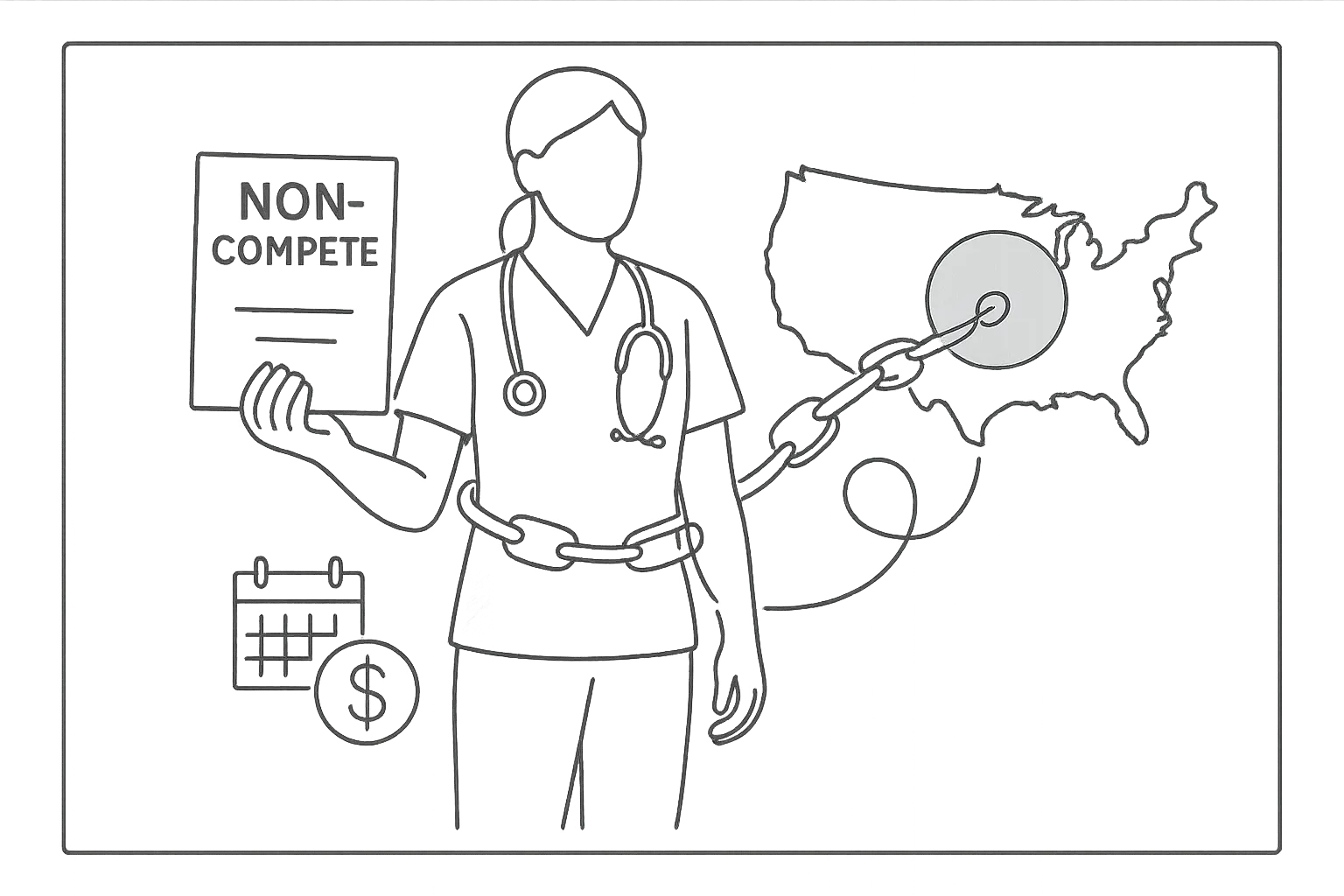
A non-compete is a contractual promise limiting specified competitive activity after an employment or contractor relationship ends. It may prohibit work for designated organizations, delivery of certain services, or practice within a defined territory for a stated period. Narrow language may affect only work that directly competes with the former employer, while broader wording can reach hospital shifts, urgent care, specialty practice, ownership opportunities, administrative roles, or telehealth.
Geography, employer locations, and covered services
Geography may be described through a mileage radius, named counties, a market area, or every location where the employer or an affiliate conducts business. A modest radius measured from one clinic can become a much larger restriction when it applies separately to several facilities. The agreement may also leave uncertainty about sites where the NP occasionally worked, locations opened after signing, or facilities later acquired by a successor.
The definition of restricted services is equally important. Language limited to the NP’s actual specialty may preserve more alternatives than a prohibition covering all clinical services. For telehealth, the analysis may involve the NP’s location, the patient’s location, the employer’s service area, state licensure requirements, and the contract’s definition of competition rather than a single geographic test.
Terms such as “competing practice,” “employer business,” “restricted territory,” and “clinical services” may quietly broaden the covenant. An NP reviewing a proposed agreement can compare these definitions with other common nurse practitioner contract red flags to identify provisions whose effect extends beyond their section heading.
Duration, triggering events, and related restrictions
The restricted period determines how long the NP may need to remain outside the covered market or avoid specified services. The contract must also be examined for the events that activate the restriction, including resignation, termination for cause, termination without cause, expiration, and nonrenewal. A covenant that applies after every separation creates a different risk than one containing exceptions for an employer-initiated termination or material breach.
Non-solicitation, confidentiality, proprietary-information, and nondisparagement clauses can continue limiting conduct even when the non-compete is narrow. A patient non-solicitation clause may restrict outreach to an established patient panel, while an employee non-solicitation provision may affect the NP’s ability to recruit former colleagues. Each restriction requires a separate reading because a favorable change to one provision does not necessarily narrow the others.
Survival and assignment provisions also matter. They may allow a purchaser, successor, affiliate, or other entity to assert post-employment restrictions after ownership or control changes. Because some state laws contain healthcare-specific rules or ownership-related exceptions, the effect of an assignment cannot be determined solely from the contract’s statement that the covenant is transferable.
Current Law and Non-Compete Enforceability

No nationwide rule automatically resolves every nurse practitioner non-compete. The Federal Trade Commission states that its 2024 Noncompete Rule is not currently in effect or enforceable. The rule therefore does not presently create a general federal prohibition for NP employees or independent contractors. Although the rule’s definition of a worker included independent contractors, that language does not currently invalidate their covenants nationwide.
The rule’s status does not eliminate all federal scrutiny. The FTC has continued to identify potentially unreasonable healthcare restrictions as an enforcement concern, including through warning letters to healthcare employers and staffing companies. Fact-specific federal antitrust enforcement is different from a blanket rule declaring every healthcare covenant invalid.
State law remains central and is changing quickly. Depending on the jurisdiction, an analysis may consider the employer’s asserted protectable interests, the restriction’s reasonableness, hardship, patient access, contract formation, and the circumstances of separation. Some states impose restrictions tied to the type of healthcare professional, employer, ownership structure, compensation level, geography, or termination event. A statute written for physicians cannot automatically be treated as applicable to NPs; current definitions and profession-specific rules must be checked.
Some jurisdictions permit courts to narrow an overbroad covenant, while others apply different statutory limitations or remedies. Patient continuity and access to care may also inform public-policy and professional considerations, but ethical guidance does not by itself decide legal enforceability. Chelle Law’s nurse practitioner contract information by state provides a starting point for understanding jurisdiction-specific contract issues.
How Other Contract Terms Increase the Risk
The economic burden of a non-compete extends beyond losing access to nearby positions. An NP may face reduced income while searching outside the territory, relocation or commuting expenses, and contractual obligations that become due when employment ends. The restriction is therefore best evaluated as part of the agreement’s complete economic structure rather than as isolated boilerplate.
Compensation reconciliation and repayment obligations
Final compensation may be affected by delayed collections, chargebacks, negative accrual, incomplete bonus periods, or the employer’s reconciliation methodology. An NP who cannot immediately join another local practice may also lose access to the patient base and referral relationships that supported prior productivity. Comparing the restriction with the agreement’s nurse practitioner compensation model helps show how much financial risk shifts to the clinician.
Signing bonuses, relocation allowances, educational benefits, and other incentives may become repayable if employment ends before a specified date. The repayment trigger, prorating formula, exceptions, and payment deadline are particularly important when a covenant simultaneously limits replacement income. The guide to NP signing bonus repayment provisions explains how these obligations can alter the cost of departure.
An NP paid through work relative value units, collections, or quality incentives may also face a final accounting after departure. The agreement may not credit work completed before termination if payment is received later, or it may offset alleged deficits against final wages or bonuses where permitted. Those provisions can materially increase the effect of even a relatively short restriction.
Termination timing, malpractice coverage, and practice requirements
A short notice period combined with an immediate post-employment restriction can leave little time to secure work outside the territory. Conversely, a lengthy notice requirement may delay the start of a new position even before the restricted period begins. The agreement needs to clarify when the non-compete starts, whether the notice period counts toward its duration, and whether different separation events change the result. These concerns can be evaluated alongside the broader rules for terminating a nurse practitioner contract.
Malpractice coverage can create a separate departure expense. If the employer provides claims-made insurance, the contract may assign responsibility for tail coverage to the NP when employment ends. Whether that responsibility changes based on resignation, termination, or length of service depends on the agreement. A restriction on nearby work can make the cost more difficult to absorb, particularly when it coincides with repayment obligations. The distinction between policy forms is discussed further in the resource on claims-made and occurrence coverage for nurse practitioners.
Post-employment plans may also be affected by licensure, prescribing authority, and supervision or collaboration requirements. A position that falls outside the restricted territory may not be a practical substitute if the NP cannot timely establish the professional relationships or approvals needed for that role. These regulatory issues do not necessarily determine whether the covenant is enforceable, but they can determine its real-world burden.
Carveouts and Alternatives That Can Limit Exposure
Clear exceptions can make a proposed restriction more predictable and less disruptive. A carveout may address hospitalist work, per diem shifts, academic duties, administrative roles, a different specialty, a designated facility, or work outside locations where the NP actually practiced. The language must correspond to the NP’s realistic career plans; an exception for work the NP is unlikely to perform offers little practical protection.
- Telehealth exceptions: The agreement can define whether remote services are restricted according to the NP’s location, the patient’s location, the employer’s market, or another identified standard.
- Termination-based exceptions: The covenant may exclude termination without cause, employer nonrenewal, a material employer breach, or another specified separation event.
- Location limits: The territory may be tied only to sites where the NP regularly worked rather than every current or future employer facility.
- Service limits: Restricted activity may be confined to the specialty or services the NP actually provided instead of all clinical practice.
- Garden leave: Compensation during the restricted period may reduce immediate financial pressure, although eligibility, offsets, payment timing, and forfeiture conditions require review.
- Buyout or release: A defined formula or release process may replace open-ended uncertainty with an identifiable cost and procedure.
Each alternative has tradeoffs. A buyout may be too expensive to provide meaningful flexibility, and a telehealth exception may be ineffective if another definition still classifies remote services as prohibited competition. A termination exception may also be undermined by language allowing the employer to characterize the separation differently. The carveout, definitions, termination article, and enforcement provisions must be read together.
Patient-transition language can address continuity concerns without granting unrestricted access to the former employer’s patient relationships. The agreement may distinguish required notices and record-transfer duties from prohibited solicitation. Any transition provision must also be considered alongside privacy obligations, professional duties, and applicable law.
When to Request a Non-Compete Review
Review is most useful before an NP signs a new offer, renewal, amendment, or independent contractor agreement. It can also be important before providing notice, accepting another local position, relocating, or assuming that a restriction is invalid. Early review provides time to identify ambiguities and understand how the covenant interacts with the rest of the contract.
- The geographic description includes multiple facilities, affiliates, counties, or every market where the employer operates.
- The restricted services could include telehealth, hospital shifts, per diem work, ownership, or specialties unrelated to the current position.
- The agreement does not distinguish resignation from termination without cause, employer nonrenewal, or a sale of the practice.
- Compensation includes productivity pay, collections, deferred bonuses, negative accrual, or repayment obligations.
- Tail insurance responsibility or post-termination malpractice coverage is unclear.
- Assignment, survival, amendment, or enforcement provisions may expand who can enforce the restriction or how it operates.
An attorney-led review can explain the covenant in context, identify conflicts among provisions, and evaluate practical exposure under the applicable law. A comprehensive nurse practitioner contract review can address the non-compete together with compensation, termination, malpractice coverage, repayment terms, and other provisions affecting a proposed or existing position.
Frequently Asked Questions
What parts of an NP non-compete should be reviewed first?
Start with the restricted services, geographic area, covered employer locations, duration, and events that trigger the covenant. Then review definitions, assignment rights, termination provisions, and related non-solicitation clauses because they may expand the restriction beyond its headline terms.
Are nurse practitioner non-compete clauses enforceable in every state?
No. Enforceability depends on current state law, the agreement’s language, the type of employer and professional covered, and the facts of the relationship. A healthcare restriction that applies to physicians may not necessarily apply to nurse practitioners, so profession-specific statutory definitions must be checked.
Does the FTC rule currently ban NP non-competes?
No. The FTC states that its 2024 nationwide Noncompete Rule is not currently in effect or enforceable. Federal antitrust scrutiny may still apply to particular conduct, but that is different from a rule automatically invalidating every nurse practitioner non-compete.
Does termination without cause automatically cancel a non-compete?
Not automatically. The result depends on the contract and governing law. The agreement must be examined for whether the covenant applies after termination without cause, resignation, nonrenewal, expiration, or other forms of separation.
Can an NP non-compete restrict telehealth work?
It may. Broad definitions of clinical services, competition, territory, or employer business can potentially reach telehealth. The analysis may involve the NP’s location, the patient’s location, employer markets, state licensure rules, and the contract’s treatment of remote services.
When should a nurse practitioner have a non-compete reviewed?
Review is best completed before signing an offer, renewal, amendment, or independent contractor agreement. An NP considering resignation, termination, relocation, or another local position may also benefit from review before acting on assumptions about the covenant.
Have Your NP Non-Compete Reviewed Before You Sign
Chelle Law can evaluate the restriction, related compensation exposure, termination terms, malpractice obligations, and other provisions that may affect your career mobility.
Contact Chelle Law