
A nurse practitioner relocation allowance can reduce the immediate cost of accepting a position in another city or state, but the payment is rarely as simple as it first appears. An employer may provide a fixed allowance, reimburse approved expenses, pay moving vendors directly, or advance funds that are forgiven over a service period. Each structure affects when the money becomes available, which expenses qualify, what records the NP must provide, and whether an early departure creates a debt.
The practical value of the benefit depends on more than its stated dollar amount. Federal tax treatment can reduce the net payment, while a broad repayment clause may require the NP to return the gross amount even after taxes have been withheld. Termination language, payroll-offset rights, credentialing conditions, signing-bonus obligations, and restrictive covenants can further affect the cost of leaving the position.
A complete nurse practitioner contract review examines the relocation provision together with the rest of the employment agreement and any incorporated policy. Chelle Law reviews the payment structure, eligible expenses, tax language, service commitment, forgiveness formula, repayment triggers, and provisions that may permit the employer to seek deductions or offsets from other compensation.
Key Relocation Allowance Issues
- Most civilian NP relocation payments and reimbursements are generally included in taxable wages under current federal law, although narrow statutory exceptions remain.
- The agreement may characterize the benefit as a lump sum, reimbursement, advance, direct vendor payment, or forgivable loan.
- Repayment language may produce different results after resignation, termination for cause, termination without cause, disability, or position elimination.
- Monthly or periodic forgiveness usually reduces exposure more gradually than an all-or-nothing clawback.
- Payroll deductions and final-paycheck offsets depend on the contract and the law governing the employment and payroll transaction.
- Relocation obligations need to be compared with signing bonuses, compensation adjustments, restrictive covenants, and other repayment provisions.
How an NP Relocation Benefit Is Structured
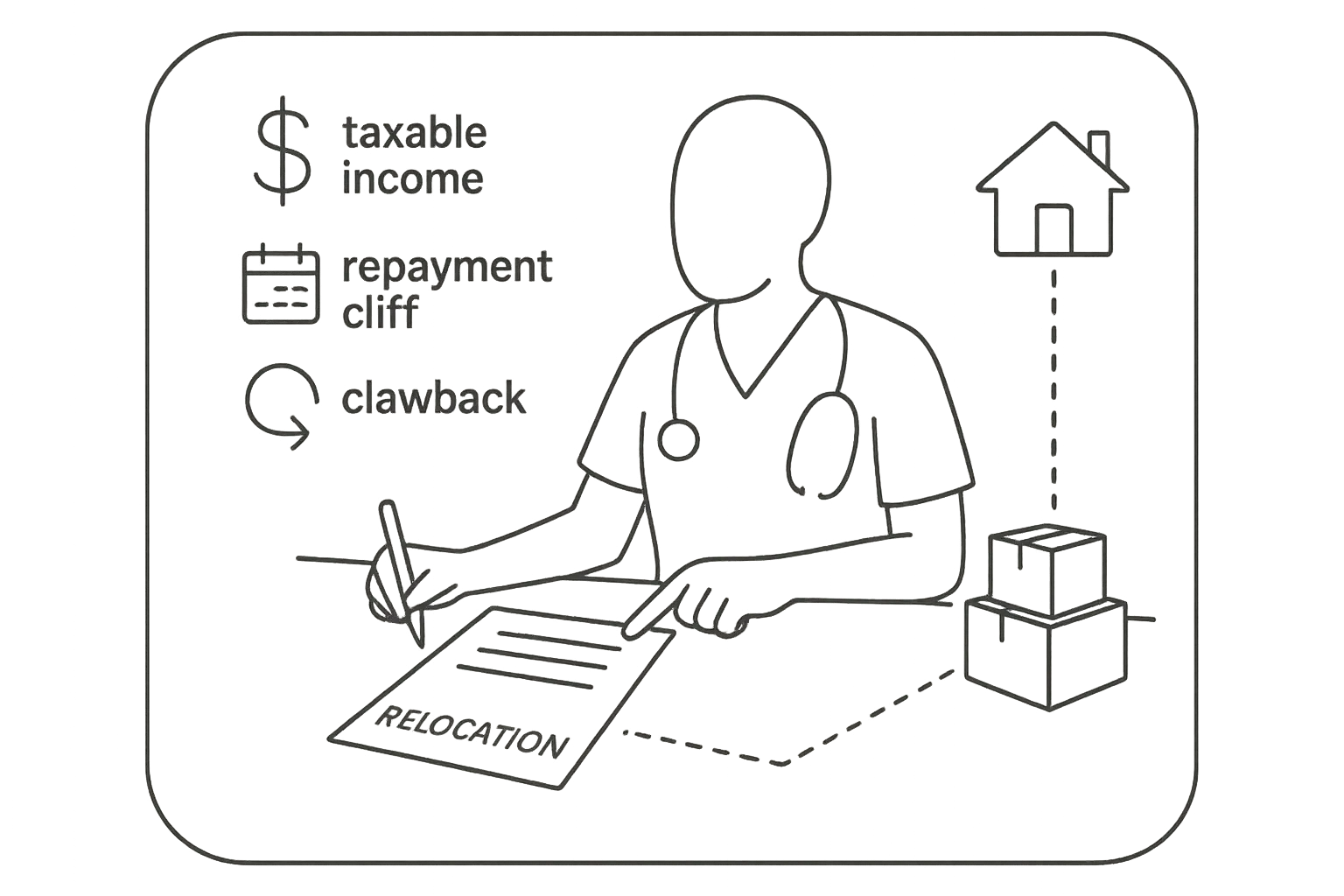
Relocation assistance is intended to offset expenses associated with moving for a new position. Depending on the written terms, covered costs may include professional movers, packing, transportation, temporary housing, storage, travel, or other approved expenses. The agreement may place the complete relocation arrangement in the employment contract or incorporate a separate policy, reimbursement form, or benefits document.
Payment Structures and Timing Conditions
The method of payment determines who initially bears the moving costs and how much administrative discretion the employer retains. Common structures include:
- Fixed allowance: The employer pays a predetermined amount, usually near the start date. The NP can use the funds as needed, but the payment may be taxable and subject to a separate clawback.
- Expense reimbursement: The NP pays eligible costs and submits receipts by a stated deadline. Reimbursement may be limited by category caps, an overall maximum, or an approval requirement.
- Direct vendor payment: The employer pays approved movers or other vendors. The provision still needs to address spending limits, vendor selection, cancellations, and amounts exceeding the approved budget.
- Advance with reconciliation: Funds are provided before the move and later compared with documented expenses. The agreement may require the return of unused funds or leave the NP responsible for costs above the allowance.
- Forgivable loan: The employer advances money and forgives the balance over a defined service period. Any unforgiven amount may become due when employment ends.
Payment may also depend on the NP beginning work by a specified date, maintaining full-time status, completing credentialing, or remaining employed through a stated milestone. If credentialing is delayed or the employer changes the start date, the contract needs enough detail to show whether payment, forgiveness, or repayment dates move with it.
Covered Costs, Caps, and Required Records
A relocation policy can define eligible costs narrowly or give the employer broad authority to approve expenses. Important details include category limits, the total cap, geographic requirements, receipt standards, submission deadlines, preapproval procedures, and whether expenses incurred before the agreement was signed qualify. An undefined requirement that costs be “reasonable” may give the employer substantial discretion to deny reimbursement after the NP has already spent the money.
Documentation provisions matter even when the benefit is expected to be taxable. Receipts and timely substantiation can determine whether a payment satisfies an employer policy or other reimbursement requirements, but receipts alone do not make an ordinary civilian relocation benefit tax-free. Any separate policy also needs to be reviewed for language allowing unilateral amendment, cancellation, or retroactive changes.
Repayment, Forgiveness, and Early Departure
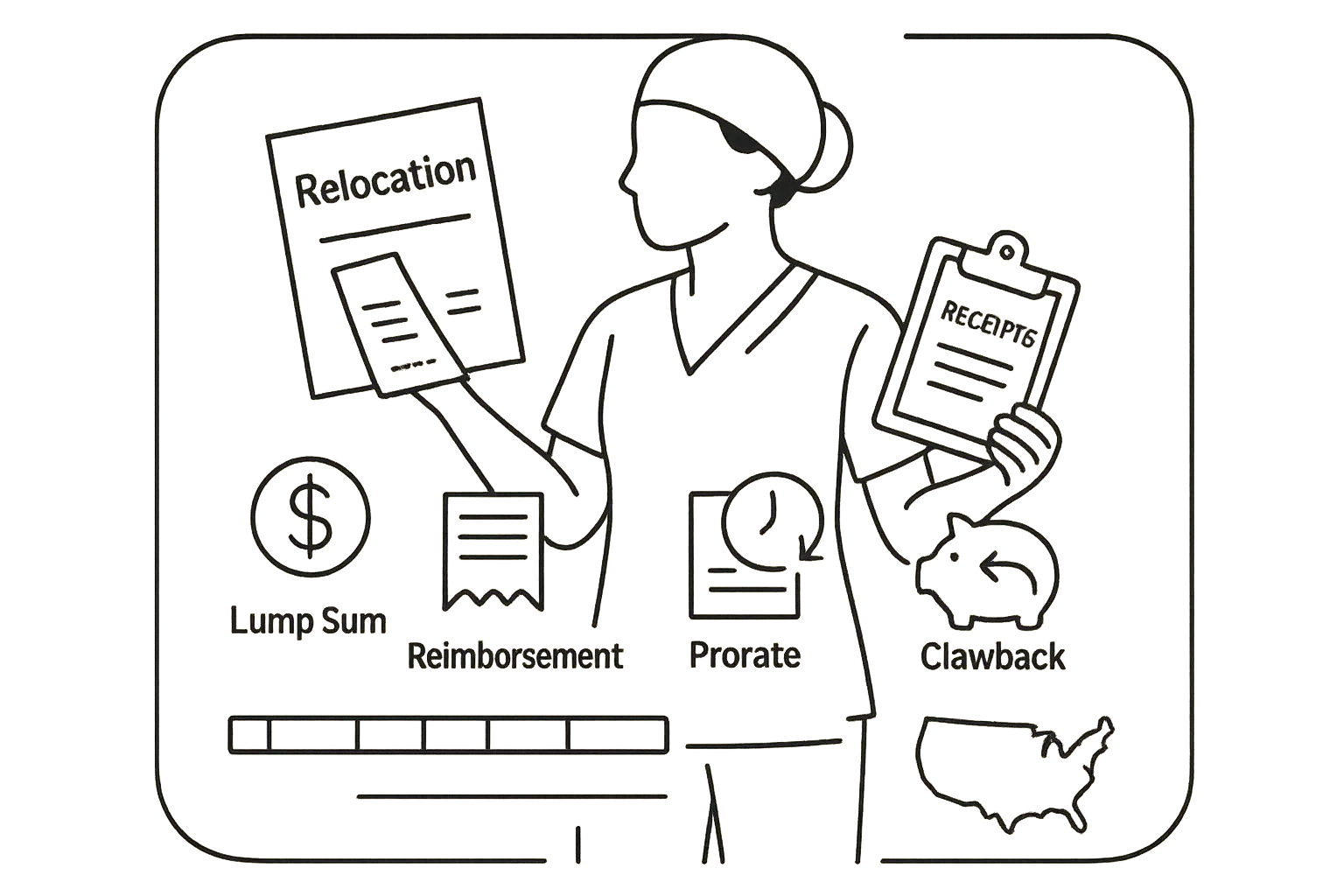
The repayment provision often creates the greatest financial risk. An allowance that appears to be a hiring benefit may function as a contingent debt until the NP completes the required service period. The language needs to be read together with the agreement’s term, renewal provisions, and termination rights because a repayment obligation may survive the end of employment.
Termination Triggers and Forgiveness Formulas
A broad clause may require repayment whenever employment ends during the commitment period, regardless of who initiated the separation or why. More precise language distinguishes resignation, termination for cause, termination without cause, position elimination, disability, failure to obtain credentials, and an employer-directed reduction in hours. These distinctions can determine whether an NP owes thousands of dollars after a separation the NP did not choose.
Forgiveness may be all-or-nothing or prorated. Under an all-or-nothing provision, the entire amount can remain repayable until the last day of the commitment. A prorated formula reduces the balance as service is completed, but it needs to identify the initial balance, the forgiveness interval, the calculation date, and the treatment of partial months. A focused review of termination provisions can clarify how the clawback interacts with notice requirements and employer termination rights.
Offsets and Overlapping Repayment Obligations
The relocation clause may authorize the employer to deduct an alleged balance from wages, accrued leave, bonuses, incentive compensation, or the final paycheck. Contract language does not create a uniform nationwide right to make those deductions. The applicable result may depend on the NP’s work location, governing law, employee status, advance authorization, the type of compensation involved, and state wage-payment requirements. The U.S. Department of Labor’s final-paycheck guidance confirms that state law may control the timing and permissibility of final-pay deductions.
Relocation debt can also overlap with a signing bonus, educational benefit, student-loan contribution, or compensation reconciliation. Each benefit may use a different service period, repayment trigger, or forgiveness formula. Comparing the relocation clause with the contract’s signing bonus repayment terms helps identify whether one departure could trigger several obligations at once.
Federal Tax and Payroll Treatment
Current federal law generally treats employer-paid or reimbursed moving expenses for civilian employees as taxable income and wages. Public Law 119-21 permanently eliminated the federal income exclusion for qualified moving-expense reimbursements for most employees. Narrow exceptions remain for qualifying active-duty Armed Forces moves and certain intelligence-community employees or appointees, but those exceptions ordinarily do not apply to a civilian nurse practitioner accepting a healthcare position.
Accordingly, an NP should evaluate the stated allowance based on the expected net value after withholding, not merely the advertised amount. The employer’s characterization of a payment as a reimbursement does not control the federal tax result. The IRS Employer’s Tax Guide to Fringe Benefits explains the current moving-expense rule, while IRS Publication 15 addresses wage reporting and payroll withholding.
Taxable relocation amounts generally may be subject to federal income-tax withholding and Social Security and Medicare taxes and reported on Form W-2. A separately identified payment may be handled under an applicable supplemental-wage withholding method. The contract or benefits documents can clarify how the employer intends to report the payment and whether a tax gross-up is included, but those terms cannot override federal tax law.
Accountable-plan rules and the special moving-expense exclusion are separate concepts. An accountable arrangement generally requires a business connection, timely substantiation, and the timely return of excess funds, but satisfying documentation requirements does not automatically make an ordinary civilian moving benefit excludable from income. Because repayment after taxes have been withheld can create additional reporting questions, the NP may also need advice from a qualified tax professional.
Contract Red Flags and Terms to Clarify
Relocation language needs to be evaluated as part of the complete compensation and exit package. The following provisions can create uncertainty or place disproportionate risk on the NP:
- A repayment trigger based on any termination without distinguishing who ended employment or why.
- Full repayment after the NP has completed most of the required service period.
- An immediate demand for the entire balance with no defined due date or payment process.
- Unclear treatment of the benefit as a bonus, wage payment, reimbursement, advance, or loan.
- Employer discretion to reject expenses without objective standards or an approval procedure.
- Broad deduction language covering wages, bonuses, accrued leave, or other amounts without reference to applicable law.
- Cross-default language that accelerates relocation repayment after an unrelated alleged breach.
- No explanation of withholding, wage reporting, gross-up treatment, or the tax documentation associated with a later repayment.
- Conflicting terms between the employment agreement, offer letter, and incorporated relocation policy.
Clearer terms can define covered expenses, approval procedures, documentation deadlines, repayment events, periodic forgiveness, and the amount due on any departure date. The provision can also identify whether interest accrues, when repayment becomes due, and whether installment payments are available. Any proposed deduction or offset remains subject to the law governing the payroll transaction.
The review also needs to account for other limits on mobility. An NP leaving a position could face a relocation demand while also losing a productivity payment or confronting a post-employment restriction. Reviewing the compensation formula, any negative accrual provision, and the agreement’s non-compete restrictions reveals whether those provisions compound the relocation exposure.
Documents Needed for Relocation Allowance Review
A relocation provision cannot always be evaluated from one paragraph in the employment agreement. Repayment rights, offset clauses, compensation adjustments, and termination definitions may appear elsewhere or in documents incorporated by reference. A useful review ordinarily includes:
- The complete employment agreement, including exhibits, schedules, and addenda.
- The offer letter and every separate relocation policy, reimbursement form, or loan document.
- Compensation exhibits addressing salary, bonuses, productivity incentives, and reconciliation rights.
- Signing-bonus, educational-benefit, or student-loan repayment terms.
- Written statements about covered expenses, tax treatment, gross-ups, credentialing, and the anticipated start date.
- Estimated moving costs and questions about likely termination, schedule, or work-location changes.
Chelle Law analyzes how these documents work together, identifies ambiguous or employer-favorable terms, and helps the NP understand the potential repayment exposure. The objective is to determine what the written benefit is worth after taxes, what events may turn it into a debt, and which provisions may warrant clarification or revision before signing.
Frequently Asked Questions
Are nurse practitioner relocation allowances taxable?
Most employer-paid or reimbursed relocation benefits for civilian NPs are generally included in taxable income and wages under current federal law. Narrow exceptions remain for certain military and intelligence-community moves. The payment structure affects reporting and withholding, and a tax professional can evaluate the NP’s individual circumstances.
Must an NP repay relocation assistance after termination without cause?
The answer depends on the repayment language. A clause covering any termination may include an employer-initiated termination without cause, while a more limited provision may exclude termination without cause, position elimination, disability, or other events outside the NP’s control.
Is a lump-sum allowance better than expense reimbursement?
Neither method is automatically better. A lump sum offers flexibility and predictable funding, while reimbursement ties payment to approved documented costs. The net value depends on tax treatment, expense limits, approval requirements, payment timing, and the applicable repayment clause.
How does prorated forgiveness work in a relocation clause?
Prorated forgiveness reduces the outstanding balance as the NP completes defined periods of service. A clear formula identifies the original amount, the monthly or periodic reduction, the calculation date, and the balance due if employment ends before the commitment is complete.
Can an employer deduct relocation repayment from an NP’s final paycheck?
Not automatically. The result depends on the agreement and the federal and state laws governing the employment and payroll transaction. State law may require written authorization, limit the amount deducted, restrict deductions from particular payments, or impose other procedural requirements.
What documents should an NP provide for relocation allowance review?
The review should include the complete employment agreement, offer letter, relocation policy, reimbursement forms, compensation exhibits, bonus terms, and written communications about expenses, taxes, credentialing, or the start date. Reviewing the documents together can reveal inconsistent triggers and overlapping repayment obligations.
Review Your NP Relocation Terms Before You Sign
Chelle Law reviews relocation benefits, repayment triggers, tax language, compensation offsets, and related contract terms that may affect your income and ability to leave a position.
Contact Chelle LawExplore Nurse Practitioner Contract Guidance
Review related legal services, practical contract resources, and state-focused information from Chelle Law.