
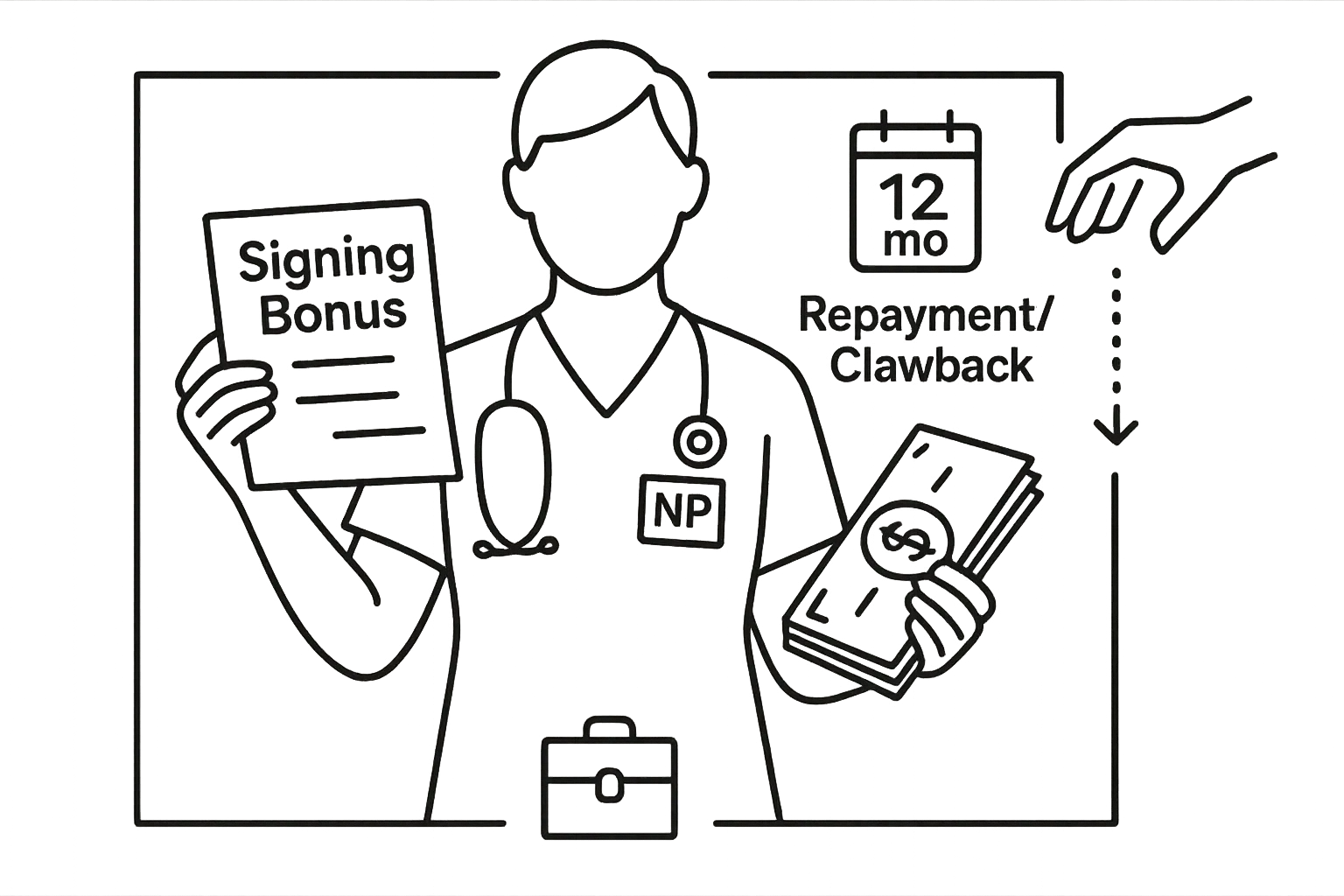
A signing bonus can make a nurse practitioner employment offer more attractive, particularly when the position involves relocation, a delayed clinical start, or the transition from training into practice. The payment may arrive before the NP has completed the service period expected by the employer, however, so the agreement may include a clawback requiring some or all of the bonus to be returned if specified events occur.
The financial risk depends less on the advertised bonus than on the repayment language. An obligation may be triggered by resignation, termination for cause, failure to begin work, an unmet productivity condition, or another event defined in the contract. The provision may also impose a short payment deadline, require repayment of the gross amount, authorize a wage offset, or add interest and collection expenses. Those terms can become especially burdensome when they operate alongside a non-compete, tail insurance obligation, or separate relocation repayment clause.
A thorough nurse practitioner contract review evaluates the bonus within the full agreement rather than treating it as an isolated benefit. Chelle Law reviews the triggering events, service-period calculation, repayment formula, termination exceptions, tax language, and available remedies so the nurse practitioner can understand the potential exposure before accepting the offer.
Key Signing Bonus Repayment Issues
- Identify every event that can trigger repayment, including resignation, termination for cause, failure to start, and unmet productivity conditions.
- Determine whether the obligation is a full clawback, monthly proration, or forgiveness at specified milestones.
- Confirm when the service period begins and whether credentialing or employer-controlled delays affect that date.
- Review repayment deadlines, interest, acceleration, attorney fees, collection costs, payroll deductions, and setoff rights.
- Look for express exceptions covering termination without cause, position elimination, employer breach, disability, or other defined circumstances.
- Clarify whether the stated balance is gross or net and obtain tax advice about the consequences of repayment.
How a Signing Bonus Clawback Fits the Employment Offer
The Contract Label Does Not Resolve Every Issue
A repayment clause may describe the payment as a signing bonus, recruitment incentive, advance, forgivable loan, or amount governed by a separate promissory note. Those labels can signal how the employer intends to administer the payment and pursue repayment, but a label alone does not determine the provision’s legal or federal tax treatment. The substance of the transaction, the employment relationship, and applicable law also matter.
The supporting documents therefore deserve the same attention as the main employment agreement. A promissory note may contain a different default date, interest rate, acceleration remedy, governing-law clause, or attorney-fee provision. The offer letter, employment agreement, bonus addendum, and note must be read together to determine whether their terms are consistent.
Repayment Risk Can Compound Other Contract Obligations
A $15,000 bonus tied to 12 months of service may appear straightforward, yet a full clawback can create immediate exposure if employment ends during month 11. That risk becomes more significant if the nurse practitioner must also repay relocation expenses, purchase tail coverage, or remain out of a restricted geographic area after departure. The practical cost of leaving may be much greater than the signing bonus balance alone.
The repayment provision must therefore be compared with the agreement’s termination and notice requirements and any post-employment non-compete restrictions. A short without-cause notice period does not necessarily eliminate a repayment obligation, and the ability to terminate the employment relationship may offer limited practical flexibility if departure creates a substantial debt.
Events That May Trigger Signing Bonus Repayment
Resignation, Termination, and Failure to Begin Employment
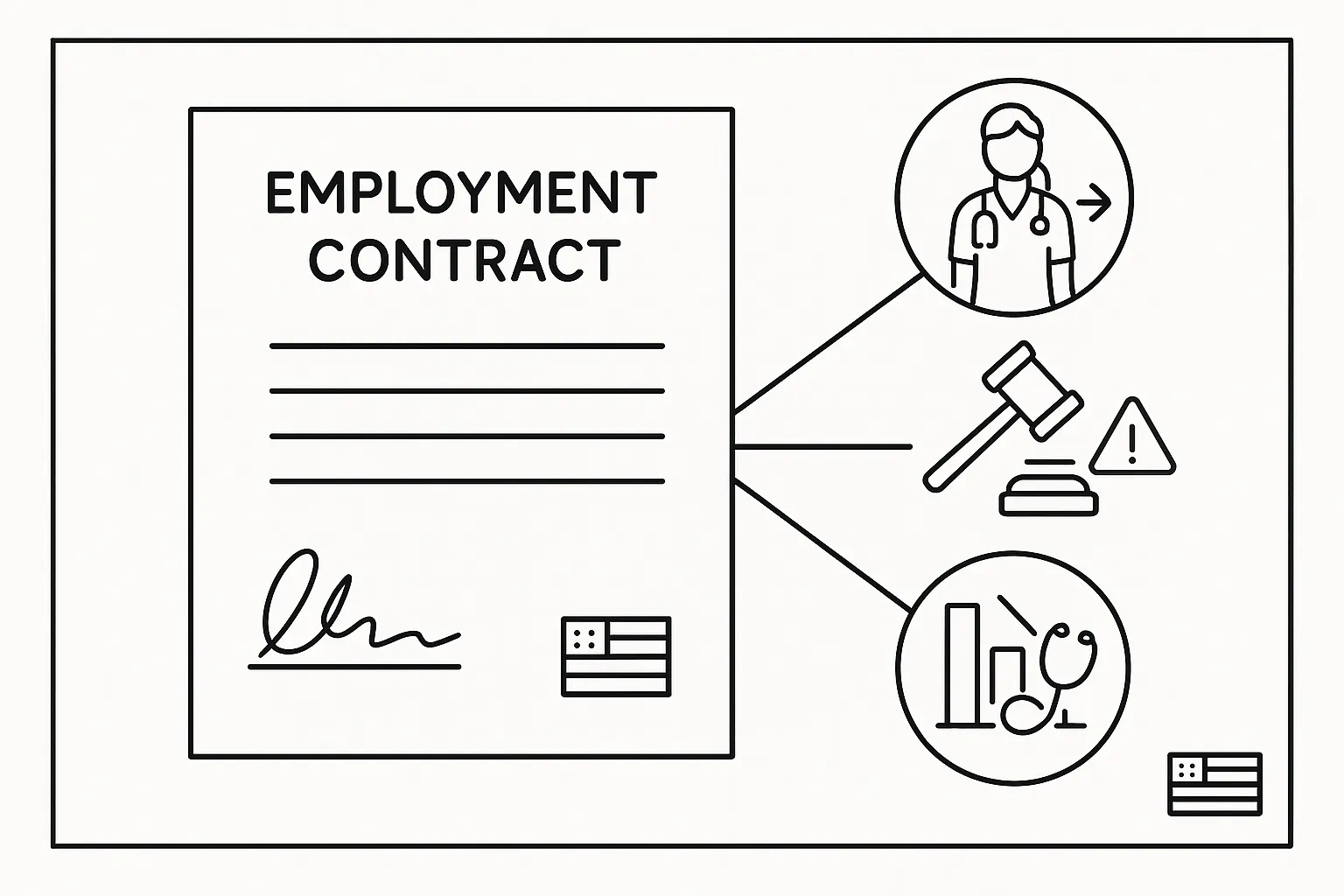
Many repayment clauses distinguish among voluntary resignation, termination for cause, and termination without cause. A narrower provision may apply only when the nurse practitioner resigns before completing the service period or is terminated for specifically defined misconduct. A broader clause may require repayment whenever employment ends, even when the employer eliminates the position or ends the relationship without alleging fault.
The definition of cause is particularly important. Broad references to unsatisfactory performance, policy violations, loss of privileges, or conduct harmful to the employer can give the employer substantial discretion. Contract analysis can identify whether cause is based on objective events, whether some grounds include notice and an opportunity to cure, and whether repayment is excused when the employer breaches the agreement or prevents the nurse practitioner from starting work.
Productivity and Employer-Controlled Conditions
Some agreements connect bonus forgiveness to collections, work relative value units, patient encounters, scheduled hours, or another performance measure. If the contract uses a productivity trigger, it needs to distinguish repayment of an upfront bonus from an ordinary adjustment to future incentive compensation. The benchmark, measurement period, source data, reconciliation process, and consequences of missing the target all require clear language.
Productivity can also depend on matters the nurse practitioner does not fully control, including credentialing, scheduling, staffing, payer enrollment, patient volume, and referral patterns. A focused NP compensation and productivity review can evaluate whether the formula allocates those risks clearly and whether a delayed start or reduced schedule changes the service or forgiveness period.
Calculating and Collecting the Repayment Balance
A full clawback requires repayment of the entire stated amount when a triggering event occurs within the service period. A prorated formula reduces the balance as service is completed, while a milestone schedule may forgive fixed percentages after six, 12, or 24 months. Proration is a contract term to request and define; it is not a universal entitlement in private employment. The formula also needs a clear start date, which could be the payment date, employment date, clinical start date, credentialing date, or another date selected by the parties.
The due date can matter as much as the formula. An immediate lump-sum obligation may create serious cash-flow pressure, while an installment option may make the balance more manageable. The review should also identify interest, late charges, acceleration, attorney fees, collection costs, and language allowing the employer to set off the debt against earned compensation, accrued paid time off, expense reimbursements, or other amounts.
Tax consequences require separate attention. Employment-related signing bonuses generally constitute wages subject to applicable withholding, but a later repayment is not necessarily limited to the net amount deposited in the employee’s account. When wages reported in an earlier year are repaid, the employee may need to return the gross amount, and the available federal tax treatment can depend on the repayment year, amount, and circumstances. Current IRS wage-reporting guidance addresses adjustments involving repaid wages, but a qualified tax professional can assess the consequences of a particular repayment.
Governing Law, Final Paychecks, and Enforcement
The enforceability and collection of a signing bonus obligation depend on the contract, the surrounding facts, and the governing jurisdiction. State law may regulate wage deductions, written authorizations, final-paycheck timing, interest, liquidated damages, and contractual remedies. A clause that authorizes a deduction does not necessarily override wage-payment restrictions that apply in the governing state.
At the federal level, the U.S. Department of Labor explains that federal law generally does not require an immediate final paycheck, although state law may require earlier payment. Its final-paycheck guidance does not create a universal federal right to deduct a private signing bonus debt from wages. The applicable state rules and the agreement’s authorization language must be evaluated together.
An employer may pursue repayment through a demand, a legally permitted payroll deduction, a contractual setoff, or enforcement of a promissory note. Whether a large repayment amount could be treated as an unenforceable penalty is jurisdiction- and fact-dependent; it cannot be determined from the amount alone. Even when liability is disputed, broad remedies and fee-shifting language can increase the cost and pressure associated with resolving the disagreement.
Contract Terms That Can Make Repayment More Predictable
Clear drafting does not eliminate every risk, but it can reduce uncertainty about when money is owed and how the balance will be calculated. Depending on the offer and the parties’ agreement, provisions that may warrant clarification or revision include:
- Pro rata forgiveness: Reduce the balance monthly or at defined service milestones rather than retaining an all-or-nothing obligation until the final day.
- Termination exceptions: Address termination without cause, position elimination, employer breach, disability, death, failure to credential, and other agreed events outside the NP’s control.
- Defined cause standards: Identify objective grounds and specify whether curable conduct requires notice and an opportunity to correct the issue.
- A precise service period: State when the period begins, when forgiveness occurs, and how approved leave or a delayed clinical start affects the calculation.
- Limited collection remedies: Clarify interest, fees, offsets, installment rights, and any cap on amounts beyond the unpaid bonus balance.
- Tax and reporting language: Define the contractual repayment amount without suggesting that the agreement alone controls tax treatment.
These points need to be considered with relocation assistance, incentive compensation, termination rights, restrictive covenants, and insurance obligations. For example, a departing NP may face both a bonus clawback and responsibility for tail insurance after employment. Reviewing broader nurse practitioner contract red flags helps reveal when several individually significant provisions create a larger combined exposure.
Signing Bonus Review Checklist
Before accepting the payment, compare the employment agreement, offer letter, bonus addendum, and any promissory note. Material terms belong in the signed documents rather than only in a recruiting email or verbal explanation. The review should answer the following questions:
- How is the payment described, and are there separate documents governing it?
- Which events trigger repayment, and how does the agreement define each event?
- Does the balance decline monthly, at milestones, or only after the entire service period?
- Which date starts the service period, and what happens if credentialing or the clinical start is delayed?
- Is the repayment figure based on the gross bonus, net proceeds, or another defined amount?
- When is payment due, and does the contract permit installments?
- Can interest, attorney fees, collection costs, or other charges increase the balance?
- Does the employer claim a right to deduct the debt from wages or other compensation?
- Which termination events excuse repayment, and are restructuring or role changes addressed?
- How does the obligation interact with relocation repayment, non-compete terms, notice, and malpractice coverage?
Warning signs include vague triggers, unilateral calculations, no proration, an unclear start date, immediate acceleration, and remedies spread across inconsistent documents. The related article on when an NP signing bonus becomes repayable provides additional context for evaluating termination-based triggers before a dispute develops.
Frequently Asked Questions
Do I have to repay a signing bonus if the employer terminates me without cause?
It depends on the contract. Some agreements excuse repayment after an employer-initiated termination without cause, while others apply whenever employment ends during the service period. Any exception needs to be stated expressly rather than assumed.
Can an employer deduct signing bonus repayment from my final paycheck?
The answer depends on the agreement and applicable wage law. Contractual deduction language does not necessarily override state restrictions on withholding earned wages, so the authorization, governing law, and final-paycheck rules must be evaluated together.
Must I repay the gross bonus or only the amount received after taxes?
The agreement may define the debt using the gross bonus, net proceeds, or another amount. A prior-year wage repayment may require returning gross dollars and can have separate federal tax consequences, so the contract and current tax guidance both matter.
What does a prorated signing bonus repayment schedule mean?
A prorated schedule reduces the balance as the nurse practitioner completes the required service period. Proration is generally a negotiated contract feature, and the clause needs to define the formula, starting date, and whether forgiveness occurs monthly or at milestones.
Can missing a productivity target trigger signing bonus repayment?
It can if the agreement clearly makes bonus forgiveness conditional on a productivity target. The contract needs to identify the benchmark, measurement period, data source, and treatment of employer-controlled factors such as credentialing, staffing, and scheduling.
Can a signing bonus repayment clause be changed after signing?
The parties may enter into a written amendment, but an employer is not necessarily required to accept a later change. Repayment triggers, proration, deadlines, and exceptions are usually easier to address while the offer remains under discussion.
Review Your NP Signing Bonus Before You Accept It
Chelle Law can analyze the repayment triggers, proration formula, termination exceptions, tax language, and collection remedies that may affect the value of your offer.
Contact Chelle Law