
Nurse practitioner compensation increasingly includes variable pay tied to productivity, quality, access, cost, or shared organizational results. A bonus can make an offer more attractive, but the stated earning opportunity does not reveal whether the target is realistic, how the employer will calculate performance, or when the compensation becomes payable. The controlling details may appear in the employment agreement, a compensation exhibit, an incorporated policy, or a plan the employer reserves the right to revise.
These provisions affect more than annual income. An NP may assume financial risk when the formula depends on employer-controlled billing, delayed collections, group performance, patient attribution, coding, staffing, credentialing, or scheduling. Audit rights, negative accrual, repayment provisions, and post-termination forfeiture can also reduce compensation that initially appeared to have been earned. Evaluating the complete arrangement requires attention to the formula, the data behind it, and the employment terms that determine what happens when circumstances change.
This guide explains common productivity and quality models, current distinctions between private compensation formulas and federal payment programs, and the contract language that allocates calculation and payment risk. Chelle Law’s NP compensation and productivity review examines these provisions alongside termination, malpractice, supervision, repayment, and restrictive-covenant terms so the clinician can understand the practical economics of the proposed agreement.
Key Takeaways
- An incentive formula needs defined metrics, thresholds, attribution rules, measurement periods, conversion factors, caps, and payment dates.
- CMS RVUs and Medicare conversion factors do not automatically establish the compensation formula in a private NP employment agreement.
- Quality bonuses may depend on individual, group, ACO, or employer-created measures that an NP cannot influence equally.
- Reporting and dispute procedures are essential when the employer controls encounter, collection, coding, and quality data.
- Reconciliation, negative accrual, clawbacks, and termination provisions determine whether credited or paid compensation can later be reduced.
- State law may affect when a bonus is earned, whether deductions or repayments are permitted, and what must be paid after employment ends.
How NP Incentive Compensation Is Structured

Productivity Models Based on Visits, Collections, or RVUs
Many arrangements combine guaranteed salary with variable compensation after the NP exceeds a monthly, quarterly, or annual threshold. Other plans use per-visit or piece-rate payments for qualifying encounters or procedures. A collections model instead pays a stated percentage of revenue actually received for services attributed to the NP, which makes billing performance, payer processing, contractual adjustments, refunds, and accounts-receivable timing part of the compensation calculation.
RVU plans commonly measure total relative value units or work RVUs and apply a contractual conversion factor after the NP reaches a threshold. The agreement needs to identify which units count, the source of the data, applicable modifiers, and when credit occurs. The separate guide to RVU compensation for nurse practitioners explains how these components affect bonus calculations, while the resource on collections-based NP pay addresses the different risks created by revenue-dependent formulas.
Each structure produces different timing and reconciliation issues. A high percentage or conversion rate may be less valuable if the threshold is unrealistic, substantial services are excluded, or payment is delayed for months. The guaranteed salary, target, rate, reporting frequency, and termination language therefore must be read as one economic arrangement rather than as isolated numbers.
Quality, Shared-Savings, and Hybrid Bonuses
Quality incentives may use preventive-care completion, chronic-disease measures, patient access, documentation, patient experience, cost, utilization, or other clinical and operational results. Some plans combine an individual score with department, medical-group, accountable care organization, or system-wide performance. Hybrid arrangements may then add productivity pay, a signing bonus, relocation assistance, or student-loan support to the base salary.
Those payments do not necessarily share the same eligibility rules. A productivity bonus may be lost if the NP is not employed on the payment date, while a recruitment payment may vest over time and become repayable after an early departure. The contract must distinguish earned incentive compensation from advances and recruitment benefits, including the separate forgiveness and repayment terms that apply to each. Additional structures are discussed in the guide to nurse practitioner bonus plans.
Decoding the Formula, Threshold, and Benchmark
RVU Files and Conversion Factors Are Not Interchangeable
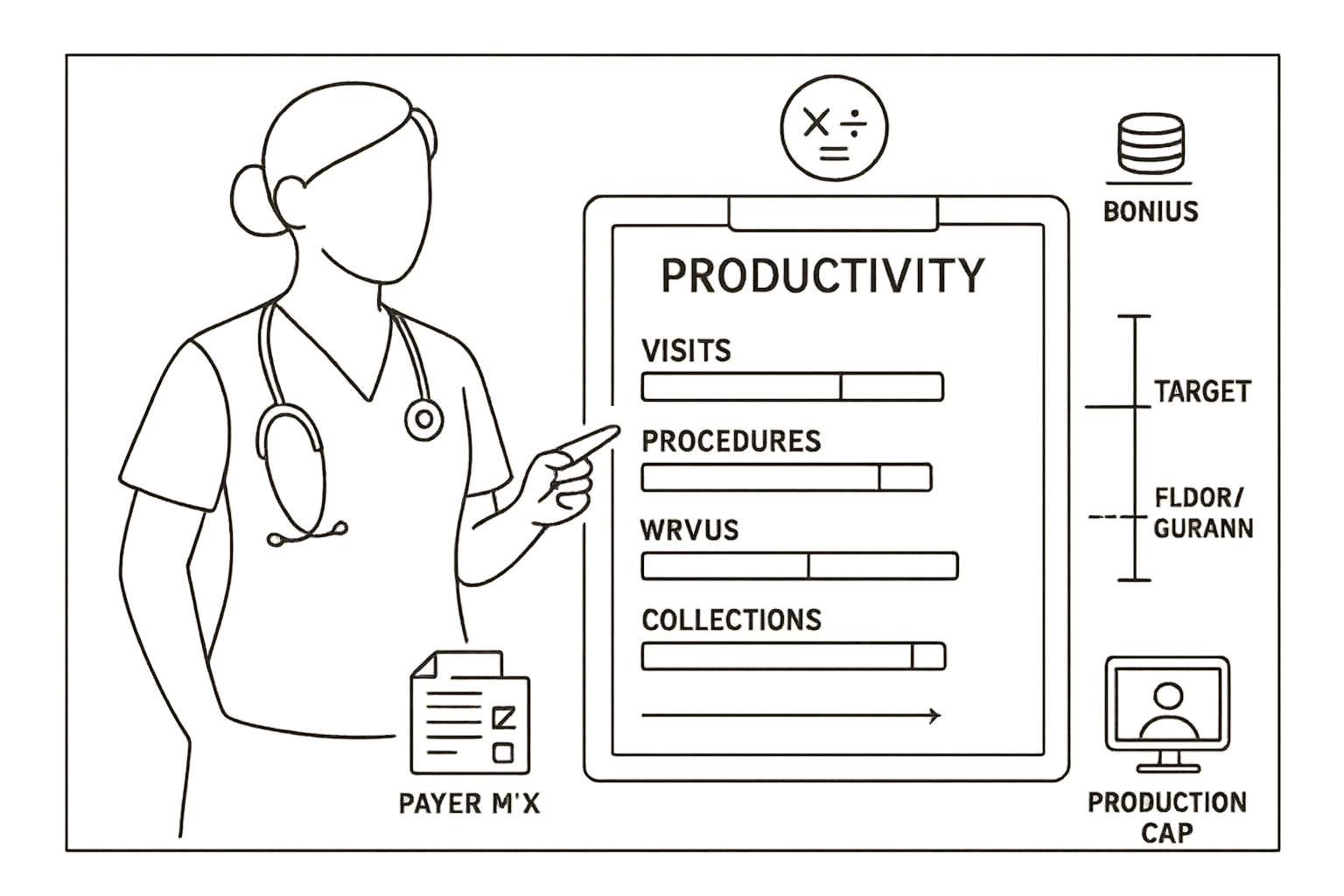
The word “productivity” is not a complete formula. The documents must specify whether performance is measured through completed visits, procedures, charges, collections, total RVUs, or work RVUs. They also need to state the threshold, the percentage or conversion factor applied above it, the measurement period, and any cap on variable earnings.
CMS publishes annual Physician Fee Schedule RVU and payment files, including 2026 Physician Fee Schedule information. Beginning in 2026, separate Medicare conversion factors apply to qualifying Advanced Alternative Payment Model participants and other practitioners. Those Medicare payment inputs do not automatically determine an NP’s contractual compensation. A private agreement may use a selected work-RVU schedule, an employer benchmark, or a separately negotiated dollar conversion factor without adopting the Medicare payment rate.
An RVU provision is clearer when it identifies the applicable annual file or code set, whether the measure is total RVUs or work RVUs, how modifiers and corrected claims are handled, and whether updates apply prospectively. The employer’s ability to change the methodology also matters. The documents can clarify the notice required for a revision and whether a later change may reduce compensation already generated under the prior formula.
Operational Conditions Can Determine Whether a Target Is Achievable
A threshold must be evaluated in the context of the work the NP will actually perform. Specialty, patient complexity, payer mix, visit length, no-show rates, panel development, telehealth, call, administrative duties, leave, and support staffing can materially affect production. A benchmark based on another specialty or a mature patient panel may not fairly predict the output of a newly hired clinician.
Conditions controlled by the employer can be equally important. Delayed credentialing, inadequate scheduling, reassignment to nonbillable duties, clinic closures, or unavailable collaborating personnel may prevent the NP from reaching the target. The agreement can address whether thresholds are prorated or adjusted during onboarding, approved leave, operational disruptions, or a material change in duties.
Some formulas carry a shortfall into later periods and offset it against future production. This negative-accrual mechanism may substantially delay or eliminate a later bonus even after performance improves. The provision needs to explain how a deficit arises, whether it resets, whether salary advances are recoverable, and what happens to a negative balance when employment ends. These issues are examined more fully in the resource on negative accrual in NP contracts.
Quality Measures, Attribution, and Data Transparency
A quality measure is useful only if the contract identifies what is being measured and how the result will be determined. Clinically relevant measures may include preventive services, chronic-condition management, timely access, documentation, patient experience, or appropriate utilization. The applicable performance year, measure specifications, benchmark version, patient population, exclusions, and scoring method can all affect the final result.
Private employer bonuses must also be distinguished from federal programs. The Medicare Quality Payment Program includes MIPS, Advanced APM, and model-specific requirements involving quality, cost, improvement activities, interoperability, and other measures. An employer-created quality bonus is not automatically a MIPS or APM payment merely because it uses similar terminology. If a contract expressly incorporates a federal measure or benchmark, it needs to identify the relevant reporting period, specifications, data source, and treatment of later program changes.
Shared-savings and group-based arrangements may depend on claims data, patient attribution, ACO or group reporting, payer reconciliation, and results produced long after the performance period. The NP may have limited influence over those outcomes. Contract analysis can identify whether the incentive depends on individual performance, group results, or both, and whether changes in the NP’s location, panel, or assigned duties alter attribution.
The reporting provision is as important as the stated target. Useful records may include credited encounters, billed services, RVUs, collections, refunds, exclusions, quality scores, benchmark data, and the employer’s underlying calculation. Reports need to arrive early enough for the NP to identify missing encounters or attribution errors before the measurement period closes. A defined correction and dispute process is especially valuable when the employer controls every source record.
Compensation incentives involving federally reimbursable services may also require compliance analysis. Depending on the structure, recipients, referral relationships, payer mix, and effect on clinical decision-making, productivity, utilization, cost, or shared-savings payments can implicate federal fraud-and-abuse and professional-conduct concerns. Describing a payment as a quality bonus does not by itself resolve those issues, and no incentive should encourage inappropriate coding, unnecessary services, patient selection, or compromised clinical judgment.
When Incentive Compensation Becomes Earned or Repayable
Calculation, earning, and payment are separate events unless the agreement clearly treats them as the same. A plan may measure performance quarterly, calculate the result after claims mature, and delay payment until an annual reconciliation. If continued employment on the payment date is required, an NP who completed the work may nevertheless lose the incentive after resignation or termination.
Audit and reconciliation provisions determine whether an earlier calculation is final. Important terms include the audit period, the errors that permit an adjustment, the treatment of refunds and corrected claims, and the process for disputing a revised calculation. An open-ended clawback or recoupment right can shift significant financial risk to the clinician, particularly if the employer may recover money through payroll deductions or demand repayment after employment ends.
State law may impose requirements that override or limit the contract’s treatment of earned wages, bonuses, deductions, repayment obligations, and final compensation. The governing state and the exact wording of the plan therefore matter. A provision that calls a payment “discretionary” may also operate differently from a formula under which the NP has already satisfied defined conditions.
Termination language needs to address compensation generated before departure but calculated, collected, or reconciled later. It can distinguish voluntary resignation, termination without cause, termination for cause, disability, and nonrenewal. Pending claims, later collections, quality results, negative balances, and prorated targets all warrant attention. The guide to terminating an NP agreement explains how compensation issues interact with notice, repayment, and post-employment obligations.
Related Contract Terms That Change the Economic Risk
An incentive exhibit cannot be evaluated in isolation from the rest of the agreement. Scope-of-practice, scheduling, call, administrative, telehealth, and location provisions determine which services the NP may perform and how much clinical time is available. Where supervision or collaboration is required, the allocation of responsibilities and the continuity of that relationship may directly affect productivity. The resource on NP supervision and collaboration agreements addresses those operational connections.
Malpractice coverage can change the financial consequences of leaving, particularly when the employer provides claims-made insurance but assigns tail coverage to the NP. Recruitment payments may create separate repayment exposure, while a broad outside-activities provision can restrict supplemental work during a slow onboarding period. These obligations may outweigh a projected bonus if they are triggered by circumstances outside the clinician’s control.
Restrictive covenants can compound a compensation dispute by limiting post-employment opportunities. The FTC currently states that its nationwide Noncompete Rule is not in effect or enforceable, so the analysis generally continues to depend heavily on applicable state law and the contract’s specific language. Geographic, temporal, service, nonsolicitation, and patient restrictions can be evaluated through the resource on non-compete clauses for nurse practitioners.
Common warning signs include undefined metrics, missing reporting rights, unexplained caps, employer discretion to revise the plan retroactively, open-ended audit periods, group measures the NP cannot meaningfully influence, and forfeiture of compensation after the work has been completed. Clearer language can identify the data source, limit retroactive adjustments, provide a correction process, address operational disruptions, and state how earned compensation will be handled when employment ends.
Frequently Asked Questions
What should an NP productivity bonus formula define?
The formula should identify the production measure, threshold, conversion factor or percentage, measurement period, attribution method, reporting rights, payment date, and any earnings cap. It should also explain whether the employer may revise the methodology and how reconciliations or calculation errors will be handled.
Are CMS RVUs the same as the RVUs used in an NP employment contract?
Not necessarily. CMS publishes RVU and Physician Fee Schedule data for Medicare payment, but a private employer may use work RVUs, a selected annual file, an internal benchmark, or a separately negotiated conversion factor. The contract needs to identify the exact methodology rather than referring generally to RVUs.
How does a collections bonus differ from an RVU bonus?
A collections bonus depends on revenue the employer actually receives, so billing performance, payer processing, refunds, adjustments, and accounts-receivable timing may affect payment. An RVU plan generally depends more heavily on coding, credited units, thresholds, attribution rules, and the contractual conversion factor.
Can an employer change productivity or quality targets during employment?
The answer depends on the employment agreement, incentive exhibit, and incorporated policies. Some documents reserve broad amendment authority, while others require notice, mutual agreement, or a written modification. The review should determine whether a change can apply retroactively or reduce compensation already generated.
What happens to an unpaid incentive when the NP leaves?
The contract may require continued employment on the payment date, provide payment for incentives earned through the final day of work, or apply different rules based on the reason employment ends. Applicable state wage law may also affect earned bonuses, deductions, repayment demands, and final-payment timing.
What records help an NP verify incentive compensation?
Relevant records may include encounter reports, credited RVUs, collections attributed to the NP, refunds, exclusions, quality scores, benchmark data, patient-attribution information, and the employer’s calculations. The agreement should provide a practical opportunity to review those records and dispute errors before the calculation becomes final.
Review Your NP Incentive Compensation Before Signing
Chelle Law reviews productivity formulas, quality measures, reporting rights, clawbacks, and termination terms so you can understand how the proposed agreement allocates financial risk.
Contact Chelle LawExplore Nurse Practitioner Contract Guidance
Review legal services, practical contract resources, and state-specific information for nurse practitioners.