
Relative value unit compensation ties a nurse practitioner’s pay to measured clinical productivity. These arrangements appear in outpatient practices, hospitals, specialty groups, and other healthcare settings, but “RVU compensation” does not describe one standard formula. An employer may use work RVUs, total RVUs, collections, or a separate internal productivity ledger, and each method can produce a materially different financial result.
The details matter because an appealing conversion rate may be offset by a high threshold, narrow attribution rules, unfavorable proration, delayed reporting, or repayment provisions. Patient volume, scheduling, coding, billing, staffing, payer requirements, and nonclinical duties also affect whether an NP can realistically reach the stated target. When the formula disregards factors controlled by the employer, substantial compensation risk may shift to the clinician.
Before accepting an RVU arrangement, an NP needs to understand how units are assigned, which services receive credit, when incentive compensation becomes earned, and what happens when employment ends. Chelle Law’s NP compensation and productivity review evaluates the formula together with reporting rights, repayment language, duties, restrictive covenants, malpractice provisions, and termination terms. This guide explains the provisions that determine the practical value and risk of an RVU offer.
Key Features of an NP RVU Compensation Plan
- The agreement needs to distinguish work RVUs from total RVUs, Medicare payment amounts, collections, and any employer-created productivity measure.
- Attribution rules determine whether the NP receives credit for shared visits, incident-to services, procedures, telehealth, and monthly or bundled care-management services.
- Thresholds, conversion factors, tiers, caps, quality conditions, and proration rules determine the realistic value of an incentive.
- Periodic reports and a meaningful correction process are essential for identifying missing or inaccurate productivity credit.
- Draw reconciliation, negative accrual, audit, refund, and clawback clauses can create repayment exposure during employment or after departure.
How RVUs Translate Into Nurse Practitioner Pay
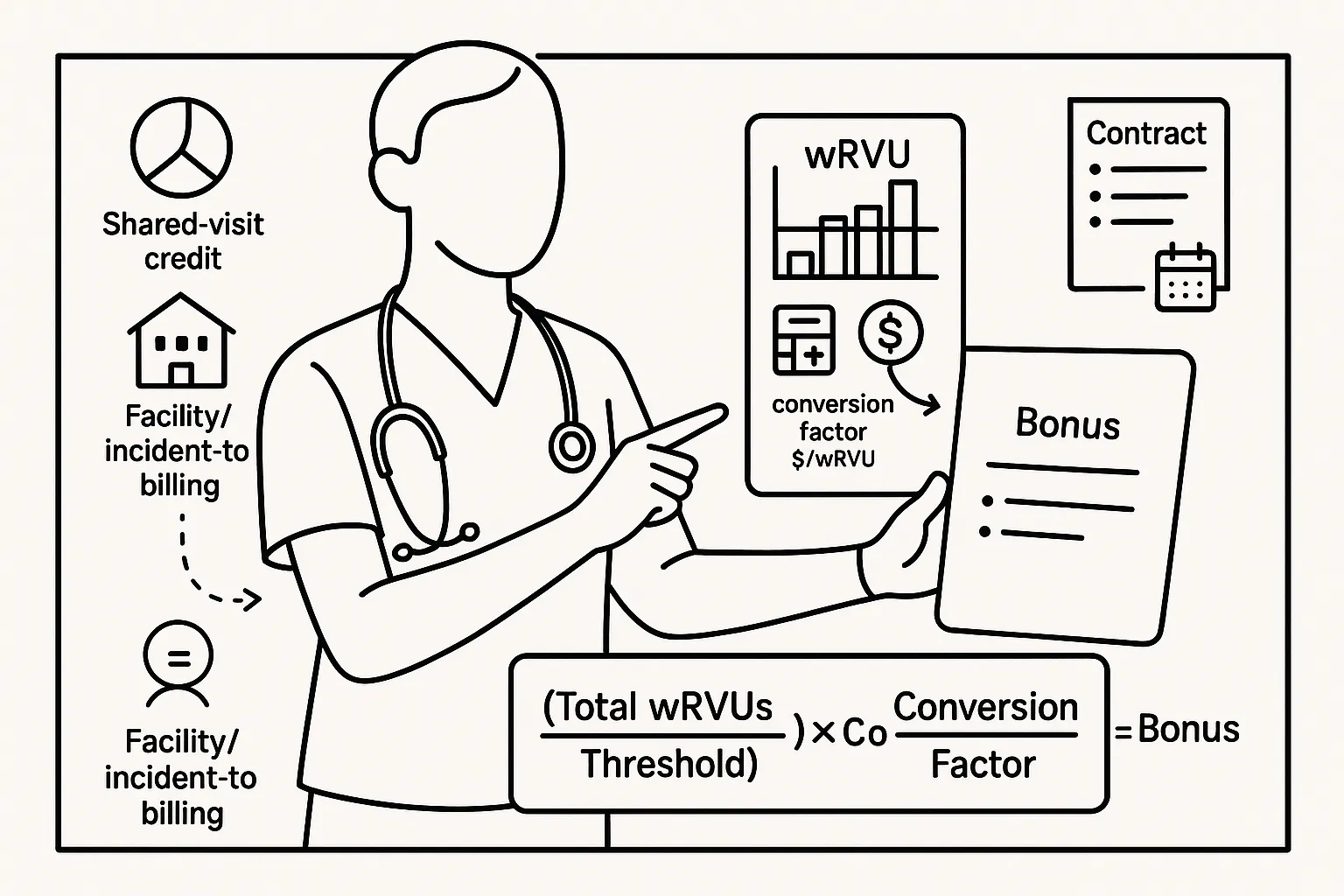
RVUs originated in the Medicare Physician Fee Schedule, which assigns separate values for practitioner work, practice expense, and malpractice expense. Medicare applies geographic adjustments and a federal conversion factor when calculating payment. Private employment agreements often use only the work component, or wRVU, as an internal productivity measure. The amount an employer pays for each credited wRVU is a contractual conversion factor and is not necessarily the Medicare payment conversion factor.
This distinction prevents several common misunderstandings. A wRVU is not the same as a total RVU, billed charge, collected dollar, or reimbursement amount. Medicare payment and billing rules also do not automatically determine which clinician receives productivity credit under an employer’s compensation plan. The agreement must identify the measure being used and explain how that measure converts into pay.
RVU Schedules, Conversion Factors, and Thresholds
An agreement may incorporate a particular year’s RVU schedule or refer generally to the current schedule published by the Centers for Medicare & Medicaid Services. CMS updates its Physician Fee Schedule relative value files annually. The 2026 methodology includes changes affecting work RVUs, practice-expense and malpractice values, geographic adjustments, and payment conversion factors. If a contract automatically adopts future CMS values, later revisions may change compensation even when the employer does not amend the stated contractual conversion rate.
A common formula combines a base salary with an incentive calculated by multiplying credited wRVUs above a threshold by a contractual conversion factor. For example, assume an annual threshold of 5,000 wRVUs and a $35 conversion factor for each credited wRVU above that target. If the NP records 6,200 compensable wRVUs, the illustrative incentive is (6,200 − 5,000) × $35, or $42,000.
The apparent simplicity of that calculation can conceal significant conditions. A plan may use monthly or quarterly thresholds, tiered rates, bonus caps, quality gates, or different values for particular services. The documents also need a clear method for handling part-time status, a midyear start, approved leave, reduced clinic availability, changes in duties, or transfers between locations. A fixed target can become unattainable when the time available to generate wRVUs decreases without corresponding proration.
Billing Attribution and Internal Productivity Credit
Attribution rules establish whether the NP receives credit for office visits, procedures, telehealth encounters, facility services, shared visits, incident-to services, care coordination, and other work. Nurse practitioners in primary care may also need to confirm whether monthly or bundled services, including eligible advanced primary care management services, appear on the productivity ledger. A formula limited to conventional office-visit codes may omit meaningful work that generates reimbursement for the employer.
CMS permits NPs to bill covered services under their own National Provider Identifier or reassign those services to an employer or contractor. Certain incident-to services may be billed under different rules when the applicable requirements are met, including supervision, continued practitioner involvement, and compliance with state law. Billing eligibility and internal compensation credit are separate questions. The agreement needs to explain whether the NP receives wRVUs when a service is billed under the employer or another practitioner.
For facility split or shared evaluation and management services, CMS billing attribution may depend on which practitioner performs the substantive portion under current requirements. That determination does not necessarily control the employer’s internal wRVU allocation. The contract or compensation policy can clarify how credit is divided when the NP performs substantial work but another practitioner submits the claim. Similar questions can arise with telehealth and virtual supervision, so the formula needs to account for the actual billing and supervision model used by the practice.
Common RVU Compensation Structures
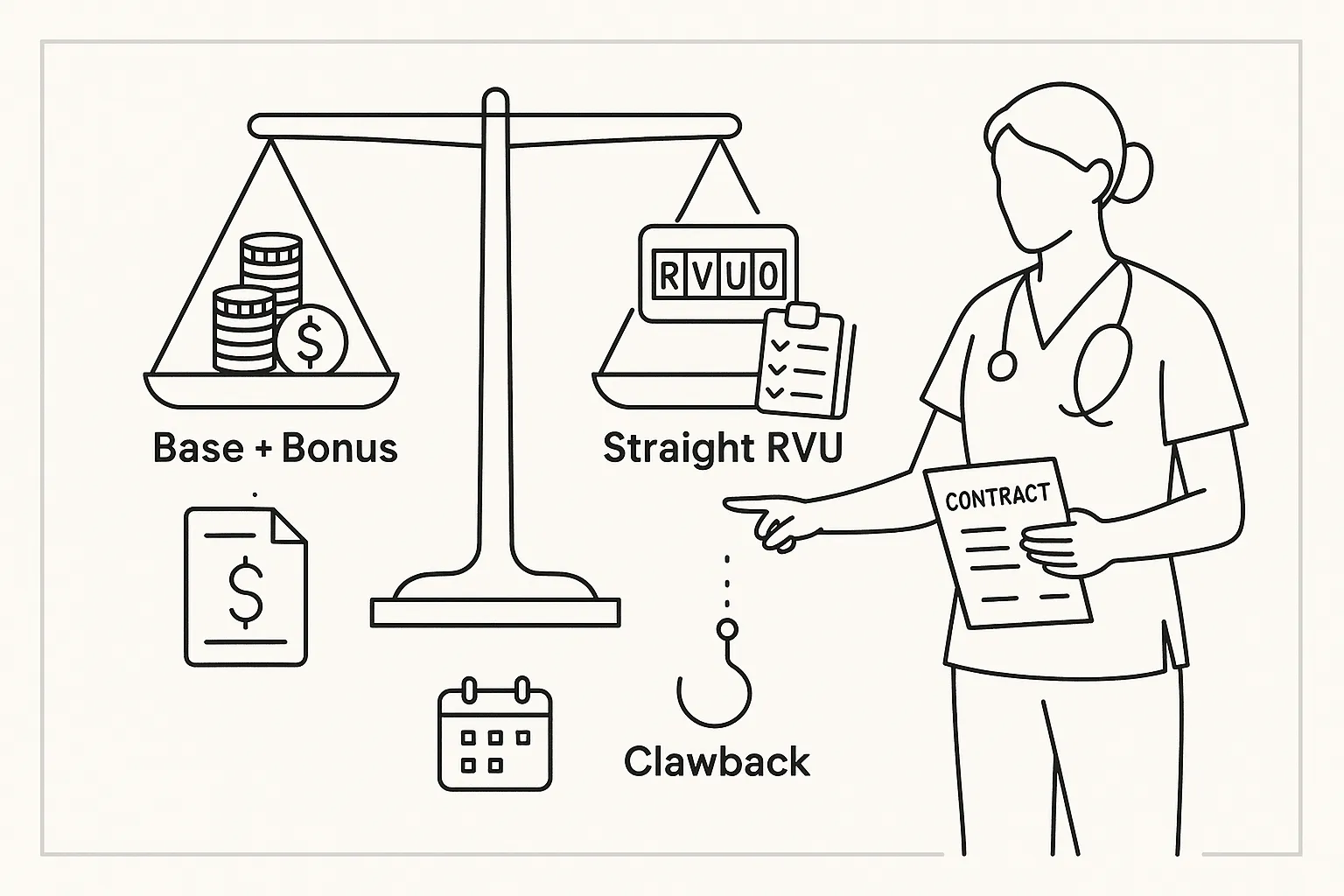
RVU arrangements allocate financial risk differently depending on whether compensation includes a guaranteed salary, production incentive, draw, or reconciliation process. The conversion factor cannot be evaluated in isolation. The threshold, service mix, patient demand, appointment schedule, staffing, and employer-controlled billing systems all affect what an NP can earn. Reviewing other nurse practitioner compensation models can help place an RVU offer in context.
Base Salary, Productivity Bonuses, and Straight Production
A base-salary-plus-bonus plan provides predictable regular pay and adds incentive compensation after the NP exceeds a defined target. This structure can limit short-term income volatility, particularly for a new graduate or a clinician developing a patient panel. The language still needs to establish whether the salary is guaranteed or merely an advance against expected production. It also needs to explain how the RVU incentive interacts with quality, retention, or other bonus structures and payout conditions.
Under straight-production compensation, most or all earnings depend on credited output. The earning potential may be higher, but the NP assumes more risk from low patient volume, scheduling gaps, payer denials, insufficient staffing, and inaccurate coding. Required activities such as chart completion, inbox management, teaching, meetings, care coordination, and administrative work may consume substantial time without producing credited wRVUs.
The best structure depends on the position and the degree of control the NP has over productivity. New graduates and clinicians building a practice may place greater value on guaranteed compensation, while an experienced NP with reliable volume may prefer a stronger production component. In either case, the formula needs to align productivity expectations with patient complexity, appointment length, schedule control, staffing, and required nonclinical responsibilities.
Draws, Reconciliation, Negative Accrual, and Clawbacks
Some employers pay a periodic draw and later compare the draw with actual production. Depending on the wording, the draw may be guaranteed compensation, a recoverable advance, or an arrangement that carries a deficit into the next measurement period. If production falls short, reconciliation language may reduce future pay or permit a repayment demand.
Negative accrual can become especially burdensome when a shortfall follows reduced scheduling, insufficient support, delayed credentialing, billing errors, payer denials, or other circumstances outside the NP’s control. The contract needs to identify whether deficits carry forward, when they reset, whether positive production in one period can be offset by a later deficit, and whether the employer can collect a balance after termination. The guide to negative accrual in NP contracts addresses these repayment risks in greater detail.
Audit and clawback provisions also require careful attention. A payer refund or coding correction may arise long after the service was performed, and broad language can shift the entire loss to the clinician. Important questions include what triggers a repayment, who determines the amount, whether the NP can inspect the supporting records, how long liability continues, and whether the clause distinguishes clinician-caused errors from employer-controlled administrative problems.
Contract Terms That Determine Whether the Formula Works
The most important RVU provisions are often distributed across the employment agreement, compensation exhibit, policies, repayment clauses, and termination section. Reading only the headline conversion rate can miss the terms that control when compensation is earned, how calculations can change, and whether an incentive survives the end of employment.
- Definitions: The documents can identify the RVU schedule, work or total RVU measure, included codes, excluded services, and treatment of corrected claims.
- Attribution: The formula can address shared visits, incident-to billing, procedures, telehealth, facility work, bundled services, modifiers, and services billed under another practitioner.
- Threshold and conversion factor: The agreement can specify the measurement period, tiers, caps, quality conditions, and proration methodology.
- Reporting: Periodic statements can show credited services, wRVUs, adjustments, denials, calculations, and year-to-date performance.
- Disputes: A workable process can provide sufficient time and supporting data to identify omitted services and challenge inaccurate credit.
- Payment timing: The language can establish when compensation is calculated, when it becomes earned, and when it is paid.
- Amendments: Limits on unilateral changes can prevent retroactive threshold increases, reduced conversion factors, or new exclusions.
- Termination: The agreement can explain whether the final period is prorated and whether earned but unpaid compensation is paid after departure.
Reporting rights deserve particular attention because an NP cannot verify a bonus without access to the underlying data. A summary number may not reveal omitted encounters, incorrect attribution, later reversals, or changes to code values. Reports need enough detail to compare services performed with the employer’s ledger, and the correction period needs to remain open long enough for the clinician to identify recurring errors.
Formula changes can also alter expected earnings. If the employer may revise thresholds, attribution rules, or conversion factors through a policy that is not attached to the agreement, the stated compensation may be less predictable than it appears. Prospective changes with advance notice present a different risk from retroactive changes affecting work already performed. A focused review of productivity and quality incentive terms can help identify how these conditions interact.
How to Evaluate an RVU Offer Before Signing
An effective review tests the formula using realistic assumptions rather than the highest possible production estimate. When available, useful information includes expected visit volume, appointment lengths, historical production for the position, staffing levels, payer mix, credentialing timelines, and the employer’s sample productivity report. The NP can then model conservative, expected, and high-productivity scenarios.
- A full-time NP with a $90,000 base salary and $30 per wRVU above a 4,000-wRVU threshold would receive an illustrative $24,000 incentive at 4,800 credited wRVUs, for total compensation of $114,000.
- A 0.6 FTE NP with a prorated 3,000-wRVU threshold and a $50 conversion factor would receive an illustrative $10,000 incentive at 3,200 credited wRVUs, in addition to the applicable salary.
- Under a straight-production model paying $60 per credited wRVU, 6,000 wRVUs would equal $360,000 before taxes, deductions, or other applicable expenses. Missing credit and uncompensated administrative work could materially reduce the practical value of that arrangement.
These examples are illustrative rather than market benchmarks. Actual thresholds, rates, credited services, and compensation levels vary by contract, specialty, schedule, payer mix, and employer system. Modeling also needs to account for ramp-up time, leave, credentialing delays, and the possibility that not every required activity generates an RVU.
Warning signs include undefined RVU terminology, broad discretion over attribution, no proration for reduced clinical time, missing reports, immediate repayment demands, and forfeiture of earned incentives at termination. A broader review of common NP contract red flags can help organize questions before signing, but the provisions must ultimately be evaluated together in the actual agreement.
How RVU Pay Interacts With Other Contract Terms
Compensation does not operate independently from the NP’s workload and employment restrictions. Call coverage, multiple practice locations, administrative assignments, supervision or collaboration obligations, and schedule changes may reduce the time available to produce credited services. A productivity target that appears reasonable for a full clinical schedule may become difficult to reach when the agreement permits substantial non-billable duties.
Termination language determines whether an NP receives an incentive for the final measurement period, whether a threshold is prorated, and when the employer completes the last reconciliation. A provision requiring employment on the payment date can cause forfeiture even after the relevant work was performed. A termination provision review can identify how notice, repayment, final compensation, and post-employment obligations interact.
Restrictive covenants may increase the practical cost of leaving an unfavorable compensation arrangement. The Federal Trade Commission’s nationwide noncompete rule is not currently in effect or enforceable, so enforceability remains dependent on applicable state law, judicial decisions, profession-specific restrictions, and the contract’s wording. Geographic restrictions, nonsolicitation clauses, notice periods, and repayment obligations therefore need to be considered alongside the RVU formula rather than treated as unrelated provisions.
Frequently Asked Questions
What is the difference between an RVU and a wRVU?
A total RVU may include components for practitioner work, practice expense, and malpractice expense. A wRVU measures the professional work associated with a service and is the component most often used in productivity compensation. The agreement needs to identify which measure applies because total RVUs, wRVUs, payment amounts, and collections are not interchangeable.
How is an NP’s RVU bonus calculated?
A common formula multiplies credited wRVUs above a stated threshold by a contractual conversion factor. Actual plans may include tiers, caps, quality conditions, prorations, exclusions, or reconciliation provisions, so the entire compensation exhibit must be reviewed rather than only the stated rate.
Is an employer’s wRVU conversion factor the same as Medicare’s conversion factor?
Not necessarily. Medicare uses its conversion factor as part of the federal payment methodology, while an employer may select a separate contractual dollar value for internal compensation. The agreement needs to distinguish the employer’s rate from Medicare reimbursement and explain whether annual CMS schedule changes affect the formula.
How should an RVU threshold address part-time work or leave?
The documents can state how the threshold changes for part-time status, a midyear start, approved leave, reduced clinic time, or a change in duties. Without a defined proration method, an NP may remain responsible for a target that does not reflect the time actually available to generate credited services.
Can an employer require repayment of RVU compensation?
An agreement may contain draw reconciliation, negative accrual, audit, refund, or clawback provisions that permit repayment demands. The triggers, calculation method, time limits, supporting records, and responsibility for employer-controlled billing errors need to be evaluated before signing.
What should an attorney review in an RVU compensation agreement?
An attorney can review the RVU definitions, attribution rules, threshold and conversion formula, reporting rights, payout timing, amendment provisions, repayment obligations, and treatment of unpaid incentives after termination. Those terms also need to be evaluated alongside duties, restrictive covenants, malpractice coverage, and termination language.
Have Your NP RVU Compensation Terms Reviewed
An RVU formula can affect income during employment and after termination. Chelle Law can review the compensation structure, attribution rules, reporting rights, repayment risks, and related contract terms before you sign.
Contact Chelle LawExplore Nurse Practitioner Contract Guidance
Review Chelle Law’s services, practical contract resources, and state-focused information for nurse practitioners.