
A nurse practitioner contract does more than describe a position and its compensation. Its provisions can determine which services the NP may perform, when physician involvement is required, who controls prescribing and clinical protocols, and what happens if credentialing or regulatory requirements delay the work. These terms affect clinical autonomy, earning potential, malpractice exposure, and the NP’s ability to move to another position.
The legal framework varies by jurisdiction and may involve statutes, board of nursing rules, prescribing requirements, facility bylaws, payer standards, and an individual licensure order. An employer may also impose operational limits that are narrower than the authority state law otherwise permits. As a result, a clause stating that an NP will practice “within the scope allowed by law” may not adequately explain the restrictions that will govern the actual job.
A careful contract analysis connects the proposed duties to supervision or collaboration terms, credentialing, billing, compensation, malpractice insurance, termination rights, and post-employment restrictions. Chelle Law reviews how these provisions work together, identifies language that leaves important responsibilities undefined, and helps nurse practitioners understand which terms may warrant clarification or revision before signing.
Key Scope-of-Practice Contract Issues
- State law establishes the regulatory baseline, but employer policies, payer rules, facility privileges, and contract terms may impose additional limits.
- Supervision, collaboration, prescribing, and clinical-approval provisions need enough detail to explain how the position will operate in practice.
- Credentialing, privileging, enrollment, and billing delays can affect the NP’s start date, productivity calculations, and compensation.
- RVU, collections, visit-volume, and quality incentives must account for the services the NP can lawfully perform and the billing method the employer will use.
- Malpractice coverage, indemnification, termination, repayment, and restrictive covenants allocate the consequences of a scope or compliance dispute.
The Regulatory Baseline Is Only the Starting Point
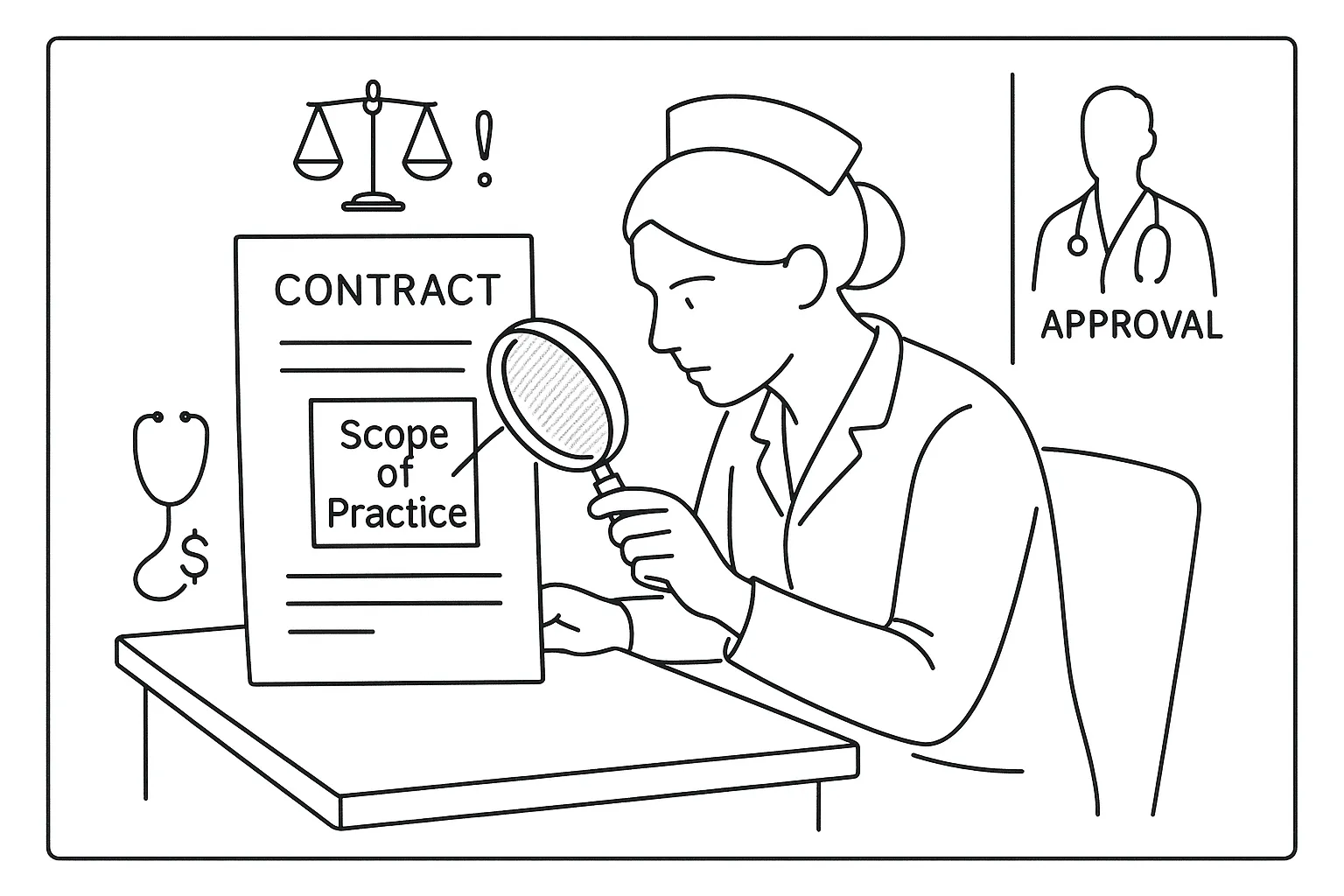
State statutes and licensing rules may address an NP’s authority to diagnose, treat, prescribe, order tests, delegate tasks, or practice without a formal physician relationship. The 2026 AANP state practice environment map groups jurisdictions into full, reduced, and restricted practice categories. That classification is a useful overview, but it is not a substitute for the controlling statute, regulation, board rule, licensure order, or other authority applicable to the particular NP.
The agreement must therefore be evaluated against current requirements in the state where services will be provided. Relevant questions may include whether a collaboration or supervision arrangement is required, what prescribing authority applies, whether controlled-substance practice carries additional conditions, and which professional titles or representations are permitted. The applicable board of nursing and any other licensing authority involved in the position remain important sources for current requirements.
State law often describes the outer boundary of permitted practice rather than the day-to-day authority granted by a particular employer. A hospital, clinic, or medical group may use credentialing criteria, formularies, clinical protocols, quality policies, or privilege restrictions that narrow what the NP can do. Contract review can identify the difference between the regulatory ceiling and the operational scope of the offered position.
How the Agreement Defines the NP’s Actual Clinical Role
Scope provisions need to be read with the job description and every document incorporated by reference. Broad language allowing the employer to change duties, locations, schedules, service lines, or policies can materially alter the position after signing. The analysis is not limited to whether a duty is legally permitted; it also considers whether the NP has the training, credentials, support, time, and compensation required to perform it safely.
Supervision, Collaboration, and Prescribing
A supervision or collaboration clause may identify the responsible physician or other authorized professional, required availability, chart-review procedures, meeting frequency, documentation duties, and substitute coverage. A generic reference to “supervision as required by law” may leave practical questions unanswered, particularly when the employer expects on-site availability, rapid approval, or review beyond the regulatory minimum.
Clinical-approval standards also need objective context. For example, a requirement to obtain approval for every “complex case” creates uncertainty if neither the agreement nor an incorporated policy defines complexity or explains how approval is obtained. A review of the related supervision and collaboration agreement can reveal whether its responsibilities, term, and termination provisions align with the employment contract.
Prescribing language may address state authority, DEA registration, controlled substances, internal formularies, electronic prescribing, refill protocols, and employer approval procedures. The allocation of registration costs and renewal duties can also be important. Undefined restrictions may interfere with patient care or expose the NP to discipline under an employer policy that was not provided before signing.
Credentialing, Privileges, Enrollment, and Billing
An agreement may promise a particular clinical role even though the work depends on payer credentialing, facility privileges, Medicare enrollment, or reassignment of billing rights. Contract terms can allocate responsibility for preparing applications, supplying information, paying fees, monitoring renewals, and responding to delays. They can also explain whether salary begins on the employment date, the first clinical day, or only after specified approvals are complete.
CMS guidance for advanced practice registered nurses distinguishes services billed under an NP’s own National Provider Identifier from services reassigned to an employer or contractor. Medicare incident-to billing involves separate conditions, including requirements involving an initiating practitioner, active involvement, supervision, setting, and applicable state law. Those billing rules do not independently expand or establish the NP’s state scope of practice.
Credentialing language also matters when a delay is outside the NP’s control. The contract can address temporary duties, base compensation, productivity thresholds, termination rights, and repayment obligations while enrollment or privileges remain pending. Employer sponsorship of privileges does not necessarily establish that every service listed in the job description has been approved by the facility or payer.
Compensation Terms Can Create Scope and Billing Risk
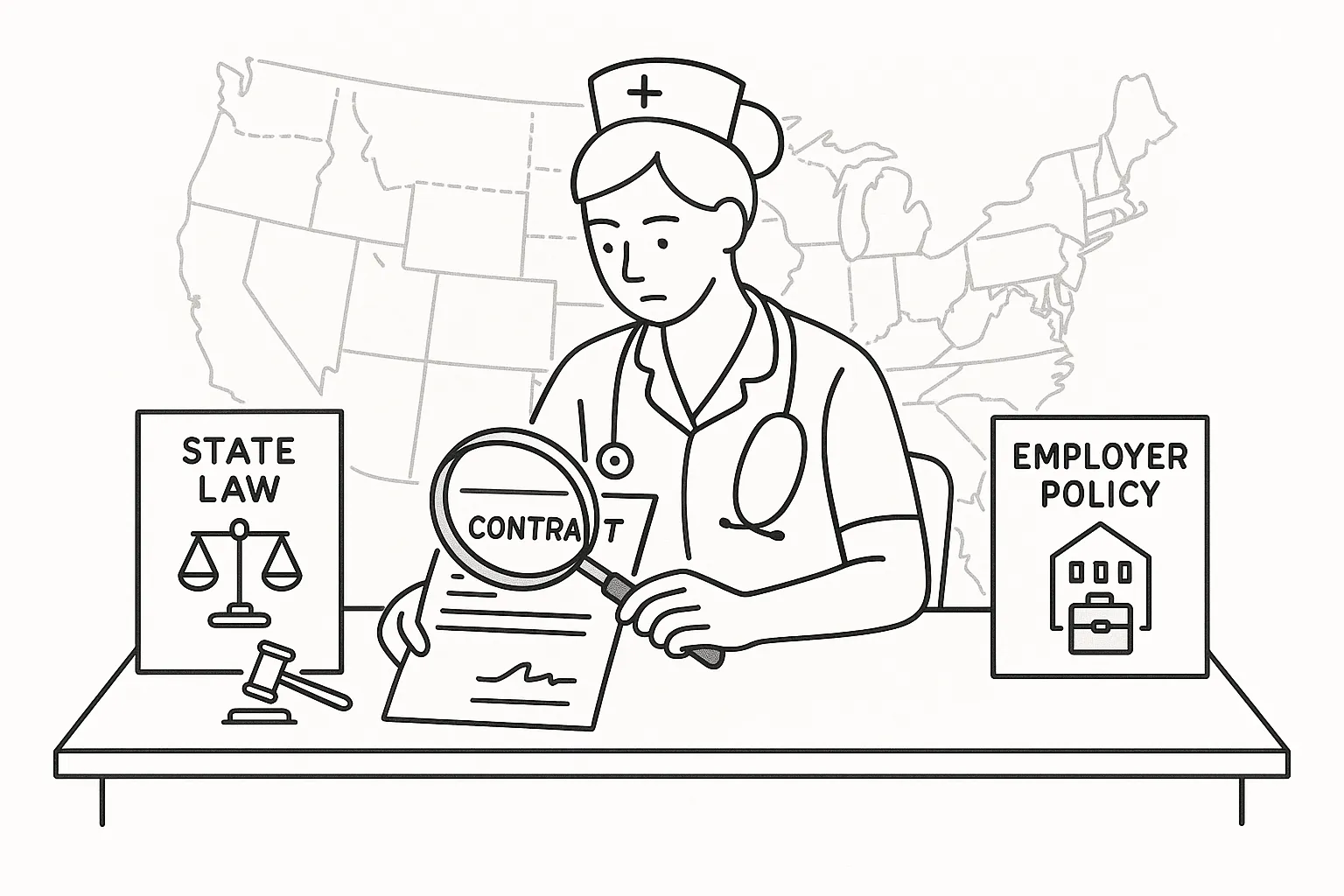
Compensation formulas can create pressure that the clinical-duty section does not reveal. Visit quotas, work relative value unit targets, collections percentages, quality measures, and bonus thresholds may assume that the NP can perform or bill for a particular volume of services. If actual privileges, staffing, scheduling, payer rules, or supervision arrangements prevent that volume, the NP may carry financial risk that is not apparent from the stated salary or bonus rate.
Productivity Formulas and Billing Assumptions
A productivity provision needs a defined methodology. Important details include which personally performed services receive credit, how shared visits are handled, whether credit is based on billed or collected amounts, when reconciliations occur, and whether negative balances carry forward. Chelle Law’s guide to nurse practitioner compensation models explains how these structures shift financial risk between the parties.
The formula should not assume that every NP service qualifies for Medicare incident-to reimbursement. CMS incident-to guidance imposes specific conditions concerning the treatment relationship, supervision, practice setting, and state law. A contract that bases compensation on an unstated billing assumption may produce lower credit than the NP expected or create compliance pressure when a service must be billed directly.
A focused compensation and productivity review can evaluate definitions, thresholds, reconciliation periods, exclusions, and negative accrual. It can also identify whether the employer retains unilateral authority to change the formula or the underlying billing methodology.
Telehealth, Multiple Locations, and Reassigned Duties
Telehealth clauses can raise licensure, prescribing, supervision, privacy, and malpractice questions in every jurisdiction where patients are located. The agreement may need to allocate responsibility for obtaining and maintaining licenses, registrations, payer enrollment, and technology access. It can also address whether the employer may assign patients in additional states without the NP’s prior agreement.
Similar concerns arise when an employer can move the NP among clinics, hospitals, service lines, or patient populations. New locations may involve different privilege requirements, travel time, call obligations, support staff, productivity opportunities, and insurance considerations. Language allowing reassignment needs to be considered alongside expense reimbursement, schedule control, compensation, and the NP’s ability to decline work outside existing training or credentials.
Who Bears the Consequences of a Scope Dispute?
A scope-of-practice conflict may affect more than clinical duties. If the NP cannot perform an assigned service, loses privileges, questions an employer protocol, or lacks required supervision, other provisions determine who absorbs the resulting cost. The agreement may permit termination, suspend compensation, demand repayment, or shift liability through an indemnification clause.
- Malpractice insurance: The contract can identify whether coverage is occurrence-based or claims-made, the applicable limits, covered services and locations, consent-to-settle rights, and responsibility for tail coverage. The distinction is explained further in the guide to claims-made and occurrence coverage.
- Indemnification: Broad indemnity language may require the NP to reimburse the employer for claims involving institutional systems, employer-directed treatment, billing practices, or policies rather than only the NP’s own conduct.
- Termination: Undefined compliance or policy violations may support immediate termination, while without-cause termination may require advance notice. Either route can affect earned bonuses, collections, privileges, insurance, and repayment obligations.
- Repayment: Signing bonuses, relocation allowances, training expenses, and other advances may become repayable when employment ends. The trigger, prorating formula, exceptions, and offset rights need to be understood.
- Restrictive covenants: Noncompete, nonsolicitation, confidentiality, and patient-contact restrictions may limit the NP’s next position even when the employment relationship ended because the offered duties could not be performed.
The FTC’s 2024 nationwide noncompete rule is not currently in effect or enforceable. That does not establish that every healthcare noncompete is enforceable. State law, applicable federal law, the contract’s wording, and current enforcement developments must be evaluated separately. A practical review of an NP noncompete clause considers its duration, geography, covered activities, patient restrictions, and effect on realistic employment options.
Scope-of-Practice Terms to Clarify Before Signing
The most important questions depend on the jurisdiction and position, but the following issues commonly warrant review before an NP accepts an employment or independent contractor agreement:
- Whether the stated duties match applicable law, the NP’s education and certification, granted privileges, payer enrollment, and available support.
- Which supervision or collaboration requirements apply and who is responsible for maintaining the necessary relationship.
- How physician availability, chart review, clinical escalation, substitute coverage, and disagreements will be handled.
- Who obtains and pays for licenses, DEA registration, payer enrollment, credentialing, and facility privileges.
- What happens to the start date, salary, productivity targets, and employment status during a credentialing or enrollment delay.
- How personally performed services, reassigned billing, shared services, and incident-to billing affect productivity credit.
- Whether the employer can change duties, locations, schedules, patient populations, policies, or compensation without mutual agreement.
- Whether malpractice coverage extends to every service, facility, telehealth jurisdiction, and outside activity required by the position.
- How a loss of privileges, supervision, collaboration, enrollment, or prescribing authority affects termination and repayment obligations.
- Which restrictions continue after employment and whether they materially limit the NP’s ability to practice elsewhere.
Reviewing these provisions as an integrated risk-allocation framework provides a more accurate picture than reading the scope clause alone. It can expose conflicts between the promised role and the compensation formula, incorporated policies, insurance coverage, or termination language before those conflicts become operational or financial problems.
Frequently Asked Questions
Can an employer impose narrower practice limits than state law permits?
An employer may use policies, privileges, formularies, or contractual requirements that are narrower than the maximum authority permitted by state law, provided those restrictions are otherwise lawful. The contract and incorporated documents need to be reviewed to determine how the actual position differs from the state regulatory ceiling.
What details belong in an NP supervision or collaboration provision?
The provision may need to identify the responsible professional, required availability, meeting or chart-review procedures, documentation duties, substitute coverage, escalation methods, and the effect of ending the relationship. The necessary terms depend on state law and the position’s operational requirements.
Does employer credentialing authorize every service listed in the job description?
Not necessarily. Licensure, payer enrollment, facility privileges, employer credentialing, and internal clinical approval are distinct requirements. The agreement can allocate responsibility for each process and explain what happens if an approval is delayed, limited, or denied.
How can incident-to billing affect an NP compensation formula?
Medicare incident-to billing applies only when its specific requirements are satisfied. A productivity formula that assumes all NP services qualify may overstate expected reimbursement or credit, so the agreement needs a clear billing methodology for directly billed, reassigned, shared, and incident-to services.
What should an NP contract address about multistate telehealth?
The contract may identify approved patient locations, licensure and registration responsibilities, prescribing restrictions, supervision or collaboration requirements, payer enrollment, malpractice coverage, and employer support for ongoing compliance. These obligations can vary by jurisdiction and service.
What happens if an NP cannot perform an assigned duty for regulatory reasons?
The outcome depends on the agreement’s duty, compensation, reassignment, termination, repayment, insurance, and dispute provisions. Contract review can identify whether the employer may suspend pay, change duties, terminate employment, or demand repayment when the issue was caused by credentialing, supervision, privilege, or regulatory limitations.
Have an Attorney Review Your NP Contract
Chelle Law can analyze how scope, supervision, prescribing, billing, compensation, malpractice, and termination provisions work together so you can understand the agreement before signing.
Contact Chelle Law