
Nurse practitioner supervision and collaboration agreements define how an NP, a physician, and sometimes an employer will coordinate clinical responsibilities. Depending on the jurisdiction and practice setting, these documents may address prescribing, consultation, chart review, escalation procedures, billing, credentialing, physician availability, and approved practice locations. They may accompany an employment contract or independent contractor agreement, but their obligations can extend beyond the primary contract.
Not every NP is legally required to maintain the same type of physician relationship. State practice authority varies substantially, and the legal requirements may depend on the NP’s role, prescribing authority, patient population, and location. Hospitals, employers, payers, and credentialing bodies can also impose operational standards beyond the minimum required by state law. A document labeled “collaboration” may therefore create meaningful oversight, financial, or termination obligations even when the label sounds informal.
Contract review focuses on how these obligations work together in practice. Important questions include whether the NP’s duties match applicable authority, who bears collaboration and credentialing costs, how downtime affects compensation, whether malpractice coverage reaches every practice location, and what happens if the designated physician leaves. Chelle Law reviews these provisions alongside the employment or contractor agreement to identify conflicting terms, unclear risk allocation, and obligations that may warrant clarification before signing.
When an NP Supervision or Collaboration Agreement Is Required
State law controls whether an NP may practice independently or must maintain supervision, collaboration, delegation, or another formal relationship. The terminology is not uniform. The American Association of Nurse Practitioners classifies state practice environments as full, reduced, or restricted, while the National Council of State Boards of Nursing explains that jurisdictions have not adopted every element of the APRN Consensus Model uniformly. Current statutes, regulations, and nursing board guidance for the state of practice must therefore be checked rather than assuming that one national model applies.
Legal Requirements Versus Employer Policies
A careful review separates obligations imposed by law from conditions created by an employer, medical staff, payer, or credentialing organization. A hospital may require specific privileges, committee approval, chart review, or physician availability even if state law permits greater independence. An outpatient practice may instead rely on scheduled consultation, written protocols, and documented escalation procedures.
This distinction affects how a provision can change during the relationship. A statutory requirement may change only when the governing law changes, while an employer policy may be revised under language incorporated into the contract. The documents need to clarify which policies apply, whether future amendments automatically become binding, and what happens if a new requirement materially alters the NP’s duties or ability to practice.
Scope, Prescribing, and Clinical Escalation
The agreement may govern delegated services, prescribing authority, controlled-substance responsibilities, record review, co-signature requirements, procedures, patient populations, and circumstances requiring physician consultation. Those provisions need to align with the NP’s authorized role and the work the employer expects the NP to perform. Chelle Law’s guide to scope-of-practice issues in NP contracts discusses how assigned duties and contractual expectations can create risk when they exceed or conflict with applicable authority.
Operational standards are more useful when they are measurable. A defined chart-review frequency, response procedure, backup arrangement, or meeting schedule provides more clarity than language allowing oversight whenever the employer deems it necessary. The agreement can also identify who responds when the designated physician is unavailable and whether the NP may continue treating patients during that absence.
Clinical Operations, Practice Sites, and Credentialing
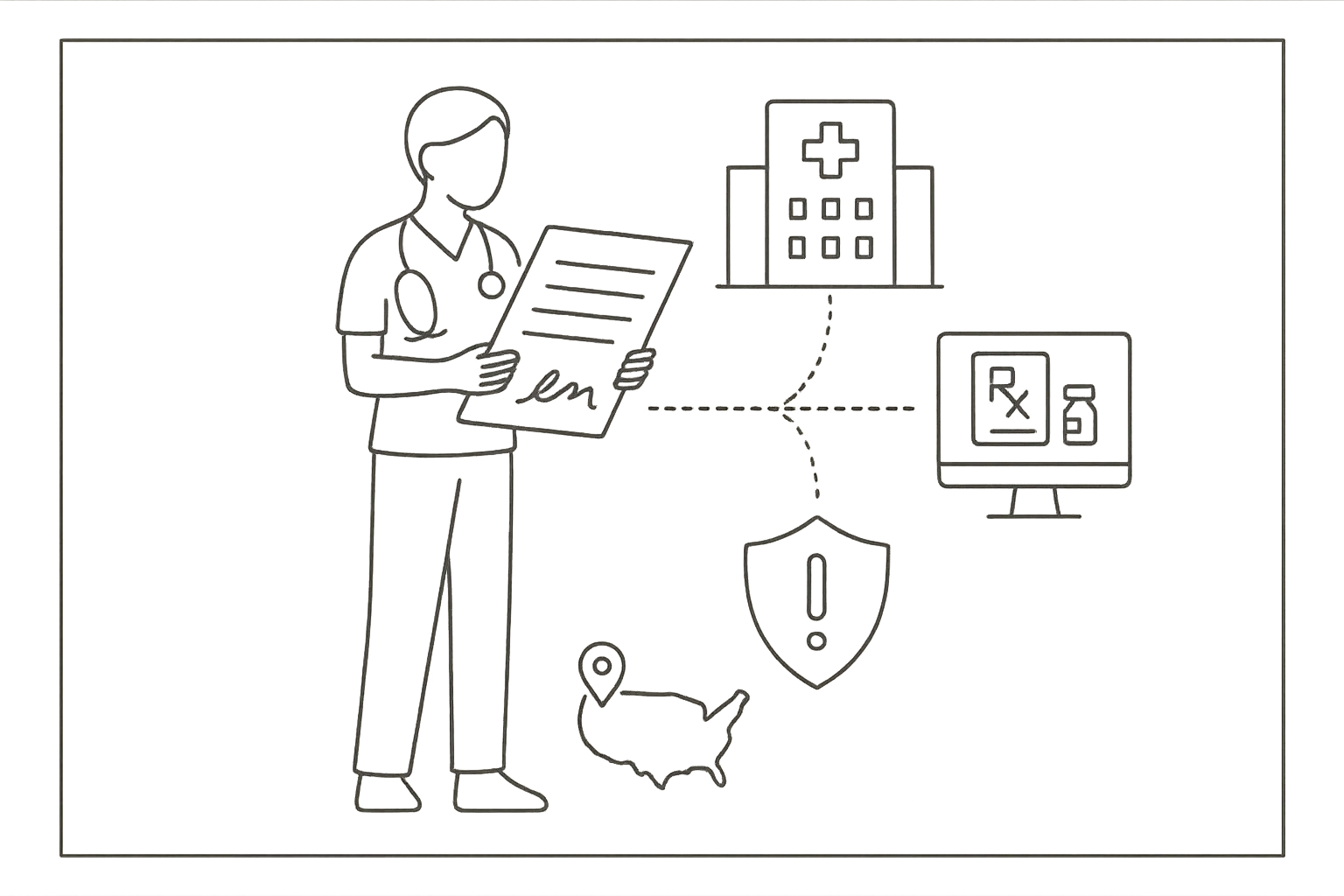
A supervision or collaboration agreement must be workable within the NP’s actual clinical environment. Hospital-based acute care practice may involve medical staff bylaws, privileges, committee approval, and specialty-specific protocols. An outpatient or specialty practice may focus more heavily on consultation availability, chart review, procedures, medication protocols, and coverage during evenings or weekends.
Multi-site work requires particular attention. The documents can identify each approved facility, whether one physician arrangement covers every site, who provides backup coverage, and whether travel or floating duties change the applicable protocols. If the physician can alter practice locations or clinical protocols unilaterally, the NP needs to understand whether those changes could expand duties, increase travel, or interfere with credentialing.
Responsibility for professional licenses, controlled-substance registrations, payer enrollment, hospital privileges, renewals, and administrative fees also needs to be assigned. The agreement can specify who prepares submissions, pays the associated costs, monitors expiration dates, and addresses delays. A credentialing failure can prevent the NP from working or billing even though the employment contract remains active, making the allocation of downtime and related expenses financially significant.
Telehealth and Cross-State Collaboration Terms
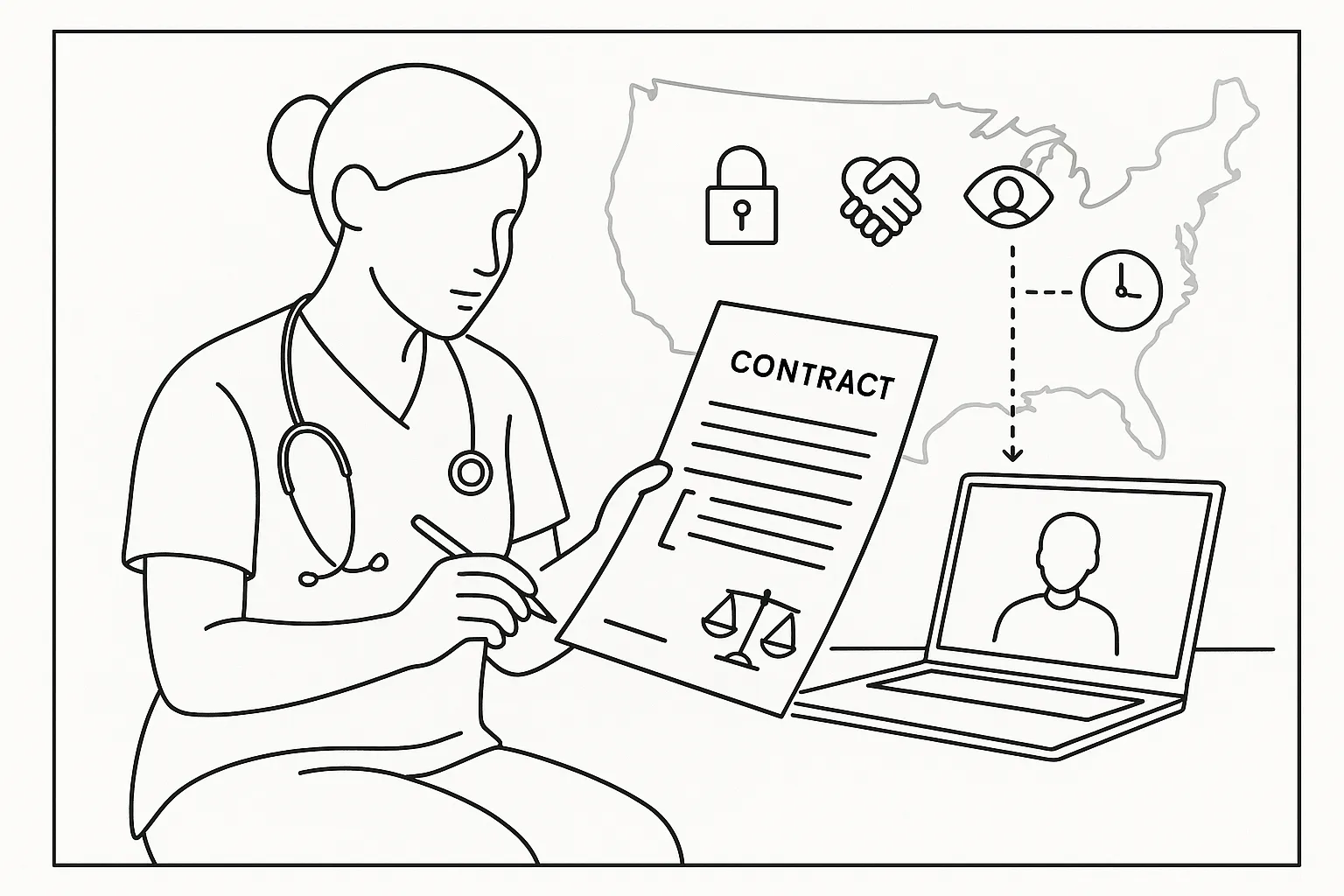
Telehealth agreements must account for the patient’s location, not only the NP’s physical work location. Cross-state practice may involve professional licensure, telehealth registration, compact participation, consent rules, prescribing requirements, and state-specific collaboration conditions. Federal telehealth licensing guidance emphasizes checking the requirements of each jurisdiction where patients are located. One collaboration agreement does not automatically authorize the NP to treat patients in every state.
The documents can identify the jurisdictions in which services are permitted, the physician arrangements applicable to each state, and who is responsible for obtaining and maintaining credentials. They can also address approved technology, patient-location verification, documentation, emergency escalation, equipment, scheduling, and the availability of assistance during remote care. Professional liability coverage must be checked for every jurisdiction in which telehealth patients are treated rather than assumed to follow the NP across state lines.
Controlled-substance prescribing requires a separate layer of analysis. DEA and HHS extended federal telemedicine flexibilities for prescribing Schedule II–V controlled medications through December 31, 2026, subject to federal and state requirements. The agreement needs to identify who holds the necessary registrations, how state prescribing rules will be satisfied, and how the parties will respond if the federal framework changes or the extension expires. Virtual physician availability also should not be treated as automatically satisfying every state-law, payer, or Medicare supervision condition.
Billing, Productivity Credit, and Collaboration Costs
Direct Billing and Medicare Incident-to Services
The agreement needs to distinguish services personally furnished and billed under the NP’s NPI from services billed under another practitioner’s NPI. The Centers for Medicare & Medicaid Services requires Medicare enrollment for NPs who bill directly. Medicare incident-to billing follows different requirements involving the service, setting, supervision, documentation, and applicable state law.
These distinctions can affect coding responsibility, audit exposure, recoupments, attribution of collections, and productivity credit. The contract can explain whose NPI will be used, how personally performed services are tracked, who provides coding support, and how payer denials or post-payment audits are handled. If compensation depends on collections or work relative value units, the formula needs to account for services that are delayed, denied, or attributed to another billing practitioner.
Downtime, Fees, and Compensation Adjustments
A physician’s departure, delayed credentialing, or lapse in required coverage may prevent the NP from treating patients or billing for services. The documents can state whether salary continues, how productivity targets are adjusted, whether the NP must use paid leave, and when either party may end the relationship. Without those terms, the NP may bear the financial consequences of an interruption outside the NP’s control.
Collaboration fees, credentialing charges, license expenses, insurance premiums, and administrative costs also require clear allocation. Any amount deducted from compensation needs a defined basis rather than open-ended employer discretion. A focused NP compensation and productivity review can evaluate how billing rules, supervision-related interruptions, collections, RVUs, bonuses, and reconciliation provisions interact.
Malpractice, Restrictions, and the End of the Arrangement
Malpractice language needs to identify the insurer, policy type, limits, named insureds, covered locations, exclusions, and responsibility for premiums. Occurrence coverage generally responds to covered incidents occurring during the policy period. Claims-made coverage may require tail insurance after the policy or relationship ends. Telehealth arrangements add another question: whether the policy covers services provided to patients located in every authorized state. Chelle Law’s resource on claims-made and occurrence coverage explains why the distinction affects post-termination exposure.
Indemnification provisions must be compared with the insurance policy and primary contract. A broad clause could require the NP to reimburse an employer or physician for losses beyond the NP’s negligence or misconduct, including liabilities the policy does not cover. Reviewing the documents together helps identify an uninsured obligation created by one agreement but omitted from another.
Restrictive covenants may include noncompete, nonsolicitation, confidentiality, patient-contact, or practice-location restrictions. The FTC’s 2024 nationwide Noncompete Rule is not enforceable, so the analysis continues to depend primarily on applicable state law, other federal law, the covenant’s wording, and current legal developments. A nurse practitioner noncompete review can evaluate the restriction in context, including whether it applies after resignation, termination without cause, expiration, or the loss of a collaborating physician.
The agreements also need a workable plan for physician departure. Relevant terms include who locates a replacement, whether the NP may continue practicing, how long the employer has to restore coverage, and whether compensation continues during the interruption. Final compensation, records, credentialing cooperation, malpractice reporting, notice periods, and repayment of signing bonuses or relocation benefits may survive the collaboration relationship. A review of NP termination provisions can identify conflicting exit obligations before they become a dispute.
Checklist for Reviewing the Complete Contract Package
A collaboration document should not be evaluated as an isolated form. Compare it with the employment or contractor agreement, applicable policies, compensation exhibits, malpractice documents, restrictive covenants, and any incorporated clinical protocols. The review should address the following questions:
- Does the agreement correctly identify the NP, physician, employer, effective term, patient population, specialty, and approved practice locations?
- Which obligations come from state law, and which arise from employer policy, credentialing standards, payer rules, or medical staff bylaws?
- Are prescribing authority, delegated duties, chart review, meetings, physician response expectations, backup coverage, and escalation procedures defined objectively?
- Who is responsible for licenses, registrations, payer enrollment, hospital privileges, renewals, collaboration fees, and related administrative costs?
- How are services billed, attributed, audited, and credited toward collections, RVUs, bonuses, or other productivity measures?
- Do malpractice, telehealth coverage, tail insurance, and indemnification provisions align with the actual insurance policy?
- What happens to duties and compensation if the physician leaves, credentials lapse, or the required arrangement becomes unavailable?
- Which noncompete, nonsolicitation, repayment, confidentiality, and termination obligations continue after the collaboration ends?
A coordinated supervision and collaboration agreement review can identify situations in which the NP remains employed but cannot practice, bears costs not disclosed in the primary contract, or becomes subject to post-termination restrictions that were easy to overlook.
Frequently Asked Questions
Does every nurse practitioner need a supervision or collaboration agreement?
No. State requirements vary according to the jurisdiction, NP role, prescribing authority, patient population, and practice setting. Even when state law does not require a physician agreement, an employer, hospital, payer, or credentialing organization may impose additional operational requirements.
What is the difference between NP supervision and collaboration?
The terminology and legal effect vary by state. Supervision may describe direct oversight, while collaboration may involve consultation, physician availability, chart review, or jointly established protocols. The governing law and actual contract language determine the obligations regardless of the document’s title.
Can an employer require more oversight than state law requires?
An employer, hospital, payer, or credentialing body may impose operational standards beyond the minimum established by state law. The agreement needs to distinguish legal requirements from private policies and explain whether policy changes can alter the NP’s duties during the relationship.
What happens if the supervising or collaborating physician leaves?
The contracts need to address who must locate a replacement, whether the NP may continue treating patients, how compensation is handled during the interruption, and whether either party may terminate if coverage is not restored within a defined period.
Does one collaboration agreement cover telehealth patients in every state?
Not necessarily. Licensure, telehealth registration, prescribing, supervision, collaboration, and malpractice requirements may depend on the state where the patient is located. The documents need to identify each authorized jurisdiction and the credentials, physician arrangements, and protocols applicable there.
Why should the collaboration agreement and employment contract be reviewed together?
The documents may address the same duties, compensation, billing, malpractice coverage, restrictive covenants, and termination events. Reviewing them together helps identify conflicting provisions, missing cost allocations, and situations in which the collaboration arrangement could end while the employment contract remains active.
Have Your NP Collaboration Agreement Reviewed
Chelle Law can review supervision and collaboration terms with the related employment or contractor agreement, identify conflicting obligations, and explain provisions that may warrant clarification before you sign.
Contact Chelle Law