
Terminating a nurse practitioner contract involves more than identifying the last day of employment. The agreement may control how notice must be delivered, whether the employer can shorten the notice period, when compensation stops, and which obligations survive the relationship. The consequences may differ depending on whether the nurse practitioner resigns, the employer invokes a without-cause provision, either party alleges breach, or both sides sign a separation agreement.
Several provisions can create significant exposure at the same time. A termination may trigger repayment of a signing bonus or relocation allowance, a final productivity reconciliation, responsibility for malpractice tail coverage, or a restrictive covenant affecting the next position. Allegations involving patient safety, professional conduct, licensure, or clinical privileges can also create credentialing and reporting concerns beyond the employment contract.
A careful review connects these provisions rather than evaluating each clause in isolation. Chelle Law analyzes the termination language, compensation documents, repayment terms, insurance provisions, post-employment restrictions, and proposed separation terms so the nurse practitioner can understand the financial and professional issues before responding, resigning, or signing a release.
Key Takeaways
- Read the termination clause together with the notice, compensation, repayment, malpractice, and restrictive covenant provisions.
- Preserve the complete agreement, amendments, notices, performance records, productivity reports, payment calculations, and relevant communications.
- Determine whether malpractice coverage is claims-made or occurrence-based and whether the contract assigns responsibility for tail coverage.
- Calculate potential signing bonus, relocation, loan-assistance, training-expense, and negative-accrual obligations before accepting a repayment demand.
- Review a separation agreement carefully when it includes a release, modifies compensation, or changes continuing obligations under the original contract.
How Nurse Practitioner Employment Contracts End
For-Cause Termination and Alleged Breach
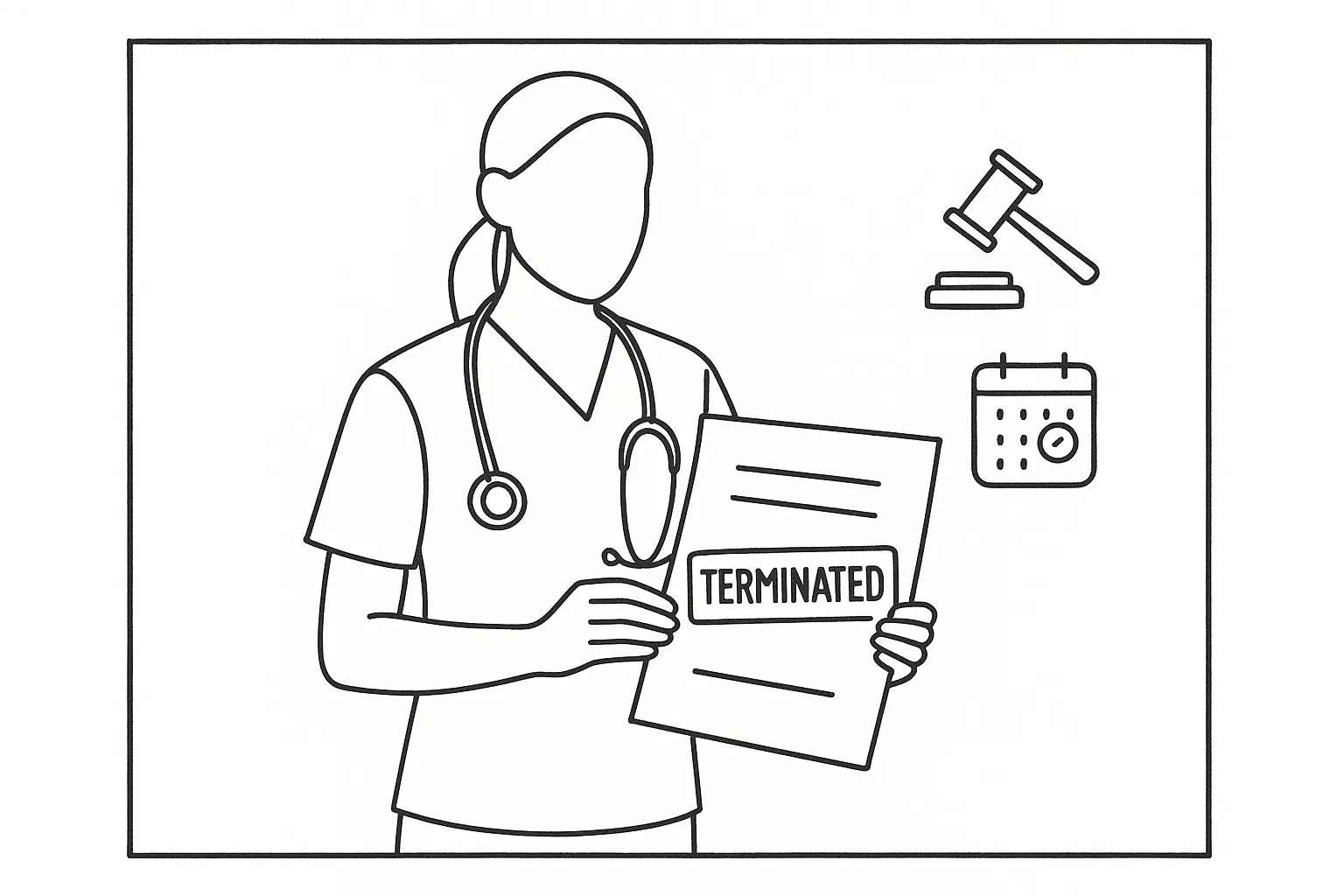
A for-cause clause identifies circumstances that may permit immediate termination or an abbreviated termination process. Examples may include a material contractual breach, professional misconduct, patient abuse, certain criminal conduct, loss of a required license, exclusion from a government program, or repeated failure to perform defined duties. The clause must be read for its exact definitions, procedural requirements, notice rights, and any opportunity to cure an alleged breach.
The classification matters because a for-cause termination may affect severance, incentive compensation, repayment obligations, malpractice coverage, and restrictive covenants. If the stated basis concerns patient safety, professional conduct, impairment, criminal activity, or licensing status, the issue may also extend to credentialing or professional reporting. Employment termination alone is not necessarily reportable, but requirements vary by jurisdiction and circumstance, as reflected in the state-based nursing regulation framework described by the National Council of State Boards of Nursing.
Without-Cause Termination and Resignation
A without-cause provision allows one or both parties to end the relationship without proving misconduct or breach. The clause commonly establishes a notice period and may address whether the employer can remove the NP from the schedule, require continued work, waive the remaining notice, or provide pay in lieu of notice. The details matter even when neither party alleges wrongdoing; the guide to without-cause termination in NP contracts examines these mechanics in greater depth.
A resignation must comply with the agreement’s method and timing requirements. Important questions include when notice becomes effective, whether email is sufficient, who must receive it, and what happens if the NP leaves before the full notice period expires. An early departure may be characterized as a breach and may affect compensation, benefits, repayment provisions, references, or post-employment restrictions.
Mutual Separation and Constructive Discharge Issues
The parties may resolve an anticipated or disputed termination through a mutual separation agreement. That document can establish the effective date, severance, final compensation, repayment treatment, insurance responsibilities, restrictive covenant modifications, reference language, and releases. A separation agreement may replace disputed obligations with defined terms, but it can also impose duties that were not present in the original contract.
Constructive discharge is a separate legal concept that may arise when an employee alleges that materially adverse working conditions effectively forced a resignation. It is not established merely because the working relationship became difficult or undesirable. Its application depends on the facts and governing law, so a nurse practitioner considering that position should obtain advice before characterizing the departure or sending a notice that could affect later claims.
Final Compensation, Benefits, and Repayment Exposure
Termination provisions cannot be evaluated without the compensation plan and any incorporated policies. Salary may continue through the effective date, but bonus eligibility can depend on remaining employed on a payment date, completing a measurement period, or satisfying a separate vesting condition. Collections-based and RVU arrangements may require a final reconciliation, and the contract may determine whether post-termination collections, coding adjustments, refunds, or negative balances affect the calculation. A focused NP compensation and productivity review can identify how those formulas allocate risk at separation.
There is no single nationwide deadline governing every final paycheck. The U.S. Department of Labor explains that federal law generally does not require an immediate final paycheck and ordinarily requires payment by the regular payday for the last pay period. State law may impose an earlier deadline or separately govern accrued paid time off, deductions, commissions, and earned incentives. The employment agreement may add payment terms, but its wording must be considered alongside applicable wage law.
Clawback provisions may apply to signing bonuses, relocation assistance, student loan support, training costs, continuing education funds, or compensation advances. The result can turn on the triggering event, service period, proration formula, and whether the departure is a resignation, without-cause termination, or for-cause termination. The employer’s demand should be compared with the written provision and its supporting calculation rather than treated as automatically correct. The resource on NP signing bonus repayment clauses explains common trigger and proration language.
A contractual duty to repay compensation can also create a separate tax issue. Bonuses and similar payments are generally taxable when received, while repayment in a later tax year may be treated differently from repayment during the same year. The contract does not determine the tax result by itself. For a substantial clawback, the NP may need tax advice based on the timing and characterization of the payment, including the principles discussed in IRS Publication 17.
Post-Employment Insurance and Restrictive Covenants
Malpractice Coverage After the Last Day of Work
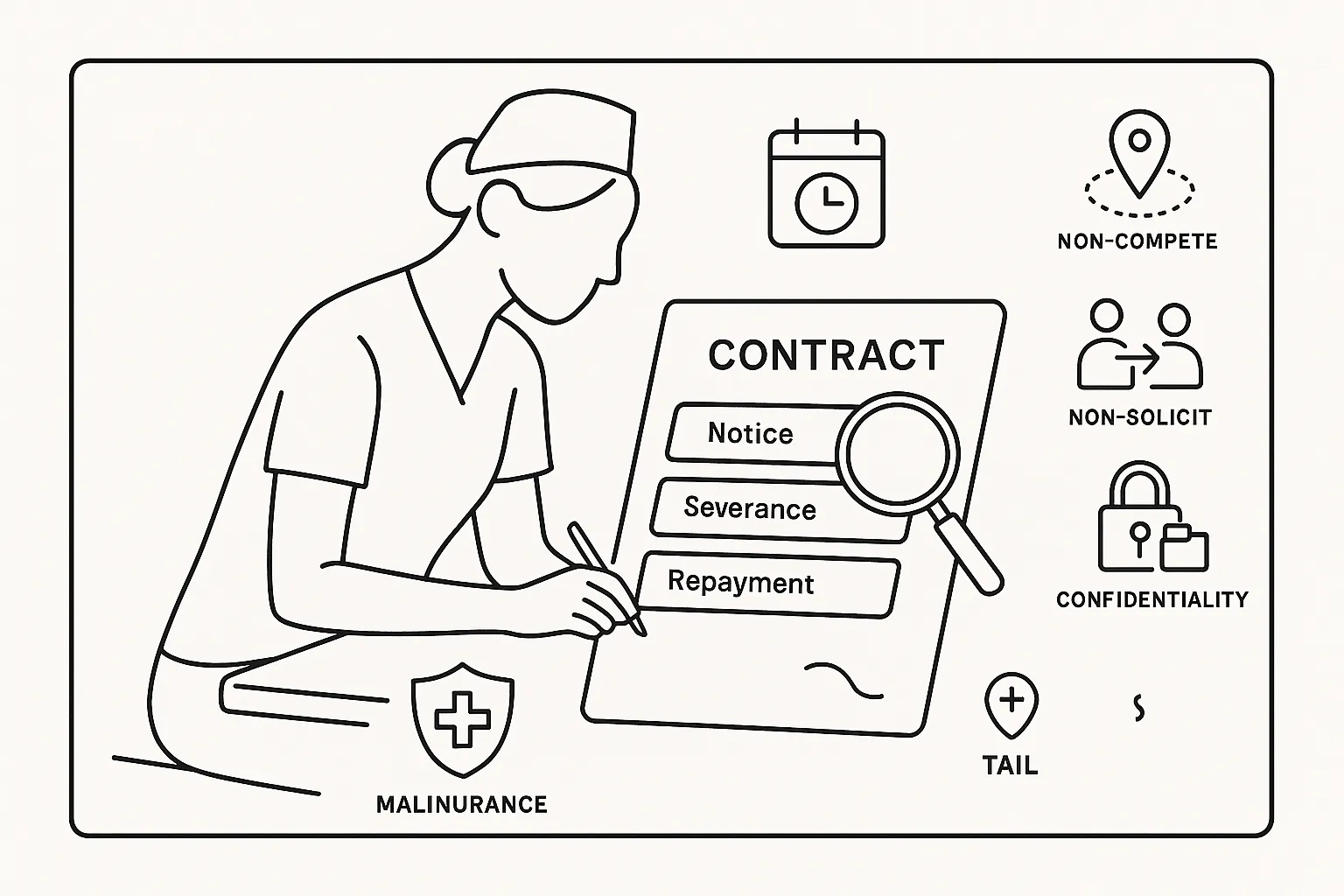
The policy type affects whether additional protection may be needed after employment ends. Occurrence coverage generally responds to a covered incident that occurred during the policy period even if the claim is filed later. Claims-made coverage generally requires the claim to be made or reported while the policy is active, subject to the policy’s terms. Extended reporting coverage, commonly called tail coverage, may therefore be important when a claims-made policy ends with employment.
A statement that the employer provides malpractice insurance does not necessarily identify the policy type, coverage limits, or responsibility for tail coverage. The agreement and policy declarations should be reviewed together. The contract may assign the full premium to one party, divide the cost, or change responsibility based on how employment ends. More detail is available in the resource comparing claims-made and occurrence coverage for nurse practitioners.
Non-compete, non-solicitation, confidentiality, and proprietary-information clauses often survive termination. Their practical effect depends on the restricted activity, duration, geographic scope, patient or employee categories, contractual exceptions, and applicable state law. A broad restriction can interfere with credentialing or a prospective employer’s willingness to proceed even when enforceability has not been decided.
The federal landscape must be described carefully. According to the Federal Trade Commission’s current rule-status page, the FTC non-compete rule is not currently in effect or enforceable. It therefore does not automatically invalidate an NP’s restriction. State law, the contractual language, the facts, and any profession-specific rules remain central to the analysis. A review of nurse practitioner non-compete clauses can help identify the provision’s practical reach before the NP accepts another position.
Protecting Patient Care, Records, and Professional Standing
A departing nurse practitioner may still have clinical and administrative responsibilities through the effective termination date. Authorized handoffs, documentation of pending matters, prescription coverage, follow-up arrangements, and communication with the care team may be necessary under employer policies and applicable professional requirements. The NP should avoid abandoning assigned responsibilities while also respecting any direction that limits access to systems or clinical duties.
Patient information must be distinguished from personal employment records. The NP may preserve the contract, pay records, personal correspondence, and other materials the NP is authorized to retain, but should not remove patient records, proprietary data, or protected information. Access, copying, transmission, retention, and handoff of patient information must follow approved procedures, applicable law, and the HIPAA Privacy Rule. A compensation dispute does not authorize an NP to retain protected patient information or improperly access records after departure.
- Preserve the governing documents: Keep the signed agreement, amendments, compensation plans, incorporated policies, notices, and any proposed separation agreement.
- Create a factual timeline: Record relevant dates, communications, alleged performance issues, schedule changes, and the delivery of termination or resignation notice.
- Request payment information: Seek a written statement addressing salary, incentives, productivity reconciliation, deductions, benefits, paid time off, and payment timing.
- Confirm insurance details: Obtain the malpractice declarations, policy type, coverage dates, limits, and written information about any required tail policy.
- Address administrative closure: Clarify credentialing, payer enrollment, employer property, system access, and authorized methods for verifying compensation records.
When the stated reason for termination concerns professional misconduct, patient safety, impairment, criminal conduct, licensing, or clinical privileges, rushed written explanations can have consequences beyond the employment dispute. Appropriate review may be necessary before responding to allegations that could affect a state board matter, credentialing application, payer participation, hospital privileges, or another professional-reporting process.
Reviewing a Separation Agreement and the Next Steps
A separation agreement can resolve uncertainty, but the value of the proposed terms must be compared with the rights being released. The document may address severance, final productivity compensation, repayment amounts, malpractice tail coverage, restrictive covenants, return of property, confidentiality, non-disparagement, references, and cooperation obligations. It may also contain a broad release of existing claims or reaffirm obligations from the original contract.
The effective termination date, payment deadlines, tax treatment, continuing restrictions, and consequences of an alleged breach need clear language. If the employer proposes a waiver or reduction of a non-compete, repayment balance, or tail obligation, the modification should be documented rather than left to an informal assurance. The same applies to an agreed reference, reason for departure, or confirmation that the NP remains eligible for specified compensation.
Prompt review is particularly important when an employer alleges cause, demands immediate repayment, disputes earned compensation, refuses to clarify malpractice coverage, threatens enforcement of a restriction, or presents a release. Useful review materials include the full contract and amendments, notices, performance documents, productivity reports, payment calculations, policy declarations, and a chronological summary. Chelle Law’s nurse practitioner contract termination review identifies the provisions affecting financial exposure, insurance, professional obligations, and the NP’s next position.
Frequently Asked Questions
How much notice must a nurse practitioner give before resigning?
The required notice depends on the employment agreement. The NP should verify the length of the notice period, the permitted delivery method, when notice becomes effective, whether the employer can waive the remaining period, and what happens if the NP leaves before the period ends.
Can an employer terminate an NP contract without cause?
An employer may use without-cause termination when the agreement grants that right and the employer follows the applicable notice and payment terms. The review should address pay in lieu of notice, scheduling during the notice period, benefit treatment, final bonus calculations, and obligations that survive termination.
When must an NP receive a final paycheck?
Federal law generally does not require an immediate final paycheck and ordinarily requires payment by the regular payday for the last pay period. State law may impose an earlier deadline or separate rules for paid time off, deductions, commissions, and earned incentives, so the location and contract terms matter.
Does termination require repayment of a signing bonus?
Repayment depends on the clause’s trigger, service period, proration formula, and treatment of resignation, without-cause termination, and for-cause termination. A repayment can also have tax consequences that differ based on timing, so a substantial clawback may require both contract and tax review.
Who pays for malpractice tail coverage after termination?
The contract and policy documents may assign tail responsibility to the employer, the NP, or both, sometimes based on how employment ends. Tail coverage is generally relevant to claims-made insurance, while occurrence coverage generally responds to covered incidents that occurred during the policy period.
Can a non-compete apply after the employer ends the contract?
Some agreements apply the non-compete regardless of which party ends the relationship, while others contain exceptions. The FTC non-compete rule is not currently in effect or enforceable, so the restriction’s practical and legal effect depends on state law, the contract language, the facts, and any applicable profession-specific rules.
Review Your Nurse Practitioner Contract Termination
Chelle Law reviews notice obligations, final compensation, repayment demands, malpractice coverage, restrictive covenants, and separation terms before you respond or sign a release.
Contact Chelle LawExplore Nurse Practitioner Contract Guidance
Find focused legal services, practical contract resources, and state-specific information for nurse practitioners.