
A nurse practitioner comparing a W-2 position with a 1099 opportunity is evaluating more than two payment methods. Employment classification can affect tax administration, benefits, malpractice costs, workplace protections, administrative duties, and the amount of financial risk assigned to the NP. The compensation figure at the top of an offer rarely captures all of those differences.
The contract label also does not resolve every classification question. Federal tax law, federal wage-and-hour law, state law, and benefit programs may apply different tests to the same working relationship. The parties’ actual practices—including control over scheduling, financial independence, permanence, investment, and responsibility for business expenses—can matter as much as the words “employee” or “independent contractor.”
A useful comparison therefore requires both financial modeling and careful contract analysis. Chelle Law reviews how an agreement addresses compensation, expenses, malpractice and tail coverage, indemnification, restrictive covenants, supervision or collaboration, billing responsibilities, repayment obligations, and termination. A qualified tax professional can separately assess estimated taxes, deductions, entity structure, and other tax consequences based on the NP’s circumstances.
Key Takeaways
- A W-2 arrangement often includes tax withholding and employer-sponsored benefits, while a 1099 agreement commonly shifts taxes, insurance, administrative costs, and other business responsibilities to the nurse practitioner.
- A higher contractor rate is not necessarily a better financial offer. The comparison must account for taxes, health and disability insurance, retirement funding, unpaid leave, malpractice coverage, accounting costs, and other overhead.
- Worker classification is determined under the legal test applicable to the issue. The IRS, Department of Labor, state agencies, and benefit programs do not necessarily use one universal standard.
- Compensation formulas, expense allocation, indemnification, tail insurance, restrictive covenants, repayment provisions, and termination rights can materially alter the value of either structure.
- NP practice authority, supervision, collaboration, telehealth, billing, and licensure requirements remain jurisdiction-specific and do not disappear merely because the NP is classified as a contractor.
What W-2 and 1099 Status Means in Practice
W-2 employment and employer-controlled work
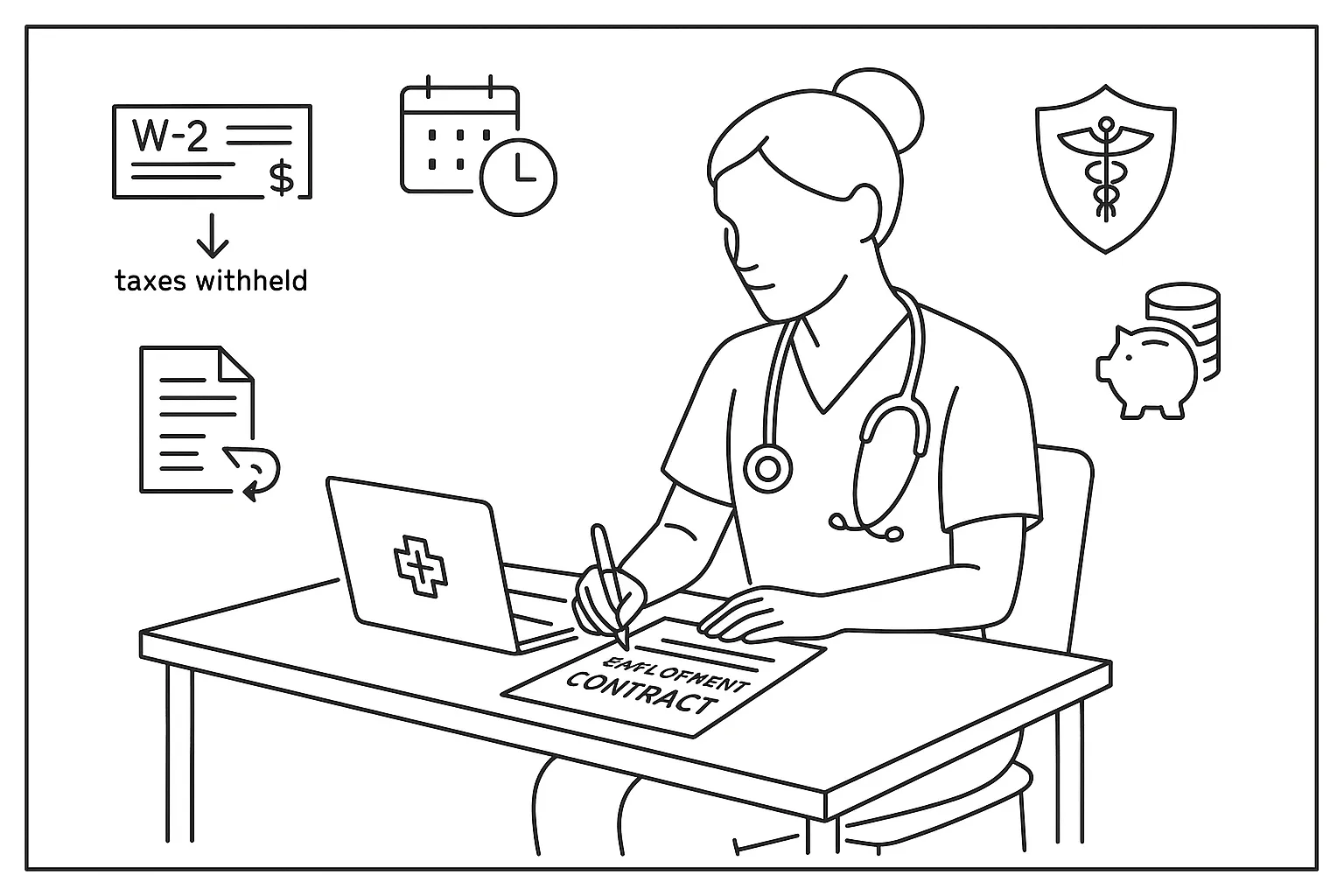
In a W-2 arrangement, the nurse practitioner is an employee of a practice, hospital, health system, or other organization. The employer generally withholds applicable income and payroll taxes and pays the employer portion of required payroll taxes. It may also control the NP’s schedule, work locations, clinical assignments, documentation systems, leave procedures, productivity expectations, and compliance policies.
Employee compensation may include salary or hourly pay, health insurance, paid time off, retirement contributions, disability coverage, continuing education support, licensing expenses, and employer-funded malpractice insurance. None of those benefits is automatic merely because a position is W-2, however. The agreement and benefit plan documents determine what is offered, when eligibility begins, and whether benefits continue during leave or after notice of termination.
Employment can provide predictable income and centralized support for credentialing, billing, and compliance, which may be particularly valuable to a new graduate. It can also involve extensive schedule control, multi-site obligations, call coverage, productivity targets, repayment provisions, and restrictions on future work. Those terms must be considered alongside the stated salary.
1099 contracting and transferred business responsibilities
A nurse practitioner working under a 1099 agreement is generally treated by the hiring entity as self-employed. The NP may be responsible for estimated tax payments, self-employment taxes, recordkeeping, insurance, retirement funding, unpaid time away from work, and professional or administrative expenses. The agreement may also assign responsibility for credentialing, licensing, billing support, equipment, travel, documentation, or professional coverage.
An appropriately structured contractor relationship may provide more control over scheduling, assignments, and business operations. In other arrangements, the hiring organization retains substantial control while transferring costs and liability to the NP. A focused independent contractor agreement review can identify payment conditions, expense obligations, indemnification language, insurance requirements, and other provisions that may not be obvious from the quoted rate.
Some contractor agreements condition payment on completed charts, submitted claims, payer reimbursement, or collections. Those conditions can delay compensation and shift payer or collection risk to the NP. The agreement may also permit chargebacks, offsets, or post-termination reconciliation, making the timing and calculation of final compensation especially important.
Worker Classification Uses More Than One Legal Test
A contract does not conclusively establish worker status merely by calling the nurse practitioner an independent contractor. For federal tax purposes, the IRS evaluates behavioral control, financial control, and the type of relationship. Payment through a Form 1099, part-time work, or an agreement stating that no employment relationship exists does not independently resolve the analysis.
Federal wage-and-hour law uses a separate framework. The Department of Labor’s rule effective March 11, 2024 applies a multifactor economic-reality analysis under the Fair Labor Standards Act, including opportunity for profit or loss, investments, permanence, control, whether the work is integral to the business, and the worker’s skill and initiative. Official Department of Labor misclassification guidance also notes litigation affecting the rule. State tax, unemployment, workers’ compensation, licensing, and employment laws may use different standards.
This distinction matters because a relationship may be evaluated differently depending on the legal question. Classification can affect tax obligations, wage-and-hour protections, unemployment eligibility, benefit rights, and potential liability for the hiring organization. If the written agreement and actual work arrangement point in different directions, the parties may face tax assessments, administrative disputes, or claims arising from misclassification.
How to Compare the Real Financial Value

Begin with all cash compensation, not only the base salary or hourly rate. Include productivity incentives, quality bonuses, signing payments, relocation assistance, student loan benefits, call pay, shift differentials, and any other compensation. For each item, determine whether it is guaranteed, discretionary, subject to a threshold, recoverable after termination, or dependent on collections or continued employment.
Next, estimate the value of W-2 benefits and employer-paid expenses. Relevant items can include health insurance contributions, retirement matching, paid leave, disability and life insurance, continuing education funds, licensing fees, professional memberships, credentialing support, and malpractice premiums. Benefit eligibility dates and vesting schedules can affect the actual value, particularly when the initial term is short or the contract permits early termination.
For the 1099 opportunity, estimate the cost of replacing those benefits and paying business expenses. The calculation may include estimated taxes, insurance, unpaid vacation and sick time, retirement contributions, accounting, legal services, software, equipment, travel, billing support, licensing, credentialing, and malpractice coverage. Tax rates, reporting requirements, retirement limits, and available deductions vary by tax year and individual circumstances, so current IRS guidance and advice from a qualified tax professional are important.
Consider a hypothetical W-2 offer paying $100,000 plus benefits and a 1099 offer paying $130,000 without benefits. The $30,000 difference is not automatically additional income. The NP must estimate taxes and subtract the cost of insurance, retirement funding, unpaid leave, malpractice coverage, and business overhead before comparing net value. The result can change substantially based on family health coverage, expected time off, policy premiums, and the amount of administrative work that is not separately compensated.
The compensation formula itself also requires review. Salary, RVUs, collections, quality measures, and hybrid formulas allocate risk differently. Definitions, thresholds, excluded services, attribution rules, reconciliation procedures, and negative accrual can determine whether an incentive is realistically attainable. Chelle Law’s guide to nurse practitioner compensation models explains how common formulas affect actual earnings.
Contract Provisions That Shift Financial and Professional Risk
Expenses, malpractice coverage, and indemnification
The agreement needs to identify which party pays for licenses, controlled-substance registrations, credentialing, continuing education, travel, equipment, supplies, billing support, professional memberships, and other operating expenses. A broad statement that the contractor bears “all expenses” can create uncertainty if the NP is expected to work at multiple sites, use specialized equipment, or complete significant unpaid administrative work.
Malpractice language requires more than confirmation that insurance exists. The review should identify the policy type, coverage limits, named insured, premium responsibility, consent-to-settle terms, and whether the policy covers every service and location. If coverage is claims-made, the agreement must address who purchases tail coverage and what happens when the relationship ends. The practical differences between policy forms are discussed in claims-made and occurrence coverage for nurse practitioners.
Indemnification can create exposure beyond ordinary malpractice liability. A provision may require the NP to reimburse the organization for claims, billing losses, penalties, or legal fees arising from alleged noncompliance. The scope of the obligation, available insurance, defense control, notice requirements, and any limitation of liability deserve careful analysis under either a W-2 or 1099 structure.
Restrictions, repayment obligations, and termination
Noncompete enforceability remains dependent on current federal developments, state law, worker status, and the wording of the restriction. The Federal Trade Commission’s 2024 nationwide rule was set aside by a federal district court and should not be treated as universally operative. The FTC’s current noncompete-rule status materials reflect the effect of court decisions and ongoing developments. Confidentiality, nonsolicitation, patient-solicitation, and liquidated-damages provisions require separate analysis rather than being treated as identical to a noncompete.
A contractor may still face restrictions on future work even when the agreement provides no employee benefits. Geographic scope, duration, restricted activities, affiliated locations, and exceptions all affect practical mobility. A nurse practitioner noncompete review can identify how several restrictive provisions interact after the relationship ends.
Signing bonuses, relocation payments, training expenses, and advances may become repayable after resignation or early termination. The triggering event, repayment schedule, prorating method, offsets, and exceptions can materially change the offer. Termination language also controls notice periods, for-cause standards, cure opportunities, final pay, outstanding collections, patient-record duties, and obligations that survive the final workday. These issues warrant a coordinated review of the agreement’s termination and post-employment terms.
NP Practice, Telehealth, and Billing Obligations
Employment classification does not determine a nurse practitioner’s scope of practice. Licensure, prescribing authority, supervision, collaboration, and delegation requirements vary by jurisdiction. The National Council of State Boards of Nursing’s APRN practice resources emphasize that requirements differ among jurisdictions. The agreement should identify any required physician or other-practitioner relationship, associated fees, coverage expectations, documentation, and responsibility for maintaining compliance without assuming that every state requires the same arrangement.
Telehealth adds another layer because the law of the state where the patient is located may govern licensure and practice requirements. An NP providing services across state lines may need to evaluate multiple licenses, prescribing restrictions, collaboration requirements, payer enrollment, and professional coverage. A contract that permits or requires multi-state telehealth work needs to allocate the cost and administrative responsibility for those obligations.
Billing rules are also distinct from worker classification. CMS recognizes that an NP may use an NPI to bill for services and may reassign billing rights to an employer or contracting entity, but reassignment does not by itself establish employee status. Medicare incident-to requirements can involve supervision, state-law compliance, active involvement in treatment, documentation, and use of the appropriate billing practitioner’s NPI. Current CMS incident-to guidance should be evaluated separately from the contract’s W-2 or 1099 label.
These billing provisions can affect compensation and audit exposure. The agreement may define who enrolls the NP with payers, controls claim submission, corrects coding errors, responds to audits, refunds overpayments, and bears losses from denied claims. Compensation based on collections or incident-to billing deserves particular scrutiny because payment may depend on factors outside the NP’s direct control.
Choosing a Structure That Fits the Role
W-2 employment may appeal to an NP who values predictable income, employer-sponsored insurance, paid leave, retirement benefits, and administrative support. Those features can be especially important for new graduates, clinicians supporting dependents, or NPs who prefer not to operate a separate business. The trade-off may include less schedule flexibility, broader employer control, productivity expectations, call duties, and contractual restrictions.
A 1099 structure may be attractive when the rate adequately accounts for taxes, benefits, unpaid time, insurance, and overhead and when the relationship provides meaningful professional independence. Experienced NPs working in locum tenens, telehealth, consulting, or multiple-practice arrangements may be more comfortable handling those responsibilities. Even then, payment conditions, indemnification, restrictive covenants, billing duties, and termination rights can undermine the apparent flexibility.
The strongest comparison considers net income, benefits, classification risk, professional liability, autonomy, administrative workload, state practice requirements, billing exposure, termination rights, and future mobility. No single structure is inherently preferable in every situation. The written agreement and the actual working relationship must support the financial and professional assumptions behind the offer.
Frequently Asked Questions
Is a higher 1099 rate always better than a W-2 salary?
No. The contractor rate must be reduced by estimated taxes, insurance costs, unpaid time off, retirement funding, accounting expenses, malpractice coverage, and other overhead before it can be compared fairly with a W-2 salary and employer-provided benefits.
Does calling an NP a contractor make the classification legally controlling?
No. The applicable legal test may examine control, financial independence, investment, permanence, and other aspects of the actual relationship. Federal tax, wage-and-hour, state-law, and benefit questions may use different classification standards.
Who pays for malpractice and tail insurance in a 1099 arrangement?
The contract determines who obtains the policy, pays the premiums, and purchases any required tail coverage, subject to applicable law and payer requirements. Contractor agreements often transfer these costs to the NP, but that allocation is not universal.
Do 1099 nurse practitioners receive paid time off or employer benefits?
Independent contractors generally do not receive employee benefits unless the agreement expressly provides them. Time away from work may also be unpaid, so the cost of replacing benefits and taking leave belongs in the financial comparison.
Does 1099 status determine how an NP can bill Medicare?
No. Medicare enrollment, NPI reassignment, incident-to billing, supervision, documentation, and state-law compliance are separate from worker classification. The agreement needs to clarify billing duties, claim control, audit responsibilities, and compensation consequences.
Should both an attorney and a tax professional review the offer?
An attorney can evaluate contractual, classification, liability, and professional risks, while a qualified tax professional can assess estimated taxes, deductions, entity choices, and reporting obligations based on the NP’s circumstances. The two reviews address different parts of the decision.
Review Your W-2 or 1099 Agreement Before Signing
Chelle Law reviews nurse practitioner employment and independent contractor agreements to identify compensation concerns, liability shifts, restrictive terms, and obligations that may continue after termination.
Contact Chelle LawExplore Nurse Practitioner Contract Guidance
Find related review services, practical contract resources, and state-focused information for nurse practitioners.