
A first nurse practitioner employment agreement determines much more than starting salary. It can set the formula for productivity pay, establish call and weekend obligations, assign malpractice tail costs, and control how quickly the NP can leave for another position. New graduates often encounter these provisions while completing licensure, credentialing, payer enrollment, and the transition into clinical practice.
An offer that looks competitive can change once the entire contract is read together. A signing bonus may become repayable if employment ends within a stated period. A productivity bonus may depend on a threshold the NP cannot reasonably meet during onboarding. A broad non-compete may restrict jobs at locations where the NP never worked. These details affect actual compensation, workload, personal financial exposure, and career mobility.
Attorney Robert Chelle reviews new graduate nurse practitioner contracts for NPs nationwide. Chelle Law analyzes the compensation formula, repayment triggers, schedule and call language, malpractice coverage, supervision or collaboration terms, credentialing responsibilities, termination rights, and post-employment restrictions. The review connects each clause to the question a new graduate needs answered before signing: What will I earn, what am I required to do, what could I owe, and what happens if this job does not work out?
Why a First NP Employment Agreement Deserves Careful Review
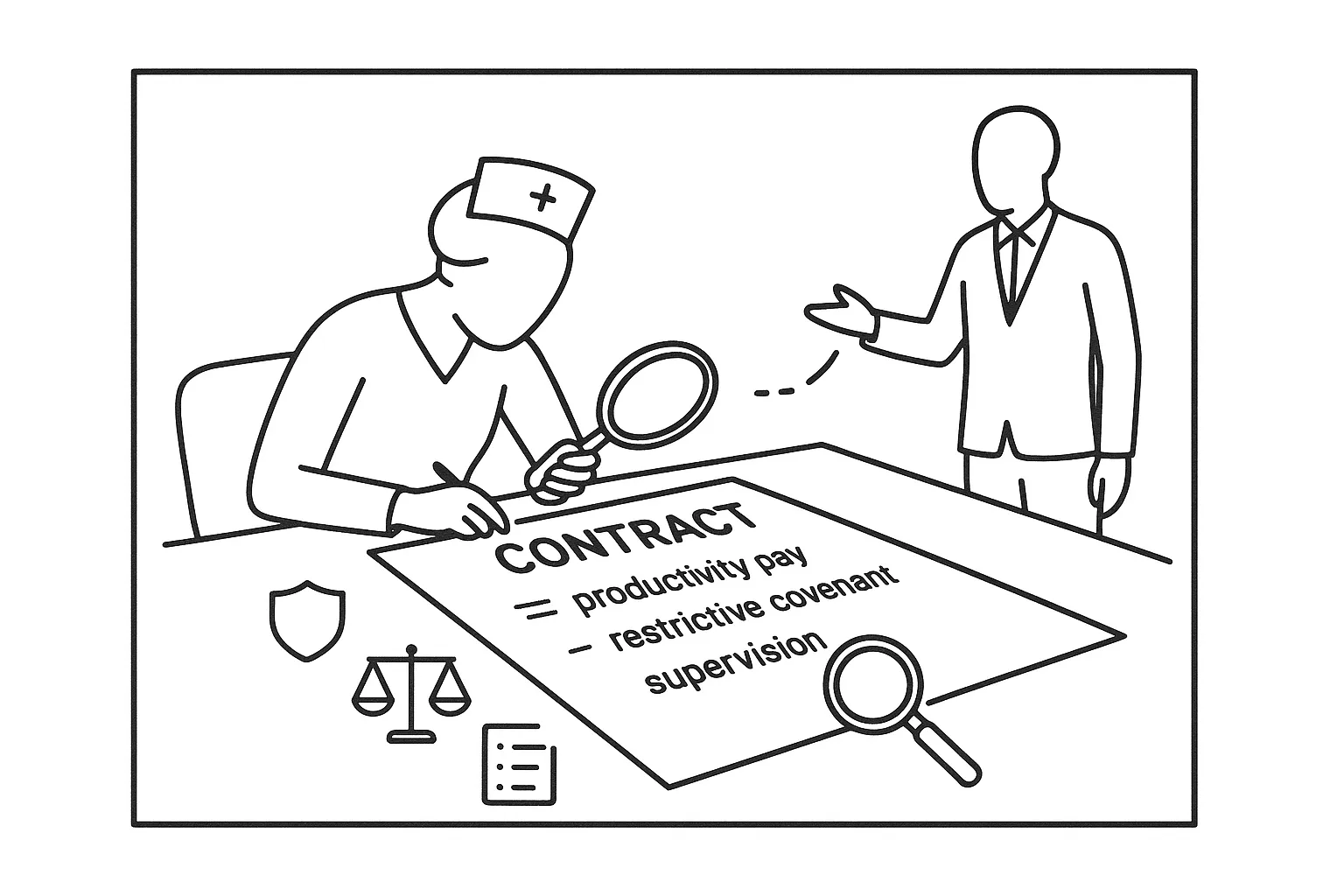
New graduate contracts commonly combine a guaranteed salary with unfamiliar provisions governing productivity, collections, negative accrual, repayment, and restrictive covenants. Reading those clauses separately can hide how they interact. If the productivity period starts before credentialing is complete, for example, the NP may begin the first measurement period without a full patient schedule. If the same contract allows a deficit to carry forward, a slow start can reduce compensation in a later period.
The agreement also needs to match the position described during recruitment. A daytime clinic role can look different if the written contract permits weekend call, floating among facilities, or reassignment of duties without defined limits. Contract review compares the promised role with the language that will control after the NP begins work and identifies provisions that may warrant clarification or revision.
- Confirm how salary, productivity pay, bonuses, and later reconciliations are calculated.
- Determine whether malpractice coverage is claims-made or occurrence-based and who pays for tail coverage.
- Define regular hours, clinical FTE, call, administrative time, work locations, and float obligations.
- Identify the events that trigger repayment, immediate termination, or post-employment restrictions.
- Allocate responsibility for credentialing, collaboration arrangements, licensure expenses, and onboarding support.
How the Contract Calculates Compensation

Starting salary is only one part of the compensation package. The agreement may tie future earnings to wRVUs, collections, quality scores, patient access, or a combination of measures. The calculation matters as much as the stated rate because the employer generally controls the billing records, collections data, and productivity reports used to determine the payment.
Salary, wRVUs, Collections, and Reconciliation
An NP may receive a fixed salary, hourly pay, a base salary plus productivity, or compensation based primarily on collections. Each model shifts risk differently. A salary provides predictable initial income, while a productivity formula places more weight on patient volume, scheduling, coding, billing performance, and the employer’s ability to collect for the services provided. Chelle Law compares these mechanics as part of a focused review of common NP compensation models.
For a wRVU formula, the contract needs to identify the threshold, conversion factor, measurement period, and treatment of work performed before or after the period. It should also be clear whether the employer can change the conversion factor or productivity target during the contract term. If that number can be revised unilaterally, the NP cannot reliably forecast the bonus.
A collections formula raises different questions. Does “collections” mean gross receipts, adjusted receipts, or net revenue after expenses and refunds? When are collections credited to the NP, and are payments received after termination still included? Chargebacks, delayed billing, excluded services, and negative accrual can reduce the amount ultimately paid even when the NP has met the expected patient volume.
Bonuses, Relocation Benefits, and Repayment Triggers
A bonus clause needs an objective formula and a definite payment date. Terms such as “quality,” “performance,” or “patient access” are incomplete unless the agreement or an incorporated plan identifies the metrics, weighting, measurement period, and person responsible for confirming the result. Broad employer discretion can turn a stated incentive into a payment the NP cannot independently verify.
Signing bonuses, relocation allowances, student loan assistance, and certain professional expenses may become repayable when employment ends before a specified date. The repayment clause controls whether the amount declines over time, whether termination without cause triggers repayment, and how quickly the balance becomes due. New graduates receiving money before their start date should closely evaluate the signing bonus repayment provision. A $10,000 benefit is not worth the same amount if the entire balance remains due until the final day of a multi-year commitment.
Workload, Scheduling, and Professional Liability
Compensation cannot be evaluated without the workload required to earn it. A salary based on four clinic days is different from the same salary covering five clinic days, rotating weekends, overnight call, and regular travel among facilities. The written terms need enough detail to show what the employer can require without additional pay.
Clinical FTE, Call, Floating, and Work Locations
Schedule language may address weekly hours, clinical full-time equivalent status, patient-contact time, administrative work, holidays, weekends, and call. If the contract only states that the NP will work “as scheduled,” the employer may retain broad control over shifts and coverage. A new graduate needs to know whether charting and administrative duties fit within scheduled hours and whether call or extra shifts produce separate compensation.
Location language deserves the same attention. A clause permitting assignment to any current or future facility can add commute time or place the NP in a different clinical setting than expected. It may also expand a non-compete if the restriction is measured from every site where the NP provides services. Handbooks and call policies must be reviewed when they are incorporated into the contract because significant call coverage obligations may appear outside the main agreement.
Malpractice Coverage, Tail Costs, and Indemnification
Occurrence coverage generally responds to an incident that happened while the policy was active, even if the claim is filed later. Claims-made coverage generally requires coverage to remain in place when the claim is reported. When a claims-made policy ends, extended reporting coverage—commonly called tail coverage—may be needed for later claims arising from services provided during employment.
The malpractice clause needs to identify the policy type, coverage limits, premium responsibility, and party responsible for tail. The NP also needs to know whether the employer’s policy covers all assigned locations and services. The distinction between claims-made and occurrence coverage can determine whether leaving the job creates a separate insurance expense.
Indemnification and defense provisions require separate analysis. An indemnity clause can assign liability beyond what the malpractice policy covers, particularly when it includes contractual breaches, billing issues, or conduct excluded from insurance. The contract should not be evaluated on the assumption that every indemnity obligation is insured.
Termination Rights and Restrictions After Employment
A first position may end because the clinical setting is not a good fit, the schedule changes, credentialing is delayed, or a better opportunity becomes available. The exit terms determine how long the NP must remain after giving notice, what compensation is still payable, which expenses become repayable, and where the NP can work next.
Without-Cause Notice, For-Cause Events, and Final Compensation
A without-cause termination clause allows either party to end the agreement without proving a breach, usually after written notice. The notice period can delay a job change, especially when the next employer requires the NP to begin sooner. The provision also needs to address whether the employer can remove the NP from the schedule during the notice period and whether salary and benefits continue through the stated termination date.
For-cause language identifies events that permit immediate termination. Broad terms such as conduct harmful to the employer’s reputation can create uncertainty if they lack an objective standard or an opportunity to cure a correctable issue. Licensure loss, exclusion from government programs, failure to obtain credentials, and alleged policy violations may carry different cure rights and different consequences for bonus repayment or malpractice tail.
Final compensation is another common source of disagreement. The agreement needs to explain whether the NP receives an earned bonus, post-termination collections, unused leave where applicable, and a final productivity reconciliation. A detailed guide to terminating an NP contract explains how notice, final pay, repayment, and post-employment duties can overlap.
Non-Competes, Non-Solicitation, and Career Mobility
A non-compete may restrict the NP from providing certain services within a geographic area for a stated period. The actual reach depends on where the radius begins, which facilities count, what clinical activities are prohibited, and whether the restriction applies after every type of termination. A 10-mile radius from one clinic is not the same restriction as 10 miles from five hospitals and satellite offices.
Non-solicitation and non-interference clauses can separately restrict contact with patients, referral sources, employees, or contractors. Confidentiality provisions may continue indefinitely and can define employer information more broadly than trade secrets or patient records. Because enforceability and scope depend on the wording and applicable law, Chelle Law evaluates how the restriction could affect realistic jobs in the NP’s market. The resource on NP non-compete clauses provides additional background on duration, geography, covered locations, and restricted activities.
Scope of Practice, Collaboration, and Onboarding
Nurse practitioner practice requirements vary by state and may address scope of practice, prescribing, physician collaboration or supervision, facility privileges, and other regulatory obligations. The employment documents need to fit the state where the NP will work. A contract that assigns a responsibility to the NP without providing the required physician participation, documentation, or administrative support can delay the start date or interfere with the intended role.
Collaboration Terms and Allocation of Compliance Duties
Where a collaboration or supervision arrangement is required, the documents need to identify who secures the participating physician, who pays any associated fee, what happens if that physician becomes unavailable, and whether the NP can continue working during a transition. These questions are different from general employment duties and may be addressed in a separate agreement. Chelle Law offers a dedicated supervision and collaboration agreement review when those documents accompany the employment contract.
The clinical duties also need to match the NP’s certification, experience, privileges, and authorized scope. Broad language requiring “all duties assigned” can create problems if it permits reassignment to a different unit, patient population, or service line without considering training and credentialing. The contract can define the role by specialty, department, location, or agreed scope rather than leaving every assignment to employer discretion.
Credentialing Delays, Start Dates, and Employer Support
Credentialing and payer enrollment often continue after the contract is signed. The agreement should state whether the start date depends on completed credentials, whether compensation begins during a delay, and whether either party can terminate if approval takes longer than expected. If a bonus repayment period begins on the signing date but employment starts months later, the timeline may not work as the NP expects.
Responsibility for licensure fees, prescribing registrations, credentialing applications, professional dues, and continuing education also needs to be allocated. Benefits described in a handbook may be changeable under the employer’s policies, while a benefit written directly into the agreement may carry a different contractual status. The complete review includes incorporated policies when they control leave, reimbursement, scheduling, or other material employment terms.
Setting Priorities Before Accepting the Offer
Not every unfavorable clause carries equal weight. A new graduate may value a strong mentoring environment, but mentorship language has limited value if the contract does not identify who provides it or how protected orientation time affects productivity. Likewise, a higher salary can be offset by unpaid call, an expensive tail obligation, a broad repayment clause, or a non-compete that blocks nearby opportunities.
The provisions requiring the closest attention usually involve money the NP cannot independently calculate, obligations the employer can change unilaterally, and costs triggered by termination. Common warning signs include:
- Negative accrual that carries a productivity deficit into a later compensation period.
- Undefined terms such as collections, net revenue, production, or clinical FTE.
- A discretionary bonus without measurable criteria, access to supporting data, or a payment deadline.
- Repayment of a signing bonus or relocation benefit after employer-initiated termination without cause.
- For-cause termination language with no cure period for a correctable breach.
- Malpractice language that omits the policy type, limits, or responsibility for tail coverage.
- A non-compete measured from facilities where the NP never regularly provided services.
- Collaboration or credentialing duties assigned to the NP without corresponding employer support.
The best time for attorney review is after the complete written agreement is available and before the NP signs or formally accepts the position. Chelle Law provides attorney analysis, a consultation about the findings, and written feedback focused on the provisions that change compensation, professional liability, workload, termination exposure, and the ability to move to another job. New graduates can also use Chelle Law’s overview of common nurse practitioner contract red flags to prepare questions about the offer.
Frequently Asked Questions
What should a new graduate nurse practitioner review before signing a first employment contract?
Review the compensation formula, bonus criteria, repayment obligations, regular schedule, call requirements, work locations, malpractice insurance, tail responsibility, collaboration terms, restrictive covenants, termination rights, credentialing duties, and benefits. Read incorporated policies as well because they may contain scheduling, leave, call, or reimbursement terms that do not appear in the main agreement.
How can a new graduate tell whether an NP productivity formula is realistic?
Identify the threshold, conversion factor, measurement period, expected patient volume, and treatment of the onboarding period. Ask for an example calculation and determine whether credentialing delays, no-shows, scheduling control, excluded services, or negative accrual can reduce the payment. A formula is difficult to evaluate if the employer can change its inputs without the NP’s agreement.
Who pays for malpractice tail coverage when the first NP job ends?
The contract controls the allocation of tail costs. Some employers pay, some require the NP to pay, and others divide responsibility based on tenure or the reason employment ends. Tail is generally associated with claims-made coverage, so the NP first needs to confirm the policy type, limits, and events that trigger an extended reporting obligation.
Can an employer change a new graduate NP’s schedule or work location?
That authority depends on the contract and incorporated policies. Language allowing the employer to set schedules or assign any facility may permit substantial changes to shifts, call, commute time, or clinical setting. Defined locations, expected hours, call frequency, and limits on reassignment make the obligation easier to evaluate before signing.
Does a signing bonus have to be repaid if the employer terminates the NP?
Repayment depends on the trigger written into the agreement. Some clauses require repayment whenever employment ends before a stated date, including termination without cause. Others prorate the amount or waive repayment in specified circumstances. The clause also needs to state when the balance is due and whether other amounts can be deducted from final compensation.
When should a new graduate NP obtain attorney contract review?
Obtain review after receiving the complete agreement and before signing or formally accepting the offer. Attorney review is especially helpful when the contract includes productivity pay, a repayment obligation, claims-made insurance, multiple locations, significant call, a non-compete, or unclear credentialing and collaboration responsibilities.
Understand Your First NP Contract Before You Sign
Chelle Law can review the pay formula, schedule, malpractice obligations, repayment triggers, exit terms, and restrictions that will control your first nurse practitioner position.
Request an NP Contract ReviewExplore More Nurse Practitioner Contract Guidance
Find related legal services, detailed contract resources, and state-focused guidance for nurse practitioner agreements.