
Nurse practitioner compensation may include a guaranteed salary, hourly pay, productivity bonuses, work relative value units (wRVUs), collections, quality incentives, or a combination of these models. The headline salary rarely tells the full story. Thresholds, conversion factors, deductions, reconciliation periods, payment timing, and employer-controlled data can materially affect what an NP actually earns.
These provisions matter because compensation risk often extends beyond a missed bonus. Negative accrual can carry a productivity deficit into a later period, repayment clauses may create obligations when employment ends, and billing or reporting restrictions can make a compensation calculation difficult to verify. Administrative duties, call coverage, supervision requirements, and restrictive covenants may also affect the value of an offer and the NP’s ability to move to another position.
Attorney Robert Chelle provides nurse practitioner compensation and productivity review for NPs nationwide. Chelle Law evaluates base pay, wRVU and collections formulas, bonus thresholds, quality incentives, deductions, reporting rights, repayment obligations, and compensation after termination. The goal is to explain how the formula operates in practice, identify financial and contractual risks, and clarify terms that may warrant negotiation before the agreement is signed.
Key Compensation Review Priorities
- Define important terms such as productivity, net collections, allowable amount, wRVUs, and quality performance so the employer cannot apply an unclear formula.
- Confirm the productivity threshold, conversion factor or percentage, measurement period, reconciliation process, and payment schedule.
- Identify deductions, chargebacks, negative accrual, repayment obligations, and post-termination adjustments that could reduce compensation.
- Require access to billing, collections, RVU, and quality reports needed to verify the employer’s calculation.
- Evaluate related terms concerning restrictive covenants, malpractice coverage, call, administrative duties, and termination because they can affect the offer’s overall value.
Nurse Practitioner Compensation Models

Base Salary, Bonuses, and Hybrid Pay
Many NP agreements provide a guaranteed base salary with additional compensation tied to productivity or defined performance targets. The salary offers income certainty, while the bonus shifts some opportunity and risk to the NP. A bonus may be calculated as a percentage of revenue above a threshold, a dollar amount for each wRVU, or a payment for reaching visit, quality, or panel targets.
The agreement should state whether a bonus is contractual or discretionary, when it is earned, how often it is measured, and when it will be paid. Salary-only and hybrid arrangements also require clear expectations for clinical hours, administrative work, call, minimum productivity, and supplemental pay. Reviewing the broader range of NP compensation models can help an NP compare offers on more than base salary alone.
Collections-Based Compensation
Collections-based compensation ties pay to money the employer actually receives for the NP’s services. This structure exposes the NP to payer mix, denials, patient nonpayment, billing delays, write-offs, refunds, and the employer’s effectiveness in submitting claims and appeals. The contract should define which collections are attributed to the NP and whether administrative fees, laboratory costs, bad debt, shared overhead, or other expenses are deducted.
The agreement should also address reporting access and collections received after employment ends. An NP who wants to understand the risks of this structure should review how collections-based pay is credited, reconciled, and paid when the employer controls the billing process.
wRVU and Productivity-Based Compensation
wRVU compensation uses a productivity measure derived from the services the NP performs. The agreement should identify whether it uses work RVUs or another RVU measure, the applicable threshold, the dollar conversion factor, the measurement period, and the point at which credit is assigned. It should also address shared or split visits and whether coding changes can affect the calculation.
A complete wRVU compensation review considers more than the conversion factor. The NP should determine whether the target is realistic, whether the employer can change the methodology, and whether reliable reports will be available to confirm credited productivity.
Productivity Metrics, Quality Measures, and Reconciliation
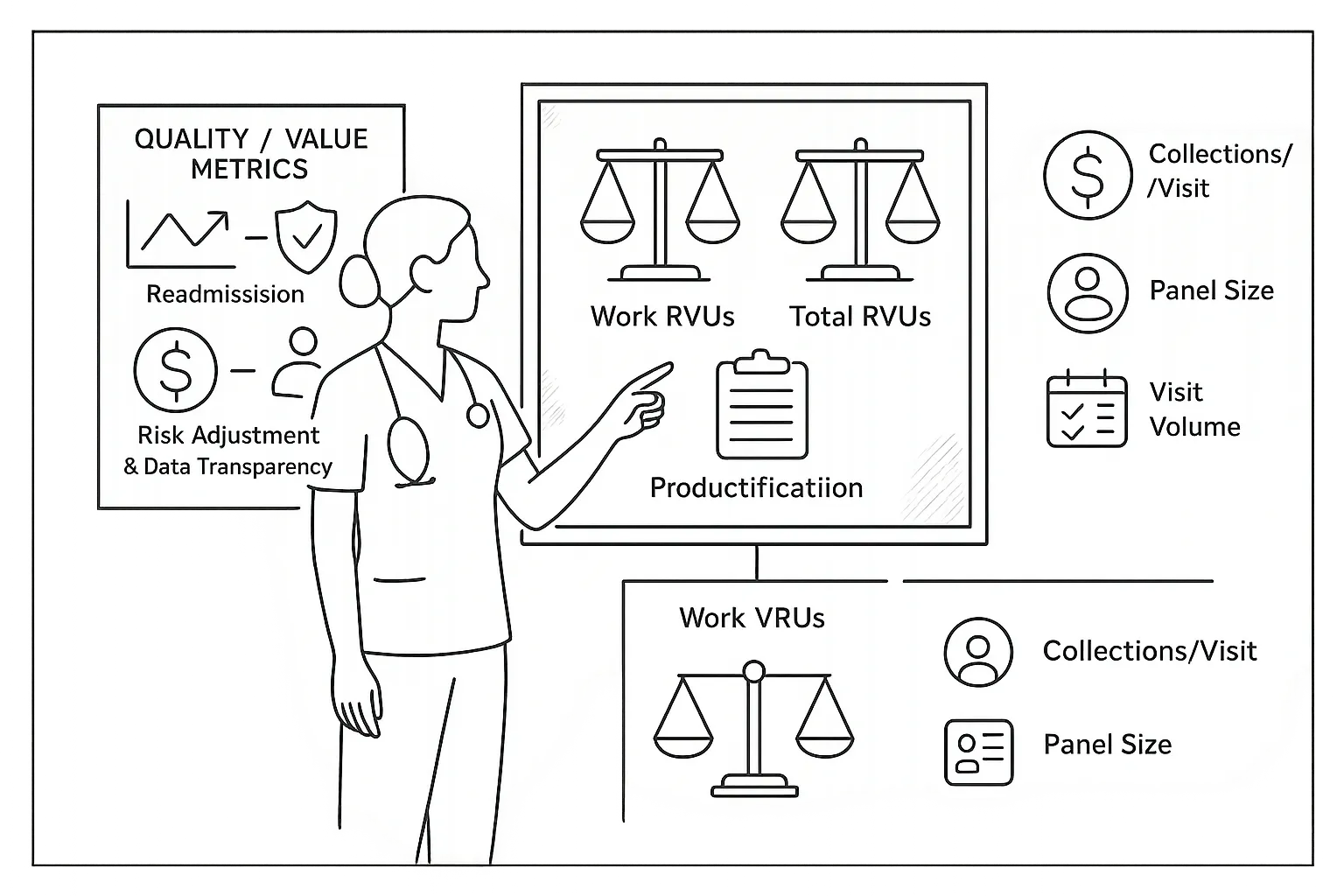
Visit Volume, Panel Size, and Quality Metrics
Employers may measure visits, panel size, collections per visit, patient satisfaction, preventive care benchmarks, readmission rates, or other quality outcomes. Each metric has limitations. Collections can fluctuate with payer mix, panel information can become outdated, and visit-volume targets may fail to credit charting, care coordination, e-consults, meetings, or other non-face-to-face work.
Quality and value-based measures should be objectively defined and supported by identifiable data. The contract or incorporated bonus plan should explain the target, measurement source, weighting, performance period, and effect on compensation. Vague quality language or an unrestricted right to revise a metric can make a stated incentive difficult to earn or verify.
Negative Accrual, Deductions, and Reporting Rights
Reconciliation language may allow an employer to adjust compensation after a measurement period. Negative accrual occurs when a productivity deficit carries forward and reduces a later bonus. The agreement should state whether deficits carry forward, how long they remain, whether they cross calendar or contract years, and whether the employer may recover a deficit from salary or other amounts owed.
The NP should also identify every permitted deduction and the records available to verify it. Broad employer discretion over write-offs, overhead, refunds, billing adjustments, or formula changes can erode compensation. A focused review of negative accrual provisions can reveal whether a shortfall creates only a missed bonus or a continuing financial obligation.
Contract Terms That Affect Compensation and Career Mobility
Restrictive Covenants, Duties, and Practice Requirements
A compensation package should be evaluated together with the duties required to earn it. Call coverage, chart completion, meetings, committee work, travel between locations, supervision or collaboration requirements, and other administrative responsibilities can reduce clinical capacity and effective hourly pay. The agreement should identify these duties and explain whether they are included in salary, separately compensated, or credited toward productivity.
Restrictive covenants can also affect the economic value of an offer by limiting where and how the NP may work after termination. Because enforceability varies by jurisdiction and contract language, an NP should not assume a restriction is harmless. A non-compete review examines duration, geographic scope, restricted services, non-solicitation language, and the termination events that trigger the restriction.
Termination, Repayment, and Malpractice Obligations
Termination provisions should explain notice requirements, final productivity calculations, bonus eligibility, collections received after departure, and the treatment of negative accrual. Signing bonuses, relocation funds, educational benefits, or other advances may be subject to repayment if the NP leaves before a stated date. The contract should identify how repayment is prorated and whether the obligation changes based on who ends the relationship.
Malpractice terms can create another significant post-employment expense. The agreement should identify whether coverage is occurrence or claims-made, the applicable limits, and who must secure and pay for tail coverage when required. Chelle Law’s malpractice and tail insurance review evaluates these obligations alongside compensation and termination terms.
How to Evaluate an NP Compensation Offer
Begin by separating guaranteed compensation from contingent compensation. Then identify the conditions required to earn each incentive, the employer-controlled factors that can affect performance, and the reports needed to confirm the calculation. For example, a $110,000 base salary plus an expected $20,000 bonus over 48 working weeks and 40 hours per week produces an estimated rate of about $68 per hour before accounting for unpaid administrative time, call, benefit differences, or a bonus that is not actually earned.
When comparing positions, include repayment obligations, tail costs, lost bonuses, collections delays, retirement contributions, insurance premiums, paid leave, and required nonclinical work. Practice setting also matters. Primary care may use panel and quality measures, specialty practices may emphasize wRVUs, telehealth may rely on per-visit or collections formulas, and shift-based positions may offer hourly or per-shift compensation. In every setting, the central questions are how productivity is measured, who controls the underlying data, and when compensation becomes payable.
Compensation Red Flags and Attorney Review
Common red flags include undefined productivity terms, discretionary bonuses presented as expected income, uncapped deductions, employer-controlled formula changes, inaccessible reports, unrealistic thresholds, and reconciliation provisions that create negative accrual or clawbacks. Unclear post-termination language is also a concern because it may allow the employer to withhold a bonus, retain later collections, or demand repayment after the NP leaves.
For a compensation review, provide the complete offer letter, employment or independent contractor agreement, addenda, bonus plan, compensation exhibits, relevant provider manuals, and available productivity or billing reports. Prior agreements should also be reviewed when they contain non-compete, repayment, or malpractice obligations. An attorney-led review can explain how the provisions interact, identify ambiguous calculations, and help the NP prioritize changes involving income, career mobility, and liability exposure before signing.
Frequently Asked Questions
How is nurse practitioner compensation commonly structured?
Nurse practitioner compensation may be based on salary, hourly pay, wRVUs, collections, productivity bonuses, quality incentives, or a combination of these methods. The contract should clearly define how each component is calculated, when bonuses are earned and paid, and whether there are thresholds, guarantees, or reconciliation periods.
What should an NP review in a productivity-based compensation formula?
An NP should review the productivity metric, the threshold that must be reached before bonus compensation begins, the conversion factor or percentage, the measurement period, and how often productivity is calculated. The agreement should also explain whether deficits carry forward, whether negative accrual applies, and what reports the NP can access to verify the calculation.
How do wRVU-based compensation models work for nurse practitioners?
In a wRVU model, compensation is tied to the work relative value units generated from the services the NP performs. The contract should identify the wRVU threshold, conversion factor, applicable methodology, measurement period, and whether coding or policy changes can affect compensation.
What should an NP know about collections-based compensation?
Collections-based compensation depends on the amount the employer actually receives for the NP’s services. The agreement should define which collections are credited, what expenses or adjustments are deducted, how long the employer continues collecting after termination, and whether the NP is paid for collections received after employment ends.
What is negative accrual in an NP compensation model?
Negative accrual means a productivity shortfall from one period may be carried forward and used to reduce future bonus compensation. The contract should clearly state whether negative accrual applies, how a deficit is calculated, how long it can carry forward, and whether it can create a repayment obligation.
What compensation terms should a nurse practitioner have reviewed before signing?
An NP should consider reviewing base salary, productivity formulas, wRVU or collections calculations, bonus thresholds, quality incentives, deductions, negative accrual, payment timing, reporting rights, repayment obligations, compensation after termination, and the employer’s ability to change the methodology.
Understand How Your NP Compensation Is Calculated
Chelle Law reviews salary, wRVUs, collections, productivity thresholds, deductions, negative accrual, reporting rights, and post-termination compensation so you can understand the financial effect of the agreement before signing.
Request an NP Contract ReviewExplore More Nurse Practitioner Contract Guidance
Review additional services, practical resources, and state-specific guidance for nurse practitioner employment and independent contractor agreements.