
A nurse practitioner employment or independent contractor agreement can affect far more than base compensation. It may define clinical duties, scheduling and call expectations, productivity requirements, malpractice liability, restrictive covenants, termination rights, repayment obligations, and the NP’s ability to change employers. An offer that appears favorable based on salary alone may contain collections formulas, clawbacks, tail insurance obligations, or post-employment restrictions that materially change its financial and professional value.
Chelle Law provides attorney-led nurse practitioner contract review services nationwide. We review NP agreements line by line, explain how the terms operate in practice, identify ambiguous or one-sided provisions, and assess their potential effect on income, liability, and career mobility. The review helps an NP understand which provisions may need clarification or negotiation before signing, including compensation formulas, scope-of-practice obligations, supervision or collaboration terms, malpractice coverage, non-competes, termination notice, and repayment requirements.
Key Nurse Practitioner Contract Review Takeaways
- A contract review can reveal clawbacks, retroactive reconciliations, negative accrual, and ambiguous collections definitions that may reduce take-home pay.
- The agreement should clearly define clinical duties, work locations, schedules, call coverage, supervision or collaboration, and credentialing responsibilities.
- Malpractice provisions should identify the policy type and state who must pay for tail coverage when employment ends.
- Non-compete, non-solicitation, termination, and repayment provisions can restrict future employment or create substantial post-employment costs.
- An attorney-led review translates contract language into practical financial and career risks and identifies concrete negotiation priorities.
Why Nurse Practitioner Contract Review Matters
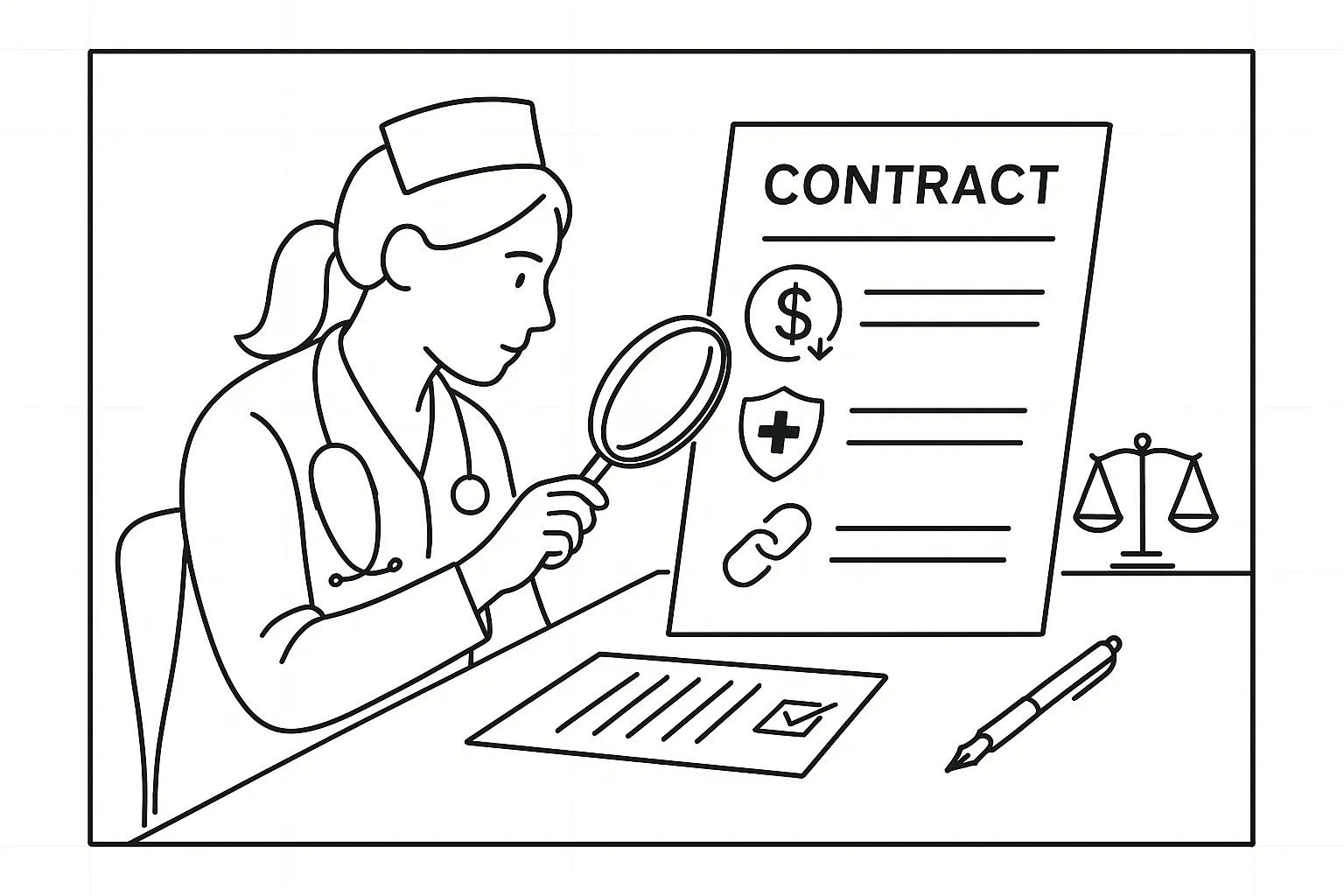
A contract is more than a description of duties. It allocates financial risk, assigns responsibility for malpractice coverage, establishes termination procedures, and may impose restrictions that continue after the relationship ends. Employer templates commonly contain ambiguous productivity formulas, negative accrual or clawback provisions, broad restrictive covenants, unilateral modification rights, and termination terms that favor the organization.
We have reviewed thousands of healthcare employment agreements and routinely encounter language that can reduce realized compensation or limit professional mobility despite an attractive headline salary. A thorough review identifies how the written terms differ from an NP’s understanding of the offer, quantifies potential income adjustments where possible, and clarifies who bears long-term costs such as tail malpractice insurance. Reviewing these provisions before signing gives the NP an opportunity to request clearer language and make an informed decision about the position.
Clinical Duties, Scheduling, and Practice Requirements

Scope of Work, Schedule, and Call Coverage
Clear scope-of-work language should describe the clinical setting, expected duties, work locations, patient responsibilities, administrative tasks, and performance expectations. Vague duties or open-ended productivity requirements can expose an NP to surprise assignments, uncompensated work, or performance claims based on standards that were never clearly defined.
The contract should also identify standard hours, weekend or holiday responsibilities, on-call frequency, and whether call duties receive separate compensation. When those details are material to the position, the agreement should not leave them entirely to future employer policy. NPs evaluating these provisions may also benefit from reviewing common call coverage requirements before accepting an undefined schedule.
Supervision, Collaboration, Licensing, and Credentialing
Supervision and collaboration provisions should reflect the law governing the employment relationship and clearly allocate responsibility for required agreements, reporting, and related expenses. Contract language that obligates an NP to locate or pay a supervising or collaborating professional can create operational and compliance risks. A focused review of supervision and collaboration terms can help identify obligations that are inconsistent with the parties’ intended arrangement.
The agreement should also address professional licensing, DEA registration when applicable, credentialing, payer enrollment, and required reporting. It matters who pays these costs, who controls the application process, and whether compensation begins on a fixed date or only after credentialing is completed. Unclear timelines can produce delayed start dates, pay gaps, or uncertainty about what happens if the employer cannot complete credentialing as expected.
Compensation, Productivity, and Employee Benefits
Base Pay, Collections, and wRVU Formulas
A guaranteed salary or hourly rate provides greater predictability only when the contract clearly states how and when it is paid. We examine whether compensation is prorated, contingent on credentialing, subject to retroactive reconciliation, or affected by employer-controlled conditions. A detailed NP compensation and productivity review evaluates how the complete formula operates rather than focusing only on the stated rate.
Collections-based and wRVU models require careful attention to definitions, accounting periods, thresholds, conversion factors, payer adjustments, exclusions, caps, and negative accrual. A collections formula should explain whether compensation is based on gross receipts or net collections and when payments are credited. A wRVU formula should identify the applicable table, conversion factor, target, and treatment of non-billable work so the NP can reasonably evaluate expected earnings.
Bonuses, Repayment Terms, and Professional Expenses
Bonus language may tie payment to productivity, quality, collections, continued employment, or employer discretion. Objective targets and payment dates are easier to evaluate than provisions allowing the employer to modify benchmarks or withhold earned compensation. The agreement should also explain whether incentives are reconciled after termination and whether an NP forfeits a bonus by leaving before the payment date.
Signing bonuses, relocation assistance, student loan benefits, and other advances often include repayment obligations if employment ends within a specified period. The review should identify the repayment trigger, whether the obligation is prorated, and whether it applies after termination without cause. Health insurance eligibility, paid time off, CME allowances, licensing reimbursement, and retirement vesting should also be considered when comparing the offer’s total value.
Malpractice, Restrictive Covenants, and Termination Risks
Malpractice Insurance and Tail Coverage
Malpractice provisions should identify the coverage type, applicable limits, and the party responsible for premiums. Under an occurrence policy, incidents during the policy period generally remain covered even when a claim is made after the policy ends. Claims-made coverage ordinarily requires the policy to remain active when the claim is reported, which may make tail coverage necessary after employment ends.
The agreement should expressly state who purchases tail coverage and whether responsibility changes based on the reason for termination. Because an unexpected tail obligation may create a substantial post-employment expense, a dedicated malpractice and tail insurance review can clarify the policy structure and the NP’s potential financial exposure.
Non-Competes, Termination Rights, and Final Compensation
Non-compete and non-solicitation provisions may restrict where an NP can work, the services the NP can provide, and contact with patients, staff, or referral sources after employment. Their practical impact depends on the duration, geographic scope, restricted activities, triggering events, and applicable state law. Even when enforceability is uncertain, broad language can create litigation risk or delay a transition to another position. An attorney can conduct a focused NP non-compete review to identify the restriction’s practical reach.
Termination provisions should distinguish termination for cause from termination without cause, define notice requirements, and explain any opportunity to cure an alleged breach. They should also address final productivity reconciliations, deferred incentive payments, tail coverage, and repayment obligations. Reviewing the termination terms and post-employment obligations helps an NP understand the financial consequences of leaving voluntarily or being terminated.
Contract Review Process and Negotiation Priorities
A complete review considers the agreement together with offer letters, compensation exhibits, bonus plans, policy references, addenda, and supervision or collaboration documents that form part of the arrangement. We look for undefined terms such as “collections,” “cause,” or “productivity target,” as well as employer discretion, unilateral modification clauses, retroactive reconciliations, and conflicting provisions.
The review translates those provisions into practical financial and career consequences, including potential clawbacks, tail insurance exposure, notice-period constraints, and limits on future practice. Written comments or proposed revisions can then focus negotiations on the terms that matter most. NPs should track offer deadlines, credentialing timelines, and repayment triggers and confirm that every agreed change appears in the final document before signing. A broader list of nurse practitioner contract red flags can also help organize questions for the employer.
Frequently Asked Questions
What does a nurse practitioner contract review include?
A nurse practitioner contract review typically includes a line-by-line analysis of compensation, productivity formulas, scheduling and call obligations, malpractice insurance, tail coverage, non-compete restrictions, termination rights, notice requirements, repayment obligations, benefits, outside activities, and other provisions that may affect the NP financially or professionally.
When should I have my nurse practitioner contract reviewed?
Ideally, an NP should have the agreement reviewed before signing it. Contract review is also useful when an employer presents an amendment, renewal, compensation change, new restrictive covenant, or other modification to an existing agreement.
Can an attorney review my compensation and productivity formula?
Yes. Compensation review can include base salary, collections percentages, RVU formulas, productivity thresholds, bonuses, quality incentives, reconciliation provisions, negative accrual, and post-termination compensation. The goal is to determine how the formula actually works and identify terms that could reduce expected compensation.
Does contract review include non-compete and termination provisions?
Yes. We review the scope and duration of non-compete and non-solicitation provisions, termination without cause, termination for cause, notice requirements, repayment obligations, and other provisions that may affect when and where an NP can begin a new position.
Will you review malpractice insurance and tail coverage?
Yes. We determine whether the agreement provides claims-made or occurrence coverage, applicable policy limits, and who is responsible for purchasing tail coverage when the relationship ends. Tail responsibility can create a significant post-employment expense if it is not clearly addressed in the agreement.
Does Chelle Law review nurse practitioner contracts nationwide?
Yes. Chelle Law provides nurse practitioner contract review services nationwide. Because employment laws, restrictive covenant rules, scope-of-practice requirements, and other healthcare laws vary by state, the agreement should be evaluated based on the laws applicable to the particular employment relationship.
Understand Your Nurse Practitioner Contract Before You Sign
Compensation formulas, malpractice obligations, restrictive covenants, termination provisions, and repayment requirements can have consequences long after you accept a position. Chelle Law provides attorney-led nurse practitioner contract review nationwide.
Request a Nurse Practitioner Contract ReviewExplore More Nurse Practitioner Contract Guidance
Review additional contract services, practical resources, and state-specific guidance for nurse practitioners.