
A nurse practitioner contract can create significant financial and professional consequences when the employment relationship ends. Notice requirements, termination for cause, without-cause termination, repayment obligations, malpractice tail coverage, restrictive covenants, and post-termination compensation can determine how quickly an NP may leave a position and which obligations continue afterward.
Termination language matters before signing and again when either party considers ending the relationship. An unclear provision may expose an NP to lost incentive compensation, accelerated bonus repayment, an unexpected tail insurance expense, or restrictions that affect the next job. Employment agreements and independent contractor agreements may allocate these risks differently, so the complete contract should be reviewed rather than reading the termination section in isolation.
Chelle Law provides attorney-led nurse practitioner contract termination review services nationwide. We evaluate how termination provisions interact with compensation, benefits, malpractice coverage, credentialing, restrictive covenants, repayment duties, and state-specific law. The goal is to explain the practical consequences of the proposed language and identify terms that may require clarification or negotiation before the NP signs, resigns, or responds to an employer’s termination notice.
Key Nurse Practitioner Termination Risks
- Ambiguous cause definitions may permit immediate termination and the loss of severance or bonus protections.
- Final-pay language may affect collections, RVUs, accrued bonuses, paid time off, and other compensation earned before separation.
- Signing bonuses, relocation assistance, educational stipends, and other benefits may become repayable when employment ends.
- Claims-made malpractice coverage may require tail insurance after termination, with the contract determining who pays.
- Non-compete, non-solicitation, confidentiality, reporting, and cooperation provisions may continue after the relationship ends.
How Termination Clauses Affect Pay and Career Mobility

Final Pay, Benefits, and Productivity Bonuses
Termination language can control final pay, accrued benefits, and whether incentive compensation already earned will be paid. Many contracts distinguish between earned but unpaid productivity compensation—such as collections, RVUs, or encounters—and discretionary bonuses. A provision that gives the employer broad discretion or conditions payment on continued employment or a later reconciliation may result in lost income.
Negative accrual provisions may also allow a productivity shortfall to reduce final compensation. For example, an NP working under a base-salary-plus-production model may have limited time to complete charts, while the employer may count only receivables posted before the termination date. A focused review of compensation and productivity terms can clarify how completed work, pending claims, bonuses, and offsets will be handled at separation.
Credentialing, Reporting, and Future Employment
Termination may affect hospital privileges, payer credentialing, references, and professional reporting. Agreements sometimes require notice of investigations, complaints, disciplinary matters, loss of privileges, or other events. Broad cooperation provisions may also require the NP to participate in investigations, litigation, or credentialing matters after employment ends without clearly limiting the time commitment or addressing reimbursement.
Career mobility can also depend on which post-termination restrictions are triggered by resignation, termination for cause, or any separation. Non-compete and non-solicitation provisions may affect practice locations, patient communications, referral relationships, and future employment opportunities. Their enforceability and practical effect depend on the language and governing law, making a separate NP non-compete review useful when a restrictive covenant could interfere with the next position.
Termination Provisions Chelle Law Reviews
For-Cause and Without-Cause Termination
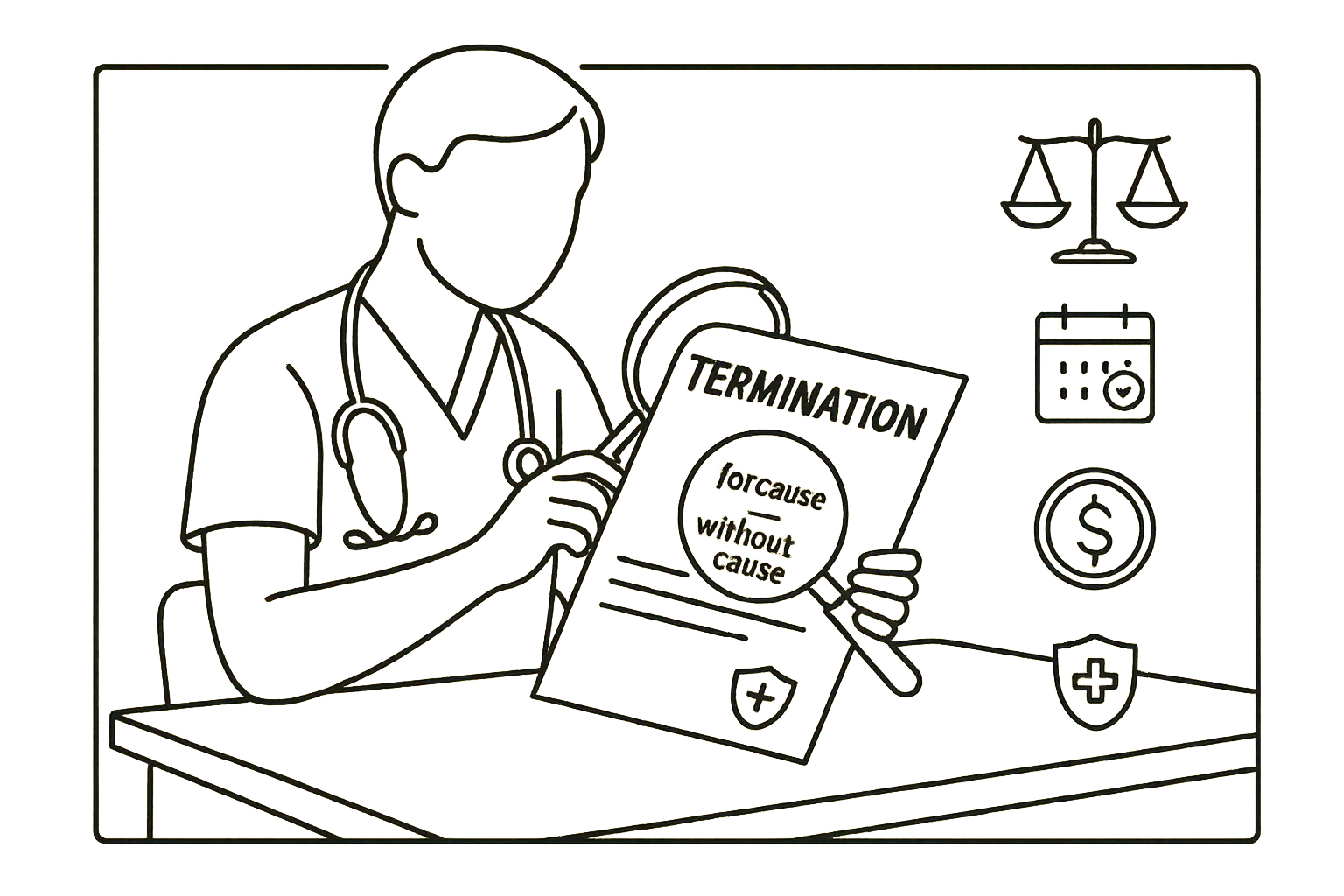
Contracts commonly distinguish termination “for cause” from termination “without cause.” Cause definitions may identify specific conduct, such as loss of licensure or a material contractual breach, or use broader standards such as failure to meet performance expectations or violation of employer policy. Vague standards can give the employer substantial discretion and may permit immediate dismissal without severance or other protections.
Without-cause termination generally allows either party to end the agreement without proving misconduct, provided the required notice is given. The notice period affects income stability, patient transition responsibilities, and the timing of a new position. The agreement should also explain whether the employer may remove the NP from the schedule during the notice period and whether compensation and benefits continue. NPs considering departure can review additional guidance on terminating an NP contract.
Notice, Cure Rights, Severance, and Final Compensation
Notice requirements should specify how notice must be delivered, when it becomes effective, and whether both parties have comparable termination rights. Cure periods can allow an NP to correct an alleged breach before for-cause termination becomes final. The agreement should also address whether administrative leave, suspension, or a credentialing delay changes the NP’s compensation during the notice or cure period.
Severance can provide an income cushion when an employer terminates the agreement without cause, but eligibility may depend on signing a release or complying with continuing obligations. Final-pay terms should explain the treatment of salary, accrued paid time off, expense reimbursements, collections, RVUs, and incentive compensation. Clear calculations and payment timelines reduce the risk that earned compensation will be treated as discretionary after separation.
Repayment Duties, Contract Terms, and Immediate Triggers
NP agreements frequently include repayment or clawback provisions for signing bonuses, relocation assistance, loan repayment benefits, training expenses, or educational stipends. The review should identify the events that trigger repayment, whether the obligation is prorated, whether the employer may deduct amounts from final pay, and whether repayment applies after an employer-initiated termination. The practical risk can be significant when several benefits become due at the same time.
Initial term length, automatic renewal, early exit fees, credentialing requirements, and suspension rights can also affect termination. Automatic renewal may extend the agreement if notice is not provided within a narrow window, while loss of privileges or denial of credentialing may permit immediate termination. These provisions should be read together so the NP understands whether one administrative event can trigger lost income, repayment, reporting, or other consequences.
Post-Termination Obligations and Insurance Risks
Restrictive Covenants, Confidentiality, and Cooperation
Restrictive covenants may include non-compete, non-solicitation, and non-interference obligations involving patients, employees, referral sources, or business relationships. Review requires attention to the restricted activities, duration, geographic area, triggering events, and any exceptions. Even when enforceability is uncertain, broadly drafted language may create practical barriers to a new job or lead to a dispute.
Confidentiality, patient-record, return-of-property, reporting, and cooperation provisions commonly survive termination. These clauses should distinguish protected information from material the NP may lawfully retain or disclose and should not create unlimited post-employment duties. Cooperation obligations are clearer when they define the required assistance, reasonable notice, expense reimbursement, and any applicable time limits.
Malpractice Coverage and Tail Responsibility
Malpractice coverage at termination is a frequent source of unexpected expense. Claims-made policies generally cover claims reported while the policy is active, so an extended reporting endorsement may be needed after the employment policy ends. The contract should state whether the employer or NP must obtain and pay for tail coverage, whether responsibility changes based on the reason for termination, and what proof of coverage must be provided.
Occurrence coverage generally applies to incidents that occur during the policy period regardless of when a claim is later made, so tail coverage is ordinarily not required for that policy. Because the distinction affects post-employment exposure, Chelle Law’s malpractice and tail insurance review evaluates the policy type, coverage allocation, and termination-related obligations stated in the agreement.
How Chelle Law Reviews NP Termination Terms
Our review identifies ambiguous cause definitions, one-sided notice rights, missing cure periods, discretionary bonus language, broad repayment triggers, unlimited cooperation duties, and restrictive covenants that may impede future employment. We also examine how the termination section interacts with compensation exhibits, benefits, malpractice insurance, credentialing, dispute-resolution provisions, and other parts of the agreement.
The review then prioritizes the provisions with the greatest financial and professional consequences. Common priorities include protecting earned compensation, clarifying when severance is available, narrowing repayment triggers, allocating tail insurance responsibility, and defining post-termination duties. Because governing law can affect final pay and restrictive covenants, an NP may also consult Chelle Law’s state-specific contract review guidance.
If a termination issue has already arisen, the NP should preserve the agreement, amendments, compensation plans, policy acknowledgments, performance evaluations, corrective-action documents, productivity reports, and relevant communications. Contemporaneous records may be important when the parties disagree about notice, bonus eligibility, repayment, severance, credentialing, or the stated reason for termination.
NP Contract Termination Checklist
- Is “for cause” clearly defined, and does the agreement provide a reasonable opportunity to cure correctable issues?
- How much notice must each party provide, and what happens to scheduling, pay, and benefits during that period?
- How will collections, RVUs, bonuses, paid time off, reimbursements, and other earned compensation be handled?
- Which events trigger repayment of signing bonuses, relocation assistance, educational benefits, or other incentives?
- Who pays for tail malpractice insurance when claims-made coverage ends?
- Which non-compete, non-solicitation, confidentiality, reporting, and cooperation duties survive termination?
- Does the contract automatically renew or impose an early exit fee?
- Can credentialing, privileges, licensure, or an investigation trigger immediate suspension or termination?
Termination provisions should also be evaluated in the context of the practice setting. Telehealth agreements may involve multi-state licensure, platform access, and collections reconciliation. Hospital contracts may connect employment to privileges and credentialing, while private practices may focus more heavily on patient relationships, referral sources, or local restrictive covenants. Any proposed revision must be adapted to the specific agreement and governing law.
Frequently Asked Questions
What should a nurse practitioner review before terminating an employment contract?
A nurse practitioner should review the required notice period, the permitted method of providing notice, repayment obligations, malpractice tail responsibility, restrictive covenants, final compensation, accrued PTO, bonuses, patient transition requirements, and any duties that continue after the employment relationship ends.
What is termination without cause in a nurse practitioner contract?
Termination without cause generally allows either the NP or employer to end the agreement without proving misconduct or breach, provided the required advance notice is given. Notice periods commonly affect how quickly the NP can leave the position and when the employer may stop scheduling or compensating the NP.
What happens if a nurse practitioner leaves without giving the required notice?
The consequences depend on the contract. Some agreements permit the employer to seek damages, withhold certain discretionary payments, accelerate repayment obligations, or treat the departure as a contractual breach. The termination provision should be reviewed before an NP gives less notice than the agreement requires.
Can termination trigger repayment of a signing bonus or relocation assistance?
Yes. Many agreements require repayment of signing bonuses, relocation assistance, loan repayment benefits, training expenses, or other incentives if the NP leaves before completing a specified period of employment. The contract should state whether repayment is prorated and which types of termination trigger repayment.
Who pays for malpractice tail insurance when a nurse practitioner leaves?
That depends on the agreement and the type of malpractice policy. If the employer provides claims-made coverage, tail insurance may be required when the relationship ends. The contract should clearly state whether the employer or nurse practitioner is responsible for purchasing or paying for tail coverage.
Does Chelle Law review nurse practitioner termination provisions nationwide?
Yes. Chelle Law provides nurse practitioner contract termination review services nationwide. Because employment laws, restrictive covenant rules, final-pay requirements, and other legal issues vary by state, termination provisions should be evaluated based on the law governing the particular employment relationship.
Understand Your Termination Obligations Before You Leave
Notice requirements, repayment obligations, malpractice tail coverage, post-employment restrictions, and final compensation may all be triggered when an NP’s employment ends. Chelle Law can review the agreement before you give notice, sign a new contract, or respond to an employer’s termination decision.
Request a Contract Termination ReviewExplore More Nurse Practitioner Contract Guidance
Review additional NP contract services, practical resources, and state-specific guidance for compensation, malpractice coverage, restrictive covenants, termination, and other employment terms.