
A nurse practitioner independent contractor agreement determines more than the contractor’s rate. A 1099 arrangement can place responsibility for self-employment taxes, malpractice premiums, licensing fees, credentialing expenses, equipment, travel, and other operating costs on the NP. A higher hourly or per-shift rate may not be a better offer once those expenses and the loss of employee benefits are included.
The contract also controls when the NP gets paid, who bears the risk of denied claims, whether post-termination collections are included, and what happens if the relationship ends early. Scheduling requirements, call obligations, restrictive covenants, indemnification, tail coverage, and repayment clauses can continue to affect the NP after the final shift. The independent contractor label is only one part of the arrangement; the actual level of control over hours, work methods, billing, equipment, and policies also matters.
Chelle Law reviews the complete 1099 agreement together with its exhibits, compensation schedules, incorporated policies, and related clinical documents. We explain the payment formula, identify costs assigned to the NP, and show how termination or renewal provisions interact with tail insurance, collections, and repayment obligations. The purpose is to answer the questions that matter before signing: What will I actually earn? Which expenses are mine? Who pays if a claim is filed later? How quickly can I leave, and what obligations follow me?
What an NP 1099 Agreement Needs to Define
A workable contractor agreement connects the business terms to the role the NP will actually perform. The document needs enough detail to calculate compensation, assign expenses, define clinical duties, and determine what happens when either party ends the relationship. Broad discretion in one clause can undercut a specific promise elsewhere. For example, a stated per-shift rate offers limited protection if the organization can add unpaid charting, meetings, or call coverage without changing that rate.
- Classification language and the organization’s actual control over schedules, equipment, billing systems, policies, and clinical work.
- The compensation formula, invoicing process, payment date, reconciliation schedule, and right to verify productivity or collections data.
- Responsibility for taxes, malpractice coverage, tail insurance, licensing, credentialing, continuing education, travel, supplies, and technology.
- Indemnification, non-compete, non-solicitation, termination, repayment, and other obligations that can survive the contract.
- Work locations, clinical scope, shifts, call, telehealth, prescribing, supervision, collaboration, and multistate practice requirements.
Classification, Compensation, and Contractor Expenses
Independent Contractor Status and Control
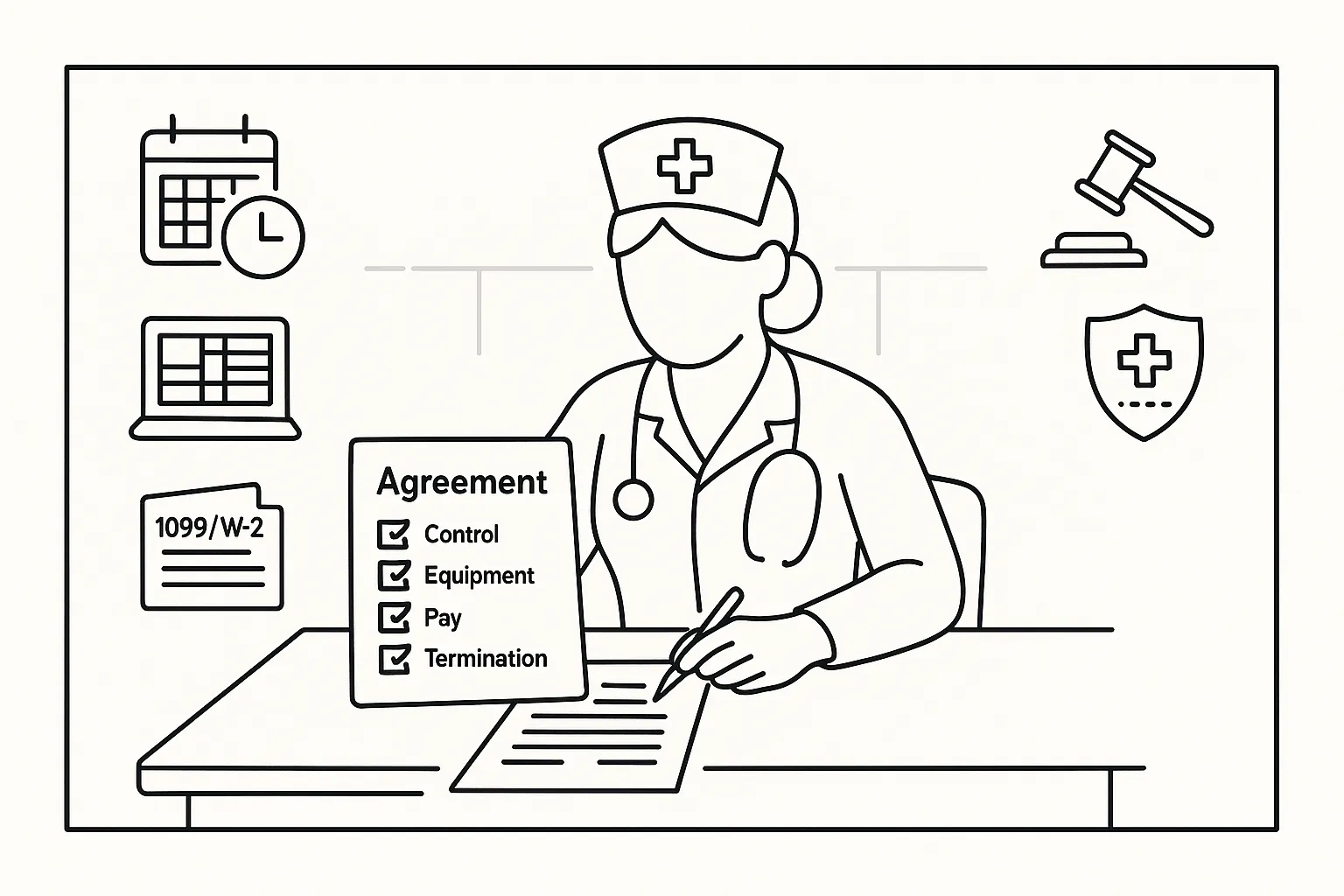
Calling the NP an independent contractor does not answer how the relationship functions. The agreement may require fixed shifts, mandatory meetings, exclusive use of the organization’s systems, compliance with detailed operating policies, or approval before the NP can work elsewhere. Those provisions need to be considered alongside who supplies equipment, who controls work methods, how taxes are reported, and whether the NP can accept other clients.
Classification affects taxes, benefits, insurance, and the allocation of business expenses. It can also create tension inside the contract. If one paragraph says the NP controls the manner of providing services but another gives the organization extensive scheduling and disciplinary authority, the documents do not describe a clean allocation of control. Our guide to W-2 and 1099 arrangements for nurse practitioners explains how the two structures commonly differ.
Payment Formulas, Billing, and Reconciliation
A contractor may be paid by the hour, shift, encounter, work RVU, percentage of collections, or a combination of methods. Each formula creates a different payment risk. If compensation is based on work RVUs, the contract needs to identify which services count, the conversion factor, the source of the data, and the date of reconciliation. If payment depends on collections, the NP needs to know how revenue is attributed and whether refunds, denials, write-offs, or billing delays reduce compensation.
Payment timing deserves the same attention as the stated rate. Does the NP submit an invoice, or does the practice generate the payment calculation? When must an invoice be approved? Can the NP inspect billing or productivity reports? If the contract ends in June, does the NP receive collections that arrive in July or August? An attractive percentage is difficult to evaluate when the collections definition or payment window is missing. The related guide to nurse practitioner compensation models compares the mechanics used in common payment structures.
- The deadline and format for invoices, time records, or encounter reports.
- Whether billing occurs under the NP’s NPI, the organization’s billing structure, or another approved arrangement.
- The treatment of denied claims, refunds, chargebacks, coding changes, and late collections.
- The NP’s access to source reports and the process for disputing a calculation.
- Whether earned but unpaid compensation survives termination.
Taxes, Practice Costs, and Reimbursements
A 1099 rate must be evaluated after subtracting the costs assigned to the contractor. The agreement may require the NP to pay self-employment taxes, malpractice premiums, licensing and credentialing fees, DEA registration expenses, continuing education, professional dues, travel, supplies, equipment, or administrative charges. A contract that does not allocate an expense clearly can produce a dispute when the first invoice or renewal fee arrives.
Reimbursement language also needs a usable process. A promise to reimburse “approved expenses” does not explain who approves them, whether approval must occur before the expense is incurred, what documentation is required, or when payment is due. If travel between assigned locations is frequent, mileage, travel time, lodging, and related limits need to be addressed before those costs begin reducing the contractor’s effective rate.
Malpractice Coverage and Clinical Obligations

Malpractice Insurance, Tail Coverage, and Indemnification
The malpractice clause needs to identify the policy type, coverage limits, premium responsibility, and any coverage obligation that continues after termination. An occurrence policy generally responds to a covered incident that happened while the policy was active, even if the claim is filed later. A claims-made policy generally requires coverage when the claim is reported. If claims-made coverage ends with the contract, tail insurance may be needed to protect the reporting gap.
“Malpractice insurance provided” is not a complete answer. The NP still needs to know whether the coverage is occurrence or claims-made, whether the NP is individually named or covered under a group policy, and who buys the tail if the relationship ends. The cost allocation can also depend on why the agreement ends. Our resource on tail insurance for nurse practitioners explains why the policy type and termination language must be read together.
Indemnification and duty-to-defend provisions create a separate risk. A broad clause can require the NP to reimburse the organization or fund a defense before fault has been established. The language may extend beyond the NP’s own conduct to billing activity, records systems, other clinicians, or policies controlled by the organization. The trigger, scope, exclusions, and relationship to malpractice coverage all need to be defined.
Scope, Scheduling, Call, and Multistate Practice
The services clause controls what work is included in the contractor rate. It may cover patient care, chart completion, inbox management, call, meetings, quality activities, supervision-related documentation, and administrative tasks. If the organization can expand those duties without adjusting compensation, the NP may perform substantial unpaid work outside scheduled clinical hours. Work locations, minimum shifts, cancellation rights, call frequency, response times, and weekend or holiday obligations also need specific terms.
State rules may affect scope of practice, prescribing, supervision, collaboration, and required documentation. When a separate collaboration or supervision document is incorporated into the contractor agreement, the two documents need consistent termination dates, cost provisions, and role descriptions. Chelle Law also offers a focused review of NP supervision and collaboration agreements when those obligations are divided among multiple documents.
Telehealth and multistate services add another layer. The agreement needs to identify where patients may be located, who tracks licensing and credentialing requirements, and whether the organization pays for additional licenses. It should also address what happens to compensation if the NP cannot begin work because credentialing, payer enrollment, or prescribing authority is delayed.
Restrictions and the Cost of Leaving
Non-Compete, Non-Solicitation, and Confidentiality Terms
A contractor agreement can restrict where the NP works during the relationship and after it ends. The actual burden depends on the restricted activity, geographic area, duration, triggering event, and locations used to measure the restriction. A 10-mile radius from one clinic is different from the same radius measured from every facility where the NP provided services. An exclusivity clause can also operate like a restriction during the contract by preventing outside clinical work or moonlighting.
Non-solicitation and patient-related provisions may limit contact with patients, referral sources, employees, or other contractors. Confidentiality language can reach beyond protected business information if it is drafted too broadly. Enforceability depends on applicable law and the exact wording, but the immediate client question is straightforward: If I leave, which jobs, facilities, patients, and professional relationships could this clause affect? The nurse practitioner non-compete guide addresses the clauses that commonly define those limits.
Termination, Final Payment, and Repayment Triggers
The termination section sets the earliest date the NP can leave without alleging breach. A 60- or 90-day without-cause notice requirement can delay a new position even when the non-compete is narrow. Cause definitions, cure periods, immediate termination rights, automatic renewal, notice delivery methods, and obligations during the notice period all affect the exit timeline.
Final compensation must be coordinated with the payment formula. If compensation depends on collections, the agreement needs to state whether the NP receives money collected after termination and when the final accounting occurs. If payment is reconciled quarterly, immediate termination without a final reconciliation clause can leave earned compensation unresolved. Our guide to terminating a nurse practitioner contract explains the notice and post-termination terms that need to be checked before notice is given.
Repayment clauses can cover signing incentives, relocation payments, training expenses, advances, equipment, or a negative compensation balance. The trigger matters. A clause requiring repayment whenever the agreement ends is broader than one limited to the NP’s voluntary departure during a defined period. The formula should state whether repayment is prorated, which termination events are excluded, when payment is due, and whether the organization may deduct the amount from final compensation.
What Chelle Law Reviews With the Agreement
A contractor agreement often relies on documents outside the main contract. A compensation exhibit may contain the actual conversion factor. An incorporated policy may control scheduling, expenses, or discipline. A malpractice summary may reveal that coverage is claims-made even though the agreement never uses that term. Reviewing only the signature document can miss the provision that determines the NP’s payment or post-termination cost.
- The proposed independent contractor agreement and every exhibit or incorporated policy provided with it.
- Offer letters, addenda, compensation schedules, side letters, and sample payment calculations.
- Available productivity reports, billing summaries, or collections worksheets used to calculate compensation.
- Malpractice declarations, coverage summaries, or documents describing tail responsibility.
- Job descriptions and related supervision, collaboration, telehealth, or facility agreements.
Chelle Law provides remote, attorney-led contract review with written comments and follow-up discussion. The review connects clauses that are easy to miss when read separately. A termination provision, for example, may trigger bonus repayment, end malpractice coverage, activate a non-compete, and cut off access to the billing data needed to verify final compensation. Those interactions determine the real cost of the agreement.
Frequently Asked Questions
What should a nurse practitioner review in a 1099 independent contractor agreement?
An NP should review the compensation formula, payment timing, invoicing requirements, scheduling control, malpractice coverage, contractor expenses, tax responsibility, indemnification, restrictive covenants, termination rights, repayment triggers, and every obligation that continues after the agreement ends.
How is an independent contractor agreement different from an NP employment agreement?
A 1099 agreement commonly assigns taxes, benefits, insurance, and business expenses to the NP that an employer might cover in a W-2 relationship. The contract may also describe greater independence over scheduling and work methods, although the actual terms and working relationship determine how much control the NP has.
Who pays malpractice and tail insurance for a 1099 nurse practitioner?
The agreement controls that allocation. An organization may provide coverage, reimburse the NP, or require the NP to purchase a policy. If the coverage is claims-made, the contract also needs to state who pays for tail insurance when the relationship ends and whether responsibility changes based on the reason for termination.
Which expenses need to be allocated in an independent contractor agreement?
The contract should allocate licensing, credentialing, DEA registration, malpractice premiums, tail coverage, continuing education, professional dues, travel, equipment, supplies, technology, administrative costs, and taxes. Any promised reimbursement also needs limits, approval requirements, documentation rules, and a payment deadline.
Can a nurse practitioner independent contractor agreement contain a non-compete?
Yes. A 1099 agreement may contain non-compete, non-solicitation, confidentiality, exclusivity, or patient-related restrictions. Whether a restriction is enforceable depends on applicable law and its wording, but the NP should still determine which locations, activities, employers, and relationships the clause could affect before signing.
Does Chelle Law review nurse practitioner independent contractor agreements nationwide?
Yes. Chelle Law provides remote nurse practitioner independent contractor agreement review services nationwide. Because classification standards, restrictive covenant laws, scope-of-practice rules, and supervision or collaboration requirements vary by jurisdiction, the review considers the proposed working relationship and the law applicable to it.
Have Your NP Independent Contractor Agreement Reviewed Before You Sign
A 1099 rate does not show who pays the taxes, malpractice premiums, tail coverage, licensing fees, or other costs. Chelle Law can review the full agreement, explain the payment and exit terms, and identify provisions that may warrant clarification or revision.
Request an Independent Contractor Agreement ReviewExplore More Nurse Practitioner Contract Guidance
Review related legal services, detailed contract resources, and state-focused guidance for nurse practitioners.